Utility Cuts and Pavement Restoration

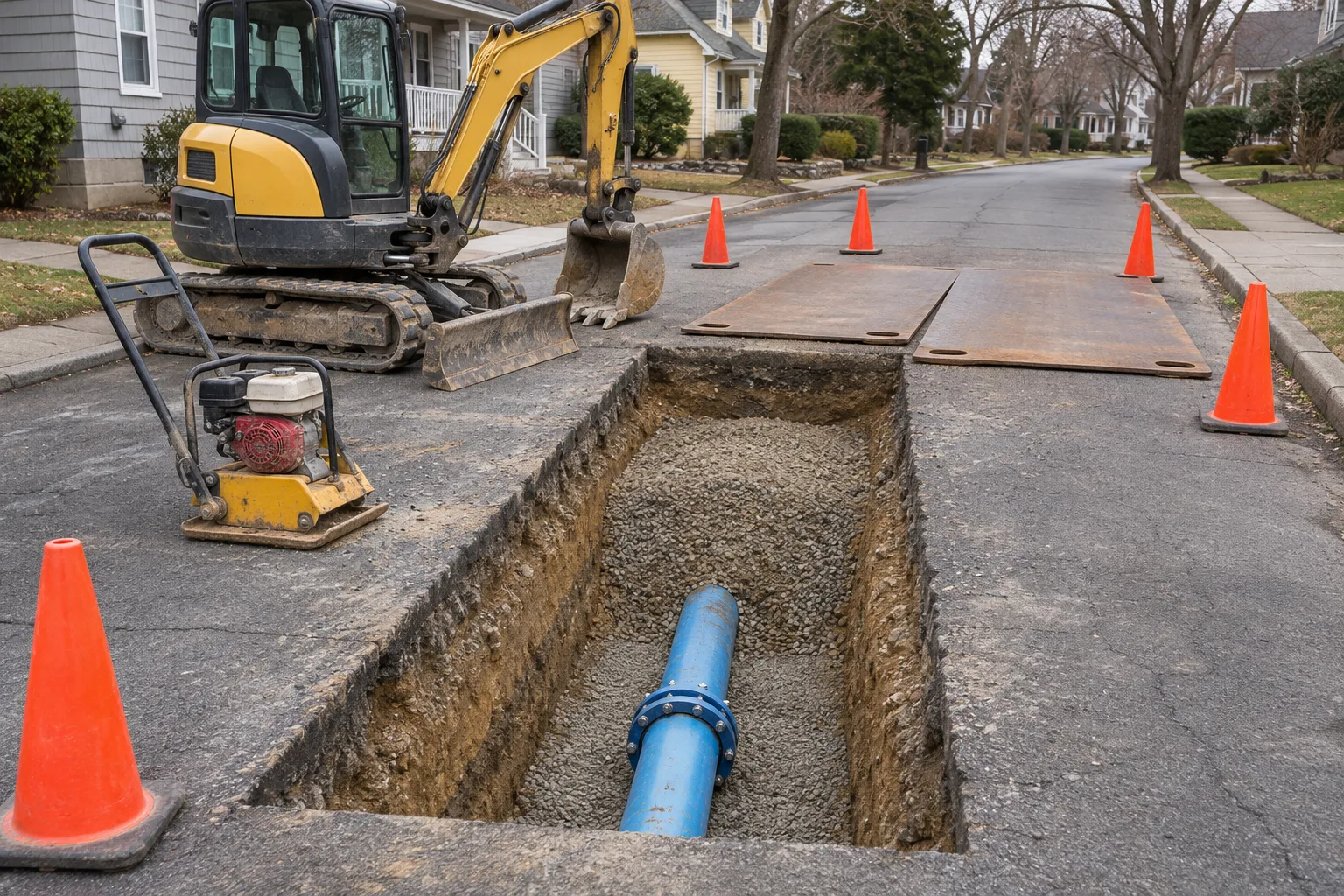
A utility cut is the small excavation that keeps a street working — a water service replaced, a sewer lateral repaired, a conduit added under pavement that was already in service. The cut itself is routine. The restoration is where most of these jobs quietly fail, and the failure almost always shows up as a dip in the road two winters later rather than anything a crew did wrong on the day the pipe went in.
State and municipal research on trench repairs has been blunt about the numbers. Iowa's statewide design guidance notes that reported service life for a utility cut patch can be as short as two to three years, and that many of the patches studied showed signs of failure within two years. Almost none of that comes from the pipe. It comes from backfill that was never compacted, lifts that were too thick, and equipment parked on the edge of the cut.
What a utility cut actually damages
Cutting a trench through pavement does more than remove a rectangle of asphalt or concrete. The soil immediately outside the trench loses the lateral support it had, and the trench walls relax into the opening. Refilling the hole does not put that support back at its original stiffness.
Iowa State research through the Iowa Highway Research Board named this the zone of influence and measured it extending roughly two to three feet from the top of the trench wall. Falling weight deflectometer testing across a completed patch showed deflections in that band noticeably higher than either the undisturbed pavement or the properly compacted trench backfill. In practical terms, the pavement is carrying load over a soft ring it was never designed for.
That is why the cutback dimension matters as much as the compaction. If the weakened ring stays under the new pavement, the patch is being built on the one part of the job that cannot be fixed later without cutting it out again.
Saw-cut before you dig, and cut back past the damage
The pavement boundary should be a saw cut, not a breaker line. A concrete pavement cut should be full depth at any boundary that is not an existing joint once the slab is seven inches thick or more; on thinner slabs, the standard practice is to cut about one-third of the depth and remove the remainder with a jackhammer so the subbase rim is not shattered.
The American Concrete Pavement Association guidance also sets two rules worth carrying into every utility job. First, leave a six- to twelve-inch shoulder of subbase and subgrade on each side of the trench so the existing pavement is not undermined while the utility is being worked. Second, keep any interior cut edge at least two feet away from an existing joint or pavement edge — and if the cut would fall inside that zone, extend the boundary to the joint.
Iowa's recommendation goes further and is the one that addresses the zone of influence directly: saw the pavement and cut the excavation back a minimum of three feet from the original trench edge, to a depth of two feet, then rebuild that ring with material matching the existing subgrade or subbase.
Saw cuts should be straight, vertical, and stopped just short of the corners to avoid overcutting. On municipal work the cut is usually limited to four sides, all parallel or perpendicular to the direction of travel, because a wandering boundary will not compact and will not seal.
Keep the machine off the edge
This is the cheapest correction on the list and the one crews skip most often. Heavy equipment bearing on the trench edges damages the sidewalls and cracks the remaining pavement, and no amount of later compaction repairs either. Iowa's guidance is explicit: keep equipment and spoil as far from the trench as the job allows, and use the smallest machine that can do the work rather than the largest one on site.
Where the excavation allows it, beveling the upper trench walls outward gives a compactor room to work the corners. Vertical walls and a narrow cut are the reason the last six inches against the pavement never reach density.
Backfill in thin lifts, at the right moisture
Lift thickness is the single most common specification violation on utility work, and it is the same rule that governs every lift on a building pad — see how thick compaction lifts should be. Iowa's research identified two- to four-foot lifts and sporadic compaction as primary causes of patch settlement, and recommends eight- to twelve-inch lifts for backfill material. Toronto's utility cut specification is tighter still for pavement areas: uniform lifts not exceeding 150 mm loose thickness, reduced to 100 mm around obstacles, each compacted to 98 percent of standard Proctor maximum dry density. Boulevard areas there run in 200 mm lifts at 95 percent.
Material matters as much as effort. Iowa recommends Class I and Class II granular backfill and allows the engineer to adjust gradation to local materials, including crushed concrete. Cohesive soil used in the top two feet to match existing subgrade goes in eight-inch lifts at 95 percent of standard Proctor, plus or minus two percent of optimum moisture.
Moisture is the part crews get wrong without noticing. Granular material compacted near its bulking moisture content — roughly the six to ten percent band where capillary suction holds particles apart in a honeycombed structure — will not densify no matter how many passes it takes. Above that band the suction releases, the structure collapses, and the material densifies. Wetting a lift that looks dry is often the difference between a patch that holds and one that settles.
Where the trench is deep, narrow, or under a busy lane that cannot be closed twice, flowable fill removes the compaction problem entirely — it is placed as a liquid, needs no lifts, and reaches working strength in a few hours. The trade-off is cost and the fact that it has to be excavated again if the utility fails.
Test the density, don't assume it
Granular backfill does not behave like cohesive soil on a Proctor curve, so a passing Standard Proctor number is not proof of density in a gravel trench. Iowa's guidance points to relative density for granular material and to dynamic cone penetrometer or Clegg hammer testing as field checks — the more blows required to drive the rod a given depth, the stiffer the fill.
On public work, the compaction testing is usually the utility owner's requirement and the contractor's expense. The density tests themselves — nuclear gauge, sand cone, drive cylinder — are covered in how soil compaction is tested. On private work it is the difference between a driveway that survives and one that ruts over the trench every spring.
Temporary restoration: plates and cold mix
Most utility cuts are open to traffic long before the permanent patch goes in, and the temporary surface decides whether the edges survive that interval. That also means the cut sits inside a work zone for days or weeks, which is why traffic control for excavation work has to be planned alongside the restoration. Steel plates need to sit flush, be fastened against movement, carry a skid-resistant surface, and overlap the cut by at least 300 mm on every side, with asphalt mix filling the voids at the plate edges.
Where the trench is backfilled and paved temporarily, the usual detail is to bring backfill to within about 80 mm of the existing surface and fill the remainder with compacted hot mix asphalt, tacking the vertical saw-cut faces before placement. Cold patch placed over an uncompacted trench is not a temporary repair — it is a promise to come back and dig it out again.
Permanent restoration: match the pavement, not the calendar
Restoring asphalt over a utility cut means matching the existing section thickness and compacting in lifts that a plate or small roller can actually reach density in — the same density rules that govern a full paving pass, covered in compacting asphalt pavement. If the cut removes the whole section rather than milling the surface, the removal procedure in removing asphalt pavement applies, and the cut material can often be recycled. The perimeter is the weak point: the vertical face of the existing pavement must be tack coated, and the joint must be tight, because a patch that is dense in the middle and loose at the edge will ravel from the outside in.
Concrete pavements are best restored with concrete, using the joint and load-transfer details described in concrete pavement construction. The ACPA guidance is direct about why: concrete can bridge slight settlement that would show through a flexible patch, and uniform compaction of hot mix in a small, confined rectangle is genuinely difficult. Where the cut crosses an existing isolation or expansion joint, that joint has to be reconstructed in the same location rather than paved over.
The concrete patch also needs load transfer. Dowel bars across transverse joints and tie bars along longitudinal joints keep the patch from rocking independently of the surrounding slab, which is what produces the classic punch-out failure at a utility cut corner. Fast-setting mixtures can carry traffic in four hours or less when the schedule requires it, and precast panels are used where the closure window is measured in hours.
Iowa's finding that portland cement concrete patches outperformed hot mix regardless of the surrounding pavement type is worth remembering on any street where the utility is likely to be reopened.
Weather, water, and the season after
Backfill placed wet, or placed dry and then saturated by the first storm, will settle. So will backfill placed frozen — frozen lumps in a lift leave voids when they thaw, and no compactor can close them afterward. Winter utility work in cold climates generally requires the trench be kept open no longer than necessary, material stockpiled under cover, and plates used until conditions allow a permanent patch.
Water is the other half of the problem, and the trench section itself — bedding, pipe zone, and backfill limits — is covered in backfilling a utility trench. The cut that interrupts a curb line, a shoulder, or a drainage path has to restore that path.
Restoration also has to put the base back the way the street was built. A cut that interrupts a curb line, a shoulder, or a drainage path has to restore that path. Ponding against a fresh patch softens the subgrade under it and starts the settlement cycle the compaction was supposed to prevent.
The sequence that actually works
- Locate and pothole the utility before laying out the cut, and set the boundary off the damaged zone, not off the pipe.
- Saw cut full depth, straight and vertical, keeping interior edges at least two feet from joints and extending to the joint when that is not possible.
- Remove pavement without lifting or breaking beyond the saw line, and leave a six- to twelve-inch subbase shoulder.
- Excavate with the smallest machine that will do the work, and keep it off the trench edge.
- Bed and backfill in lifts the compactor can actually densify — eight to twelve inches for granular, less near obstacles.
- Hold moisture above the bulking range on granular material, and at optimum plus or minus two percent on cohesive material.
- Verify density before the pavement goes back, not after.
- Restore temporary surface with fastened, flush plates or compacted hot mix over a compacted trench.
- Rebuild the base course to the section the existing pavement was designed for — see subgrade, subbase, and base course.
- Restore permanent pavement to matched thickness with tacked joints, dowels or tie bars where the slab requires them, and reconstructed isolation joints.
- Restore drainage and shoulder, then inspect the patch after the first wet season.
None of these steps is unusual or expensive on its own. The reason utility patches fail is that they are small jobs done under traffic pressure, and the two things easiest to skip — thin lifts and edge protection — are the two that decide whether the repair lasts three years or thirty.