Traffic Control for Excavation Work

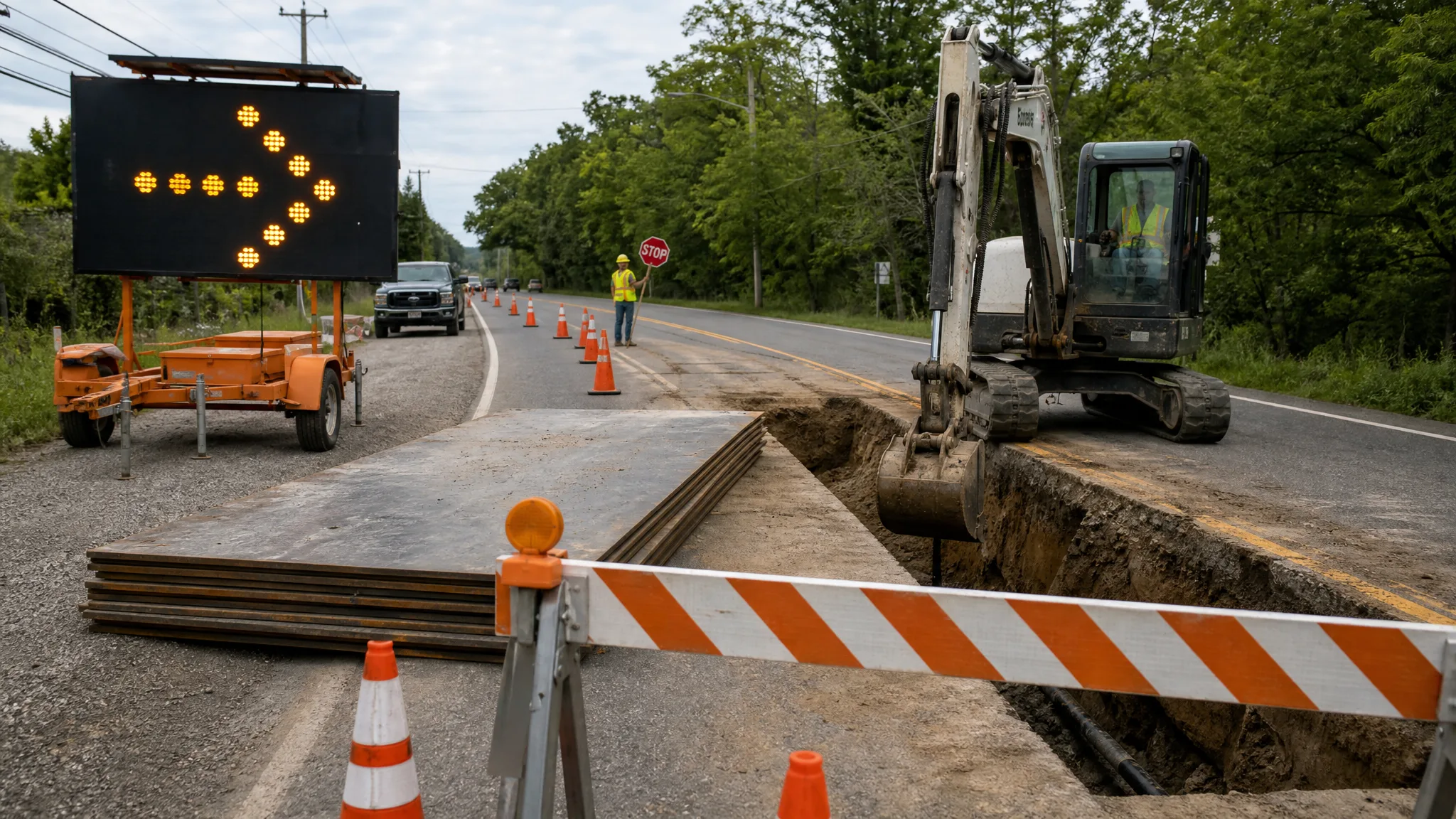
An excavation that opens the traveled way is a different job than one in a back yard. The soil and machine are the same, but the public is now part of the worksite, and the way the cut is set up decides whether a driver sees it in time. A temporary traffic control zone gives road users a clear path around the work before they reach it.
Traffic control is a permit item and a safety item at once. Utility cuts, road crossings, and street excavations need a plan that matches the posted speed, the lane width being taken, and the duration of the work. This guide covers what an excavation crew actually builds: warning, tapers, buffers, flaggers, devices, road plates, and closeout.
When Excavation Work Needs a Traffic Control Plan
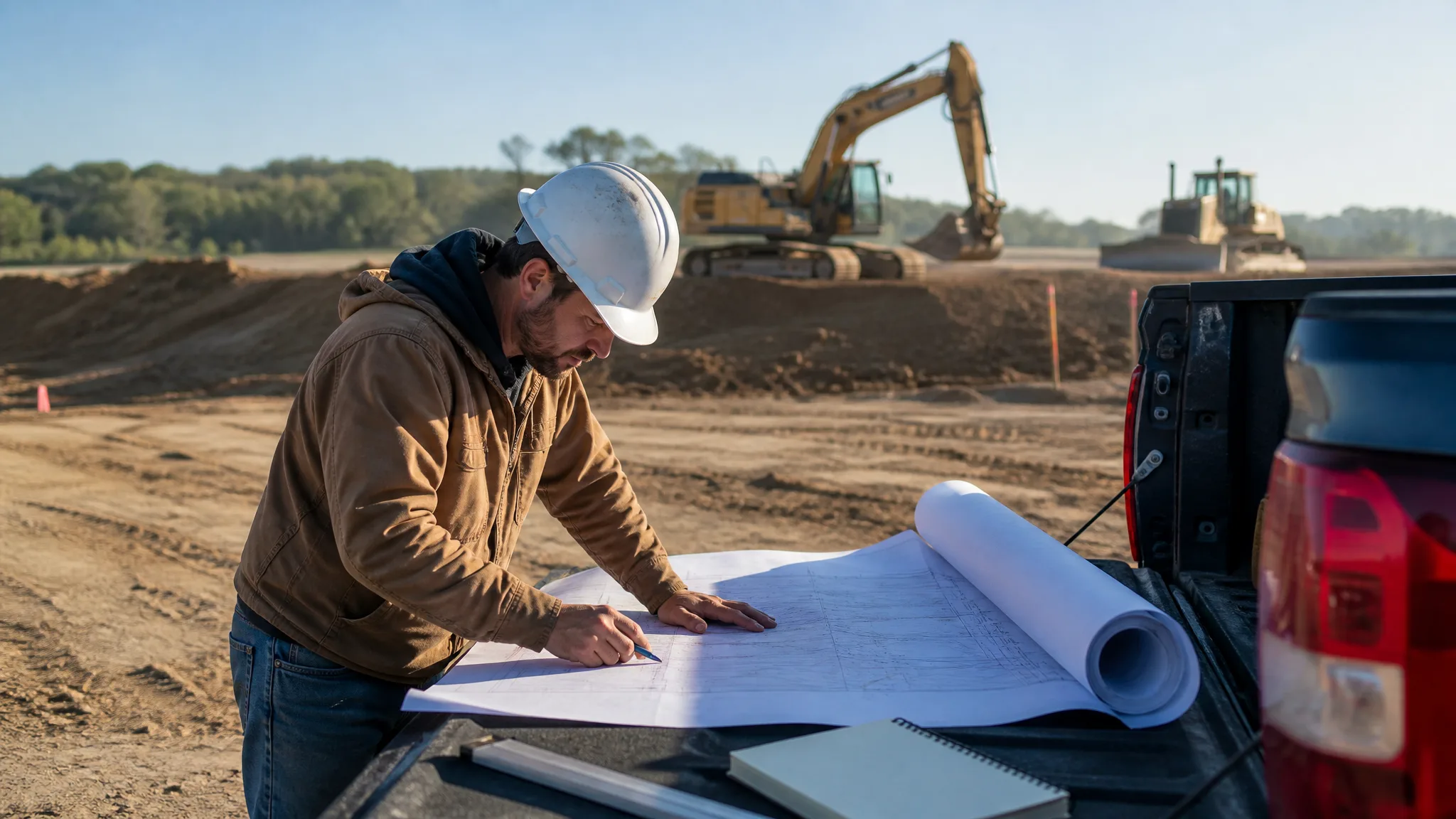
The trigger is not the size of the machine. It is whether the work affects the traveled way, the shoulder, or a pedestrian route. A utility cut in a residential street needs traffic control even if the trench is three feet wide and the job lasts a day, because the moment a lane is closed or a worker is exposed to moving traffic, the site has to route vehicles and protect people.
On public roads, the plan is generally reviewed by the agency that owns the road—a city, county, or state department of transportation. That agency controls permit conditions, work hours, lane-closure restrictions, and the standard drawings that apply. Using the agency's own standard layout is usually faster than designing one from scratch.
Private work is not automatically exempt. A commercial lot or internal site road still needs a plan if delivery traffic, employees, or pedestrians share the space with the excavation. The same principles scale down: warn early, separate people from the cut, keep a path open. For work squeezed into alleys or narrow infill lots, Tight-Access Excavation covers the machine and staging side.
The Four Parts of a Temporary Traffic Control Zone
Every work zone breaks into four areas. The first is the advance warning area, where signs tell drivers what is coming. The second is the transition area, where tapers move traffic out of its normal path.
The third is the activity area, made up of the work space, the traffic space, and the buffer space. The work space holds the crew, equipment, and spoil. The traffic space is where vehicles are routed through. The buffer separates the two and gives an errant vehicle room to recover before it reaches people.
The fourth is the termination area, where traffic returns to its normal path. An abrupt return is its own hazard, especially when the zone ends over a crest or around a curve. A downstream taper and a clear END ROAD WORK sign close the loop.
Advance Warning Distance
The first warning sign has to be far enough back that a driver can read it, react, and change lanes without braking hard. On urban streets, the MUTCD guidance places the first sign at four to eight times the speed limit in feet, with the longer end of the range at higher speeds. On rural highways the multiplier rises to eight to twelve times the speed limit.
The published spacing table is a useful check. Urban low-speed roads commonly use 100 feet between signs, urban high-speed roads 350 feet, rural roads 500 feet, and expressways or freeways 1,000 to 1,500 feet, with the third sign as far as 2,640 feet upstream. These are guidance values, not a substitute for judgment—a sign hidden behind a parked truck is not warning anyone.
Place the first sign where it can be seen at speed, and do not let it conflict with existing regulatory signs or driveway sight lines. If geometry forces a compromise, move the sign and document why.
Calculating Taper Length
Taper length is the part of the plan most often estimated by eye, and it is the part with a defined formula. The MUTCD uses two equations for taper length L, where W is the width of the offset in feet and S is the posted speed, the off-peak 85th-percentile speed before work started, or the anticipated operating speed in mph.
- For speeds of 40 mph or less: L = W × S² ÷ 60
- For speeds of 45 mph or more: L = W × S
A worked example makes it concrete. Closing a 12-foot lane on a 40 mph street gives W = 12 and S = 40, so L = 12 × 1,600 ÷ 60 = 320 feet for a merging taper. The same closure at 50 mph gives L = 12 × 50 = 600 feet. That is why a taper copied from a low-speed job does not work on an arterial.
The taper type then scales from L. A merging taper is at least L, a shifting taper at least half of L, and a shoulder taper at least one-third. A one-lane, two-way taper runs 50 feet minimum and 100 feet maximum, and a downstream taper is 100 feet per lane. Device spacing inside a taper should not exceed 1.0 times the speed limit in mph, so at 40 mph cones go no more than 40 feet apart.
Buffer Space: The Part Contractors Cut First
Buffer space is the empty distance between the last channelizing device and the first worker or machine. It exists because vehicles make mistakes. When a driver drifts into a closed lane, the buffer is the only thing between that vehicle and the crew.
Length is based on stopping sight distance for the operating speed. Published values run 155 feet at 25 mph, 250 feet at 35 mph, 360 feet at 45 mph, 495 feet at 55 mph, and 645 feet at 65 mph. A 40 mph buffer of 30 feet is functionally no buffer at all.
Two rules follow. Nothing is stored in the buffer—not spoil, not pipe, not a spare bucket. And the buffer is measured from the actual work, not from where the truck is parked. If the excavation is long, the buffer moves with the active portion of the work.
Flaggers and One-Lane, Two-Way Operations
When both directions share a single lane, movements from each end must be coordinated. That can be done with flaggers, a flag transfer, a pilot car, temporary signals, or stop-and-yield control. Where one end cannot see the other, flaggers at both ends or a pilot car are the usual answer.
If two flaggers are used, one is designated coordinator and the two must communicate by radio, verbally, or by agreed signals that cannot be mistaken for flagging signals. A single flagger is acceptable only when that person can see end to end and control both approaches.
Equipment is specified, not improvised. The STOP/SLOW paddle must be at least 18 inches wide with letters at least 6 inches high on a rigid handle. Flags are limited to emergency situations. Workers exposed to traffic must wear high-visibility apparel meeting ANSI/ISEA 107 Performance Class 2 or 3, consistent with the federal rule in 23 CFR 634. Stand where the paddle can be seen well in advance, on the shoulder with an escape path, and never turn your back on traffic.
Channelizing Devices and Positive Protection
Cones, drums, barricades, and temporary barriers all channel traffic but do not do the same job. Cones suit short-duration work at low speeds where a hit cone is acceptable. Drums are more visible and stable in wind and are the usual choice for longer closures. Barricades close a lane or road and can carry signage.
Positive protection—temporary concrete or water-filled barriers—is the right answer where the consequence of a vehicle entering the work space is severe: high-speed roads, long-duration work, bridge work, and deep open excavations close to traffic. A line of cones will not stop a car. A barrier is designed to.
Inspect devices through the day. They get struck, blown over, and moved by delivery trucks, and a closure that was correct at 7 a.m. can have a 40-foot gap by noon. Walk the zone after each shift change and after any reported strike. Equipment moving inside the site needs its own separation from workers, covered in Working Safely Around Heavy Equipment.
Steel Road Plates Over Open Cuts
Road plates let traffic cross an open trench overnight. A plate is a structural element, not a lid. It has to span the opening, sit on sound bearing on both sides, and be rated for the traffic using it.
Most highway-rated steel plates are designed for AASHTO HS-20 loading, and manufacturers publish span and thickness tables pairing a plate size with a maximum allowable span. A plate adequate for a three-foot opening is not adequate for a six-foot opening. Using an undersized plate, or one not seated on solid pavement, is how plates fail.
Plates also have to be secured. They can walk under repeated axle loads, especially where traffic turns or brakes. Use the anchoring method accepted by the agency, ramp or bevel the edges, and check the plate after traffic runs over it. Plate use on a public road is usually a permit condition. If the cut holds water, Dewatering an Excavation matters before the plate goes back on.
Pedestrians, Driveways, and Business Access
A plan that only thinks about vehicles leaves people walking in the lane. Pedestrian routes have to be maintained, and where the normal path is blocked, an accessible alternate has to be provided. Barriers that channel pedestrians should be detectable by people with visual disabilities, which generally means a continuous bottom rail rather than a floating sign.
Driveway access is the other friction point. A trench across a driveway strands residents and can shut a business for the day. Sequence the work so each access is closed for the shortest possible time, notify occupants in advance, and coordinate with trash pickup, mail delivery, and emergency services. On commercial frontage, keeping the entrance open may be a permit condition.
Emergency access deserves its own plan. Fire apparatus and ambulances may need a route the normal taper does not provide. Confirm it before the cut opens, not after a call comes in. Site entrances and haul routes need the same thought, covered in Temporary Construction Entrance and Building a Construction Haul Road.
Inspection, Night Work, and Closing Out the Zone
Night work changes the equipment list. Devices need to be retroreflective, and the area needs enough lighting that drivers see the taper and workers see each other. Light towers aimed at the work can blind approaching drivers if they are not positioned and shielded correctly. A zone left overnight needs inspection before dark and again at first light.
Weather moves devices. Wind blows over drums and signs, rain cuts visibility, and snow buries the taper. After any significant weather event, walk the zone before assuming it is still set correctly, and do the same after any vehicle strike.
Closeout is part of the job. Remove devices in a sequence that does not leave drivers facing a sudden lane shift, reopen lanes only when the surface is ready, and confirm that plates, ramps, and temporary patches are stable. Document the zone with photos at setup and removal, keep the approved plan and field changes on file, and make sure the permanent patch meets the agency's standard. Utility cut restoration follows the same lift and compaction rules as any trench, covered in Backfilling a Utility Trench.
None of this moves any dirt, but it is the part of a roadway excavation that protects the crew and the public. Build the zone from the formula and the standard drawing, keep the buffer empty, and inspect it like the life-safety system it is. The locate side has to be right before the cut opens too—see Calling 811 Before You Dig and, if something goes wrong, What to Do If You Hit a Utility Line.