Flowable Fill for Utility Trenches

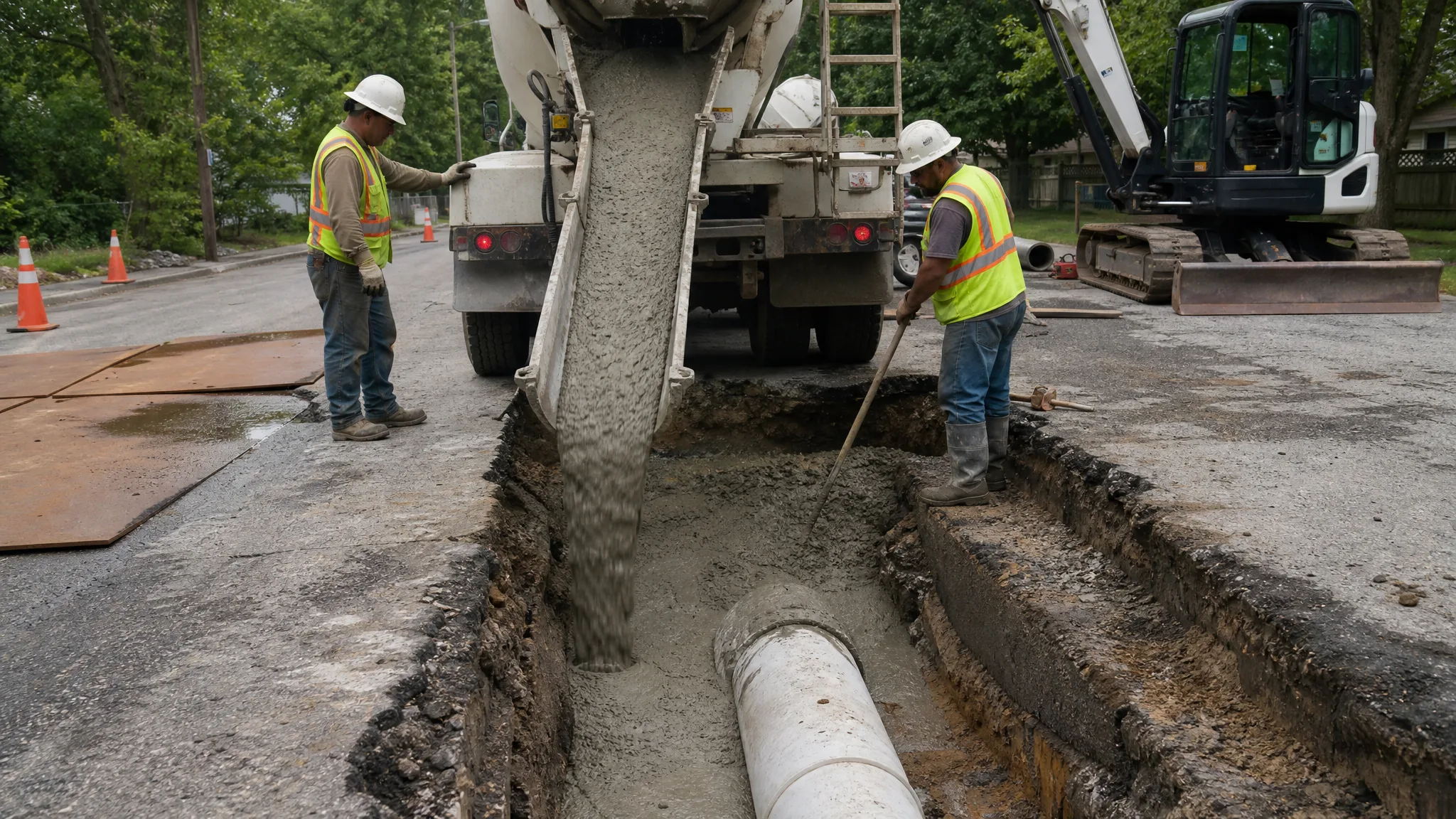
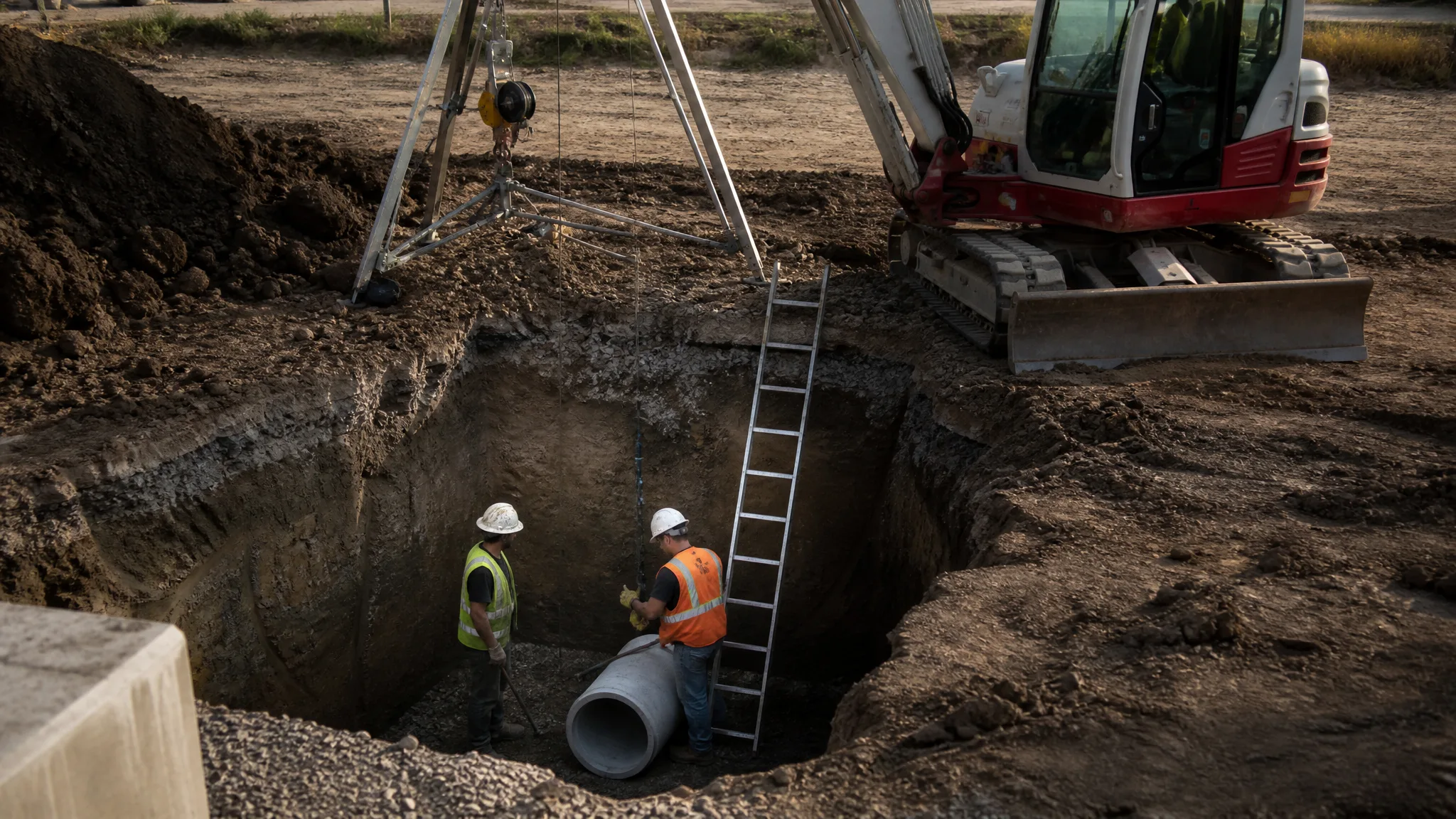
Picture a utility crossing under a county road: four lines, three different owners, twelve inches of clearance between them, and a trench too narrow to get a plate compactor anywhere near the pipe haunches. That is the job flowable fill was invented for. You pour a slurry, it finds every void under and around the pipe, and it hardens into a material with more bearing capacity than the best-compacted granular backfill you could have wedged in there with a hand tamper.
Flowable fill, also called controlled low-strength material or CLSM, changes the compaction conversation rather than winning it. Understanding what it is, how strong it should be, and where it goes wrong is the difference between a repair that lasts decades and a settled patch that comes back every spring.
What flowable fill actually is
Flowable fill is a family of engineered fill materials made from water, fly ash, portland cement, and often sand or fine aggregate. It is placed as a self-leveling, self-compacting, non-settling liquid and left to harden into something that behaves like a very weak concrete. The trade has a long list of names for it: controlled density fill, unshrinkable fill, lean mix backfill, flowable fly ash, and lean concrete slurry all describe the same idea.
The American Concrete Institute's Committee 229 defines CLSM with an upper compressive strength limit of 1,200 psi, but the working range is far below that. Per FHWA guidance on fly ash in flowable fill, most mixes are designed to top out between 150 and 200 psi specifically so they can be dug out later, and strengths can be designed as low as 50 psi.
One useful detail for anyone worried about material cost: fly ash used in flowable fill does not have to meet the concrete admixture specification (AASHTO M 295 or ASTM C 618). High-carbon and high-loss-on-ignition ash that would be rejected at a ready-mix plant is routinely suitable for flowable fill, subject to whatever the specifying agency allows.
Why it works where granular backfill struggles
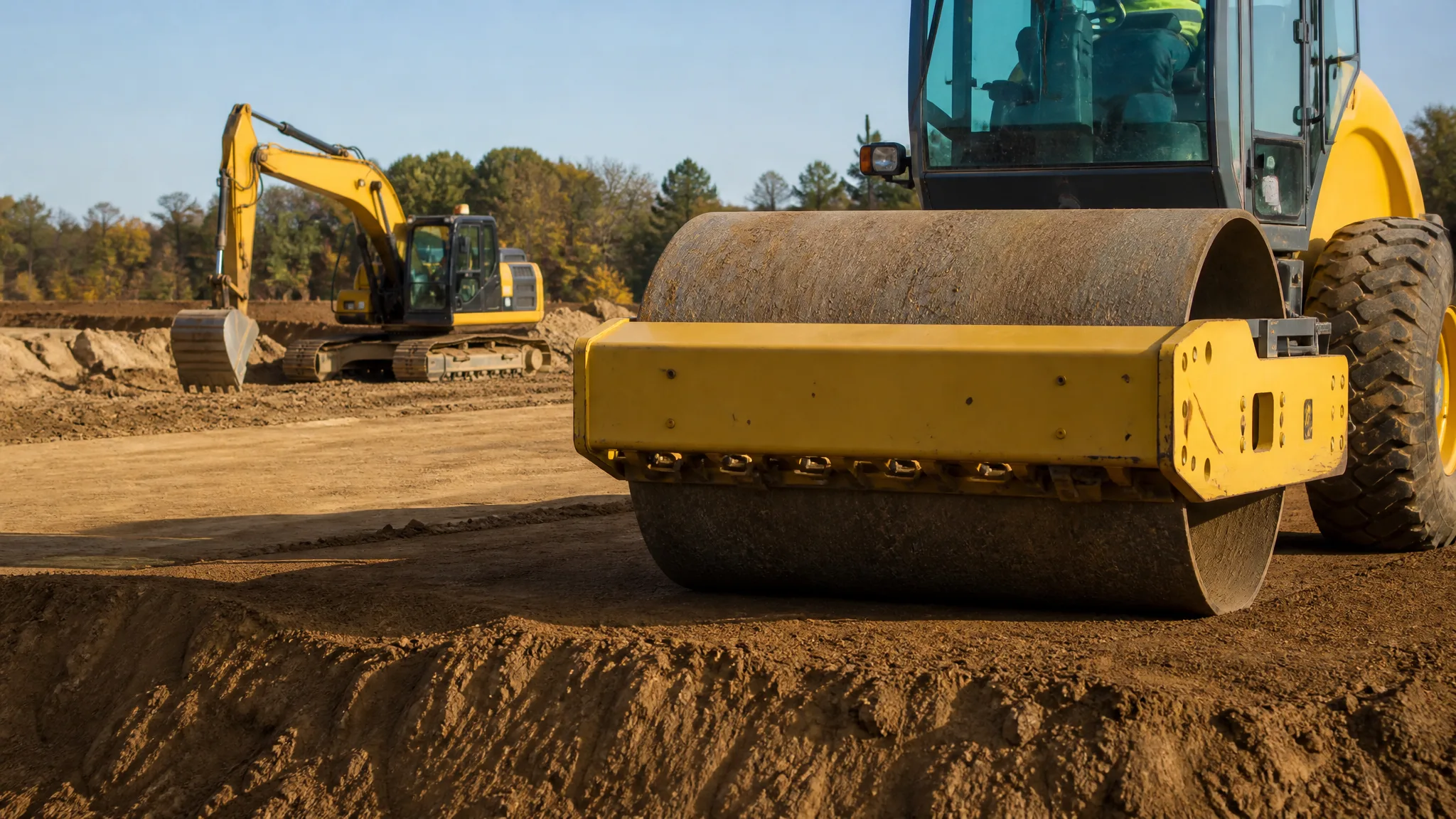
Compacted backfill depends on a chain of things going right: the right material, the right moisture, thin enough lifts, the right machine, and enough room to run it. Flowable fill removes the chain. It is self-compacting by nature and does not need a machine, a lift thickness, or a moisture test to reach its design condition.
That is also a safety argument. FHWA notes that flowable fill becomes more economical than conventional earthen backfill when shoring or sloping is required for worker safety, because with flowable fill nobody has to be in the excavation at all. Less excavation, no shoring, no compaction labor, and a narrower trench that disturbs less of the surrounding soil.
It is not a substitute for understanding how backfill normally works. If you are new to the sequence, the compaction and lift rules in backfilling a utility trench still tell you what the material around a pipe has to accomplish, even when the material itself changes.
Excavatable versus non-excavatable
Every flowable fill decision starts here, and it has to be made before the truck is ordered. An excavatable application is one where the material may need to be removed later, for a tap, a repair, or an extension. A non-excavatable application is one where nobody expects to dig it up again.
The strength targets follow. FHWA guidance limits compressive strength to roughly 100 to 200 psi where mechanical equipment will do the future excavation, and 50 psi or less where it will be dug by hand. A widely used ready-mix association reference specification sets a minimum 28-day strength of 30 psi, caps hand-excavatable material at 50 psi, and caps machine-excavatable material at 200 psi.
Do not let the low number fool you into thinking the material is weak in service. FHWA points out that mixes in the 50 to 70 psi range still have at least two to three times the bearing capacity of well-compacted earthen backfill. The strength is low on purpose, so a future crew with a bucket can get through it.
The practical failure is silence. If the specification and the order do not say the material must remain excavatable, the plant may send a mix that keeps gaining strength for years. Then a simple water tap becomes a hydraulic breaker job.
What the mix looks like in plain terms
There are two broad families. High fly ash mixes are mostly fly ash with a small percentage of portland cement, typically around 95 percent ash and 5 percent cement. Low fly ash mixes replace most of the ash with sand or another fine filler and keep just enough ash and cement to make the sand flow.
FHWA's published ranges put cement at roughly 50 to 100 pounds per cubic yard and added water at 50 to 80 gallons per cubic yard for most combinations. High-calcium Class C ash may need no cement at all, because it self-cements. High-air-content mixes are also used, where entrained air reduces water demand and limits strength through void content.
Strength rises with cementitious content and generally falls as water increases. That is the same trade-off as concrete, just at a much lower level, and it is why a mix that looks perfect at the chute can test too strong at 28 days if nobody watched the water.
Preparing the trench and placing the material
Flowable fill is forgiving about access and unforgiving about the hole. Standing water dilutes and washes the mix, so dewater first. Loose spoil, debris, organic material, and frozen ground have to come out, because the material hardens around whatever is in the trench rather than consolidating it.
Then think about pressure. Flowable fill is a fluid before it sets and exerts high fluid pressure on formwork, walls, embankments, and any containment structure, which means anything expected to hold it has to be designed for that load. The same reference specification recommends protecting the material from freezing for at least 24 hours after placement.
Delivery is normally by ready-mix truck, but the material can also be pumped, placed by bucket or conveyor, or run through a hose. It does not usually segregate even when dropped from height or pumped a long distance, which is why it can fill a haunch nobody could reach with a shovel.
Setting is fast by earthwork standards. FHWA reports that typical high fly ash mixes with about five percent cement set enough to support the weight of an average person in roughly three to four hours, and that construction equipment can cross the surface within 24 hours without apparent damage. Some high-calcium mixes set quickly enough to allow street patching in one to two hours.
Bleeding, subsidence, and topping off
Wet mixes bleed. As bleed water evaporates or soaks into the surrounding soil, the fill surface drops, typically on the order of one-eighth inch per foot of depth in high fly ash mixes with high water content. That is not ongoing settlement once the material takes its initial set, but it is enough to leave a low spot under a pavement patch.
The fix is scheduling, not more material at the initial pour. Place the fill, let it bleed and take its initial set, then top off to the required elevation before the patch goes in. Crews that pour flush to final grade in one pass and pave the same day tend to buy themselves a dip.
Flotation is the failure mode to plan for
An empty pipe in a trench full of slurry wants to float. The reference specification requires the contractor to take appropriate measures, such as straps or soil anchors, to prevent flotation or misalignment when flowable fill is placed around pipes, tanks, or pools. Pipe manufacturers name flotation as one of the main disadvantages of the method.
Common field practice is to anchor the pipe down before the pour, often with rebar or strapping set in an X over the crown and anchored into the trench walls, and to check line and grade immediately before and during placement. Some crews fill the pipe with water where the specification and the product allow it, which kills the empty-bore buoyancy. Pouring in stages rather than one full-depth lift gives the material time to gain a little strength and reduces the uplift on a light-wall pipe.
This matters most with corrugated HDPE, PVC sewer main, and thin-wall pipe, and least with heavy concrete pipe that already outweighs its displacement. It is also the reason the pipe bedding details in installing storm drain pipe still apply: flowable fill supports the pipe, but it does not straighten a pipe that was laid out of line.
Where flowable fill earns its price
The classic applications are the ones where compaction equipment cannot reach or where nobody should be in the hole. Utility trenches under pavement, crossings packed with other lines, bridge abutment backfill, culverts, and pipe bedding all fit. FHWA's application list also includes embankments, bases and subbases, insulating fill, caissons and piles, and filling abandoned storage tanks, shafts, and tunnels.
Void filling is its own category. A washed-out area under a slab, an abandoned vault, a forgotten septic tank, or a mine void can be filled without excavating down to it, which is often the only affordable option. The same logic applies to abandoned tank closures where removal is not required.
It also solves muddy-site problems. A soft, pumping subgrade that will not support a crane or a concrete truck can sometimes be bridged with a flowable fill mat rather than undercut and replaced, which is a different route to the same goal as soil stabilization for unstable subgrade.
Where it is the wrong tool
Long rural runs of water main are usually cheaper in granular backfill, because the material is local, the trench has room, and there is no pavement to restore. Flowable fill's advantage shrinks as haul distance to a ready-mix plant grows, since the savings come partly from avoiding haul and compaction labor.
It is also a poor fit where the site cannot accept a concrete truck. If the plant is 40 minutes away and the pour is four yards, the truck minimum and the wait time can eat the entire benefit, and a crew standing around waiting on delivery has stopped producing. Narrow access jobs need the delivery plan solved before the trench is opened, the same way tight-access excavation needs the machine plan solved first.
And it should not be poured against a subgrade that cannot support it. Organic soils, frozen ground, and trench bottoms that are pumping underfoot are a sign the foundation problem comes first. Pouring a rigid mat over a soft bottom simply transfers the problem to the material above it.
Cost, quantity, and how to compare it
Flowable fill is sold by the cubic yard like ready-mix concrete, and the quantity is close to the trench volume with little allowance for swell or shrink. That makes takeoff simple compared with granular backfill, where you have to account for soil swell and shrinkage and for material that gets rejected or lost.
The honest comparison is against the fully loaded cost of the alternative: aggregate, hauling, placement labor, compaction equipment, density testing, and the time all of that takes in a trench that may need shoring. Add the value of not putting a crew in the excavation and the number often flips. On a small repair in a roadway, it frequently wins outright.
Quality control and the paperwork
Strength is the acceptance test. Cylinders are made and tested per ACI 229 practice, and the mix is judged against the strength specified for its application, not against a generic number. Flowability is checked with a slump cone, flow cylinder, or mortar flow cone depending on the specification.
Keep the batch tickets, the placement location and volume, and the cylinder results together. When a future repair crew opens the trench, the question of whether that material was designed to be excavatable is answered by the record, not by a guess. Mark excavatable and non-excavatable areas on the as-built drawings while the job is fresh.
One more habit worth building: tell the plant, in writing, what the material has to do. Excavatable, non-excavatable, and the strength limit are order-level decisions, and they are the ones most likely to be lost between the engineer's specification and the dispatch desk.
A field checklist for a flowable fill pour
- Confirm the application. Excavatable or non-excavatable, stated on the order and on the drawings.
- Verify the trench. Dewatered, free of loose spoil, debris, organics, and frozen material.
- Check the pipe. Line, grade, joints, and bedding verified immediately before the pour.
- Rig for flotation. Anchors, straps, or ballast in place on any pipe or tank that could rise.
- Brace the containment. Formwork and walls designed for fluid pressure.
- Plan the delivery. Truck access, discharge point, and a realistic pour rate for the plant distance.
- Protect from freezing. At least 24 hours of protection in cold weather.
- Expect to top off. Allow for bleed and subsidence before patching or paving.
- Test and record. Cylinders per the specification, batch tickets kept, results filed with the as-builts.
- Document the mix. Strength limit, mix design, and supplier recorded so the next crew knows what is in the ground.
Flowable fill is not a shortcut around good earthwork. It is a deliberate trade: you give up the ability to compact in exchange for a material that does not need to be compacted, and you accept a permanent record of what you buried. Ordered correctly and placed with the flotation and bleeding issues handled, it outlasts most of the trenches it fills.