Backfilling a Utility Trench

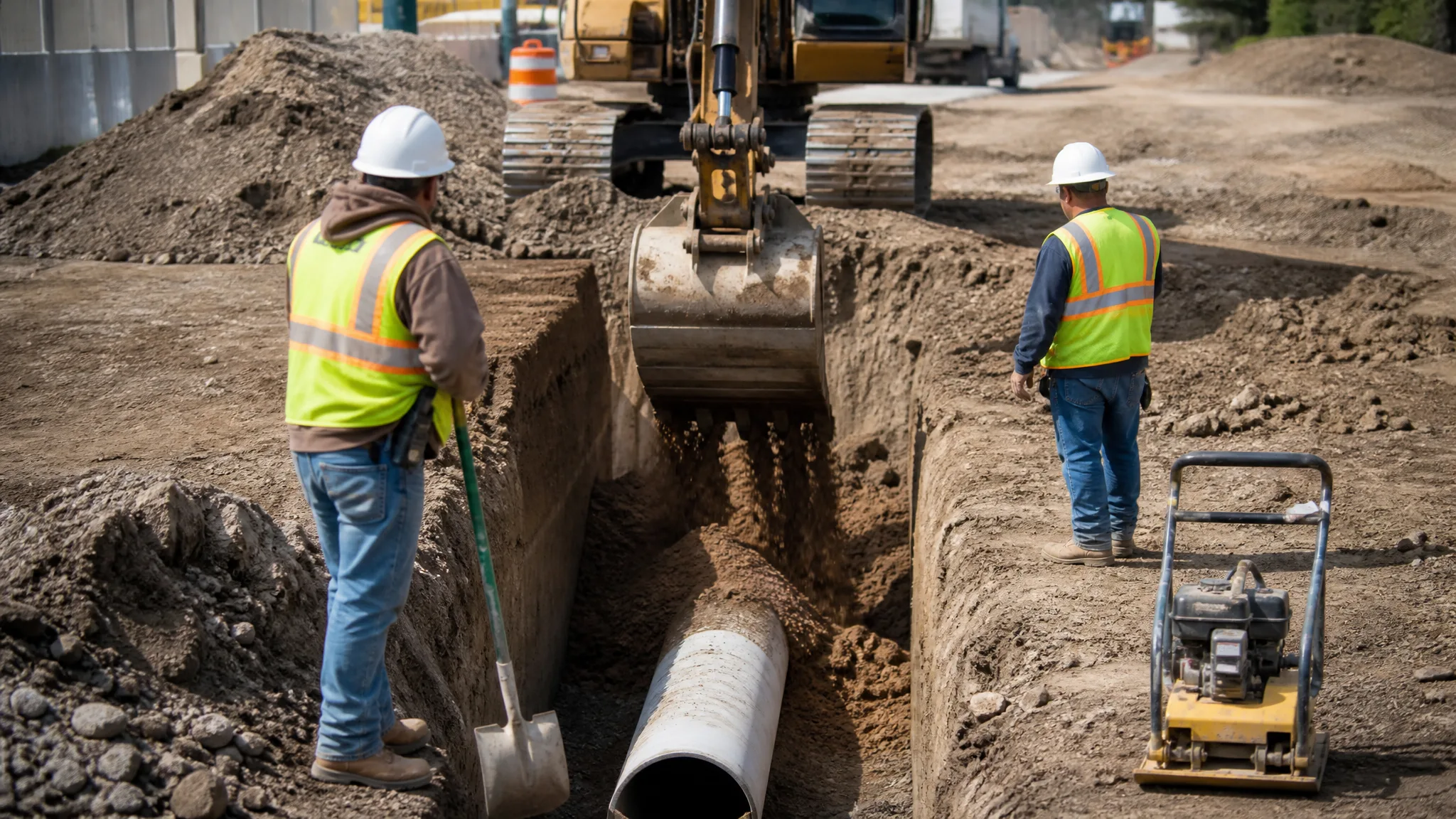
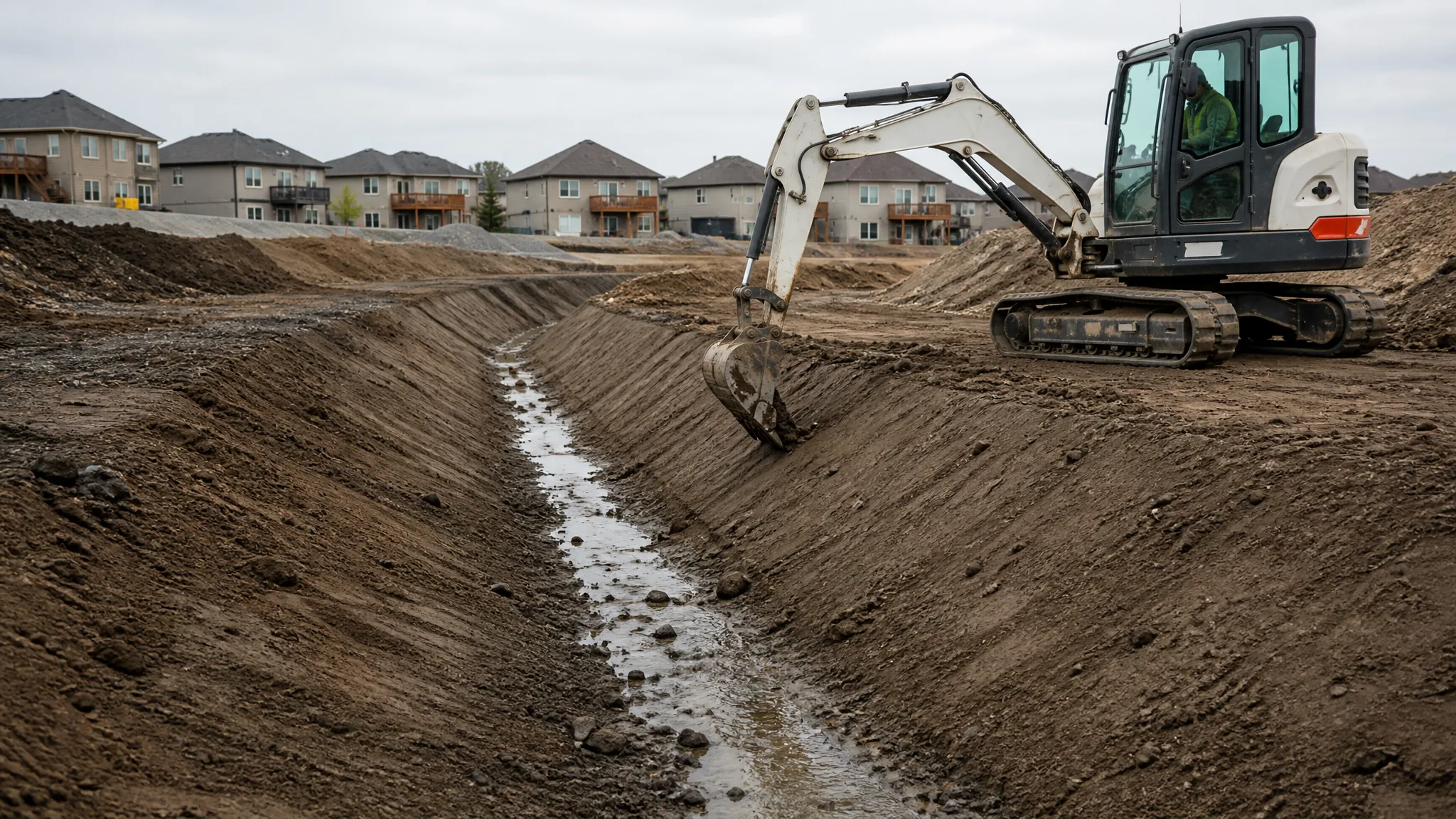
Digging a utility trench gets the attention, but the backfill is where most trenches fail. Dirt placed too loose, in lifts that are too thick, or with the wrong material will settle over the following months. When the fill settles, the pipe inside it moves, and a pipe that moves cracks or pulls apart at a joint. That is how a clean job becomes a leak, a sinkhole, or a backed-up sewer long after the crew has moved on.
The rules for getting it right are well established and not complicated. The failures almost always come from skipping them for speed. A utility trench is filled in three distinct zones, each with its own material and compaction requirements:
- Bedding supports the pipe from below.
- Haunching and initial backfill support the pipe from the sides and hold it on line.
- Final backfill fills the rest of the trench up to grade.
Why Trench Backfill Fails
Backfill fails by settling, and settlement is driven by density. Soil that is placed loose never reaches the density it would have had in its natural state, so it continues to consolidate under its own weight and traffic loads. Under a road that means a dip in the pavement. Over a pipe that means the pipe loses side support, deflects, and eventually cracks or separates at a joint.
Because the failure develops slowly, the crew that did the work is usually long gone by the time it shows. That is why inspectors are strict about how the trench is filled, not just about how it was dug.
Bedding: Supporting the Pipe
Bedding is the material that directly carries the pipe. For most storm, sewer, and water pipe, that is a granular layer such as crushed rock or pea gravel placed and compacted below and around the pipe up to its springline. A minimum of about 4 to 6 inches below the pipe is typical, and for flexible pipe like PVC or HDPE the bedding is often carried to about 6 inches above the crown.
Bedding matters because it spreads the pipe's weight evenly and keeps it off hard points. Where rock is struck, it is removed below the pipe and replaced with bedding so the pipe never rests directly on rock at any point, including at the joints. Bedding is compacted with hand tampers or light walk-behind equipment, never heavy machines that could damage the pipe.
Haunching: The Support Most Crews Skip
The haunch is the space beside and slightly under the pipe, between the bottom of the pipe and roughly its horizontal centerline. Many failures trace back to this zone. If the haunch is not filled and compacted, the pipe has nothing pressing back on it from the sides, so it deflects under load and its top flattens.
Haunch material, usually clean sand or gravel, is placed by hand and worked under both sides of the pipe, and it is compacted on both sides at the same time so the pipe is not pushed off line. The goal is a pipe that is supported all the way around, not one resting on a peaked ridge of bedding.
Initial Backfill
Initial backfill extends from the bedding up to roughly 12 inches above the pipe crown, and it is what locks the pipe in place. Material is select granular fill or approved native soil free of rocks larger than about 1 to 1.5 inches and free of debris.
The first layers are placed in lifts no thicker than about 6 inches and compacted with hand tools or light equipment. Heavy compactors and machine traffic are kept away until the pipe has enough cover to protect it. This is slow work, and it is exactly the work that pays for itself later.
Final Backfill
Final backfill runs from the top of the initial backfill to finished grade, or to the bottom of the pavement section if the trench crosses a road. This is the bulk of the volume, and it can use native material if the material meets the specification.
In practice, that caveat does most of the work. Native soil with high clay content, organic material, or rocks larger than about 3 inches should not go back in if it cannot be reliably compacted in the tight space of a trench. Frozen clods and construction debris stay out of the backfill entirely. Final backfill is normally placed in lifts of about 8 inches loose and compacted with a jumping jack, plate compactor, or roller where the trench is wide enough.
Compaction Requirements and Testing
Backfill is measured by relative compaction, which compares the field density to the maximum dry density from a laboratory Proctor test. The two standard references are the Standard Proctor, ASTM D698, and the Modified Proctor, ASTM D1557, and the specification should say which one applies, because a target of 95 percent means different things against each test.
Typical municipal specifications require at least 90 percent relative compaction for backfill outside paved areas and 95 percent under pavement and near structures, though some agencies require 95 percent throughout and specify the Modified Proctor as the reference. Our overview of how soil compaction is tested explains the nuclear gauge and sand cone methods used in the field.
Testing is usually performed by the geotechnical engineer or a testing lab, often once per 200 to 300 linear feet of trench per lift, and more frequently in critical areas such as under streets or near structures. A failing test means the lift has to be scarified, moisture-conditioned, and recompacted before the next lift goes in.
Lift Thickness: The Most Common Violation
The single most frequent mistake is placing lifts that are too thick. A bucketload gets dumped into the trench, the compactor works the surface, and only the top few inches actually reach density. Everything below stays loose and will settle later. An 8-inch maximum loose lift, which compacts to roughly 6 inches, is the practical ceiling for trench work in most specifications.
If you take one thing from this article, take this: measure the lift from the top of the previous compacted surface before the next bucket goes in.
Compaction Equipment for a Trench
Match the machine to the soil and the space. Granular soils respond well to vibratory plate compactors. Cohesive soils compact better with a rammer or jumping jack. Wide trenches may allow a walk-behind roller, but the space around the pipe usually rules it out near the pipe zone.
Moisture is as important as the machine. Soil compacts best within a few percent of optimum moisture, so material that is too dry or too wet will refuse to reach density no matter how long it is worked. Flooding or jetting the trench with water is sometimes used to settle granular fill, but it is not a substitute for compaction: water can pull fines away from the pipe, leave voids, and wash out support on one side. Where it is used at all, it is only with granular material and the engineer's approval. Our guide to choosing the right compaction equipment and our article on how wet is too wet to compact soil cover the details.
Flowable Fill and CLSM
When compaction is impractical, controlled low-strength material, also called flowable fill or controlled density fill, offers a way out. It is a self-leveling, low-strength mix of roughly 50 to 150 psi at 28 days that flows around and under the pipe and needs no mechanical compaction.
It is most useful under streets where settlement would damage the pavement, in congested corridors where a compactor cannot reach, and on emergency repairs where time is short. It costs more per cubic yard than native backfill, and it still has to be excavatable for future repairs, which limits how strong it can be. It is not a blanket substitute for granular backfill where a specification requires granular material.
On a job where the pipe is nonmetallic, confirm the tracer wire that allows the line to be located later is placed and protected before the trench is closed.
Inspections and Common Mistakes
Inspectors tend to look for the same handful of things: bedding type and thickness, lift thickness measured against the previous compacted surface, the right compaction equipment for the zone, moisture near optimum, material free of oversized rock and organic matter, and passing test results before the next lift.
Work is typically stopped when lifts are too thick, when oversized native rock is dumped back into the trench, or when compaction proceeds without testing. Those stops cost time, but they prevent far more expensive settlement repairs later. Learn the local requirements early, because they are usually the same rules that govern the digging itself, from water and sewer trench excavation to backfilling a foundation.
Restoring the Surface
Once the trench is back to grade, the surface finish matters as much as the fill beneath it. Under a lawn, that means topsoil and seed. Under a gravel drive, it means matching the existing base and surface course. Where the trench crosses pavement, the cut has to be restored so it bridges the trench rather than settling into it.
Repair and grading work should always follow the same standard as new construction. Our guides to building a gravel driveway and to identifying soil types on a jobsite are useful references for matching what was there before, and a call to 811 before you dig protects the next crew from finding your line the hard way.
Backfill done by the book is unglamorous, repetitive work. It is also the part of a utility job that keeps the pipe intact, the road smooth, and the phone quiet for years after everyone has left the site.