Tight-Access Excavation

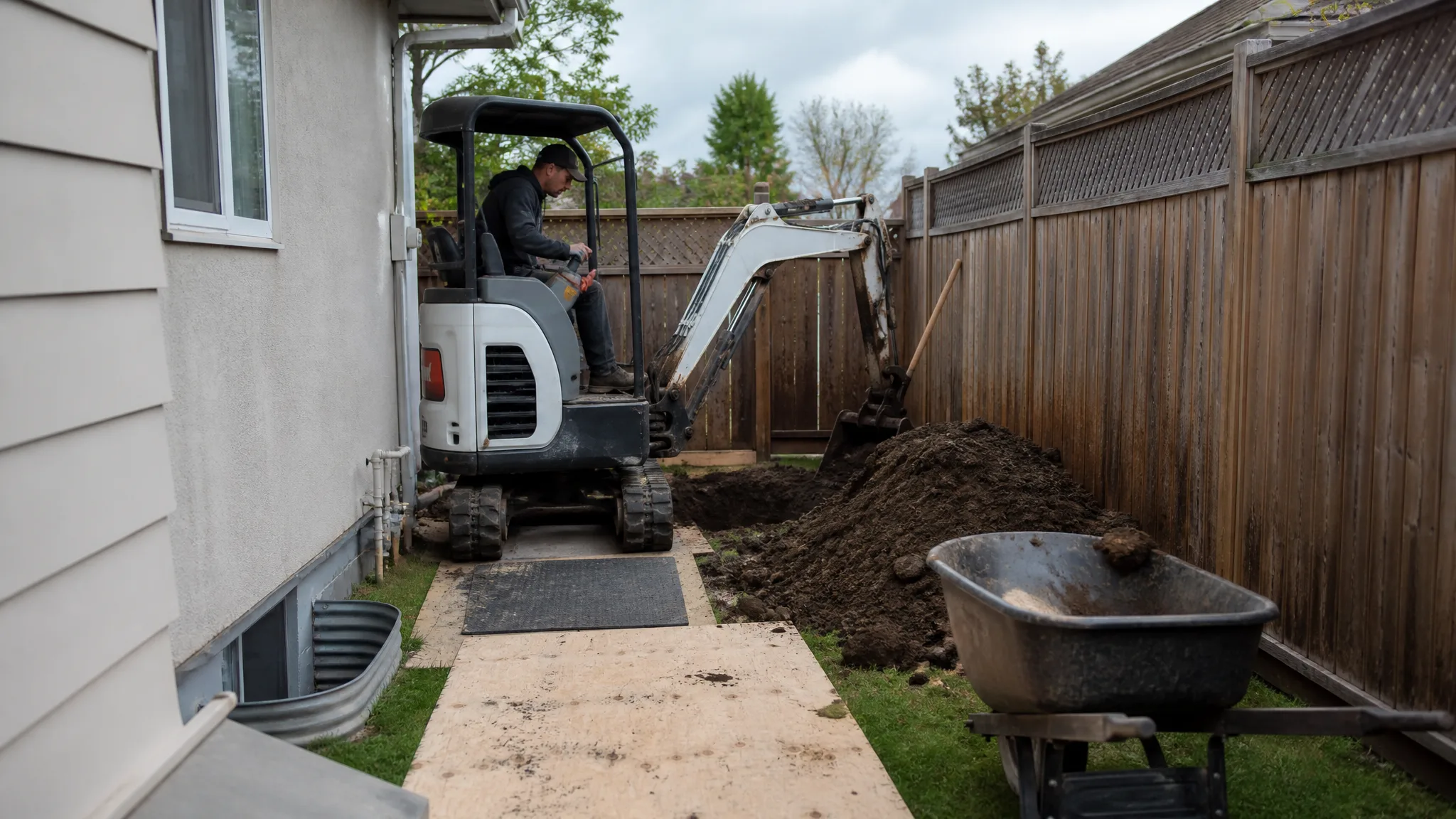
Some digs come with a wide-open site and room for trucks to swing through. Others come with a thirty-inch gate, a neighbor's fence on one side, a house on the other, and nowhere to put the spoil. Tight-access excavation is a planning problem before it is an operating problem, and the contractors who do it well are the ones who measured the opening before they chose the machine.
What Makes a Job Tight-Access
A job is tight-access when the machine has limited clearance on at least one side, or when the site cannot be reached by the trucks and equipment the work would normally require. Common examples include fenced residential backyards, narrow side yards between houses, alleys, courtyards, urban infill lots, digs between two existing structures, and utility work inside a traffic lane. Sometimes the constraint is a gate. Sometimes it is an overhead wire, a gas meter, a mature tree, or a retaining wall. Often it is all of the above at once.
What these jobs share is that space, not machine power, drives every decision — machine size, how spoil leaves the site, how the operator sees what he is doing, and how the surrounding property gets protected.
Match the Machine to the Opening
Start with a tape measure, not a rental catalog. Walk the route the machine will travel and measure the narrowest point: the gate frame, an arbor or pergola, a low overhang, a utility meter, a fence return. Then note the machine's transport width and operating width, and confirm it clears with room to spare.
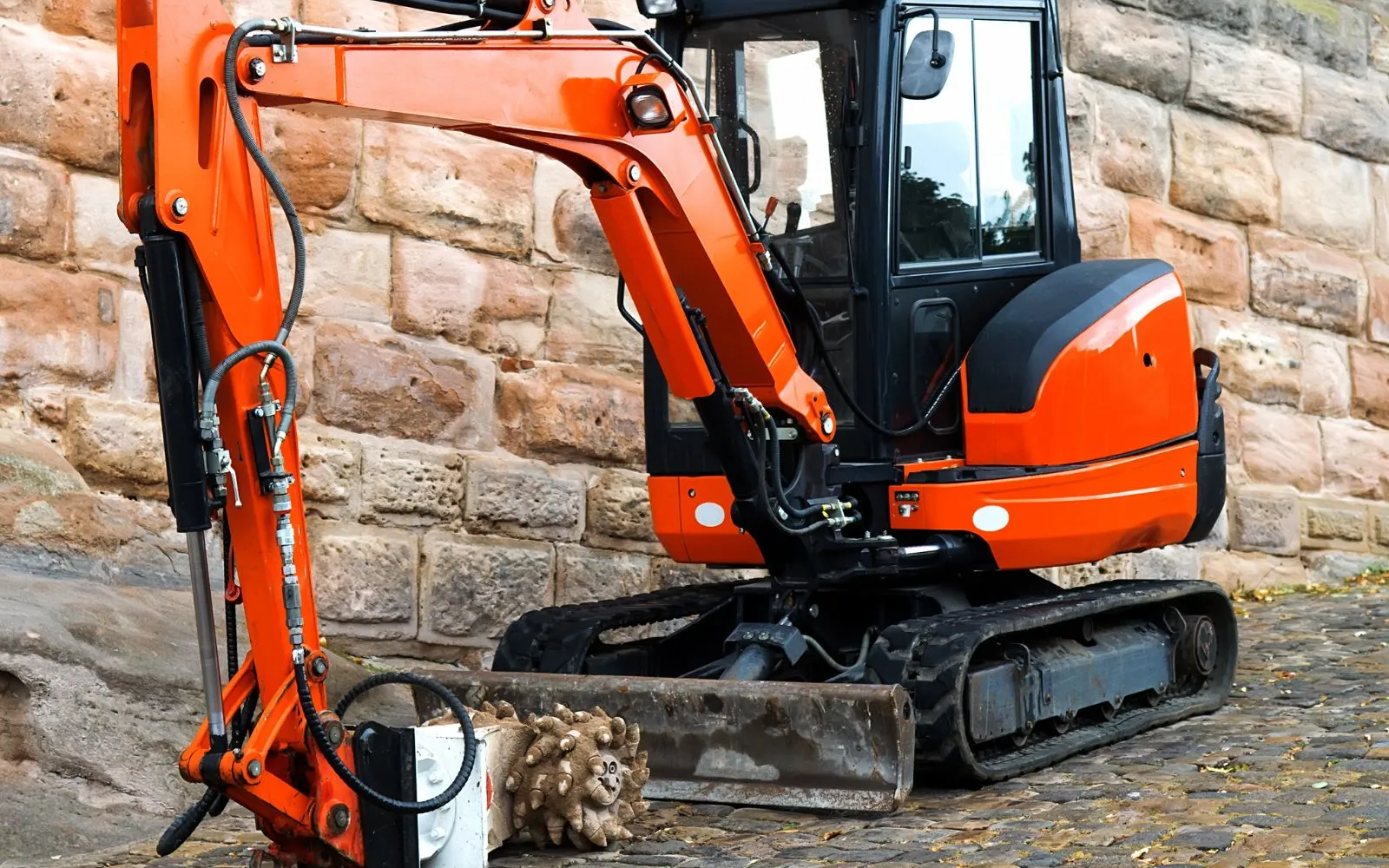
Compact excavators come in a wide range of widths, and the smallest units fit openings that larger minis cannot, which is the whole point of the category. Some models offer retractable or foldable undercarriages that narrow the machine for transport and widen it for stability once it is in position. Weight matters too, because a heavy machine on soft turf leaves ruts that become a restoration cost. Comparing a compact excavator against a tracked skid steer for the same tight work is a useful exercise; see mini excavator vs. skid steer and how wide a mini excavator is for the real dimensions.
Tail Swing: The Clearance That Decides the Machine
Width gets you through the gate. Tail swing is what lets you actually work once you are back there. Excavators come in three broad configurations. On a zero tail swing machine, the upper housing and counterweight stay within the track width as the house rotates. On a reduced or minimum tail swing machine, the housing extends only a few inches beyond the tracks. On a conventional machine, the counterweight swings well outside the tracks and needs real clearance to rotate safely.
The trade-off is real. A compact or zero tail swing design buys rear clearance, but it usually gives up some maximum lifting capacity and some stability on grades compared with a conventional machine of the same class, because the counterweight is smaller or positioned differently. Conventional excavators remain the better choice on open sites, for truck loading, and for heavy lifting.
So the rule for tight work is simple: read the tail swing radius off the spec sheet and compare it with the clearance actually available behind the machine. If the counterweight sweeps beyond a fence line or into a traffic lane, the configuration is wrong, even if the bucket is right.
Protecting Surfaces: Plates, Mats, and Plywood
There are two different jobs here, and confusing them is a common and expensive mistake. Bridging and ground protection are not the same thing.
Steel road plates are for spanning an opening — a trench, a utility cut, a road cut, an unsupported void. A plate used over an opening has to be properly sized for the load it carries, and on public roads it usually requires local approval and a traffic plan. HDPE ground protection mats are for loaded, continuous ground: turf, pavers, decorative concrete, or muddy temporary routes where you need to spread load and reduce rutting. A plastic mat is not a bridge and should never be used to cover an open excavation.
On lawns, 3/4-inch plywood laid in overlapping sheets is still the standard low-cost protection. Keep turns on the plywood or mats, not on bare turf, because turning under load is what tears up grass. Lining a fence line or siding with plywood prevents the scrape damage that turns a small dig into an insurance conversation.
Protecting the Things You Cannot Move
Backyard work happens among things that are not replaceable in a day: mature trees, fences, patios, outbuildings, and the neighbor's house. Root systems extend well beyond the trunk, and cutting major roots to make room for a machine can kill a tree slowly over years. Keep the machine off the critical root zone where you can, and protect the trunk with a wrap if it is in the work area. The principles are the same ones that apply on any site; see protecting trees during excavation and grading.
Working close to existing structures raises a second set of questions about vibration, soil support under adjacent footings, and how much ground can safely be removed. That is a planning exercise, not an operating decision made in the seat — working safely near existing foundations covers underpinning, monitoring, and equipment placement.
Getting the Spoil Out
On a tight site, moving the dirt is often the larger job. If a truck cannot reach the dig, the crew has to. For small residential work that frequently means a two-person approach: the machine digs and stockpiles, and a second person moves material by wheelbarrow or powered buggy to a container, dumpster, or staging area on the street. Some jobs end up craning a small machine over a house into a back yard where no gate exists; others use a conveyor or vacuum system instead.
Whatever the method, plan the volume before the first bucket. Loose, excavated soil takes more space than it did in the ground, and the number matters when you are ordering containers or estimating haul trips. The math is covered in how to calculate excavated soil volume and truckloads and soil swell and shrinkage factors. Keep the spoil pile out of the access route and back from the edge of any open excavation.
Digging Safely in Restricted Space
Confined work multiplies the usual excavation hazards because escape routes are shorter and lines of sight are worse.
- Locate everything first. Call 811 before you dig, respect the tolerance zone, and hand dig or use vacuum excavation near marked utilities. See calling 811 before you dig.
- Use a spotter. When the operator cannot see the person working or the edge of the dig, someone has to direct the machine. Nobody should ever be under a suspended load, and no one belongs inside the swing radius.
- Watch the overhead. Backyards are full of service drops and low wires. Minimum approach distances to energized lines apply regardless of how small the machine is; see excavating near overhead power lines.
- Protect the trench. Once anyone is in a trench five feet deep or more, a protective system is required — the same rule as on an open site. Review when trench protection is required and choosing a trench protective system.
- Plan access and egress. Ladders or ramps in and out, spoil and equipment back from the edge, and attention to nearby structures and slopes.
Setting Up the Work Zone in a Backyard
Tight-access jobs start with logistics. Where does the machine park, where do materials land, and where does spoil go? Will the operator have room to stage buckets and attachments, or should the truck carry spares and stay out of the way? Is there a hose bib or power source for utilities? Is there enough room to get the machine out at the end, loaded and clean, without crossing a restored lawn?
Talk to the property owner about the route before the machine arrives, since fences may need a panel removed temporarily and gates may need to be pulled. If an access easement across a neighbor's property is the only practical route, that is a permission conversation, not an operating decision. Keep the work area fenced or marked so that children, pets, and passersby cannot wander in.
When Tight Access Changes the Plan
Sometimes the honest answer is that the site is too constrained for the method the homeowner imagined. A utility line under a mature tree may be a candidate for trenchless technology instead of open-cut trenching, trading excavation volume for a small entry pit. Precise work around live utilities may call for hydro excavation. And where a machine truly cannot get in, hand work, smaller equipment, or a crane lift into the yard may be the only options.
Tight-access work is not the same as general urban excavation, though the two overlap. Where urban excavation deals broadly with permits, traffic, and dense neighborhoods, the tight-access question is narrower: what fits, what it protects, and how the material leaves.
Common Mistakes
- Guessing at the gate opening instead of measuring it, then discovering the machine is two inches too wide.
- Using a plastic ground protection mat as a bridge over an open excavation.
- Choosing a compact machine for rear clearance, then asking it to make a heavy lift it was never designed for.
- Turning on bare turf instead of plywood or mats, and paying for the lawn twice.
- Working without a spotter in conditions where the operator genuinely cannot see.
- Letting spoil pile block the only route in and out of the site.
- Digging without locates because the dig "looks small."
Tight-access excavation rewards preparation far more than it rewards machine size. Measure the route, match the tail swing to the clearance, protect what you cannot replace, decide how the dirt leaves before you start digging, and the job stays profitable instead of becoming a restoration project.