Soil Stabilization for Unstable Subgrade


Every earthwork schedule has two versions: the one where the ground cooperates, and the one where it does not. The second version usually starts the same way — the subgrade is too soft, too wet, or too variable to build on, and no amount of rolling will fix it. Soil stabilization is how contractors change that condition instead of arguing with it.
The options run from simple to complex: a thicker granular section with geosynthetic reinforcement, chemical treatment with lime, cement, or fly ash, undercutting and replacement with select fill, or deep ground improvement with aggregate piers when the bad soil goes down farther than anyone wants to dig. Choosing correctly starts with understanding what is actually wrong with the ground.
What "Unstable Subgrade" Actually Means
"Soft ground" is not a soil type — it is a behavior. A subgrade is unstable when it cannot carry the loads that will be placed on it without rutting, pumping, or shearing. Density test results can look acceptable on paper while a loaded truck still leaves ruts a foot deep, because density tells you about compaction of the material that is there, not about whether that material belongs there in the first place.
The usual culprits are excess moisture, organic material such as roots and buried topsoil, undocumented fill, expansive clay that changes volume with moisture, and soil that was disturbed and then re-compacted while wet. Any of these can produce a subgrade that passes one test and fails the next load.
Diagnose Before You Pick a Fix
The depth of the weak material is the single biggest driver of cost, so it needs to be measured, not guessed. Test pits and borings tell you how deep the soft layer goes and where the water table sits. A proof roll — a loaded dump truck or water truck walked slowly across the prepared grade — shows exactly where the ground cannot take load, which is where borings often miss.
From there the decision tree is straightforward. A foot or two of soft material is usually an undercut-and-replace problem. Deeper soft material that is uniform but weak points toward reinforcement or chemical treatment. Deep, saturated, organic deposits tend to be a geotechnical engineer's problem, not a field call.
Mechanical Stabilization With Aggregate and Geosynthetics
The oldest fix is to put more and better material on top. A thicker aggregate section spreads wheel loads over a wider area and reduces the pressure reaching the subgrade. What makes that work in practice is keeping the aggregate from disappearing into the soil beneath it.
That is what geosynthetics do, and the two main types are not interchangeable. Geotextiles provide separation, filtration, and drainage — they keep soft subgrade from pumping up into the stone layer and keep the stone from punching down into the mud. Geogrids provide stabilization and reinforcement of the aggregate layer itself. Guidance used by state agencies treats subgrade soils with a resilient modulus below roughly 12 ksi — equivalent to an R-value below about 20 — as weak enough that subgrade enhancement may be needed to supply reinforcement.
Installation matters as much as selection. The material goes directly on a prepared, unfrozen subgrade, overlapped and pulled tight so it does not wrinkle, and the first lift of aggregate is placed without running the truck over the exposed fabric. A geosynthetic installed over deep, unconsolidated mud does not create strength that is not there; it only performs when there is a competent granular layer above it and reasonably firm soil below.
Undercutting and Replacement With Select Fill
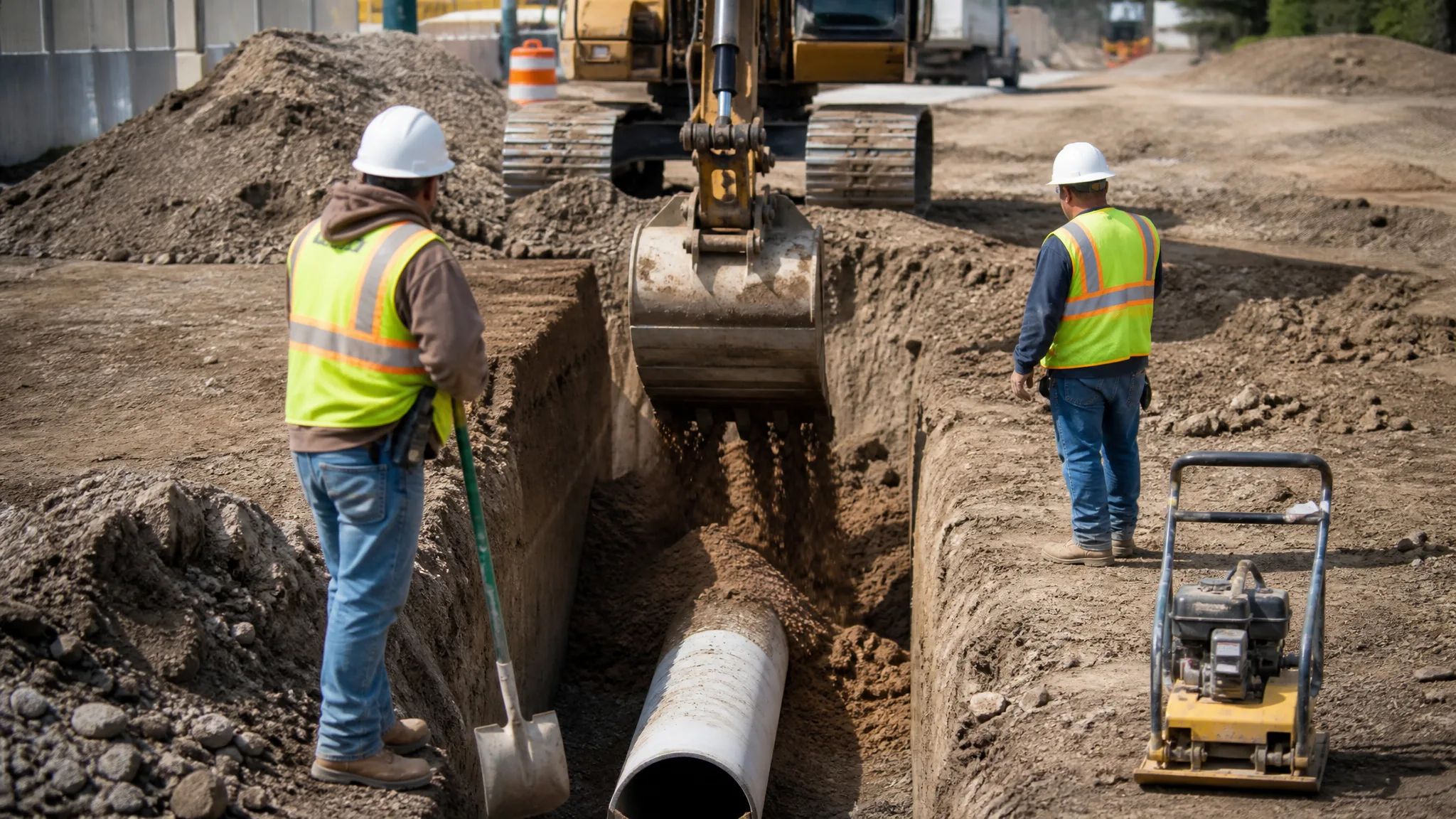
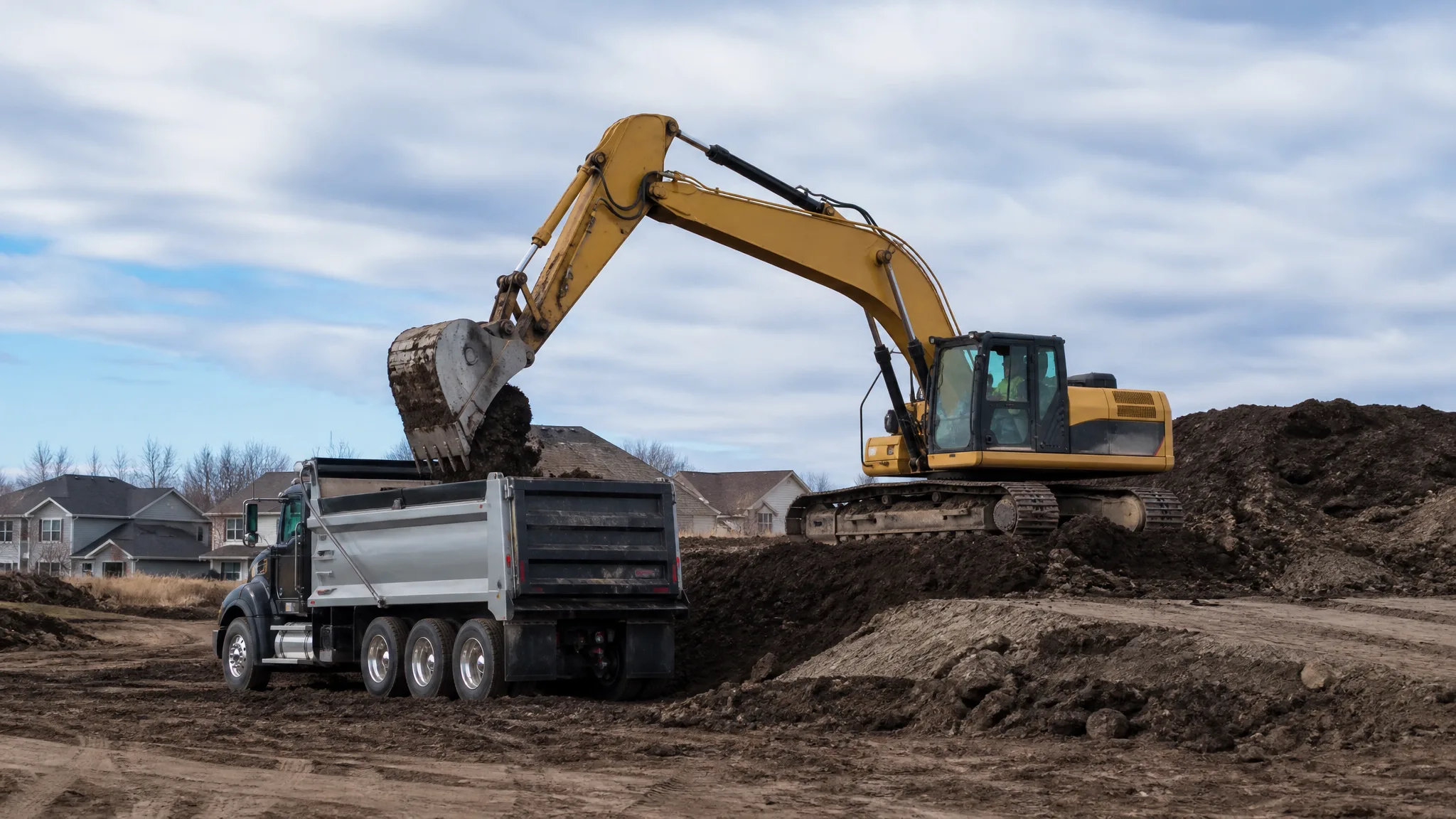
When the unsuitable material is shallow, removing it is often the cheapest and most predictable fix. The soft soil is excavated down to a suitable bearing layer, the resulting hole is backfilled with a clean, compactable granular material, and the fill is placed in thin lifts and compacted to the density required by the specification — commonly 90 to 95 percent of the standard Proctor maximum dry density under the soil compaction standards, with modified Proctor requirements for heavily loaded areas. Excavated material that leaves the site still has to be measured and hauled, so the volume and load count matter as much as the dig itself.
Two details separate a good undercut from a bad one. First, the unsuitable material must actually leave. Pushing it to the side and covering it with a lift of good fill only relocates the problem. Second, undercut quantities should be measured and priced as a unit item, because the depth never matches the estimate precisely and unpriced undercut is how contractors lose money on soft sites.
Lime Stabilization for Plastic Clay Soils
Lime — quicklime or hydrated lime — is the classic chemical treatment for plastic, expansive clays. When it is mixed into clay, it changes the soil chemistry: clay particles agglomerate into larger, less plastic groupings, the plasticity index drops, the material becomes workable, and moisture is consumed in the reaction, which dries out wet soil at the same time. Over time, pozzolanic reactions add strength.
Lime is not a universal fix. It works on plastic clays and silty clays, not on clean granular soils, and it struggles with organic material and soils with high sulfate content, which are prone to swelling. Application rate is a percentage of dry soil weight and should come from a laboratory mix design, not from a rule of thumb. In practice the lime is spread, mixed to depth in the upper portion of the subgrade, allowed to mellow, mixed again, brought to moisture, and compacted in the same pass of work.
Cement and Fly Ash Stabilization
Cement and fly ash work through cementation rather than clay chemistry, binding soil grains together. Class C fly ash is self-cementing and can be used on its own; Class F fly ash needs an activator such as lime, cement, or cement kiln dust to develop strength. Typical fly ash addition rates run from about 8 to 16 percent of the dry weight of the soil, and higher rates generally produce higher strength, but the actual number has to come from laboratory mix design testing.
Two construction details decide whether the treatment performs. The first is delay time — the elapsed time between when the material contacts water and when it is finally compacted. Strength falls as delay grows, which is why specifications commonly cap compaction delay at about one hour. The second is moisture, because maximum strength in stabilized soil is often reached at moisture contents below the optimum for density, several points below optimum in silt and clay soils. Fly ash also acts as a drying agent, and can pull moisture out of wet soil quickly enough to let work continue the same day.
Deep Fixes: Aggregate Piers and Other Ground Improvement
When soft material extends 15 or 20 feet down, undercutting stops making economic sense. That is the point where engineered ground improvement takes over. Aggregate piers — dense columns of compacted stone and gravel installed in groups beneath a loaded area, typically 20 to 36 inches in diameter — reinforce the soil and stiffen the zone that receives the load. They are designed, not improvised: pier spacing, depth, and stone gradation come from a geotechnical evaluation, with verification testing on site.
Other deep options include preloading the site with surcharge fill to consolidate soft clay before construction, deep soil mixing, and driven or drilled piles that carry load past the weak layer entirely. Each of these changes the project's cost structure, so the decision is made with the owner and the engineer, and it is usually made early — the worst outcome is discovering deep soft ground after the footing excavation is open.
Water Control and Working Platforms
Most unstable subgrade problems are water problems wearing a soil costume. Water that is kept off the site never has to be dried out, and water that is drained away early costs a fraction of what it costs to remove saturated soil and replace it.
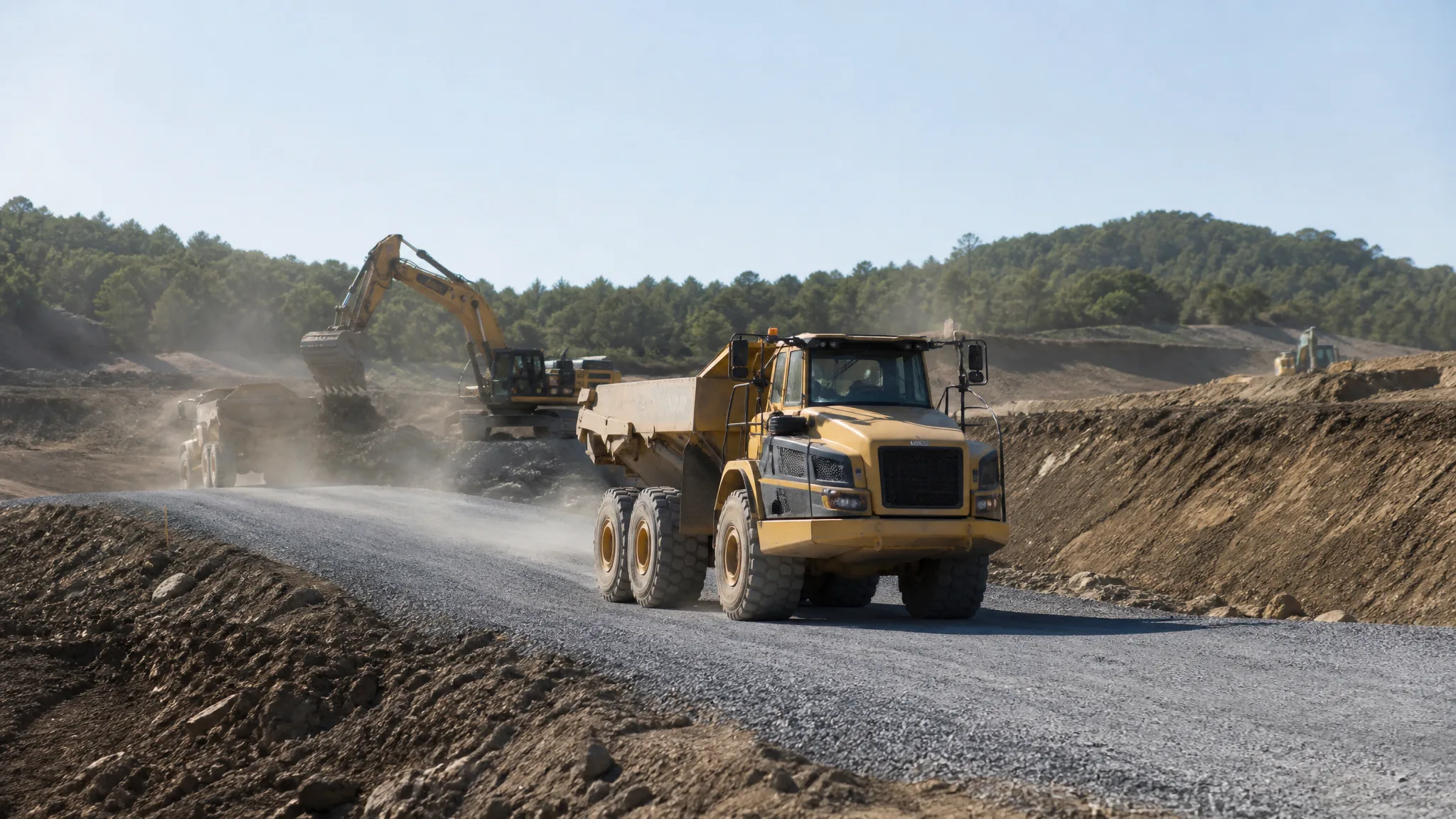
That means shaping the subgrade so it sheds water instead of collecting it, ditching and diverting surface flow, keeping pumps available in low areas, and protecting the worked surface with silt fence and stabilized entrances so sediment and runoff do not circulate back onto the grade. Where equipment must cross soft ground, a working platform of granular material distributes the load instead of churning the subgrade into a rutted mess.
Wet soil cannot be compacted to the required density — the water occupies the pore space that soil particles need to move into. Drying, blending with drier material, or replacing the wet material are the real options, and adding more passes with a heavier roller is not one of them. That is also why matching the compactor to the soil matters less than getting the moisture right first.
Common Mistakes on Soft Ground
- Rolling harder instead of fixing the source. Compaction energy does not create bearing capacity where there is none.
- A thin stone "band-aid" over mud. Without separation or reinforcement, aggregate disappears into soft subgrade.
- Over-excavating and backfilling with unsuitable material. Material that failed as subgrade will fail as fill.
- Skipping the laboratory mix design for lime, cement, or fly ash, then guessing at application rates in the field.
- Letting stabilized material sit too long before compaction, which throws away the strength the treatment was meant to provide.
- Not pricing undercut as a unit item, then absorbing the extra depth and haul-off out of profit.
- Leaving the finished subgrade unprotected against rain, traffic, and freezing, then rebuilding it before the next trade arrives.
Choosing a Method and Protecting the Work
Work the options in order of cost. Start with drainage and moisture control, then consider a reinforced granular section, then undercut and replace, then chemical stabilization, and finally engineered deep improvement. The right answer depends on the depth and type of weak material, the moisture condition, the loads the ground will carry, and the schedule available — which is exactly the information a geotechnical report provides.
Whichever method is chosen, the work only holds up if it is protected afterward. Finished subgrade should be shaped to drain, kept free of construction traffic that was not part of the plan, and covered or paved as soon as the schedule allows. Stabilization buys a site that performs; protecting it is what keeps the fix from being done twice.