Rock Excavation Methods

Rock is where an earthwork estimate goes to die. Dirt moves at a predictable rate with a predictable machine; rock does not. The same cut that a 20-ton excavator would peel out in a day can turn into two weeks of hammering once the bucket rings off a ledge that was never on the drawings. The good news is that rock excavation is not a mystery — it is a sequence of decisions, and contractors who make those decisions in the right order keep rock from wrecking the schedule and the budget.
Why Rock Is a Different Job Than Dirt
Excavating soil is a cutting problem — the material fails along the bucket edge and loads. Excavating rock is a fracture problem. The material usually has to be broken before it can be dug, and how easily it breaks depends less on horsepower than on the rock itself: its compressive strength, how weathered it is, and above all the spacing and orientation of its joints, bedding planes, and fractures.
That is why two sites with the "same" rock can behave completely differently. A blocky, closely jointed shale will come apart under a single-shank ripper. A massive, unjointed granite of the same strength will not budge no matter how much weight is sitting on the shank. Discontinuities — not just strength — decide whether a method works.
How Rock Is Rated Before Anyone Picks a Method
Because rock behavior is so variable, the first step on any rock job is characterization. If the site has been investigated, start with the geotechnical report, which should describe rock type, depth to rock, weathering, and often a "rock line" or point of refusal for the drilling that produced the borings.
Where the stakes are high, that is supported by seismic refraction — a geophysical survey that measures how fast sound waves travel through the rock mass. Seismic velocity correlates well with rippability (the ease of mechanical excavation), and it is the basis of the rippability charts the major dozer manufacturers publish. Sampling and lab testing of cores round out the picture.
The practical takeaway: rock that shows wide fracture spacing and competent, intact material is generally a poor ripping candidate, and harder methods need to be brought in. Rock with closely spaced joints, weathering, and seams is usually a ripping candidate.
Ripping: Usually the Cheapest Way to Break Rock
Ripping is the process of tearing rock loose with one or more steel teeth mounted on the back of a bulldozer. Where it works, it is by far the most economical option — the Federal Highway Administration's guidance on rock excavation puts ripping costs at roughly 50 to 65 percent less than blasting, with far fewer permits and much lower risk.
Ripping has real limits. It suits soft to moderately firm, fractured rock and shallow cuts. In dense formations, a light blast is sometimes used first to open the mass, after which ripping and loading follow. Rippers come in pull-type and bulldozer-mounted versions; for rock, a dozer-mounted ripper wins because it can put more downward pressure on the tip. Single-tooth rippers are used for the toughest material and maximum depth; multi-tooth (up to five) rippers suit softer ground or secondary breaking.
Ripping is typically done in passes, and in tough material a grid pattern — crossing the first set of passes at an angle — fractures the mass more efficiently than parallel passes alone. Once loosened, an excavator loads the broken rock.
Hydraulic Breakers and Hoe Rams
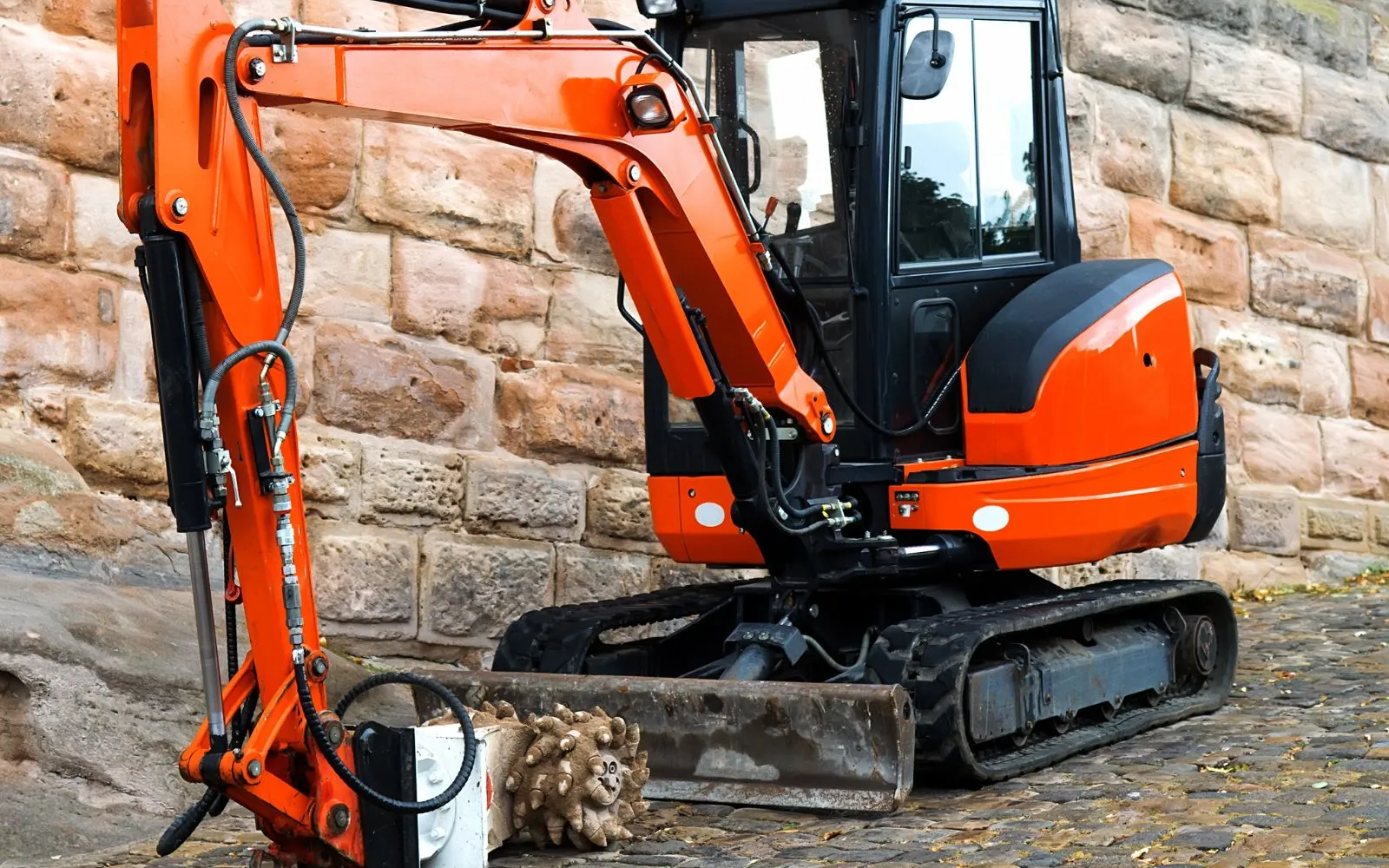
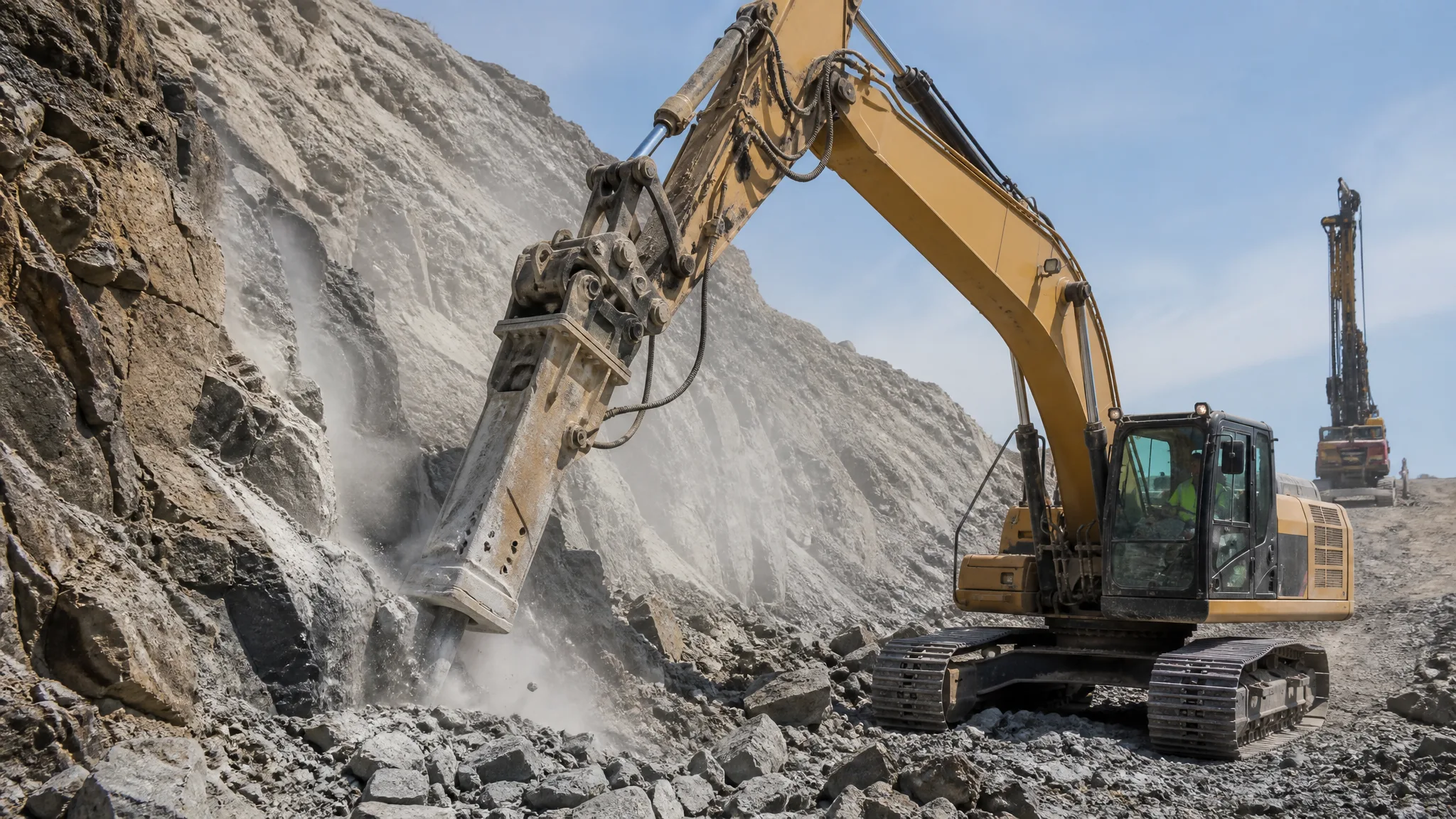
A hydraulic breaker (also called a hammer or hoe ram) is a percussion tool mounted on an excavator. It is the method of choice where blasting is restricted by environmental, noise, vibration, or permitting constraints — and it is also how most contractors handle isolated rock, shallow ledges, and oversize boulders that are too big to load.
Technique matters more than most operators expect. The hammer is positioned perpendicular to the surface so the piston energy goes into the rock instead of glancing off it, and impact points are laid out in a grid so the rock breaks into pieces that can actually be loaded and hauled. Working at an angle is both less productive and harder on the tool. In slope work, hammering parallel to a major discontinuity can drive fractures back into the finished face, so orientation gets planned, not guessed.
A breaker can be used across most rock types, but it performs best in soft to highly fractured rock because existing discontinuities act as natural split lines. In massive, hard rock, production drops sharply and the cost per cubic yard climbs fast.
Non-Explosive Splitting and Expansive Grout
Between ripping and blasting sits a family of quiet methods that generate little or no vibration. Hydraulic rock splitters drive steel wedges into pre-drilled holes with a hydraulic ram, cracking the rock along the hole line. Manual wedges and feathers work the same way on a smaller scale.
Expansive grout — also sold as non-explosive demolition agent — is poured into drilled holes where it sets and expands, generating enough pressure to crack rock and concrete over hours. It is slow, but it produces no flyrock, no ground vibration, and no blast noise, which makes it useful inside occupied buildings, in dense neighborhoods, and anywhere blast limits are tight. For secondary breaking at a graded face, a breaker on the excavator is usually cheaper than either splitting method.
Drilling and Blasting: When Nothing Else Will Do It
For large volumes of competent rock, drilling and blasting remains the fastest and least expensive way to break the mass. Blasting splits into two broad families. Production blasting uses larger, widely spaced charges to fragment a large burden — the rock between the existing face and the hole. It is efficient, but it creates radial fractures and backbreak that weaken the rock left behind.
Controlled blasting is used along the final slope face. Presplitting, smooth blasting, and cushion blasting all use closely spaced holes and lighter charges to create a clean fracture plane. Presplit holes are typically only 2 to 4 inches in diameter because the goal is a discrete fracture rather than bulk breaking, and because those small holes drift off line with depth, presplitting is generally limited to roughly 50 feet of depth and to slopes steeper than about 1:1.
Blasting is a specialty. Contractors hire licensed blasting firms that handle hole layout, loading, timing, and vibration control — and the excavation side of the job is really about giving that crew a safe, well-drained bench to work from.
Blasting Safety and Regulation
OSHA's blasting rules live in 29 CFR 1926 Subpart U, and they apply to every blasting operation on a construction site:
- Only authorized and qualified persons may handle explosives, and the blaster must be qualified by training, knowledge, or experience (1926.900, 1926.901).
- Smoking, open flames, and spark-producing devices are prohibited near magazines or while explosives are handled, transported, or used.
- Explosives must be accounted for at all times, stored in locked magazines, and tracked with an inventory and use record; losses and thefts are reported to authorities.
- Near structures, railways, highways, or anything that could be damaged, the blaster takes special precautions — mats or equivalent methods — to control the throw of fragments.
- Visual and audible warning signals, flags, or barricades are required, and above-ground blasting is to be done between sunup and sundown where possible.
Table U-1 in 1926.909 sets the standard signal sequence: a one-minute series of long blasts five minutes before the blast signal, a series of short blasts one minute before the shot, and a prolonged blast for all clear after inspection of the blast area. Blasting also carries its own permitting and insurance requirements — local permits, blast-vibration limits, pre-blast surveys of nearby structures, and seismograph monitoring are common conditions. None of that is negotiable because the job is small.
Equipment, Production, and Cost Realities
Every rock method has a different cost structure. Ripping needs a dozer with the right ripper, working hours on the shank, and a loader behind it. Breakers need a carrier sized to the hammer — an undersized machine beats itself apart, and an oversized hammer on a small carrier does the same — plus time, which is the real expense. Blasting brings mobilisation, drilling, explosives, permits, and monitoring.
Rock also changes the downstream math. Broken rock does not compact, so rock that is not hauled off usually has to be dug out and replaced with suitable fill before anything is built on it. It is heavier than soil, so hauling costs more per cubic yard, and the swell factor that governs how many truckloads leave the site is measured in different terms. Oversize rock often has to be broken down again before it can be loaded efficiently, and rock that a plan calls "unclassified excavation" can completely change the price of a job — which is exactly why per-yard pricing needs the rock line spelled out before anyone signs.
Matching the Method to the Job
The method falls out of the volume, the rock, and the constraints:
- Isolated rock and shallow ledges: hydraulic breaker on the excavator already on site.
- Fractured, weathered rock over a wide area: rip and load.
- Massive rock, large volume, no nearby structures: drill and blast, with controlled blasting along the finished face.
- Rock near utilities, water lines, or occupied buildings: ripping where possible, breakers or splitting where vibration is capped.
- Tight residential digs and trench rock: breaker or splitter, with utility locates already completed and trench access planned.
In practice, most rock jobs use combinations: presplit the face, production blast the bulk, rip the weathered top, and break the oversized pieces with a hammer before loading.
Common Mistakes on Rock Jobs
- Assuming rippability from rock type alone instead of from fracture spacing and seismic data.
- Sizing a breaker too small for the carrier or the rock, then paying for it in downtime and tool wear.
- Blasting close to structures or utilities without pre-blast surveys, vibration monitoring, or a plan for complaints.
- Setting up a grade plan that ignores how slowly rock cuts actually proceed.
- Forgetting that rock under a foundation excavation usually means undercut and replace, not build on what is left.
- Failing to plan rock disposal, recycling, or crushing before the muck pile is already sitting on the site.
- Working a rock face with the excavator on sloped, loose ground without stabilizing the platform first — the same stability rules that apply to working on slopes apply to rock, only with harder, heavier material sliding downhill.
- Under-pricing because the quantity in the bid was soil volume and the quantity in the hole was rock volume — a mistake best caught by comparing calculated volumes and truckloads against what actually leaves the site.
None of this is exotic. It is the same discipline the rest of an earthwork job runs on — characterize the material, pick the cheapest method that physically works, protect the people nearby, and price the work you actually found.