How to Calculate Excavated Soil Volume and Truckloads


Every excavation job comes down to the same two numbers: how much dirt you are moving and how many trucks it will take to get it gone. Get those numbers wrong on the low side and you are paying for a second truck to show up mid-haul. Get them wrong on the high side and you are bidding yourself out of the job. The good news is that both figures are simple to calculate once you understand the three states of soil and the difference between what sits in the ground and what actually fits in the box. This guide walks through the exact formulas we use in the field, with worked examples, real swell factors, and the truck capacities that determine your final load count.
The Three States of Soil: Bank, Loose, and Compacted
The single most common estimating mistake is treating dirt as if it takes up the same space before digging, during hauling, and after it is placed. It does not. Soil has three volume states, and each one changes your numbers:
- Bank cubic yards (BCY) — the volume of soil in its natural, undisturbed state in the ground. This is what your grade stakes and site plan are measured in.
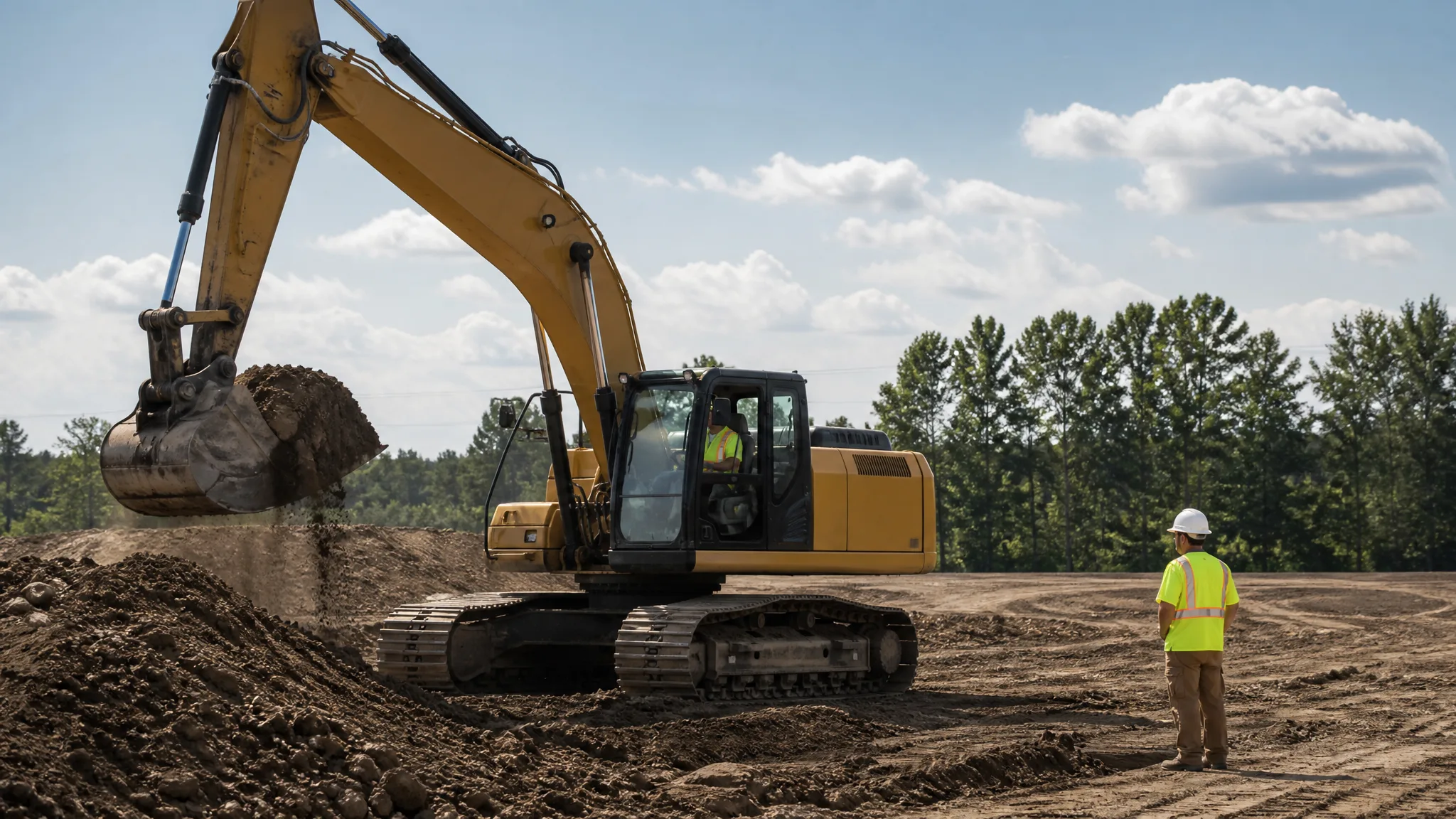
- Loose cubic yards (LCY) — the volume after excavation breaks the soil apart. Digging adds air pockets, so loose volume is always larger than bank volume. This is what the dump truck carries.
- Compacted cubic yards (CCY) — the volume after soil is placed and compacted for fill. It is typically smaller than the loose volume and often smaller than the original bank volume.
For truckload calculations, the only number that matters is loose cubic yards. Ordering or quoting in bank yards and then loading trucks by volume is how crews end up short on haul-off capacity by 25 percent or more.
Step 1: Calculate the Bank Volume in Cubic Yards
Start with the undisturbed volume. For a rectangular excavation, the formula is dead simple:
(Length in feet x Width in feet x Depth in feet) ÷ 27 = cubic yards
The 27 is the number of cubic feet in a single cubic yard. Worked example for a house foundation pad: a 60-foot by 40-foot area excavated to a depth of 4 feet holds 60 × 40 × 4 = 9,600 cubic feet, or 9,600 ÷ 27 = 355.5 bank cubic yards.
When the footprint is irregular, break it into rectangles and triangles, calculate each one, and add them together. For triangles, use (base × height ÷ 2 × depth) ÷ 27. You do not need survey-grade accuracy for a truck count, but you do need to account for every section of the dig.
Step 2: Account for Soil Expansion (Swell)
Soil expands when it is dug up. The swell factor tells you how much bigger the loose volume is than the bank volume, and it varies dramatically by material. Multiply your bank cubic yards by the swell factor to get the loose cubic yards you will actually load and haul:
Bank cubic yards × Swell Factor = Loose cubic yards
Here are the swell factors we use in the field for common materials:
| Material | Typical Swell | Swell Factor |
|---|---|---|
| Topsoil / organic loam | 15–25% | 1.15–1.25 |
| Sand and gravel | 10–15% | 1.10–1.15 |
| Common earth / clay loam | 25–30% | 1.25–1.30 |
| Heavy clay | 30–40% | 1.30–1.40 |
| Rock / blasted material | 30–50% | 1.30–1.50 |
Continuing the foundation example: if that 355.5 bank cubic yards is common earth with a 25% swell, the loose volume is 355.5 × 1.25 = 444.4 loose cubic yards. That is the number your trucks have to move — nearly 90 yards more than the site plan suggested. Moisture matters too: wet clay runs toward the high end of the range and gets heavier at the same time, which we will come back to in the weight check.
Step 3: Sloped Excavations and Irregular Cross-Sections
Trenches and pits rarely have vertical walls. OSHA requires benching or sloping on any trench deeper than 5 feet, and most pits are dug with sloping sides for safety and stability. A sloped excavation is a trapezoid in cross-section, so use the average-width method:
((Top width + Bottom width) ÷ 2) × Depth × Length ÷ 27 = bank cubic yards
Example: a 120-foot trench with a 6-foot bottom, 2:1 slopes, and an 8-foot depth has a top width of 6 + (2 × 8) = 22 feet. The average width is (22 + 6) ÷ 2 = 14 feet. Volume is 14 × 8 × 120 ÷ 27 = 497.8 bank cubic yards — versus 213 cubic yards if you calculated it as a straight-walled box and came up short on spoil. When a project has a separate topsoil strip before the main dig, calculate the strip separately and add it in; mixing the two changes both the swell factor and the material's end use.
Step 4: Convert Loose Yards to Truckloads
Once you have the loose volume, divide it by the truck's practical capacity. The rated "struck" capacity of the box is not the same as a heaped load, and legal weight limits usually bind before volume does. Practical hauling capacities we plan around:
| Truck type | Typical box (heaped) | Typical payload |
|---|---|---|
| Small dump / single axle | 6–9 cubic yards | 10–13 tons |
| Tandem / 10-wheel dump | 10–12 cubic yards | 14–18 tons |
| Tri-axle dump | 12–15 cubic yards | 18–22 tons |
| End dump (semi) | 16–18 cubic yards | 24–26 tons |
| Belly dump (semi) | 20–22 cubic yards | 24–26 tons |
Loose excavated soil weighs roughly 2,200 to 2,600 pounds per cubic yard depending on moisture. Run the weight check on every estimate: a 12-yard tandem load of wet common earth at 2,500 pounds per yard weighs 30,000 pounds, which exceeds the legal payload on many configurations. When weight binds, you haul fewer yards per load even though the box looks half empty. Always confirm which limit — volume or weight — controls the loads for your specific truck and material. (For a closer look at what different trucks can actually hold, see our breakdown of how many yards a dump truck holds.)
Putting It All Together: A Full Worked Example
Take a 100-foot by 50-foot commercial pad dug to 3 feet in common earth, hauled by 12-yard tandem dump trucks:
- Bank volume: 100 × 50 × 3 ÷ 27 = 555.6 BCY
- Loose volume with 25% swell: 555.6 × 1.25 = 694.4 LCY
- Truckloads by volume: 694.4 ÷ 12 = 57.9 → 58 loads
- Weight check: 694.4 × 2,400 lb = 1,666,560 lb ÷ 30,000 lb per load (12 cy × 2,500 lb) ≈ 55.6 → if legal payload caps at 13 tons per truck, loads climb to 64
Rounding matters. You never order 57.9 loads — you order 58, and you add a 10–15% contingency on top of that for overdig, sloppy loading, and the inevitable extra pass the operator takes. On a job this size that means budgeting for 64 to 67 truckloads even though the clean math says 58.
Real-World Adjustments That Change Your Count
Every experienced operator knows the field never matches the plan exactly. These are the adjustments we build into every estimate:
- Overdig tolerance — graders and operators routinely dig 3 to 6 inches past grade, which adds volume across the whole footprint. Add 5% before you even start.
- Reuse vs. export — if spoil is staying on site for fill, only the exported surplus gets trucked. Estimate the fill volume in compacted yards and subtract it from the loose total.
- Bucket heaped vs. struck — a heaped bucket holds 10–20% more than struck capacity, which changes both loading pace and truck fill. Know which number your equipment spec uses.
- Short loads and haul cycle — drivers hauling to a distant dump site will short-load to protect axles and save fuel. Volume math assumes full loads; cycle time determines fleet size, not load count.
- Contingency — 10–15% is standard on private work and mandatory on anything with a fixed haul-off price.
Pro Tips for Accurate Soil Volume Estimates
Good estimates come from good takeoffs. Stake the excavation corners and verify depth with a laser or GPS rather than eyeballing it — a 1-foot depth error on a 50 by 100 pad changes the volume by more than 185 cubic yards. Use the bucket count as a cross-check: if your excavator bucket is 0.75 cubic yards heaped and you are tracking loads, 12 bucket passes per 9-yard truck is a reliable sanity check on the ground — our guide to how many yards are in an excavator bucket explains the struck versus heaped difference in detail. And when you order fill or arrange disposal, order in loose yards — the delivered quantity is what the truck carries, and suppliers quote the same way.
Document the estimate with photos of the site, the grade stakes, and a signed change order for anything that shifts mid-project. On excavation work, the difference between a profitable job and a loss leader is almost always in the volume math that never made it onto the original bid.
Frequently Asked Questions About Excavated Soil Volume
How much does excavated soil expand?
Most excavated soil expands 20 to 40 percent depending on the material. Common earth and clay loam typically swell about 25 to 30 percent, sand and gravel only 10 to 15 percent, and blasted rock up to 50 percent. Multiply your bank cubic yards by the swell factor to get the loose volume you are actually hauling.
How many cubic yards fit in a dump truck?
A standard tandem dump truck carries about 10 to 12 cubic yards heaped, tri-axles run 12 to 15, and semi end dumps 16 to 18. Legal weight limits often reduce the practical load for heavy, wet soil, so run the weight check before you commit to a load count.
Do I order fill dirt by bank or loose yards?
Always order in loose (delivered) cubic yards — that is what the truck carries and what the supplier quotes. If you only know the bank volume, multiply by the material's swell factor first so you order enough.