Excavation Cost Per Cubic Yard

Ask two excavating contractors what they charge per cubic yard and you can get two very different numbers for the same hole. Excavation is priced by the hour, by the day, by the cubic yard, or as a fixed price for the job, and the per-yard figure people quote is really the job price divided by the volume of dirt moved. Understanding what sits inside that number is the difference between a fair bid and a surprise invoice.
What "Cost Per Cubic Yard" Actually Covers
When a contractor quotes excavation per cubic yard, the price is meant to cover more than the act of digging. It bundles the machine, the operator, the fuel, the maintenance reserve, the supervision, and usually the hauling or placement of the dirt. That is why published national ranges for common earthwork vary so widely: one guide is quoting the digging alone, while another is quoting digging plus hauling plus disposal fees.
Read any per-yard number as a shortcut for a whole scope of work, not as a shopping price. The scope behind the number is what you are really comparing.
Typical Excavation Prices in the U.S.
Published 2026 cost guides cluster around a few headline ranges. Common earth excavation is frequently listed at roughly $8 to $15 per cubic yard for straightforward dirt, with some guides stretching a general range from about $2.50 to $15 per cubic yard depending on how much labor and hauling is folded in. A full residential excavation often lands somewhere between $1,500 and $5,600.
Machine and operator time is usually quoted separately at about $100 to $350 per hour, or roughly $800 to $2,000 per day. Mobilization, the cost of trailering the machine to and from your site, commonly runs $200 to $800. These are published guidance ranges, not bids, and they move with region, soil, and season.
The Three Ways Contractors Price Excavation
Before you compare numbers, establish which basis the quote uses, because each shifts risk.
- Hourly or daily. Common on small or unpredictable jobs. You carry the risk if the ground turns out to be harder than expected, and you benefit if it goes smoothly.
- Per cubic yard. Used for bulk earthmoving where the volume can be calculated in advance. The contractor carries the productivity risk, so the per-yard rate tends to be higher than the raw hourly math.
- Fixed price for the job. Easiest to compare, but the exclusions in the fine print matter as much as the total.
Why the Same Hole Costs $3 or $40 Per Yard
Fixed costs do not shrink just because the job is small. Mobilization, setup, and the minimum a contractor has to charge to make a trip worthwhile get spread across the volume moved. On a large cut, those costs spread thin and the price per yard drops. On a small dig, they spread across a few dozen yards and the price per yard climbs quickly.
That is why a big bulk cut can price out at a low per-yard rate while a backyard dig for a small project prices several times higher per yard for the same material. Volume is the single biggest variable in the per-yard number.
Bank, Loose, and Compacted Yards
Dirt changes volume as it moves. A cubic yard measured in the ground is a bank yard. Once it is dug and broken up, it swells into a larger loose volume. Compacted back into place, it shrinks again. Unless a bid states which yard it is measuring, you cannot be sure what you are being charged for.
The conversion between bank, loose, and compacted volume is called swell and shrinkage, and it is the most common place a per-yard quote quietly changes. Many contractors price bank yards for the cut and add separately for the haul, which is a fair approach as long as both sides understand it.
How to Calculate the Volume You're Paying For
Volume math is simple and worth doing yourself so you can sanity-check a bid. Convert the hole to cubic feet, then divide by 27, the number of cubic feet in a cubic yard.
For example, a cut 40 feet long, 30 feet wide, and 3 feet deep is 40 x 30 x 3 = 3,600 cubic feet. Divide by 27 and you get about 133 cubic yards. If the material will be hauled off, remember you are paying to move loose yards, which are larger than the bank yards you measured in the ground.
For the truck side of the math, a tandem dump truck legally carries far less than its bed volume, so load counts and yard counts rarely match one to one. Our guides on calculating excavated soil volume and truckloads and on how many trucks a job needs walk through the conversions.
What Drives the Number Up
Five factors move a per-yard price more than anything else.
- Access. A machine that can drive onto the lot works at full speed. A tight lot where the crew has to work around a fence line or use a smaller machine can double the hours for the same volume.
- What the ground is made of. Sandy loam digs fast. Wet clay sticks to the bucket and slows everything. Rock is the wildcard that can mean a breaker attachment, a different machine, or a renegotiated price, which is why good bids state whether rock is included or excluded.
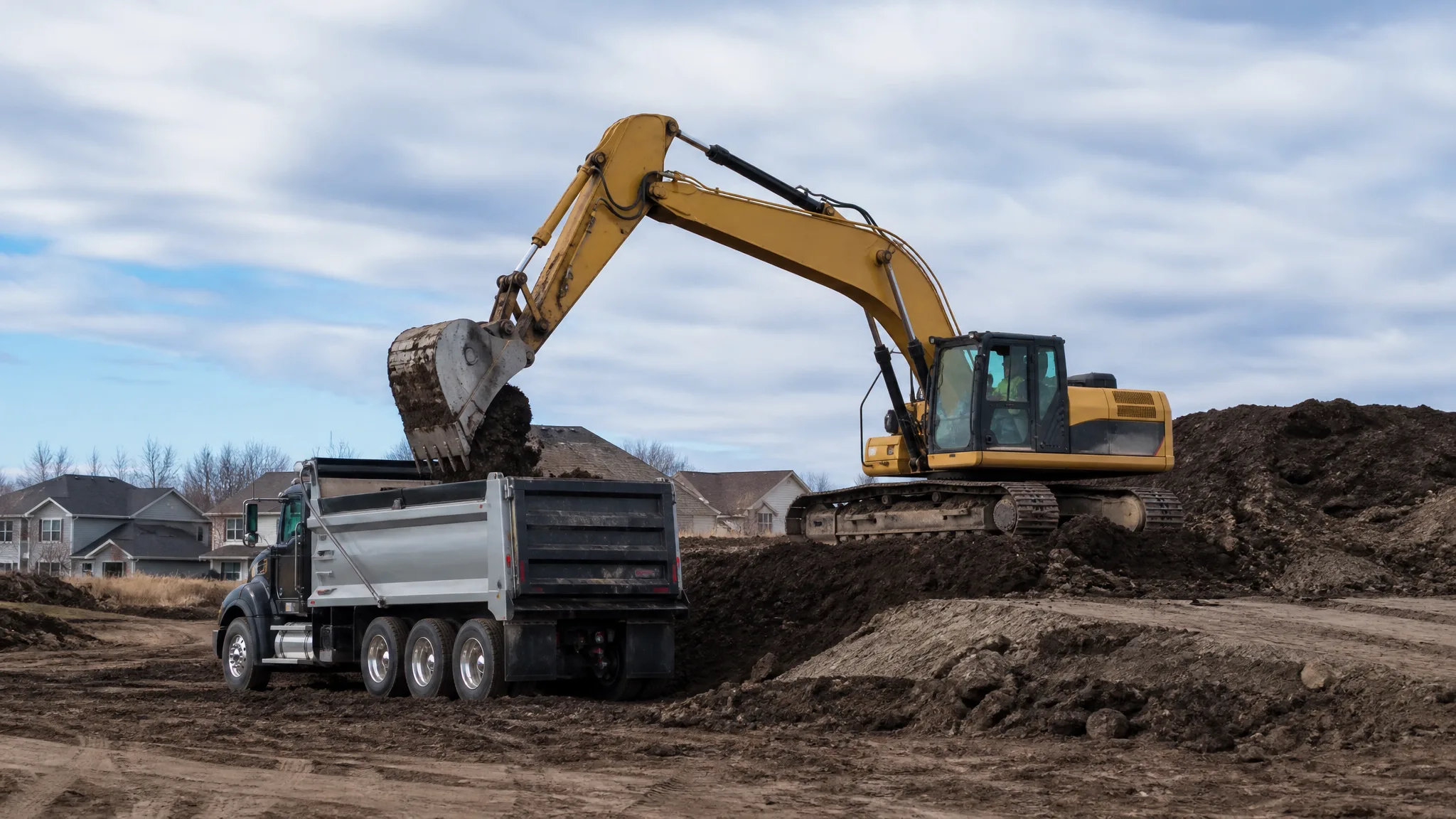
- Where the spoil goes. Spreading dirt on site is close to free. Trucking it off adds haul time, trucking cost, and often a tipping fee at the far end.
- What has to come in. Imported fill, gravel, and topsoil are materials plus delivery, and they add up faster than most owners expect.
- Water and utilities. Groundwater may require dewatering, and permits, inspections, and utility locates add calendar time even when they cost little.
Hauling and Disposal Costs
Hauling excavated dirt off site is routinely listed at about $8 to $25 per cubic yard, with accessibility driving the spread. When tipping fees are included, published estimates for full dirt removal run far higher, and a loaded truck to the dump can cost well over a thousand dollars once hauling and disposal are combined.
That gap is the most common reason two bids for the same hole differ by thousands. One contractor plans to spread the spoil on site; the other plans to truck every yard across town. Ask which one you are getting.
Mobilization, Minimums, and Small-Job Pricing
Almost every excavating contractor has a minimum charge or a minimum billable day. It covers the reality that loading a machine, trailering it, and setting up costs real money whether the job takes two hours or ten. Expect a mobilization charge on top of the work, and expect a minimum that can make a tiny job feel expensive per yard.
If your job is small, ask whether it can be bundled with nearby work or scheduled to share a mobilization. That single line item is often the easiest cost to reduce.
How to Compare Excavation Bids
Line up bids by scope, not by total. Confirm the unit basis, what volume it covers, whether hauling and disposal are included, whether imported material is included, and how rock or unexpected groundwater will be handled. A low number built on generous assumptions about the ground is not cheaper, it is just incomplete.
The same discipline that goes into estimating an excavation job from the contractor's side applies to reviewing one from the owner's side. For a deeper look at how contractors build the number, see our guide to excavation job costing and to heavy equipment cost per hour.
Questions to Ask Before You Sign
- Is the quote per bank yard, loose yard, or a flat price?
- Is hauling and disposal included, and is there a tipping fee?
- Is rock included or excluded, and at what rate?
- Is imported fill or gravel included?
- Who is calling 811 to mark utilities before the first scoop?
- What is the minimum charge and the mobilization fee?
Getting clean answers to those questions will tell you more about the real cost of your excavation than the per-yard rate ever will. And if you are weighing machine ownership against hiring the work out, our comparison of renting versus owning an excavator helps frame that decision.