OSHA Soil Classification Types A, B, and C

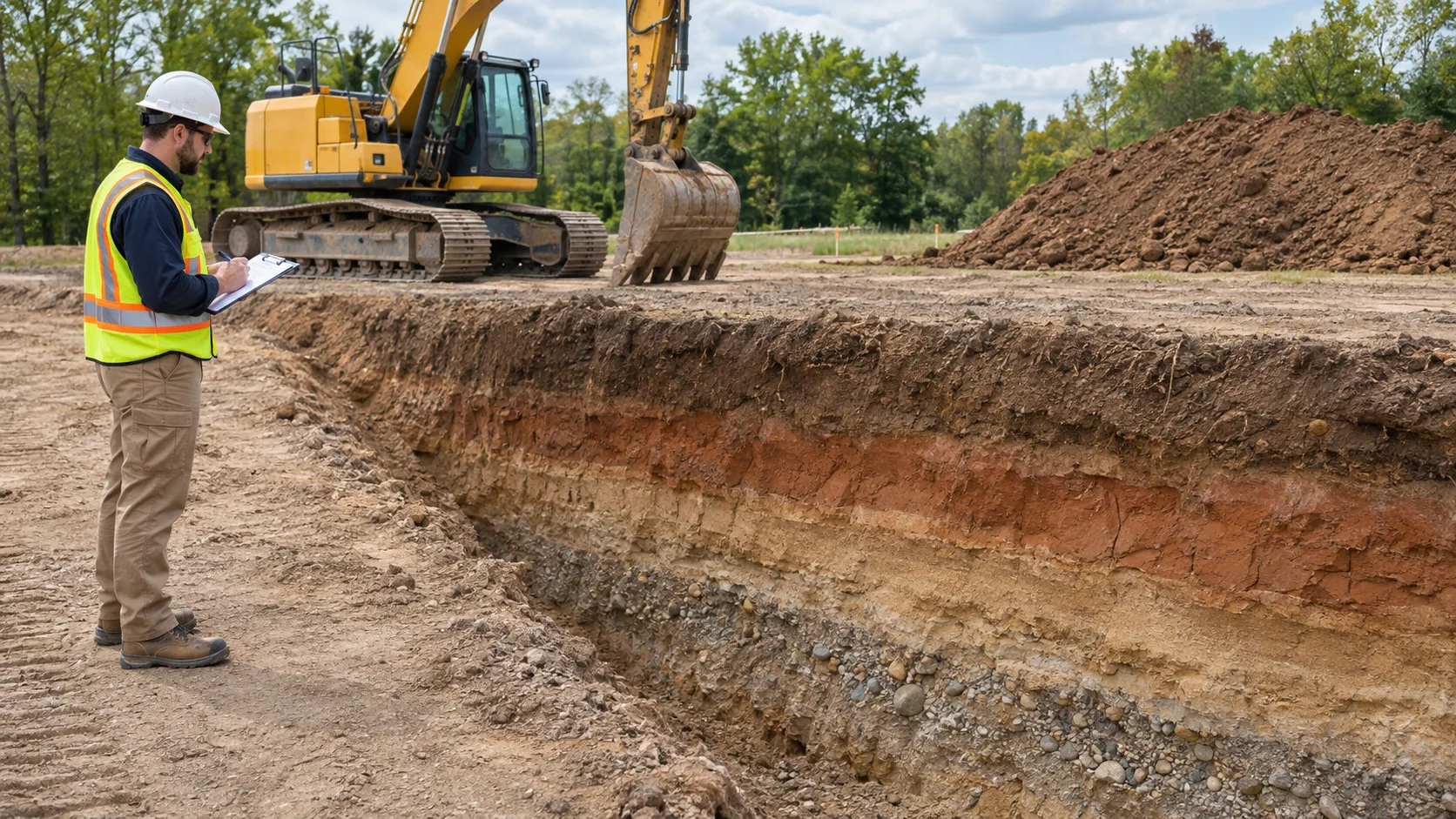
A trench rarely fails because a crew was careless. It fails because the soil that looked solid at 7 a.m. was judged by appearance instead of strength. Under OSHA's excavation standard, every soil and rock deposit has to be classified by a competent person as Stable Rock, Type A, Type B, or Type C before anyone climbs in — and that single decision is what determines whether a wall can be sloped at 3/4:1, 1:1, or 1 1/2:1, or whether sloping is not an option at all.
This is not paperwork. The classification drives the protective system, the slope ratio, the depth at which a trench box is required, and the citation a compliance officer writes if the wall comes down. Here is how the system in 29 CFR 1926 Subpart P, Appendix A actually works, and where crews get it wrong.
What the Classification Actually Decides
Appendix A applies whenever a sloping or benching system is designed under § 1926.652(b)(2), when timber shoring is designed under Appendix C, and when hydraulic shoring is designed under Appendix D. In practice it decides almost everything about how a trench is protected.
The trigger for protection stays the same: at 5 feet deep or more, employees need a protective system unless the excavation is made entirely in stable rock, or a competent person examines the ground and finds no indication of a potential cave-in. Below 5 feet, a competent person still has to look. If you are unsure where your job falls, start with our breakdown of when trench protection is required.
The classification is also only as good as the person making it. Appendix A requires the call to be made by a competent person — someone who can identify existing and predictable hazards and has the authority to correct them. If your crew does not have one on site, that is the first problem to fix, and it is worth reading what a competent person in excavation is actually responsible for.
The Four Categories at a Glance
OSHA ranks deposits in a hierarchy of decreasing stability: Stable Rock, Type A, Type B, and Type C. Stable rock means natural solid mineral matter that can be excavated with vertical sides and remain intact while exposed. Everything else is a soil type, and the type is set by composition, strength, and the conditions the deposit is exposed to.
Two numbers do most of the work. Cohesive soil is judged by unconfined compressive strength, measured in tons per square foot. Type A needs 1.5 tsf (144 kPa) or more. Type B sits between 0.5 and 1.5 tsf (48 to 144 kPa). Type C is 0.5 tsf (48 kPa) or less. Granular soils are classified by what they are rather than by a strength reading, because they have no cohesive strength to measure.
Type A Soil: The 1.5 tsf Threshold and the Exceptions That Void It
Type A is cohesive soil with an unconfined compressive strength of 1.5 tsf or greater: clay, silty clay, sandy clay, clay loam, and in some cases silty clay loam and sandy clay loam. Cemented soils such as caliche and hardpan also count, as long as a hand-size sample cannot be crushed into powder or individual particles by finger pressure.
The exceptions matter more than the definition, because a soil that tests at 2.5 tsf can still be Type B. No soil is Type A if it is fissured, if it is subject to vibration from heavy traffic or pile driving, if it has been previously disturbed, if it is part of a sloped layered system whose layers dip into the excavation at 4H:1V or steeper, or if other factors require a less stable classification.
That last clause is the one contractors underestimate. Ground that was backfilled two years ago, ground next to a busy haul road, and ground with tension cracks at the surface are all disqualified from Type A no matter what a pocket penetrometer says. This is the same reason a clean-looking cut can still be a hazard: see why workers should not work in an unprotected trench.
Type B Soil: The Middle Band Most Jobsites Fall Into
Type B covers cohesive soil with strength greater than 0.5 tsf but less than 1.5 tsf. It also captures a long list of granular soils that behave predictably enough to slope: angular gravel similar to crushed rock, silt, silt loam, sandy loam, and in some cases silty clay loam and sandy clay loam.
Type B is also where previously disturbed soil lands, unless it would otherwise be Type C. Dry rock that is not stable is Type B. And a soil that meets the strength or cementation requirements for Type A, but is fissured or subject to vibration, is Type B — that is how the exceptions above get applied in the field.
Most residential utility work in mixed ground ends up here. Silt and sandy loam shed off a vertical face, hold a 1:1 slope reasonably well, and still slough after a rain. That behavior change is exactly why the classification is a live decision rather than a line on a form.
Type C Soil: The Default for Wet, Granular, and Layered Ground
Type C is cohesive soil at 0.5 tsf or less, plus granular soils including gravel, sand, and loamy sand. Submerged soil, or soil from which water is freely seeping, is Type C by definition. So is submerged rock that is not stable, and so is material in a sloped layered system where the layers dip into the excavation at 4H:1V or steeper.
Water is the fastest route to a Type C call. A trench that was Type B in the morning can be Type C after a night of rain, and the competent person is required to reclassify it. If groundwater is entering the cut, the practical answer is usually to control the water before touching the walls — our guide to dewatering an excavation covers the options, and soil stabilization for unstable subgrade covers what to do when the bottom will not hold up either.
The Visual Analysis
Appendix A requires at least one visual and at least one manual analysis, both by a competent person. The visual pass is not a glance at the spoil pile. It includes looking at excavated samples and at the soil forming the walls, estimating particle sizes and the relative amounts of each, and watching how the material behaves as it comes out of the bucket.
Soil that stays in clumps when excavated is cohesive. Soil that breaks up easily and will not hold a clump is granular. Fine-grained material points to cohesive soil; coarse sand and gravel point to granular.
The visual pass also looks for trouble: tension cracks at the surface, chunks spalling off a vertical face, small amounts of material raveling down the wall, evidence of previous disturbance or buried utilities, layered systems whose beds slope toward the cut, seepage or a high water table, and sources of vibration nearby. Any of these can override the strength reading. If the cut has already come down, the response is a rescue problem, not a classification problem — read trench collapse rescue before you need it.
The Manual Tests That Produce a Number
Manual analysis is where qualitative impressions become a defensible call. Appendix A lists four accepted tests, and a crew should be able to run all of them with tools already in the truck.
- Plasticity. Roll a moist sample into threads as thin as 1/8 inch. If a two-inch length holds on one end without tearing, the soil is cohesive.
- Dry strength. Dry soil that crumbles into grains or powder under moderate pressure is granular. Dry soil that falls into clumps which break only with difficulty, and shows no fissures, can be treated as unfissured cohesive material.
- Thumb penetration. Type A soil at 1.5 tsf can be indented by the thumb but penetrated only with very great effort. Type C soil at 0.5 tsf is easily penetrated several inches and can be molded by light finger pressure. Test an undisturbed sample such as a large clump of spoil, as soon as practical after excavation.
- Pocket penetrometer or hand shearvane. Both give a direct estimate of unconfined compressive strength, and both need a saturated or near-saturated sample to read properly.
The drying test is the other tool worth knowing: a one-inch-thick, six-inch-diameter sample dried thoroughly will develop cracks if significant fissures are present. Cracks mean the soil cannot be Type A, regardless of strength.
From Classification to Slope Ratio
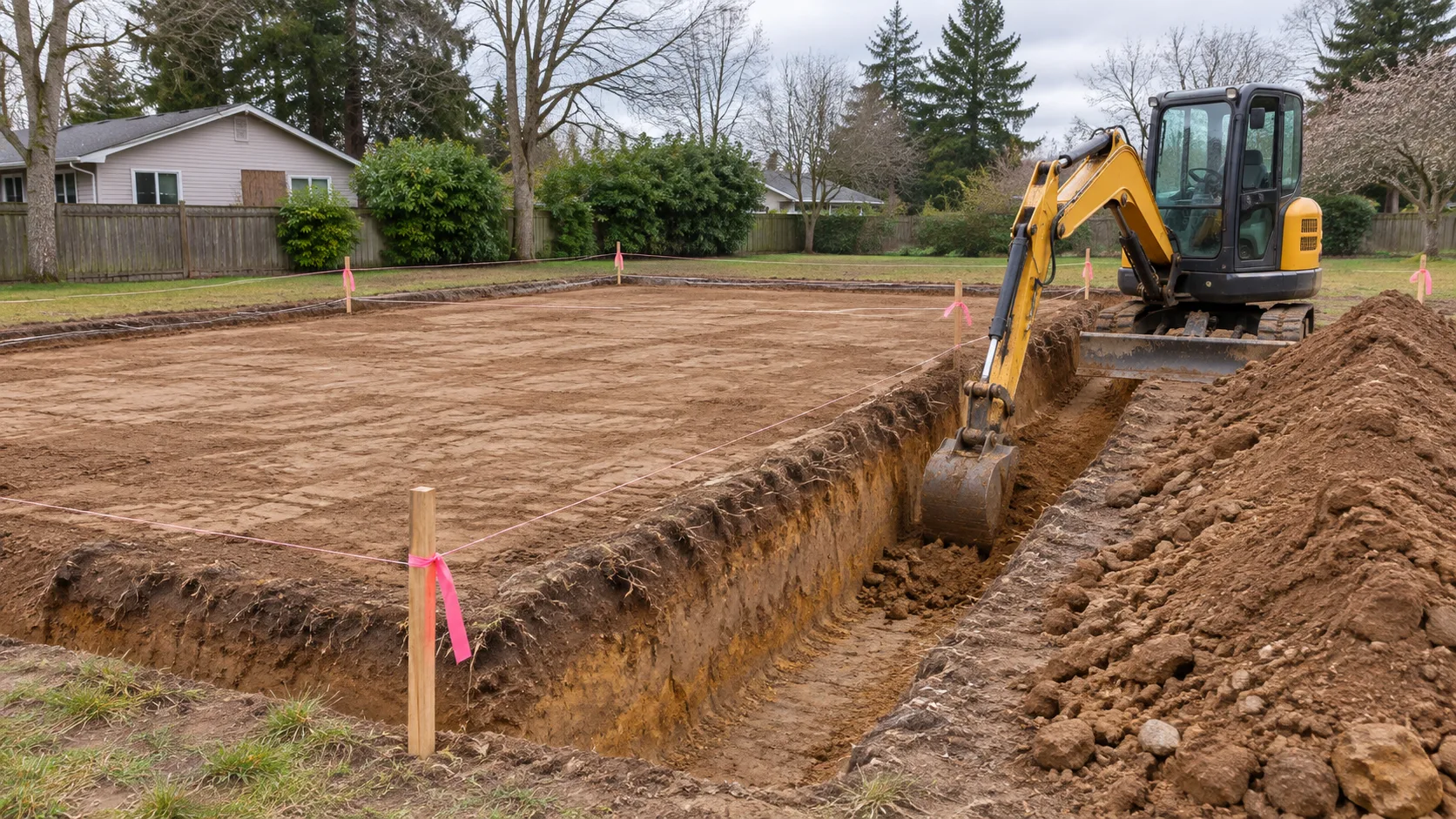
Table B-1 of Appendix B sets maximum allowable slopes for excavations less than 20 feet deep. Stable rock can be cut vertical. Type A allows 3/4:1, or 53 degrees. Type B allows 1:1, or 45 degrees. Type C allows 1 1/2:1, or 34 degrees.
There is one important exception: in Type A soil, an excavation 12 feet deep or less that will be open 24 hours or less may be sloped at 1/2:1, or 63 degrees. Beyond 20 feet, sloping and benching must be designed by a registered professional engineer.
Two rules cut the allowable slope further. If there are signs of distress, the actual slope has to be cut back at least 1/2H:1V flatter than the maximum. And where surcharge loads from stored material, equipment, traffic, or adjacent structures are present, a competent person has to determine how much additional flattening is needed — which is why spoil piles and equipment have to be kept back from the edge. If sloping will not fit the site, the next decision is a protective system, covered in choosing a trench protective system.
Layered Systems and Reclassification
Layered ground is classified by its weakest layer. That is the conservative default and the one that keeps crews alive when a sand seam sits under a stiff clay cap. Appendix A does allow each layer to be classified individually where a more stable layer lies beneath a less stable one, but that only helps if the competent person can actually see and identify the layers.
Reclassification is mandatory, not optional. If the properties, factors, or conditions affecting the classification change in any way, they must be evaluated again and the deposit reclassified as needed. Rain, a broken water line, a concrete truck idling next to the trench, or a weekend of drying all count.
Where Classifications Go Wrong
The most common error is a Type A call on ground that has been dug before. Previously disturbed soil is not Type A, no matter how stiff it feels. The second is ignoring vibration and surcharge: a trench beside a haul road or a running backhoe is not the same trench as one in a quiet field. The third is treating the classification as a single event instead of an ongoing judgment — the crew that rechecks the walls after a rain is doing the job the standard actually requires.
Get the classification right and the rest of the system follows logically: the slope, the shielding, the ladder placement, the spoil location. Get it wrong and every downstream decision inherits the mistake. For a broader look at what goes wrong in open cuts, read the dangers of excavations, and pair it with how to identify soil types on a jobsite for the field identification side that feeds this classification.