Trench Collapse Rescue

A trench collapse is one of the few construction emergencies where the instinct that saves lives everywhere else — get in there and dig — is the thing most likely to kill someone. Walls that stood all morning can fail without warning, and the space a buried worker occupies is usually too small for a second person to do anything useful in without bringing the rest of the wall down on both of them.
What follows is the first-minutes response for a crew that has just watched a collapse, and then the planning that makes that response possible. It is written for the common situation on residential and light commercial work: no rescue technician on site, no specialized trench equipment staged, and a fire department that may be fifteen minutes away or may be a regional team an hour out.
The First Sixty Seconds
Stop everything. Shut down the machine, get the operator out of the cab, and stop every other engine within earshot — vibration travels through soil and the wall that just failed is not the only unstable face in the trench. Call 911 immediately and use plain language: trench collapse, worker buried, exact address, nearest cross street, gate location, trench depth and width, and how deep the worker is buried.
Then do the hardest thing in the sequence: keep everyone out. No one enters the trench, no one jumps in to dig by hand, and no one stands on the lip directly above the victim. Move people back from the edge, because the surcharge from a few adults standing at the lip is a real load on an already failed wall.
Finally, account for everyone else on the crew. Confirm who was in the trench, who was out, and where each person is now. In the confusion of a collapse, the second victim is often someone nobody realized was down there.
Why the Second Collapse Is the Real Killer
Soil is far heavier than it looks. NIOSH puts it plainly: one cubic yard of dirt can weigh more than 3,000 pounds — about the weight of a compact car. A worker buried to the chest is carrying a load no human body can tolerate for long, and burial above the chest is usually fatal within minutes.
The mechanics work against rescuers too. Digging at the base of a failed wall removes the toe that is still holding the remaining face, and the excavation of soil changes the loading on walls that were already at their limit. Add the vibration of equipment, the weight of people and spoil at the lip, and any water moving into the trench, and a second collapse becomes the likely outcome rather than the unlikely one.
NIOSH's own summary of the data is blunt: workers do not often survive trench collapses. That is why the agency's message is prevention, not rescue technique. A rescue plan exists to keep a bad situation from becoming a double fatality.
The Would-Be Rescuer Problem
This is not a hypothetical. A NIOSH alert on confined-space fatalities found that roughly 60 percent of those deaths involved would-be rescuers — coworkers, supervisors, or passersby who went in after the first victim and became the second and third. The National Safety Council's trenching guidance is equally direct: if you are watching someone being buried in a cave-in, do not attempt to rescue them yourself, and never enter the excavation.
The impulse to help is not the problem. Entering an unprotected excavation to act on that impulse is. The one thing a crew can do that reliably makes a collapse worse is to put more bodies into the hole.
What a Safe Rescue Actually Requires
OSHA's excavation standard requires a protective system for every employee in an excavation, with narrow exceptions for stable rock and for excavations under five feet deep where a competent person finds no indication of a potential cave-in. That requirement does not switch off because someone is injured. A rescue entry is still an excavation entry.
In practical terms, a defensible rescue means a protective system designed for the soil and depth, installed by people trained to install it, with atmospheric monitoring, a designated rescue lead, and a means of egress. That is a technical rescue operation, and it is why the answer to a collapse is almost always a trained team rather than the crew that was digging the trench.
The regulatory floor is set in when trench protection is required, and the system selection logic is covered in choosing a trench protective system. If your crew cannot describe those two things from memory, they are not prepared to improvise a rescue either.
What You Can Do Without Entering
There is a substantial list of useful work that does not involve putting a person in the hole. Talk to the victim. Establish whether they are responsive, tell them help is coming, and instruct them to stay still and keep their head clear if they can. Panic and movement cause more soil to shift.
Clear the lip. Remove spoil piles, tools, fuel cans, hoses, and anything else that could fall in or add load near the edge. OSHA requires excavated material and equipment to be kept at least two feet back from the edge of an excavation, and during a rescue that minimum should be treated as a starting point, not a target.
Control water and utilities. Shut off any hose or pump discharging near the trench, and keep water from running in. If there is a gas, electric, or sewer line in the trench, call the utility owner and keep ignition sources away — a severed gas line turns a rescue into an evacuation.
Establish control. Put one person in charge, set up an inner and outer boundary, keep spectators and unnecessary equipment out, and write down times and names as they happen. Meet the responding units with the facts they need: depth, width, soil type, water present, utilities involved, what protective system was in place, what equipment is on site, and exactly where the victim is.
How Trained Crews Get Someone Out
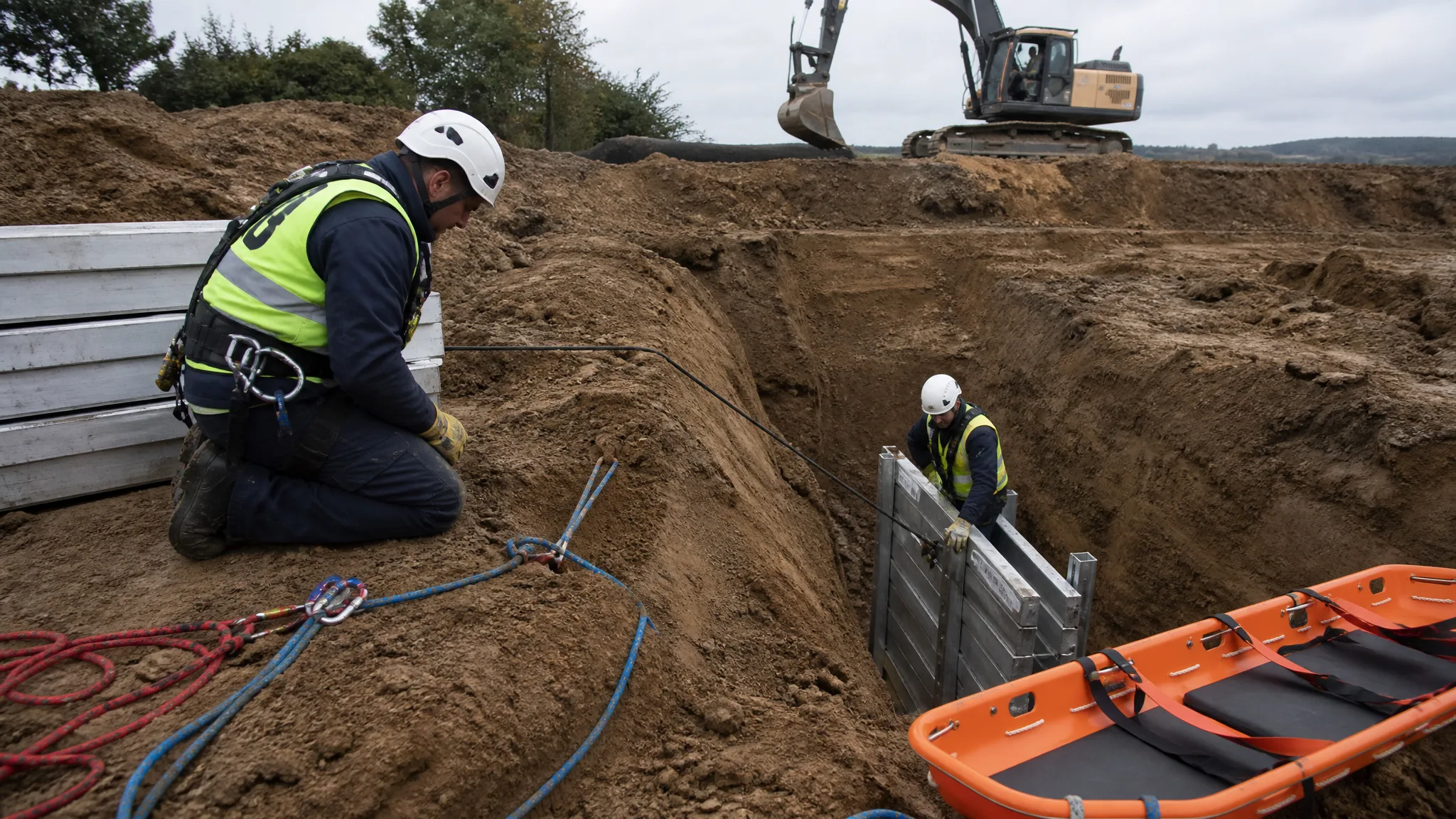
Technical rescue teams work from the outside in. The first priority is stabilizing the scene, which usually means cutting back or excavating the trench walls from the top to create the room to set trench panels or hydraulic shoring before anyone goes down. Nothing enters the hole until the hole is shored.
Digging is done with hand tools, buckets on ropes, and vacuum excavation rather than a machine bucket. A tracked excavator working at the lip of a collapsed trench is a vibration source and a secondary-collapse risk, and its bucket has no business near a person in a hole. Once the victim is exposed and shored, removal is usually by lifting harness or basket stretcher, with medics controlling the medical decisions.
Crush syndrome is the reason medical control matters. A person who has been pinned for any length of time can deteriorate rapidly after release, and the decision about how and when to extricate belongs to the medics, not the equipment operator.
Water, Atmosphere, and Utilities
Atmospheres in excavations are tested before entry when a hazardous atmosphere exists or could reasonably be expected, and OSHA requires testing before employees enter excavations deeper than four feet where oxygen deficiency or a hazardous atmosphere is possible. Sewer trenches, landfill areas, and pits near fuel storage are the obvious cases.
The standard also requires emergency rescue equipment — breathing apparatus, a safety harness and line, or a basket stretcher — to be readily available where hazardous atmospheres exist or may develop, and attended while in use. OSHA has been explicit in interpretation that a local rescue squad cannot substitute for that equipment, because the required response is measured in minutes or seconds, not in response time.
Water deserves its own line. The standard prohibits working in an excavation with accumulating water unless adequate precautions are taken, and water is also one of the most common triggers for the collapse itself. If the trench is taking water, that is a stop-work condition, not a nuisance to work around. The drainage and pumping side is covered in dewatering an excavation.
The Plan You Build Before the Dig
Every part of this response depends on decisions made before anyone breaks ground. NIOSH recommends a trench emergency action plan as part of pre-job planning, and the U.S. Army Corps of Engineers safety manual requires a rescue plan for excavations deeper than five feet that includes provisions for self-rescue and assisted rescue, along with the equipment to support it.
A usable plan is short and specific. It names who calls 911 and who meets the responding units at the gate. It lists the address, a GPS pin, the nearest trauma center, and the utility locate ticket number. It records the trench depth, the soil classification, and the protective system in use. It names the employees with current first aid and CPR training and identifies the equipment on site — ladders, shoring, retrieval lines, stretcher.
One step crews routinely skip: call the fire department before the job and ask whether they have trench rescue capability. Many departments do not, and the regional team that does may be well over an hour away. Knowing that in advance changes how you plan the dig, and it changes what you tell the 911 dispatcher. Utility locating belongs in the same pre-job conversation — calling 811 before you dig is the starting point, and what to do if you hit a utility line covers the strike itself.
Training and Drills
A competent person is the baseline for excavation work, not a rescue qualification. The role is defined in what a competent person in excavation actually does, and it covers soil classification, protective system selection, and the daily inspections that are supposed to catch a failing wall before it fails.
Technical rescue training is organized in levels — awareness, operations, and technician — under the NFPA standards for technical search and rescue. For a contractor, awareness-level training for supervisors and equipment operators is a realistic minimum: recognize the hazard, secure the scene, call for the right resource, and do not become a victim. Anything beyond that requires equipment and recurring practice, and a certification nobody drills is not a capability.
Run the drill at least once a year. Have someone call out a mock collapse and watch what the crew actually does. The gap between the written plan and the first two minutes of a real event is usually larger than anyone expects.
After the Incident
Preserve the scene. Move nothing except what is required to save a life, and photograph the trench, the spoil placement, the protective system, the equipment positions, and the weather conditions before anything is disturbed.
Reporting deadlines are short. Under OSHA's recordkeeping rule, an employer must report a work-related fatality within eight hours and an in-patient hospitalization within 24 hours. Notify the general contractor or owner, the utility owners if their facilities were involved, and your insurer, and keep a written timeline of who was notified and when.
Then investigate honestly. The useful questions are about the system, not the individual: was a protective system specified, was it installed as designed, was it inspected after the last rain, was the spoil back from the edge, and was there a ladder within 25 feet of lateral travel. A stand-down that revisits those questions is worth more than a memo about being careful.
What Prevents the Next One
The prevention list is short and unglamorous. Use a protective system on every trench five feet or deeper, and on shallower trenches where a competent person sees any sign of instability. Inspect before work starts, through the shift, and after every rainstorm.
Keep spoil and equipment back from the edge, provide a ladder within 25 feet of lateral travel in trenches four feet or deeper, and stop work when water starts accumulating. Those four habits account for most of the difference between a routine dig and a fatality report. The broader hazards are covered in the dangers of excavations and in why workers should not work in an unprotected trench.
None of that helps once the wall is down. What helps then is a crew that knows not to jump in, a phone call made in the first thirty seconds, and a trained team on the way. Build the plan before you need it, because the day you need it there will be no time to write one.