Choosing a Trench Protective System

Any worker in a trench deeper than 5 feet must be protected from cave-ins by an adequate protective system, and shallower trenches need one too when a competent person finds any indication of a potential cave-in. Under OSHA's excavation standard, 29 CFR 1926 Subpart P, contractors have four basic tools: sloping, benching, shoring, and shielding. The job is not to memorize the rules but to know which of those four fits the soil, the depth, the available space, and the work being done. Choosing the wrong one wastes money, and choosing none can kill someone.
The Rule That Sets Everything in Motion
Section 1926.652(a)(1) requires each employee in an excavation to be protected from cave-ins by an adequate protective system, with only two exceptions: the excavation is made entirely in stable rock, or it is less than 5 feet deep and a competent person finds no indication of a potential cave-in. Read that carefully, because the 5-foot mark is not a free pass for shallow work. A 4-foot trench cut through loose sand or saturated fill still needs protection if the competent person sees a cave-in hazard.
The standard also requires the system to have the capacity to resist, without failure, all loads that are intended or could reasonably be expected to act on it. That includes soil weight, water, vibration from traffic or nearby equipment, and surcharge from stored material or spoil. A trench is not a static condition; it changes as the day goes on and as the weather turns.
Two Families: Cut It Back or Hold It Back
Every method in the standard falls into one of two ideas. Sloping and benching remove soil so the wall no longer wants to fall, by cutting it back to a flatter angle or stepping it. Shoring and shielding hold the wall back with a structure that resists the pressure.
The definitions matter more than they look. OSHA defines sloping as forming sides inclined away from the excavation, benching as forming one or a series of horizontal levels or steps, shoring as a structure that supports the sides of the excavation, and a shield as a structure able to withstand the forces imposed by a cave-in and protect the employees inside it. Those last two sound similar but behave very differently, and confusing them is a common and serious error.
Sloping: The Simplest Method
Sloping is usually the fastest and cheapest route when there is room to work, because the machine that dug the trench is already sitting there. The catch is footprint: the flatter the angle, the wider the top of the excavation and the more right-of-way the job consumes.
Maximum allowable slopes come from soil classification in Table B-1 of Appendix B. Stable rock may be cut vertical (90 degrees). Type A soil is 3/4:1 (53 degrees), Type B is 1:1 (45 degrees), and Type C is 1½:1 (34 degrees). A short-term maximum of 1/2:1 (63 degrees) is allowed in Type A soil for excavations 12 feet deep or less that stay open 24 hours or less.
Two limits are easy to forget. The actual slope must be cut back at least an additional 1/2:1 flatter whenever there are signs of distress, such as fissures, sloughing, bulging, or material trickling off the face. And any sloping or benching for an excavation deeper than 20 feet must be designed by a registered professional engineer. If you are unsure where your soil falls, our guide to identifying soil types on a jobsite walks through the field tests, and trenching techniques for different soil types explains how each one behaves when cut.
Benching: Steps Instead of a Slope
Benching trades one long continuous slope for a series of steps, which can save space when the wall is stable enough to stand between levels. The standard allows benching only in Type A and Type B soil. Type C soil, the least stable, cannot be benched at all, because the vertical faces between steps are exactly what a Type C wall cannot hold.
Bench geometry is restricted too. A common field rule from OSHA's technical guidance is that the bottom vertical height of the first bench should not exceed 4 feet, with subsequent benches up to 5 feet vertical in Type A soil and 4 feet in Type B soil, to a total trench depth of 20 feet. Above 20 feet, benching needs an engineer's design. Layered soils add their own requirement, with the maximum slope set for each layer based on which soil types stack on which.
Shoring: Bracing the Sides
Shoring is active support that presses against the walls and holds them in place. It can be timber, mechanical, or aluminum hydraulic. Aluminum hydraulic shoring uses crossbraces against vertical uprights or horizontal wales and is designed specifically to support the sidewalls of an excavation and prevent cave-ins.
Timber shoring designs are drawn from Appendix C. Aluminum hydraulic shoring normally comes from the manufacturer's tabulated data, falling back to Appendix D only when that data cannot be used. Shoring is the right family when you cannot cut the walls back, such as tight right-of-way, a narrow street, or a wall that has to stay vertical against an existing utility or structure.
Shielding: Trench Boxes
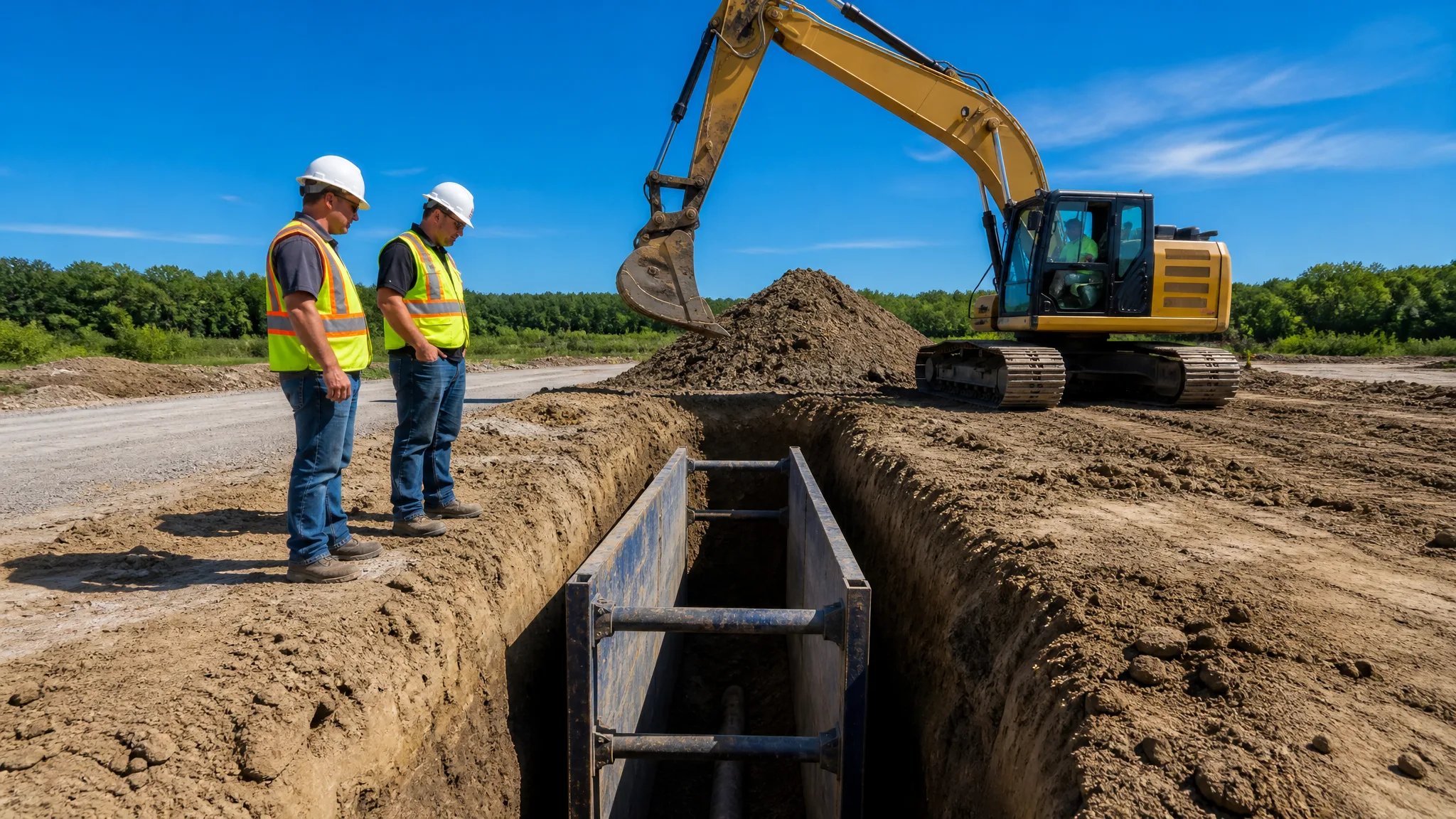
A shield is the familiar trench box, also called a trench shield: a structure built to withstand the forces of a cave-in and protect the employees inside it. It is portable and moved along as the trench advances. Unlike shoring, it does not stop the soil from moving; it catches the collapse and keeps the people inside the protected area safe.
That distinction has real consequences. A shield protects the employees inside it, not the utility line, foundation, or structure next to the trench. OSHA requires support systems for adjacent structures separately, so a trench box is never a substitute for shoring or underpinning a wall you are trying to hold up. Employees also must never be inside a shield while it is being installed, removed, or moved vertically.
Two field limits apply. Shields must be installed so they resist lateral or other hazardous movement under sudden lateral loads, and excavation may run no more than 2 feet below the bottom of a shield, only if the shield was designed for the full trench depth and there is no indication of soil loss from behind or below it.
Designs, Tabulated Data, and the 20-Foot Rule
Whichever method you choose, the design has to come from one of the options in 1926.652(b) or (c). For sloping and benching, that means an allowable configuration, Appendices A and B, tabulated data, or an engineer's design. For support and shield systems, it means Appendices A, C, and D, the manufacturer's tabulated data, third-party tabulated data, or an engineer.
Tabulated data is not a loose suggestion. It must be in writing, identify the parameters that affect selection and the limits of use, and, when it is a third-party table, name the registered professional engineer who approved it. A copy must be kept at the jobsite while the system is being built. Any trench 20 feet or deeper requires a shield designed by a registered professional engineer or based on RPE-approved tabulated data.
Matching the System to the Job
The choice is a practical trade-off, not just a code checkbox. Sloping is fast but eats space. Benching also needs width, plus soil stable enough to hold vertical faces. Shoring and shielding fit tight quarters but cost more in equipment, labor, and handling time.
Soil type is the first filter because it caps what is allowed. Depth is the second because it drives the load and the 20-foot design threshold. Water is the third: seeping or standing water usually pushes a soil down to Type C classification, which removes benching and flattens the required slope. Utility crossings change the plan too, which is why jobs like excavating for water and sewer lines often need a system chosen before the first bucket of dirt moves.
Installation, Use, and Removal Basics
Support and shield systems must be installed and removed in a way that protects employees from cave-ins, structural collapse, and being struck by members of the system. Members must be securely connected to prevent sliding, falling, kickouts, or other predictable failure, and removal begins at the bottom and progresses upward, releasing members slowly so the crew can watch for movement.
Backfilling should progress together with removal so the wall is never left unsupported. Install a support system in step with the digging rather than opening a long, unprotected trench and trying to catch up later. Keep spoil piles and equipment at least 2 feet back from the edge to control surcharge and falling material, the way our guide on how far spoil piles and equipment must be kept from an excavation explains. When groundwater is the problem, pair the protective system with a plan for dewatering the excavation.
Common Mistakes
Most failures are not exotic. They come from a handful of repeated shortcuts, and they show up in the same places where trenches typically go wrong, as we cover in where an excavation typically fails and avoiding common mistakes in trench excavation.
- Benching Type C soil, which the standard does not allow.
- Treating a trench box as shoring for an adjacent structure or utility.
- Standing outside the shield's protected area, or riding it during vertical moves.
- Cutting the slope exactly at the maximum with no allowance for distress or surcharge.
- Digging deeper than 2 feet below the bottom of a shield.
- Letting spoil or equipment crowd the edge and load the wall.
- Not keeping the tabulated data or engineer's design on site.
Where the Competent Person Comes In
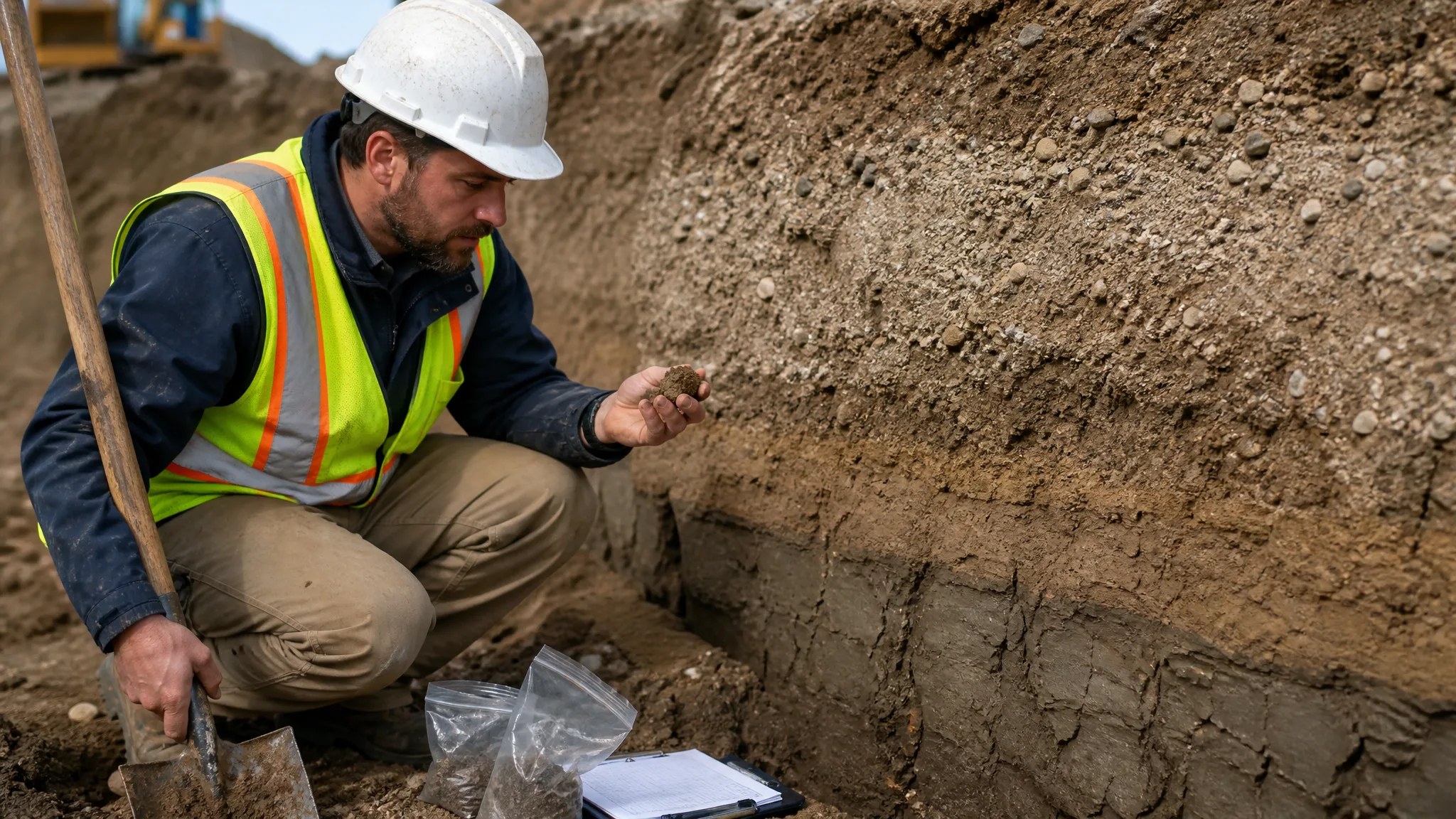
Every one of these decisions starts with soil classification and continues with daily inspection. The competent person classifies the soil, determines the protective system, inspects the excavation and adjacent areas before work and throughout the shift, and re-checks after every rainstorm or other hazard-increasing event.
That person also has to have the authority to stop the work and get employees out of the excavation until precautions are in place. Without that authority, the title is empty. For the full picture of the role, see our guide on what a competent person in excavation does, and for the rule that decides when any of this kicks in, start with when trench protection is required. When in doubt, remember the plain logic behind why no worker should be in an unprotected trench: a cubic yard of soil weighs more than a ton, and a cave-in gives no warning.