When Is Trench Protection Required?


Every utility trench, water line, and drainage run starts the same way: an excavator cuts a narrow hole in the ground, and someone eventually has to climb into it. That is exactly when the question matters — when is trench protection legally required? Under the federal construction standard (29 CFR 1926 Subpart P), the answer is anchored to a 5-foot threshold, but soil type, water, and depth all move the requirements. Here is how to know when you must slope, shore, or shield an excavation before anyone goes in.
The 5-foot rule, explained
OSHA's cave-in protection requirement is clear: every employee in an excavation must be protected from cave-ins by an adequate protective system unless the excavation is made entirely in stable rock, or it is less than 5 feet deep and a competent person has examined the ground and found no indication of a potential cave-in. In practice, that means any trench 5 feet or deeper needs sloping, benching, shoring, or shielding before workers enter.
Do not treat the 5-foot mark as a free pass on shallower work. If a 4-foot trench shows tension cracks, seepage, or previously disturbed soil, a competent person can require protection at any depth. The 5-foot line is the default trigger, not a guarantee of safety above it.
What counts as a trench
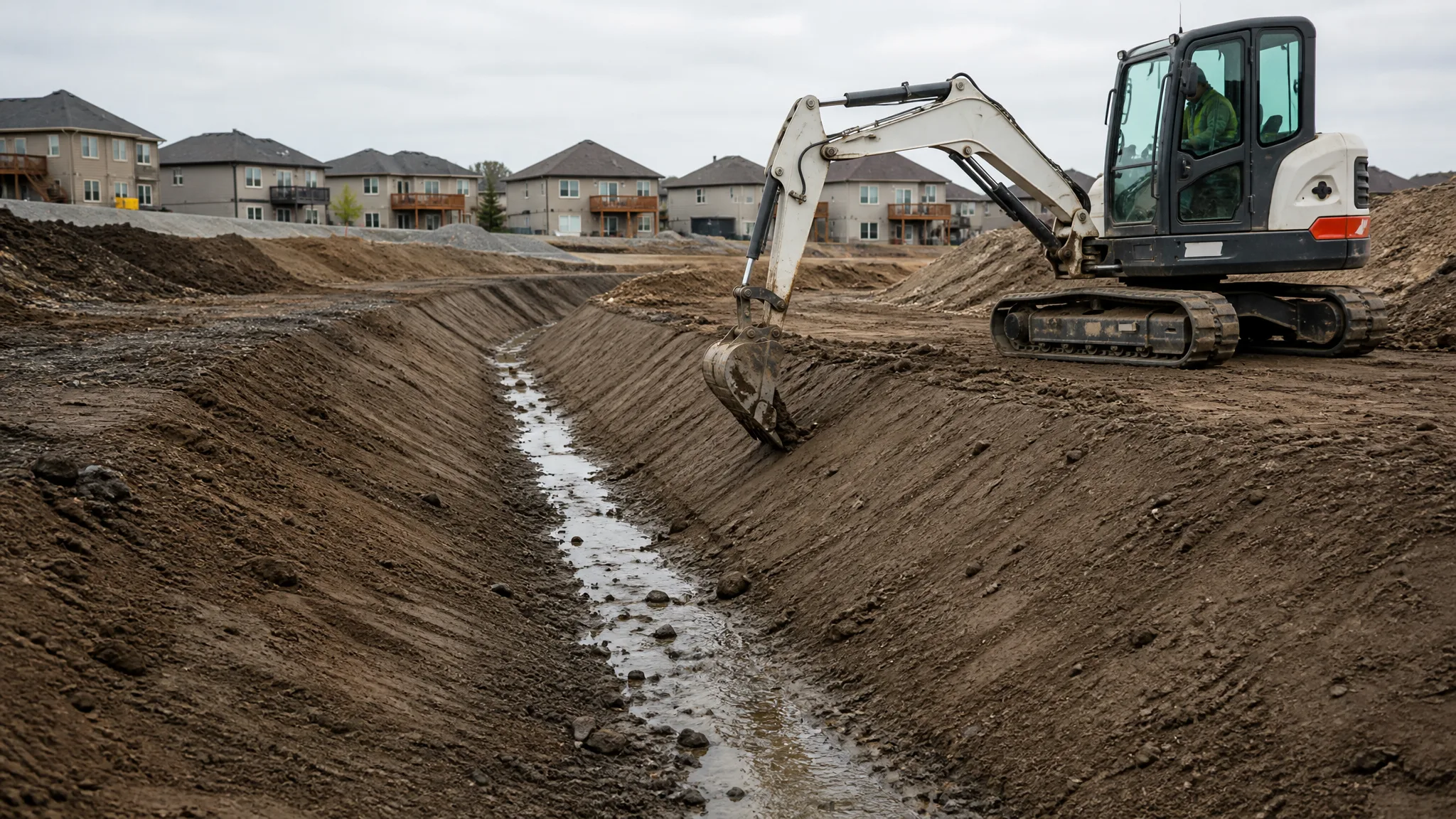
OSHA defines a trench as a narrow excavation made below the surface, where the depth is generally greater than the width and the width at the bottom is not greater than 15 feet. Pipe runs for water, sewer, storm drainage, and utilities are the classic examples — and they are where most trench fatalities happen.
Openings wider than 15 feet at the bottom are simply called excavations, but the cave-in protection rule still applies to every employee in them. A wide basement dig, a bell-bottom pier hole, or a buried tank excavation all fall under the same Subpart P umbrella. If you are unsure whether your hole qualifies as a trench, treat it like one — the consequences of guessing wrong are fatal.
Slope, shore, or shield: the three protection methods
OSHA recognizes three families of protective systems. Sloping cuts the walls back to a safe angle so the soil cannot collapse into the hole; benching is a variation that forms horizontal steps in the walls. Both need room to work — you cannot slope a trench squeezed between a road and a building.
Shoring supports the walls with structures such as timber bracing or aluminum hydraulic shores. Shielding — usually a steel trench box — does not support the walls; it protects workers inside the box when the walls let go. Pipe crews favor trench boxes because the box can be dragged along as the pipe is laid, and the workers stay inside protected space the whole time.
Soil classification comes first
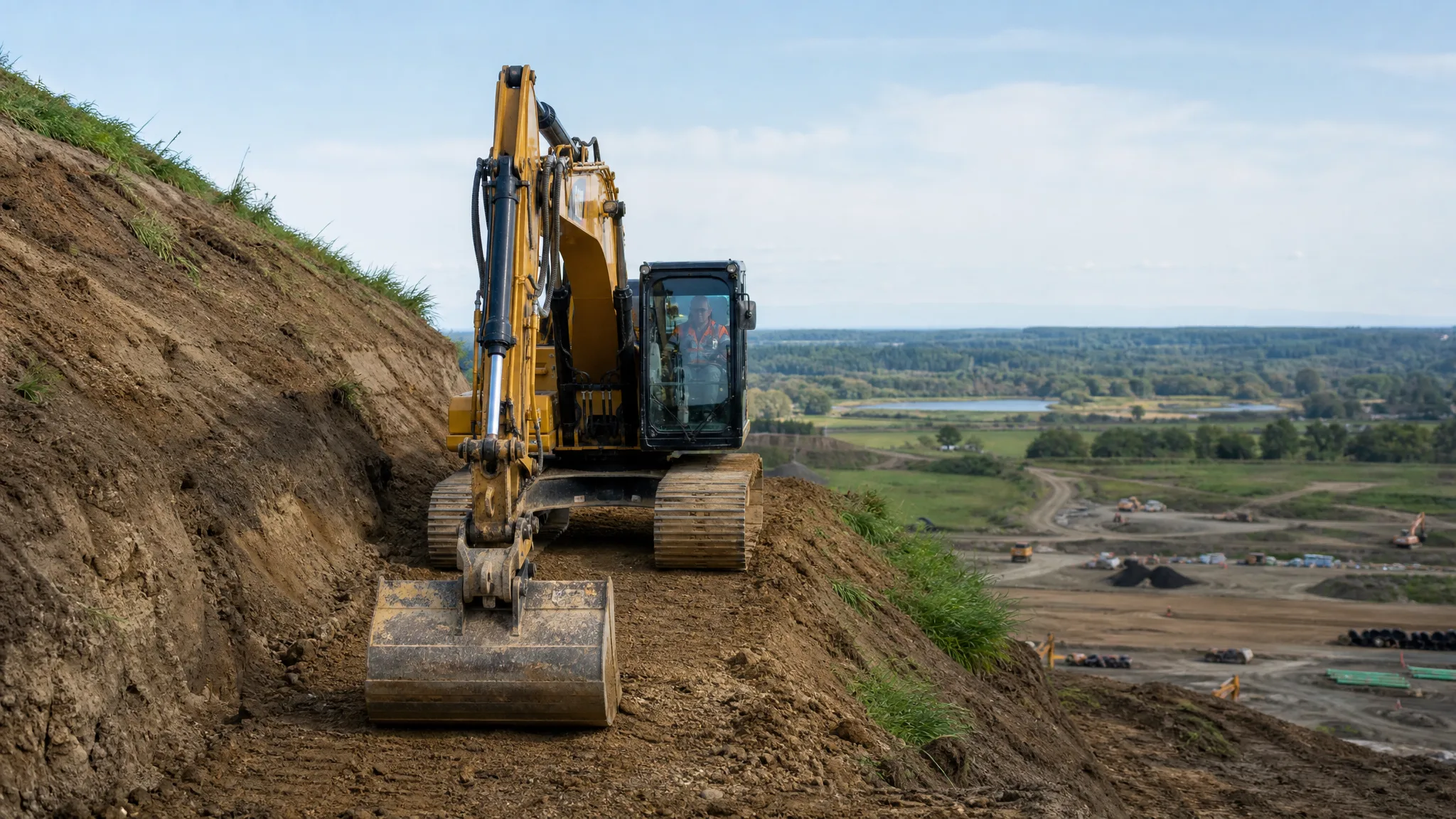
Before choosing a slope angle or a shoring system, a competent person must classify the soil — the same exercise that drives how crews dig trenches in different ground in the first place. The categories, in order of stability, are stable rock, Type A, Type B, and Type C. Type A is cohesive soil with an unconfined compressive strength of 1.5 tons per square foot or greater — clays, silty clay, sandy clay, and cemented soils like caliche. But no soil qualifies as Type A if it is fissured, previously disturbed, subject to vibration, or layered so that layers dip into the excavation at 4 horizontal to 1 vertical or steeper.
Type B covers cohesive soils between 0.5 and 1.5 tsf, plus granular soils such as angular gravel, silt, and sandy loam, along with disturbed soils that do not classify as Type C. Type C is the least stable: cohesive soil at 0.5 tsf or less, granular soils like sand and loamy sand, submerged soil, or soil from which water is freely seeping. The classification must be based on at least one visual and one manual test — a thumb penetration test, a plasticity thread test, or a pocket penetrometer — and it must be redone when conditions change, such as after rain saturates the ground.
Maximum allowable slopes by soil type
Once the soil is classified, the maximum allowable slope comes straight from the regulation. Stable rock may stand vertical. Type A soil can be cut at 3/4 horizontal to 1 vertical, about 53 degrees from horizontal. Type B requires 1:1, or 45 degrees. Type C requires the flattest cut at 1.5 to 1, about 34 degrees. There is also a short-term allowance for Type A: excavations open 24 hours or less and no deeper than 12 feet may be cut at a steeper 1/2:1, about 63 degrees.
If the soil has not been classified at all, the standard's default option is to slope every excavation at the Type C angle of 1.5 to 1. Benching is only allowed in the configurations spelled out for Type A and Type B soils — OSHA's tables do not permit benching in Type C, which is exactly the soil where crews are tempted to cut steps. When walls must be vertical, as they often are over the pipe, the lower vertical portion has to be shielded or supported, with the system extending at least 18 inches above the top of the vertical side.
Shoring and shielding: when the trench box comes out
Support and shield systems must be designed for the depth and soil they face. OSHA allows four design routes: timber shoring built to the standard's appendix tables, aluminum hydraulic shoring to its appendix, any system built to manufacturer's tabulated data, or a design by a registered professional engineer. That tabulated data must be kept at the jobsite while the system is in use, and any deviation from the manufacturer's specs requires written approval.
Trench boxes earn their keep during pipe installation, but crews misuse them in predictable ways. Workers may not ride in a shield while it is being installed, removed, or moved vertically, and the excavation may not extend more than 2 feet below the bottom of a shield or support system unless the system was designed for the full depth. A box that stops short of the pipe depth is worse than no box at all, because crews believe they are protected when they are not.
Deeper than 20 feet: the engineer's rule
There is a second depth line contractors must know: 20 feet. Sloping and benching for excavations greater than 20 feet deep must be designed by a registered professional engineer — the slope tables in the standard simply do not apply beyond that depth. The same standard applies to support and shield systems that fall outside the approved options: they need an engineer's design or engineer-approved tabulated data.
Deep sewer drops, lift stations, and shafts routinely cross this line. If a project plan calls for anything beyond about 20 feet, budget for engineered design early; an engineer cannot approve the system after the hole is already open.
The daily checklist that keeps crews legal
Protection on paper means nothing without daily enforcement. A competent person must inspect the excavation, the adjacent area, and the protective system before work starts each shift, as needed through the shift, and after every rainstorm or other hazard-increasing event. If the inspection finds a cave-in hazard or failing system, exposed workers must be removed until conditions are corrected.
The supporting rules matter just as much. Trenches 4 feet or deeper need a ladder, ramp, or stairway within 25 feet of lateral travel. Spoil piles and equipment must sit at least 2 feet back from the edge, and the spoil itself needs a placement plan before the first bucket swings. Underground utilities must be located before digging — contact the utility owners, and if they cannot respond within 24 hours you may proceed only with caution and detection equipment. Surface water must be diverted away from the opening, accumulated water must be controlled and monitored, and excavation below the footing line of an adjacent foundation or retaining wall is off-limits without shoring, underpinning, or an engineer's approval. Workers must also stay clear of suspended loads, wear high-visibility gear when exposed to traffic, and use walkways with guardrails when crossing an open cut.
Common ways crews get it wrong
The same mistakes show up on jobsites year after year. Crews classify disturbed backfill as Type A because it looks like clay. They dig in wet ground and never reinspect after a storm. They park the spoil pile on the edge because the site is tight. They set the ladder 40 feet down the trench. They pull a trench box that is too short for the pipe depth, or they climb in and out of the box while the excavator is lifting it.
Each of those shortcuts has the same root cause: treating the 5-foot rule as a paperwork line instead of a physical reality. Soil that stood vertical yesterday can run like water today after rain — which is why the competent person's daily inspection, not last week's plan, is the real safety system on every trench job.
Know the rules before the first bucket
Trench protection is not complicated, but it is unforgiving. Memorize the triggers: 5 feet for cave-in protection, 4 feet for ladders, 2 feet for spoil setbacks, and 20 feet for engineered design. Then make soil classification and daily inspection habits, not exceptions.
For the full picture on why unprotected trenches are so dangerous, read our breakdown of why workers should not work in an unprotected trench and the dangers of excavations. Crews running pipe should study common mistakes in trench excavation and how far spoil piles and equipment must be kept from the edge. If you are excavating a buried tank or utility trench on a residential lot, our guide to excavating for a septic system walks through the same rules on a real project — and crews working around buildings should review how excavation contractors work safely near existing foundations.