What Is a Competent Person in Excavation?


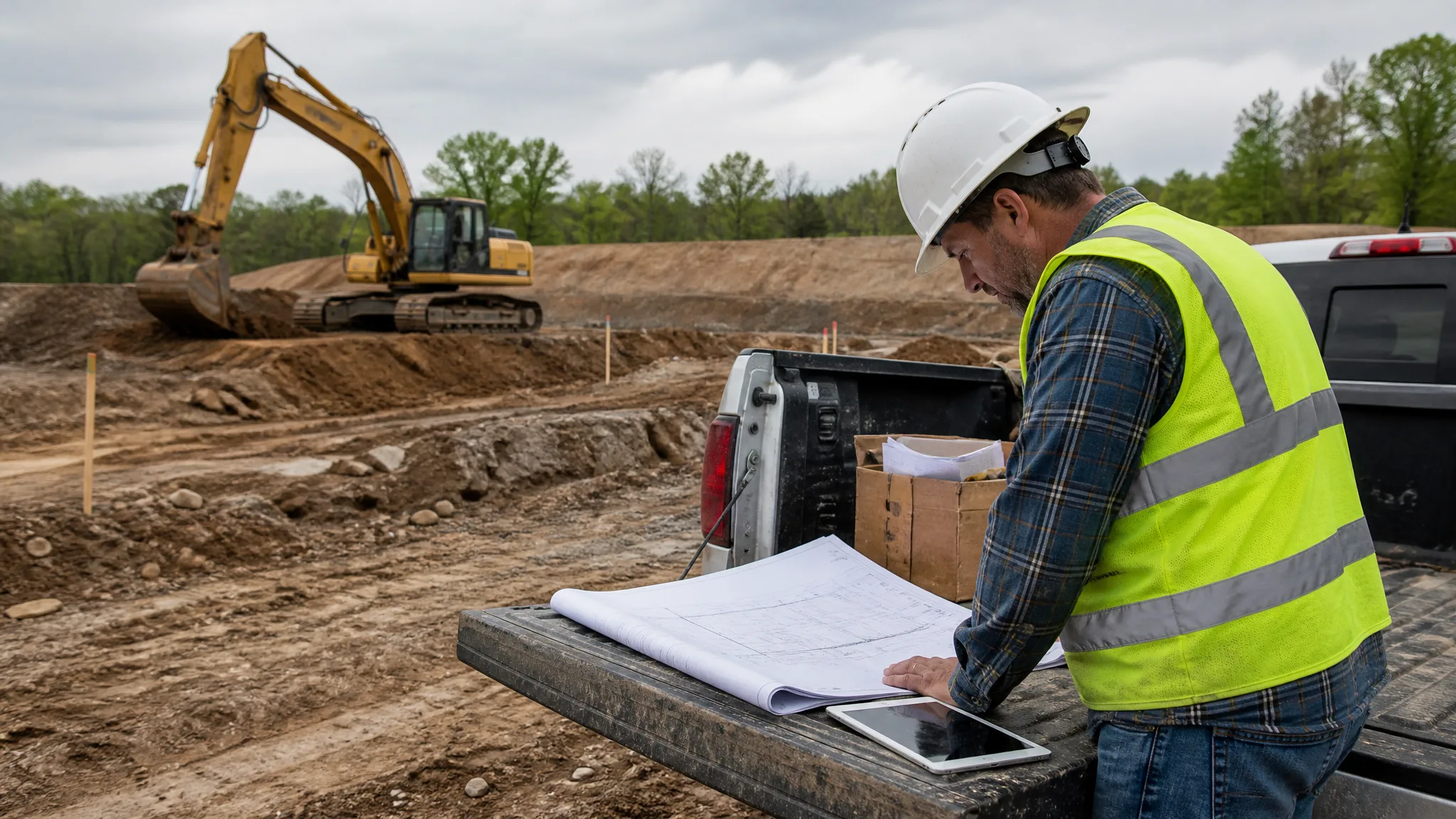
Every excavation rule in OSHA's construction standards leans on the same role: the competent person. The term sounds formal, but the definition is deliberately practical. A competent person is someone who can recognize the hazards that already exist or can reasonably be predicted on a dig, and who has the authority to correct them on the spot. In excavation work, that pairing of judgment and authority is the difference between a near miss and a fatality.
OSHA's Definition of a Competent Person
The excavation standard defines a competent person as "one who is capable of identifying existing and predictable hazards in the surroundings, or working conditions which are unsanitary, hazardous, or dangerous to employees, and who has authorization to take prompt corrective measures to eliminate them" (29 CFR 1926.650(b)).
Two parts of that definition matter equally. The person has to be genuinely capable of spotting excavation hazards — which takes training, experience, and judgment, not just a title. And the person has to hold real authorization to act, including the power to stop work and pull people out. A supervisor who can identify a bad slope but cannot halt the crew is not a competent person under the standard.
The role is not unique to excavations. Other construction standards name a competent person for scaffolds, fall protection, cranes, and more. On a digging site, the excavation competent person is the one who owns cave-in prevention, soil classification, and protective system decisions.
Why Excavation Work Depends on This Role
Trenching and excavation is among the most hazardous work in construction, and the hazards are not always visible. A trench wall that looks fine can be a wedge waiting to move. Groundwater can change the soil from cohesive to running in a shift. A spoil pile set too close to the edge adds a surcharge the wall cannot carry.
Because conditions change hour to hour, the standard does not rely on a one-time engineered answer alone. It relies on a trained person inspecting the dig repeatedly and adjusting the protection as the ground, the weather, and the work change. That is why the competent person appears throughout Subpart P, not in one clause.
Soil Classification Is a Competent Person's Job
Choosing protective systems starts with the soil. Under 29 CFR 1926 Subpart P Appendix A, the competent person classifies soil and rock deposits — Type A, Type B, Type C, or stable rock — using both visual analysis and manual tests. The classification then sets the maximum allowable slope or drives the shoring, shielding, or benching decision.
Classification is not a one-time label. The standard expects the competent person to re-classify when conditions change. A dry Type B clay that takes on water, a wall that develops fissures, or ground near vibration and heavy traffic can all move a deposit to a more conservative type. Knowing the slope limits for each type, and the conditions that force a downgrade, is core knowledge for the role. The mechanics of digging by ground condition are covered further in trenching techniques for different soil types.
Choosing and Inspecting Protective Systems
The competent person determines whether a cave-in is possible and, if so, what protection is required (29 CFR 1926.652(a)(1)). That can be sloping, benching, shoring, or a shield such as a trench box. Where tabulated data or manufacturer instructions govern a system, the person has to follow them.
The role also includes examining material and equipment used for protective systems — damaged trench boxes, cracked shoring members, worn hydraulic cylinders — and deciding whether they are still suitable for use (29 CFR 1926.652(d)(3)). Damaged protective equipment that is put back in a trench is a common and preventable failure. Dirt that is added as fill around a system has its own rules; see excavating for a basement for how working space and overdig affect these decisions.
Daily Inspections: When, Where, and How Often
The inspection duty is specific. Under 29 CFR 1926.651(k)(1), daily inspections of the excavation, the adjacent areas, and the protective systems must be made by a competent person for evidence of possible cave-ins, failure of protective systems, hazardous atmospheres, or other hazardous conditions.
The standard sets the timing clearly:
- An inspection before the start of work and as needed throughout the shift.
- An inspection after every rainstorm or other hazard-increasing occurrence.
- Inspections only where employee exposure can reasonably be anticipated.
A post-storm inspection is the one crews most often skip, and it is one of the most important. Water changes the soil, undercuts slopes, and can fill a trench that was safe the day before. The same logic applies to winter work, where freezing and thawing change how the ground behaves — see cold weather earthwork.
The Authority to Stop Work
Inspection without authority is theater. Under 29 CFR 1926.651(k)(2), when the competent person finds evidence of a situation that could result in a possible cave-in, failure of protective systems, hazardous atmospheres, or other hazardous conditions, exposed employees must be removed from the hazardous area until the necessary precautions are taken.
That is the second half of the definition doing its work. The competent person's correction can be nothing more than ordering everyone out and rebuilding the protection. A crew that understands that call is never overridden by production pressure is a crew that goes home whole.
Water, Weather, and Changing Conditions
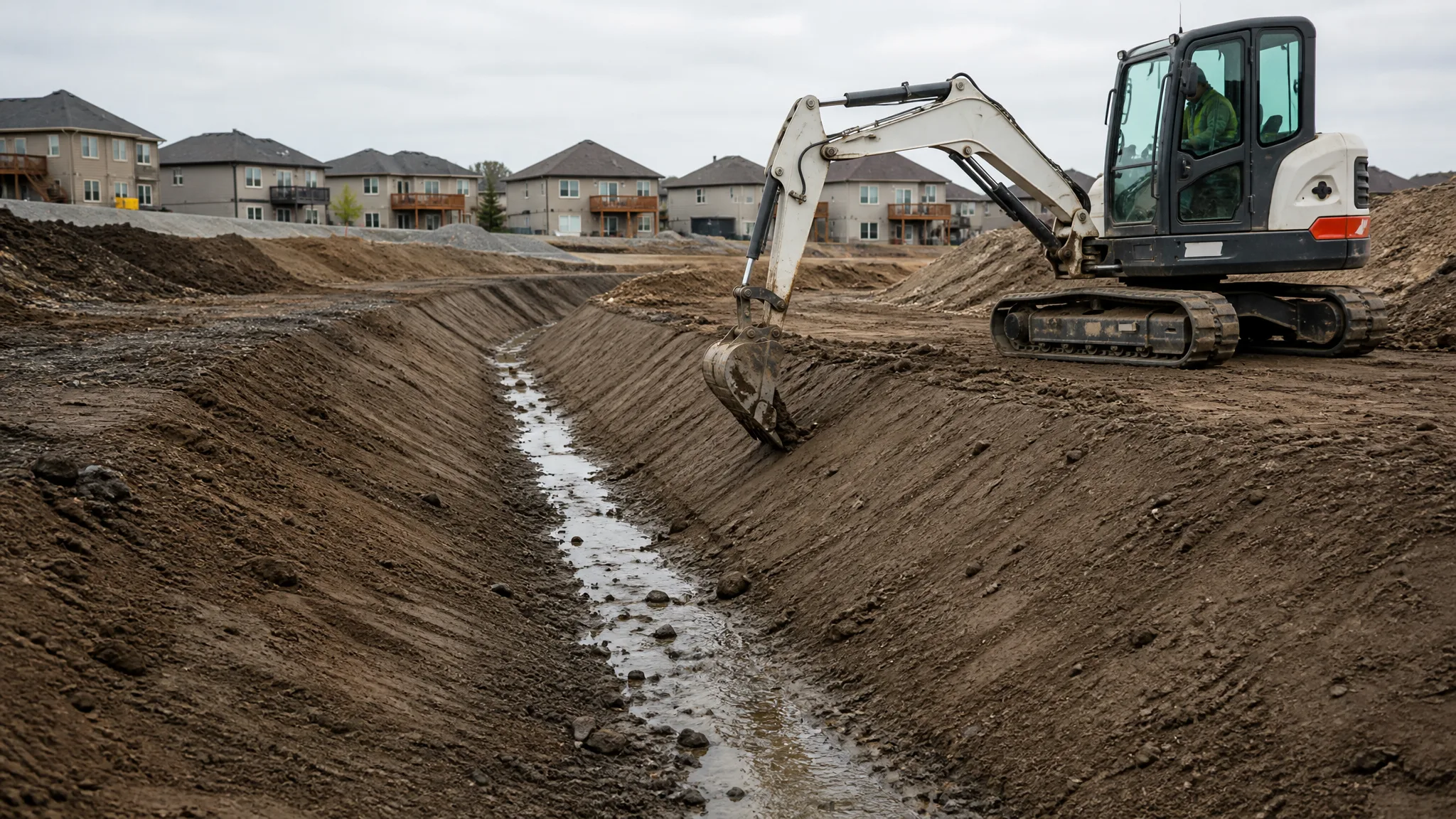
Water accumulation gets its own competent person duties. Where water is controlled by removal equipment such as pumps, the equipment and the operation must be monitored by a competent person to ensure they are working properly (29 CFR 1926.651(h)(2)). Excavations subject to runoff from heavy rain require an inspection and compliance with the water-protection rules (29 CFR 1926.651(h)(3)).
Where an excavation interrupts natural drainage, diversion ditches, dikes, or other means are used to keep surface water out. The full playbook for drying and controlling a wet dig is in dewatering an excavation.
Adjacent Structures, Traffic, and Surcharge
The competent person also watches what is happening around the hole. Where adjoining buildings, walls, or structures are endangered, support systems such as shoring, bracing, or underpinning must be provided (29 CFR 1926.651(i)). Excavating below the level of a footing or retaining wall is generally prohibited unless a support system is in place, the ground is stable rock, or a registered professional engineer has approved the situation as safe.
Surcharge loads — from stored material, equipment, adjacent structures, or traffic — affect the slope a wall needs. Appendix B to Subpart P has the competent person determine the appropriate slope to prevent collapse from those loads. Where mobile equipment works near the edge without a clear view of it, a warning system such as barricades, signals, or stop logs is required (29 CFR 1926.651(f)). Excavating next to an occupied structure carries its own precautions, covered in working safely near existing foundations.
Access, Egress, and Structural Ramps
Ramps and egress are inspections too. Structural ramps used only by employees for access or egress must be designed by a competent person, and ramps used by equipment must be designed by a competent person qualified in structural design (29 CFR 1926.651(c)(1)(i)). Trench excavations 4 feet or deeper must have a safe means of egress — a ladder, stairway, or ramp — within 25 feet of lateral travel for employees (29 CFR 1926.651(c)(2)).
These are the small, structural details that turn a safe-looking trench into a trap when a worker cannot get out quickly.
Training, Designation, and Documentation
OSHA sets no specific course or card for this role. It does require the employer to instruct each employee in recognizing and avoiding unsafe conditions (29 CFR 1926.21(b)(2)), and it expects the competent person to have demonstrated capability with the specific hazards. Industry training such as the OSHA 3015 excavation and soil mechanics course is a common way to build that capability, but the standard's test is ability and authority, not a certificate.
Two practical points follow. First, an OSHA interpretation (1992) confirms there is no blanket rule that a competent person must be on site at all times; the person must make the required inspections and ensure corrective measures are taken, with presence driven by the conditions at that site. Second, good contractors document the role — who is designated, what they inspected, and when — because an inspection log is also the record that shows the duty was met. Hazard reporting that starts before the dig, such as calling 811 before you dig and pre-task planning, works best when the competent person owns it end to end.
The Bottom Line
The excavation competent person is not a formality to fill in on a checklist. The role is the standard's front line against cave-ins, and it only works when the person on the ground has both the knowledge to see a problem and the authority to stop the job for it. Contractors who designate the role deliberately, train it, back it with documentation, and never override it are doing the single most effective thing they can to keep digging crews safe. For the protection thresholds the role applies, start with when trench protection is required and the essentials of excavation safety.