Dewatering an Excavation


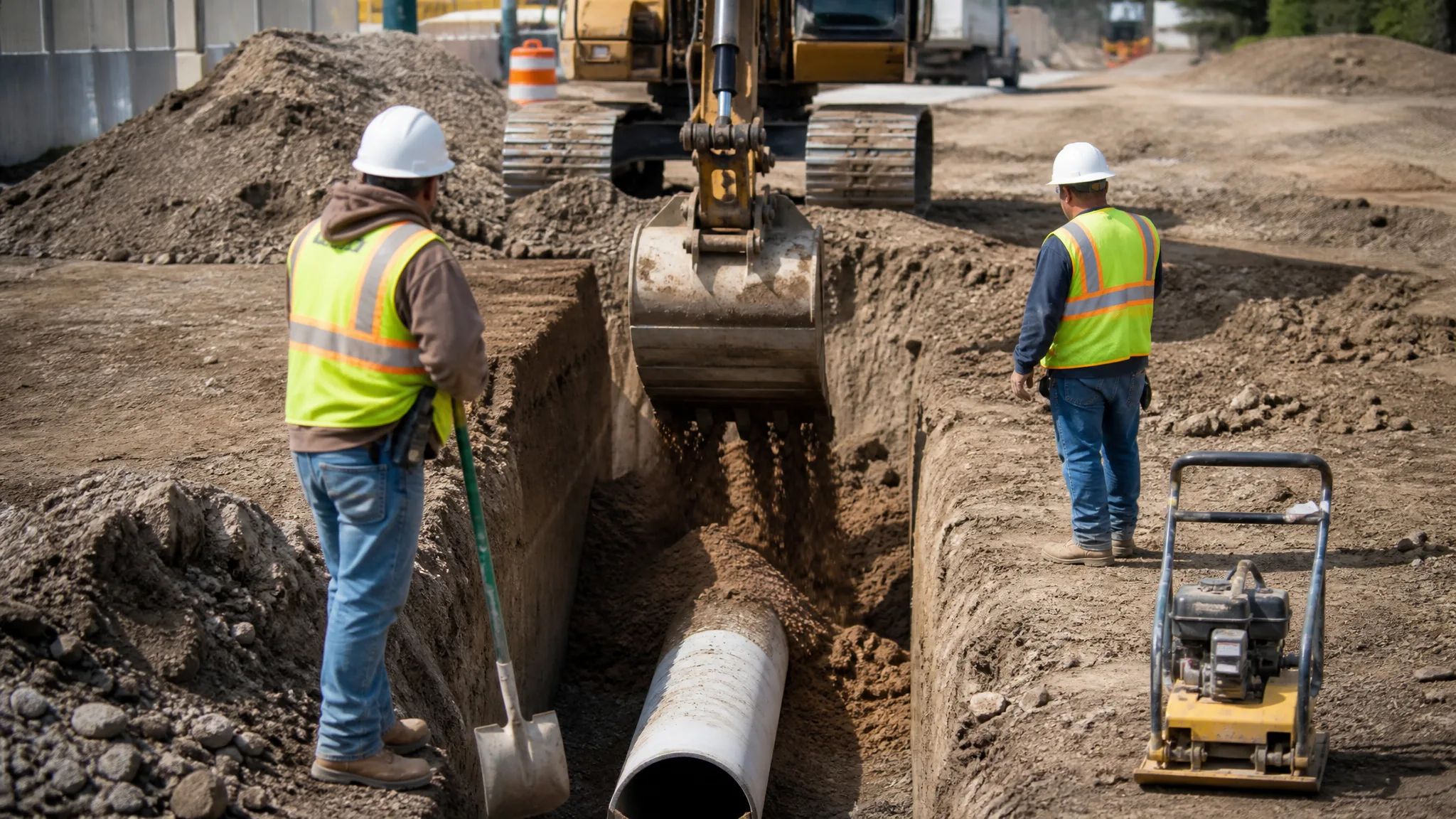
Few things stop an excavation job faster than water. A little seepage turns a solid floor into mud, mud turns into soft footing, and before long the crew is either fighting sloughing walls, waiting for the hole to dry, or pulling a machine out of the muck. Dewatering — controlling groundwater and surface water around and inside an excavation — deserves attention before the first bucket ever swings, because it drives safety, slope stability, compaction, and the schedule all at once. Here is how contractors think about it, the methods they actually use, and the rules that keep wet work from turning dangerous.
Why Water Changes Everything on an Excavation
Water does two kinds of damage to an open excavation. First, it attacks the soil. Saturated soil loses shear strength: trench walls that stood fine in dry ground start sloughing and caving, and the floor turns to a soup that will not hold equipment or compaction. Second, it attacks the work. Wet fill cannot be compacted properly, and a hole that keeps flooding eats hours of pump time and crew time that nobody priced into the bid.
That is why dewatering is a planning conversation, not a reaction. The contractor who knows the water is coming — and has a method ready — keeps the floor dry, the walls stable, and the schedule intact. The one who reacts usually pays for it twice.
Know the Water Before You Dig
Good dewatering starts with good reconnaissance. Pre-construction soil reports and borings reveal the soil types and where the water table sits, and nearby wells, ponds, creeks, and drainage patterns hint at how the groundwater behaves through the seasons. Springs and seeps on the surface, damp basements in neighboring buildings, and even the depth of nearby water wells are all clues an experienced estimator reads before setting a price.
This is the same due diligence that drives every other excavation decision — assessing the risks and mapping what is under the site before opening the ground. A site with a shallow water table and sandy soils is a completely different job than dry clay, and the dewatering method has to match the ground, not the calendar. For more on pre-dig investigation, see our guides to pre-construction planning and risk assessment, subsurface mapping, and how hydrology shapes excavation and grading.
What OSHA Requires Around Water
Water is not just a production problem — it is a regulated safety hazard. Under OSHA's excavation standard (29 CFR 1926 Subpart P), employees may not work in an excavation where water has accumulated or is accumulating unless adequate precautions have been taken. Those precautions can include support or shield systems against cave-ins, water removal to control the level of accumulating water, or a safety harness and lifeline. When pumps or other water-removal equipment are used, a competent person must monitor them to make sure they keep working properly.
The standard also requires contractors to handle surface water: if an excavation interrupts the natural drainage of surface water such as streams, diversion ditches, dikes, or other suitable means must keep that water out of the hole and drain the area around it. Excavations subject to runoff from heavy rain must be inspected by a competent person — and the daily inspection rules require another look after every rainstorm. Wet walls change the cave-in risk too, which is exactly why soil classification and trench protection requirements matter more when water shows up. For a broader refresher on the hazards, see advanced excavation safety practices.
Keep Surface Water Out First
The cheapest water to control is the water that never reaches the excavation. Before any pumping starts, the smart play is to divert: a diversion ditch or berm on the uphill side of the hole, grading that sheds water away from the work, and ditches that carry runoff to a low point or sediment trap instead of into the excavation. If the dig interrupts a natural drainage path, that diversion is an OSHA requirement, not an option.
Good housekeeping around the hole matters just as much. Spoil piles should be shaped and placed so they shed water rather than funnel it, and open excavations should be protected against the afternoon storm that always seems to find them. Perimeter erosion controls and inlet protection keep the site from exporting mud even before the pumps turn on. The same principles apply to drainage systems during excavation, spoil pile management, and the jobsite handoff that comes later.
Sump Pumping: The Workhorse Method
For shallow excavations with modest water inflow, sump pumping is the simplest and most economical answer. The crew digs a sump — a small pit sunk below the floor of the excavation, usually in a corner or low spot — and sets a submersible or centrifugal trash pump in it. Water drains to the sump, and the pump lifts it out through a discharge hose to a settling area away from the hole.
Sump pumping works well when inflow is manageable and the floor can tolerate a little water. It has real limits, though. In fine sands and silts, aggressive open pumping can create "boiling" at the bottom — water flowing upward through the soil, carrying sand with it and undermining the floor and the walls. And pumping from inside the hole does nothing to keep the surrounding ground from saturating, so walls above the water level can still soften and slough. When water is that active, contractors switch from removing water to lowering the water table itself.
Wellpoints: Lower the Water Before You Dig
When an excavation must go below the water table and stay dry and stable — common for deep basements, utilities, pump stations, and footings in sand or gravel — wellpoints are the standard tool. A wellpoint system is a ring of small-diameter screened pipes jetted into the ground around the excavation, connected by a header pipe to a vacuum-assisted pump. The pump pulls water through the screens, lowering the water table in a cone of depression around the site before digging even starts.
Wellpoints are typically spaced several feet apart around the perimeter, and a single stage commonly lowers groundwater on the order of 15 feet. Dig deeper than that and the system needs a second stage, or the job moves to deeper wells. Because the water is pulled down evenly instead of pumped out of a hole in the floor, the excavation floor stays firm and the walls keep their strength — which is exactly the soil behavior the trench protection rules are built around.
Deep Wells and Eductor Systems for the Big Jobs
Large excavations, deep shafts, and sites with high-yield aquifers outgrow wellpoints. Deep wells are drilled around the site and fitted with submersible pumps that draw from far below the excavation, creating a deep, wide drawdown that keeps big holes dry. Eductor (or ejector) wells use high-pressure water to lift groundwater from great depths and are used where drawdowns are very deep or yields are low.
These systems are engineered work — well spacing, pumping rates, and filter pack design come from groundwater specialists, not guesswork. For most residential and light commercial jobs they are overkill, but when a project needs them, they are usually subcontracted to a dewatering company that designs, installs, and monitors the whole system.
What Pumping Does to the Ground Around You
Every gallon a dewatering system removes comes from somewhere, and lowering the water table has consequences beyond the hole. The drawdown extends outward from the site, and in soft, compressible soils — silts, soft clays, and peat — removing water can cause the ground to consolidate and settle. That is how dewatering near a building can crack a foundation or drop a sidewalk, even when no excavation ever touched the structure.
On sensitive sites, contractors monitor settlement with survey points and crack gauges, and engineers may specify recharge wells, slurry walls, or sheet piling to limit the reach of the drawdown. If you are digging next to an occupied building, assume the neighbor's foundation is watching — the same precautions that protect structures near excavations apply to the dewatering system too.
You Cannot Pump Mud Straight Into the Ditch
The water that comes out of an excavation is usually dirty — sediment-laden and full of the fines the crew just spent all day trying to keep out of the hole. Pumping that water straight into a storm drain, ditch, or stream is an erosion-control violation and a fast way to earn a stop-work order. Discharge has to be treated before it leaves the site, typically by routing it to a sediment basin, settling pond, dewatering bag, or filter device, or across a vegetated buffer that settles the solids out.
Where a project disturbs an acre or more, the federal Construction General Permit and its stormwater pollution prevention plan (SWPPP) govern the site, and most states apply similar rules to smaller sites. Dewatering discharge requirements vary by permit and location, so the operator's job is simple in principle: settle the sediment, keep the turbid water on site, and never let mud reach the drainage system. The erosion-control measures that protect a site — silt fence, inlet protection, stabilized exits — are covered in our spoil pile and erosion control guide.
When the Site Stays Wet Anyway
No dewatering plan survives contact with a hundred-year rain, and some sites simply will not dry out. When the ground stays saturated, contractors stabilize the work instead of fighting it: granular working platforms and stone haul roads carry equipment across soft ground, mats spread the load under machines, and crews watch for the classic signs of a machine about to sink. Wet fill is un-compactable fill, so moisture management matters at both ends — see how wet is too wet to compact soil and why equipment gets stuck in mud for the full story.
Dewatering is rarely glamorous, but it is almost always the difference between a job that flows and a job that floods. Plan for the water, match the method to the ground, treat the discharge, and watch the ground around you — do those four things and a wet site is just another excavation.