Trenching for Underground Electrical Lines

Running power to a shed, a detached garage, a gate, or a landscape lighting loop almost always starts the same way: you dig a trench. But an electrical trench is not the same animal as a water line or a footing dig. The depth is set by code, the bedding matters, and a few inches of missing cover is the difference between an inspection pass and a re-dig. This guide covers how deep underground electrical lines actually need to be, which wiring method to trench for, and how to dig the ditch so the electrician and the inspector both sign off.
What "Cover" Means in an Electrical Trench
Before you dig a single bucket, understand the one number the whole job hangs on: cover. Cover is the shortest distance between the top surface of the buried conductor or conduit and the top of finished grade. It is measured from the top of the wire, not from the bottom of the trench, and not to the center of the pipe.
This trips up a lot of crews. If the code calls for 18 inches of cover and you dig an 18-inch trench, the top of the conduit sits at 18 inches only if it rests exactly on the bottom. Set it on sand bedding and the cover shrinks. The practical formula is simple: required cover, plus the outside diameter of the conduit or cable, plus any bedding, equals the trench depth you cut.
The Minimum Cover Depths in NEC Table 300.5
Burial depths for electrical work come from Article 300.5 of the National Electrical Code and its Table 300.5. The table is organized by wiring method across the top and by location down the side, and the logic is straightforward: the more mechanical protection the wiring method provides on its own, the shallower it can go.
For general locations such as lawns, yards, and open earth, the commonly cited minimums for circuits over 120 volts are:
- Direct-buried conductors and cables (for example UF-B or USE): 24 inches
- Rigid nonmetallic conduit (PVC): 18 inches
- Rigid metal conduit or intermediate metal conduit (RMC or IMC): 6 inches
The wide spread is deliberate. Bare direct-burial cable depends entirely on dirt for protection, so it goes deep. Rigid steel conduit is its own armor, so six inches is considered enough. Because these numbers are minimums and the table has multiple location rows, always confirm the exact value that applies to your installation against the current adopted code and your local authority having jurisdiction (AHJ).
Direct-Burial Cable vs. Conduit: Choose Before You Dig
The wiring method decides your trench depth, so it needs to be settled before the machine shows up. Direct-burial cable is the cheapest material and the fastest to lay, but it forces the deepest trench at 24 inches and it offers no protection if someone digs into it later.
PVC conduit at 18 inches is the sweet spot most residential jobs land on. It caps the wire, it lets you pull or replace conductors later, and it meets the physical-damage protection rules at the ends. Rigid metal conduit is the shallowest legal option at 6 inches, which matters in rock or where deep digging is impractical, but the material costs more and it is heavier to handle.
One more code point that shapes the plan: underground raceways are classified as wet locations, so the conductors inside them must be rated for wet conditions. That is why you see UF, USE, THWN, and similar listings rather than plain interior wire in these runs.
The Residential 120-Volt GFCI Exception
There is a well-known reduction in Table 300.5 that applies to a lot of homeowner projects. A residential branch circuit rated 120 volts or less, protected by a GFCI, and limited to 20 amps is allowed to be buried at a reduced depth for direct-buried cable, commonly 12 inches instead of 24.
All three conditions have to be true at the same time. A 120-volt outdoor outlet circuit on a GFCI breaker qualifies. Step up to a 240-volt feeder for a subpanel, a welder, or a well pump and the reduction disappears, putting you back to 24 inches for direct burial or 18 inches in PVC conduit. Many electricians simply run PVC on anything 240 volts, because it gives a shallower trench and better protection at the same time.
Depths Under Driveways, Roads, and Concrete
Location changes the requirement. Runs that pass under a residential driveway or outdoor parking area used only for the dwelling are typically held to 18 inches, while crossings under public streets, highways, commercial parking lots, and roads generally require 24 inches regardless of wiring method because of the loads and future excavation above them.
Concrete changes the math again. The table includes reduced depths where the installation sits under a specified thickness of concrete slab, since the slab itself acts as a barrier against casual digging. If your route crosses a sidewalk, patio, or apron, plan the crossing elevation and the slab thickness together rather than assuming the open-earth number carries over.
Warning Ribbon, Bedding, and Backfill
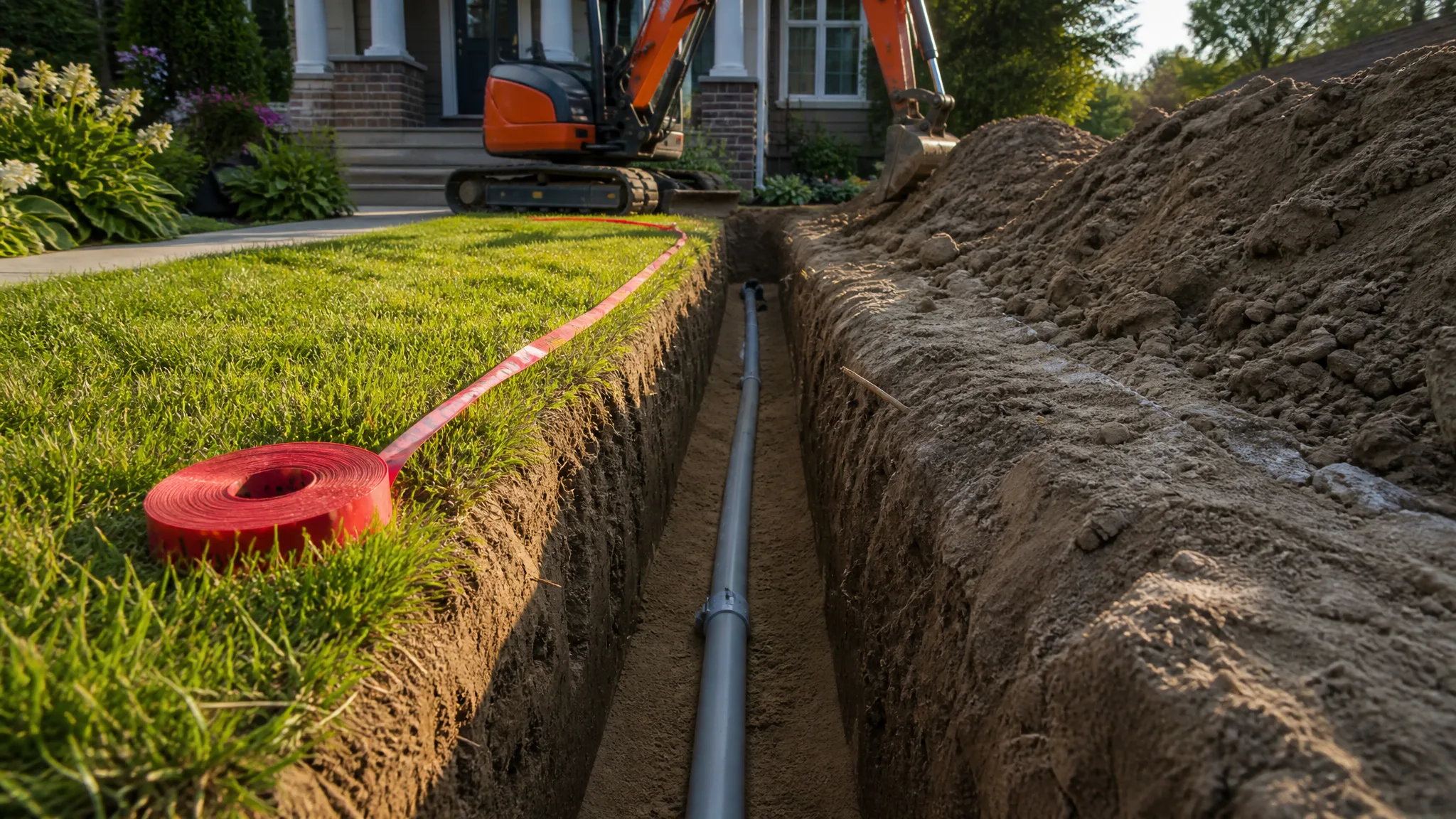
Protection does not stop at the wire. For direct-buried cables and nonmetallic service lateral conductors that are not encased in concrete, the code calls for a continuous warning ribbon installed in the trench above the installation, commonly specified as at least 12 inches above the conductors. That ribbon is what warns the next person with a shovel or a machine that something electrical is below.
Good trench practice reinforces the code minimum. A sand or fine-grain bedding layer cushions the conduit and keeps sharp rock off it. Backfill placed in lifts, free of large rocks, broken concrete, and debris, prevents point loads that can crack PVC over time. Leave the first several inches around the conduit stone-free, then bring in the rest of the spoil once the pipe is protected. If you are stockpiling the trench spoil on site, keep it well back from the cut — the same setback rules that apply to any open trench apply here, which is covered in our guide on how far spoil piles and equipment must be kept.
Protecting the Riser Where Conduit Emerges From Grade
The most exposed part of an underground run is where it leaves the ground. Where conductors emerge from grade, the code requires protection from the minimum cover depth up to at least 8 feet above finished grade, and where that protection is subject to physical damage it must be a listed material such as rigid metal conduit, IMC, Schedule 80 PVC, or an equivalent.
This is why you rarely see thin-wall Schedule 40 PVC sticking up out of the lawn into a meter or a shed panel. Schedule 40 is fine for the buried portion; the exposed riser is where it needs to be upgraded. Plan the riser location before you backfill, because moving it after the fact means re-opening the trench. A clean, protected riser is also the first thing an inspector looks at.
How to Dig an Electrical Trench Step by Step
- Confirm the design. Get the wiring method, circuit size, and required cover in writing, then verify against local code and the utility's own service-lateral specs.
- Call 811 and mark private lines. Public locates do not cover everything; the process and the gaps are explained in calling 811 before you dig.
- Lay out the route. Mark the centerline and set the trench width wide enough to work safely and to bed the pipe.
- Cut to the calculated depth. Required cover plus pipe diameter plus bedding equals trench depth. Check the bottom with a rod or laser as you go, and keep the bottom smooth and stone-free.
- Bed, lay, and protect. Place bedding, set the conduit or cable, and install the warning ribbon above it where required.
- Backfill and compact. Backfill in lifts, keep rock away from the pipe, and compact so the trench does not settle into a visible dip across the lawn.
Depth control is the part contractors get wrong most often, and it is the same skill used on any cut-to-grade job. The techniques in our how to set grade guide apply directly to trench bottoms.
Trench Safety and Locates
A trench is a hazard the moment it is deeper than a few feet, regardless of what goes in it. Excavations five feet deep and greater require protection, and any excavation can require it sooner in unstable soil, with water present, or where the walls show signs of failure. Know the rules before the cut is opened; our breakdown of when trench protection is required covers the thresholds, and common mistakes in trench excavation covers the field habits that cause problems.
Water is the other variable. An open trench that fills with rain or groundwater weakens the walls and makes depth control nearly impossible, so plan for dewatering an excavation on wet sites or in high water tables. And when a route under a driveway, a mature tree, or a road makes open trenching impractical, the alternatives are covered in trenchless technology for utility installation.
Common Trenching Mistakes to Avoid
- Measuring to the bottom of the trench. Cover is measured to the top of the wire or conduit at finished grade.
- Forgetting pipe diameter. An 18-inch cover requirement in 4-inch conduit needs more than an 18-inch ditch.
- Using Schedule 40 where the riser is exposed. The above-grade protection is a different requirement than the burial depth.
- Skipping the warning ribbon. It is inexpensive and required in specified cases.
- Backfilling with rock against the pipe. Sharp backfill point-loads the conduit and leads to breaks that surface years later.
- Trenching before the wiring method is chosen. Switching from direct burial to conduit after the dig can mean re-cutting the whole run to a different depth.
Get the wiring method and the cover number set first, dig to that number with the same care you would give any grade, and the electrical trench becomes one of the simpler parts of the job. The same care in bedding and backfill shows up again on water and sewer runs, which we cover in excavating for water and sewer lines.