Trenchless Technology for Underground Utilities


Trenchless technology is the umbrella term for the methods that install, replace, or repair underground pipe and conduit with little or no continuous open cut. Instead of peeling back a strip of road, lawn, or field for the whole length of a run, a trenchless crew works from a smaller entry and exit point and puts the pipe in the ground from there. For a utility that has to cross a highway, a railroad, a stream, or a mature landscape, that difference is often the reason the project is buildable at all.
What Counts as Trenchless Technology
"Trenchless" is not one machine or one technique. It is a family of methods that share the same goal: avoid the long, deep open cut. The main ones are horizontal directional drilling (HDD), also called directional boring; horizontal auger boring; pipe ramming; impact moling; microtunneling and pipe jacking; and the rehabilitation and replacement family, including pipe bursting and cured-in-place pipe lining.
Each method has a different sweet spot. Some steer, some cannot. Some handle gravity sewer that has to hold a precise slope, and some are only good for a short, straight crossing. Picking the right one is a function of soil, length, diameter, depth, and how much accuracy the pipe demands.
How Horizontal Directional Drilling Works
HDD is the most common trenchless method for new pressure pipe and conduit. It is a three-stage process. First, a steerable pilot bore is drilled along a designed path from the launch pit to the receiving pit. Second, the bore is enlarged with reamers, often in several passes. Third, the product pipe is attached behind a swivel and pulled back through the enlarged hole.
The drill head is steered by a walk-over electromagnetic sonde in shallow and medium bores, or by a wireline magnetic or gyro system on long, deep, or critical crossings where the surface receiver cannot reliably pick up the signal. Crews log the tracked position, depth, and inclination at regular intervals so the bore matches the plan and any deviation can be corrected while it is still cheap to fix.
HDD is usually described as best suited to crossings in the 300 to 500 foot range, but installations of 10,000 feet and longer have been completed. It started as a small-diameter method for telecom and gas conduit, and larger bores are now common, with diameters in the 24 to 48 inch range and some installations approaching 60 inches.
The Other Trenchless Methods
Horizontal auger boring uses a casing fitted with a cutting head and a rotating auger, jacked from the launch shaft. Spoil comes back through the auger. It handles most soils except mixed ground with boulders, but it requires pits at both ends and cannot steer.
Pipe ramming drives an open-ended steel casing through the ground with a percussive hammer, then clears the spoil. It is economical, works in almost any soil, and is well suited to short, straight crossings under railroads and highways. Its limits are that there is no control over line and grade, the pipe can deflect on hard obstructions, and it is essentially limited to steel casing, roughly 2 to 55 inches.
Impact moling pulls or pushes pipe through a bore made by a bullet-shaped mole driven by compressed air or hydraulics. It is cheap and works for small-diameter, short runs, but it is unguided, so it is limited in length and accuracy.
Microtunneling and pipe jacking use a remotely controlled, laser-guided boring machine and jack the pipe behind it. This is the method for gravity mains that must hold a tight line and grade, at the cost of higher cost per foot and launch and reception shafts.
Pipe Bursting and Rehabilitation
Not every trenchless job is a new line. Where an existing pipe is deteriorated or undersized, pipe bursting pulls an expansion head through the old pipe to fracture it outward while dragging a new pipe into the space. Cured-in-place pipe lining instead inserts a resin-saturated liner that is inflated and cured against the host pipe wall. Both avoid excavating the length of the line, and both are common for sewer and water mains in developed areas where open cut is expensive or unacceptable.
When Trenchless Beats Open-Cut Trenching
Trenchless wins when the surface is the problem. That includes roadway, rail, and waterway crossings; urban corridors where traffic, businesses, or pavement make open cut costly and disruptive; environmentally sensitive ground such as wetlands and streambanks; mature landscapes and trees that owners want preserved; and deep runs where an open cut would need extensive shoring and dewatering.
Open cut still wins in plenty of situations. Shallow agricultural or residential utility runs with easy access and no obstacles are usually cheaper with a conventional water and sewer trench. Ground that the geotechnical investigation shows to be full of boulders, large cobble, or karst can make a steerable bore impractical. So can a design that demands a bend radius tighter than the product pipe allows. Trenchless is a tool for the right problem, not a default.
Entry and Exit Pits: The Excavation Still Required
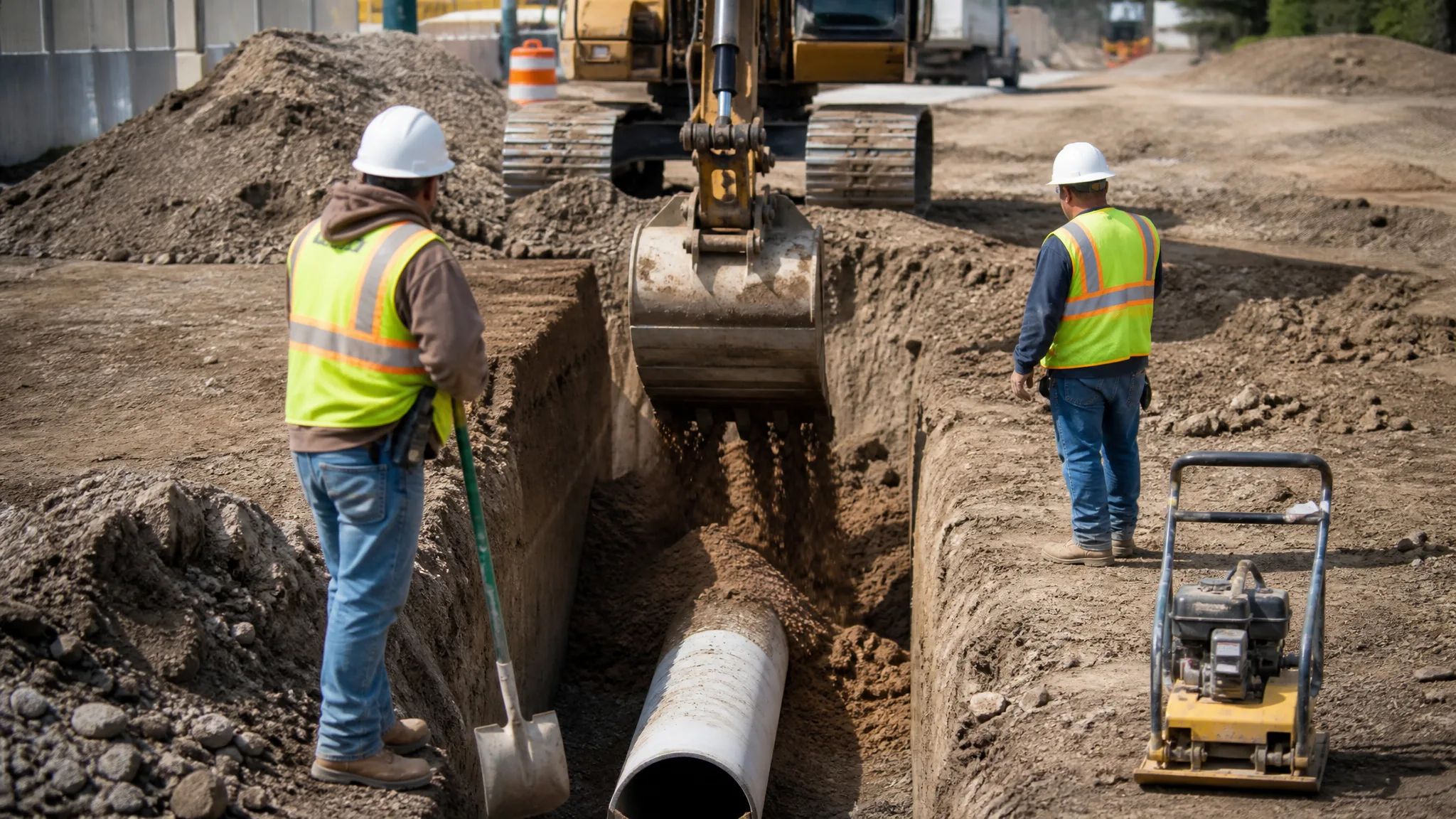
Trenchless is not excavation-free. It is excavation-light. Most methods still need a launch pit and a receiving pit. Whether those pits sit in dirt, asphalt, or concrete changes the cost: pavement means saw cutting, removal, and haul-off, and then the pit has to be backfilled and the surface restored to the owner's or agency's standard.
Pit work is ordinary excavation work, which means it carries the ordinary hazards. Spoil has to be kept back from the edges and managed, trenches and pits may need protective systems, and groundwater has to be handled. The crews digging and backfilling these pits follow the same rules as any other dig, including when trench protection is required and managing spoil piles on the site.
Geology, Cover, and Bend Radius
A bore is only feasible if the geology and the pipe geometry agree. Good practice is to plan the path around the ground rather than through it. Cobble and boulder beds deflect tools and shock the string. Loose running sands with high groundwater and no confinement invite collapse. Heavily fractured rock and karst can swallow drilling fluid.
Bend radius is the other hard limit. As a rule of thumb, the minimum radius an HDD bore can turn without over-stressing the pipe is roughly 100 to 120 times the outside diameter for HDPE, 40 to 60 times OD for steel, and about 125 to 150 times OD for fusible PVC, depending on grade and wall thickness. Cover matters too: under a waterway, a common owner specification is at least 10 feet of cover below the bed, and the depth must clear scour, future utilities, and any seasonal frost.
Drilling Fluids and Inadvertent Returns
HDD depends on drilling fluid, usually a bentonite or polymer mix pumped to the cutting head. The fluid carries cuttings, cools and lubricates the tool, and stabilizes the bore. A recycling unit separates cuttings and holds the fluid's properties where they need to be.
Fluid is also the main environmental risk. An inadvertent return, or frac-out, is drilling fluid escaping to the surface or into a water body through a path other than the entry and exit points. It happens when downhole pressure exceeds what the ground can hold, which is most likely where cover is shallow and the soil is permeable. The controls are boring deeper, keeping fluid density and viscosity only as high as needed, watching surface conditions over the alignment, and having containment and a stop-work plan ready. On regulated crossings, that plan may be a permit condition, and discharge of sediment-laden water off site generally falls under the site's stormwater and SWPPP obligations.
Locating, Potholing, and Cross-Bore Risk
Because a steerable bore is blind underground, accurate locating is non-negotiable. The public one-call service is the starting point — see calling 811 before you dig — but it only marks public utilities. Private lines, service laterals, and abandoned pipe are the owner's or contractor's responsibility, and on congested sites they are usually verified with electromagnetic locating and ground-penetrating radar, then confirmed by vacuum potholing before the drill moves.
The reason is the cross bore. Even accurate drilling can intersect an existing line it did not know about, and a new utility bored through a sewer lateral is a serious, sometimes explosive, defect. Post-installation closed-circuit TV inspection of the crossing, and a documented bore log, are standard safeguards on high-risk bores.
Permits, Cost, and Bidding
Trenchless work in a public right of way is permitted work. Expect right-of-way, DOT, railroad flagging, and waterway permits depending on what the bore crosses, along with a frac-out response plan and a fluid management and disposal plan on some projects.
On cost, published industry figures for directional boring commonly land around $30 to $60 per linear foot, but that range is a starting point, not a quote. Pricing is driven by three buckets: preparation, conditions, and restoration. Preparation covers entry and exit pit work, saw cutting, and backfill material. Conditions cover soil behavior, rock and cobble, groundwater, and how many existing utilities the alignment has to thread. Restoration covers bringing pavement, concrete, and landscaping back to an acceptable standard. A short bore under a driveway and a long bore under an arterial roadway are wildly different jobs even at the same pipe size. Build the estimate the same way any excavation estimate is built, and confirm the geotechnical picture before bidding.
What to Verify Before You Mobilize
- A bore plan with geometry, bend radii, cover, and the tracking method to be used.
- A geotechnical summary that names the formations, boulders, groundwater, and any lost-circulation zones.
- A drilling fluid program with test frequency and target ranges.
- A reaming schedule with tool list and flow and pressure targets.
- A frac-out response plan with stop-work criteria, containment, and contacts.
- A locating and potholing plan that covers private utilities, not just the public marks.
- A restoration plan and permit coverage for every surface and waterway the bore crosses.
Trenchless technology is powerful precisely because it is disciplined work. A crew that plans the path around the geology, keeps its fluids under control, and tracks the bore like it matters will install a pipe a road can never see. A crew that skips those steps will find every one of them later, usually with a frac-out, a stuck string, or a cross bore attached.