Excavating for Water and Sewer Lines


Water lines and sewer lines usually get dug by the same machine, in the same afternoon, by the same crew. They are still two different jobs with two different failure modes. A water service that is too shallow freezes in the first hard winter. A sewer that loses its fall fills with solids and backs up into a basement. Both are digging problems before they are plumbing problems.
This guide covers what actually drives the excavation work: frost depth for the water line, the fall that has to hold for the sewer, how grade is set and checked, trench width and protection, bedding, backfill and compaction, separation between the two lines, and the inspection that has to happen before anything gets covered.
Two Utilities, Two Different Sets of Rules
A water service line is pressurized. Water does not care about slope, because pressure pushes it uphill if it has to. What it cares about is depth — it has to stay below frost, and it has to stay away from contamination sources. A sewer is the opposite: it moves entirely by gravity, so it cares about elevation and fall more than almost anything else, and it has to be laid straight and uniform from end to end.
That difference changes how the trench is dug. Water service trenches are forgiving on grade and strict on depth. Sewer trenches are strict on both, and every foot of error in elevation compounds over the length of the run.
How Deep Do Water Service Lines Go?
Depth for water service is set by the frost line, and the frost line is set by where you are. The plumbing code approach is to require the service pipe to be installed not less than 12 inches deep and not less than 6 inches below the established frost line, with the local authority having jurisdiction setting the frost depth that applies. Colder regions therefore end up with water services far deeper than warm ones, and the local number is the only one that matters.
This is the point where copying details from another state gets expensive. A depth that works in one area will freeze solid in another, and a service that freezes in a yard is a repair that means re-excavating the entire run. Ask the local building department or water utility for the required cover, and trench to that depth with a little margin rather than to a number pulled from a forum.
Sewer Depth and the Fall That Has to Hold
Sewer line depth is set by two things at once: the depth required to protect the pipe from freezing, and the depth required to make the connection. The pipe has to arrive at the municipal main or the septic tank at the right elevation, which means the fall required over the length of the run determines how deep the line has to start at the house.
Minimum slopes come from code. Under the International Plumbing Code, horizontal drainage piping is installed in uniform alignment at uniform slopes, with a minimum slope of 1/4 inch per foot for pipe 2-1/2 inches and smaller, 1/8 inch per foot for pipe 3 to 6 inches, and 1/16 inch per foot for 8-inch and larger pipe. Many residential sewer designs deliberately use 1/4 inch per foot even on 4-inch pipe because a bit more fall is easier to hold in the field and leaves margin for the unknown at the connection point — but the local standard is what governs.
The word that matters most in that code language is uniform. A sewer cannot have a sag or a high spot anywhere in the run, because the low spot collects solids and the high spot blocks flow. A sewer trench that looks right from the surface can still be a failed line if the pipe bellies in the middle.
Setting Up Grade: Stakes, Laser, and the Connection Point
Good sewer work starts at the wrong end of the job. The first elevation to establish is the connection point — the existing main, manhole, or tank inlet — because everything upstream has to work back from it. Once that elevation is known, the required fall over the run gives the elevation at the house, and that tells you how deep the trench has to be.
From there, grade is controlled with grade stakes and a laser level or transit, checking the pipe invert as the line is laid rather than after. Pulling string after the pipe is in the trench is not a grade check, and neither is working from the top of the pipe alone if the bells are a different thickness. Checking elevation every pipe length, and again before backfill, is what keeps a line out of the callback column.
Trench Width, Depth, and Protection
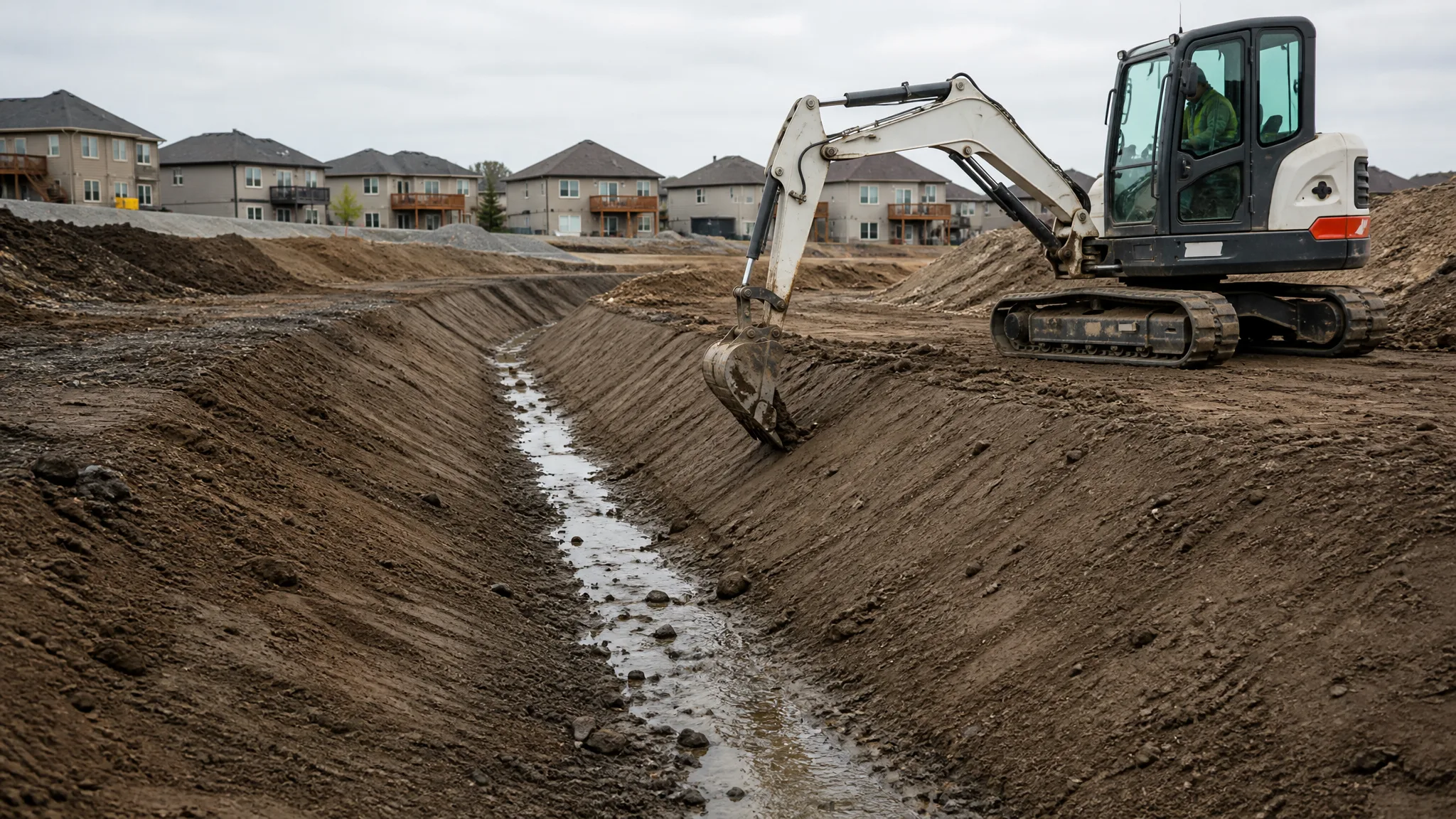
Utility trenches should be dug as narrow as the pipe and the compaction equipment will reasonably allow. A narrow trench keeps the pipe supported by undisturbed soil on both sides, limits the volume of backfill to compact, and reduces surface settlement later. Trench width has to open up where a compactor has to work, but the days of digging a wide, sloppy trench because the bucket is convenient are the days that produce dips in the finished surface.
Depth brings safety rules with it. Any trench 5 feet or deeper requires a protective system — sloping, shoring, or a trench shield — under OSHA's excavation standard, and a competent person has to classify the soil and inspect the site. Spoil gets set back at least 2 feet from the edge, and ladders or ramps are required for egress once a trench hits 4 feet. Locating existing utilities comes before any of this, and where a line has to be exposed by hand, suction excavation verifies it without the risk of a strike.
Bedding and Pipe Support
A pipe is only as good as what it rests on. Bedding has to provide uniform support along the full length of the barrel, with no rock points, no soft pockets, and no hard spots that concentrate load on one section of pipe. The trench bottom is either undisturbed soil, shaped to fit the pipe, or a granular bed placed and leveled to a consistent thickness. A trench carrying water needs to be dewatered and dried before bedding goes in, because bedding placed in standing water or mud cannot be leveled or compacted properly.
Bells, hubs, and couplings deserve specific attention because they are wider than the pipe barrel and need a recess cut so the pipe bears on its barrel instead of hanging on the joint. For buried plastic pipe, the standard practice for bedding and backfill classes comes from ASTM D2321, which pairs soil types and pipe stiffness with the right bedding condition and compaction method.
Backfill and Compaction
Backfill happens in two stages. Initial backfill goes in beside and over the pipe, using fine, stone-free material placed by hand or with a small machine and compacted carefully so the pipe is not shifted or crushed. After that, the trench is filled in lifts — typically 6 to 12 inches loose — with each lift compacted with the right machine before the next is placed, usually to 90 to 95 percent of standard Proctor density for utility trench work unless the specification says otherwise.
Water jetting a trench and calling it compacted is not compaction on most specifications, and the failure shows up later as a strip of settling ground over the line that has to be repaired after the driveway or sidewalk is already in. Compaction in lifts over a utility trench is one place where doing it slowly pays for itself twice.
Separating Water and Sewer
Water and sewer lines have to stay apart, because a leaking sewer near a leaking water line is how a drinking water supply gets contaminated. The common standard is horizontal separation, with the required distance coming from local plumbing and water utility standards rather than a single national number.
Where the two lines have to be close, vertical separation does the work instead: the water line runs above the sewer, with enough clearance between them, and the water pipe is often sleeved for additional protection through the crossing. The logic is simple — water above, sewer below, and never the reverse. If a crossing is unavoidable and the required separations cannot be met, that is a conversation to have with the inspector before the pipe is backfilled, not after.
Inspection, Testing, and Records Before You Cover It
Once the pipe is covered, everything about the installation becomes an assumption. That is why the checks happen with the trench open. Water service lines get pressure tested before backfill. Sewer lines get a grade check, and usually a leakage or flood test, along with a visual inspection of the joints.
The inspection itself should be scheduled before backfill, not after, and the work is documented with photographs of the bedding, joints, and separation details while they are still visible. Nonmetallic pipe should carry tracers or warning tape installed above it so the next person on the site — or the next person with a shovel in ten years — has a chance of finding it without a strike. As-built drawings of the actual inverts and depths are worth the twenty minutes they take to record.
Common Mistakes in Utility Excavation
- Digging to a frost depth borrowed from another region. Frost depth is a local number.
- Losing sewer grade by dragging spoil or working off a soft trench bottom. The pipe follows the trench, not the plan.
- Over-wide trenches that leave large volumes of fill to compact and settle over the line.
- Resting pipe on bells or rock points instead of uniform bedding, which cracks pipe under load.
- Backfilling without an inspection, then discovering a grade or separation problem with the trench closed.
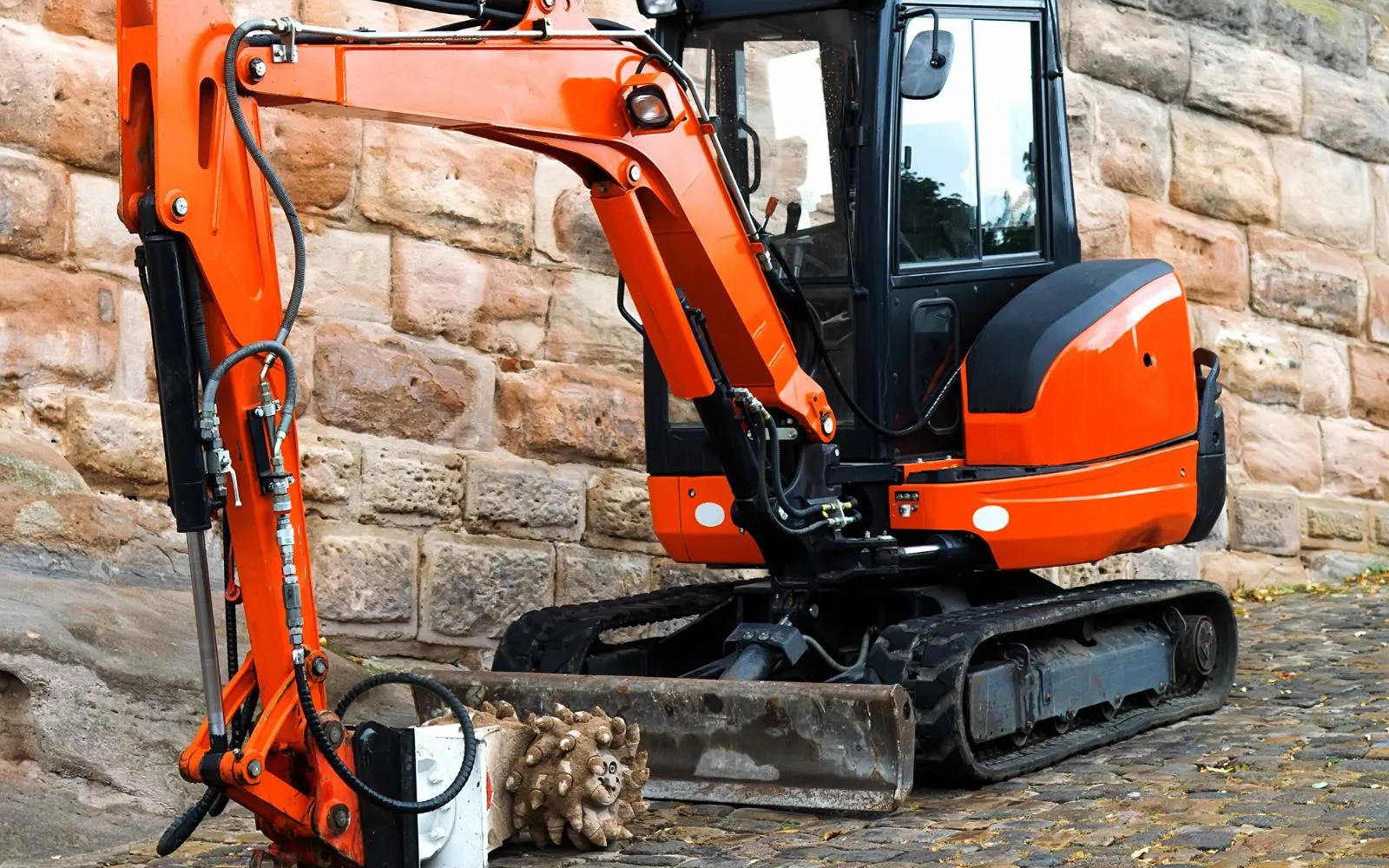
- Using the wrong machine for the access. Long, deep runs favor a larger excavator, while tight residential yards usually favor a compact machine and hand work inside the tolerance zone near existing utilities.
- Skipping the locate or assuming private utilities are marked. Irrigation, gas grills, and private laterals are not part of the public locate.
Utility excavation is not complicated work, but it is unforgiving work. Depth, fall, bedding, and compaction each have a narrow band of acceptable results, and every one of them is easier to verify before the trench is filled than after. Get the locates done, establish the connection elevation first, hold the grade as you lay the pipe, and photograph what you are about to bury.