On-Site Crushing and Screening

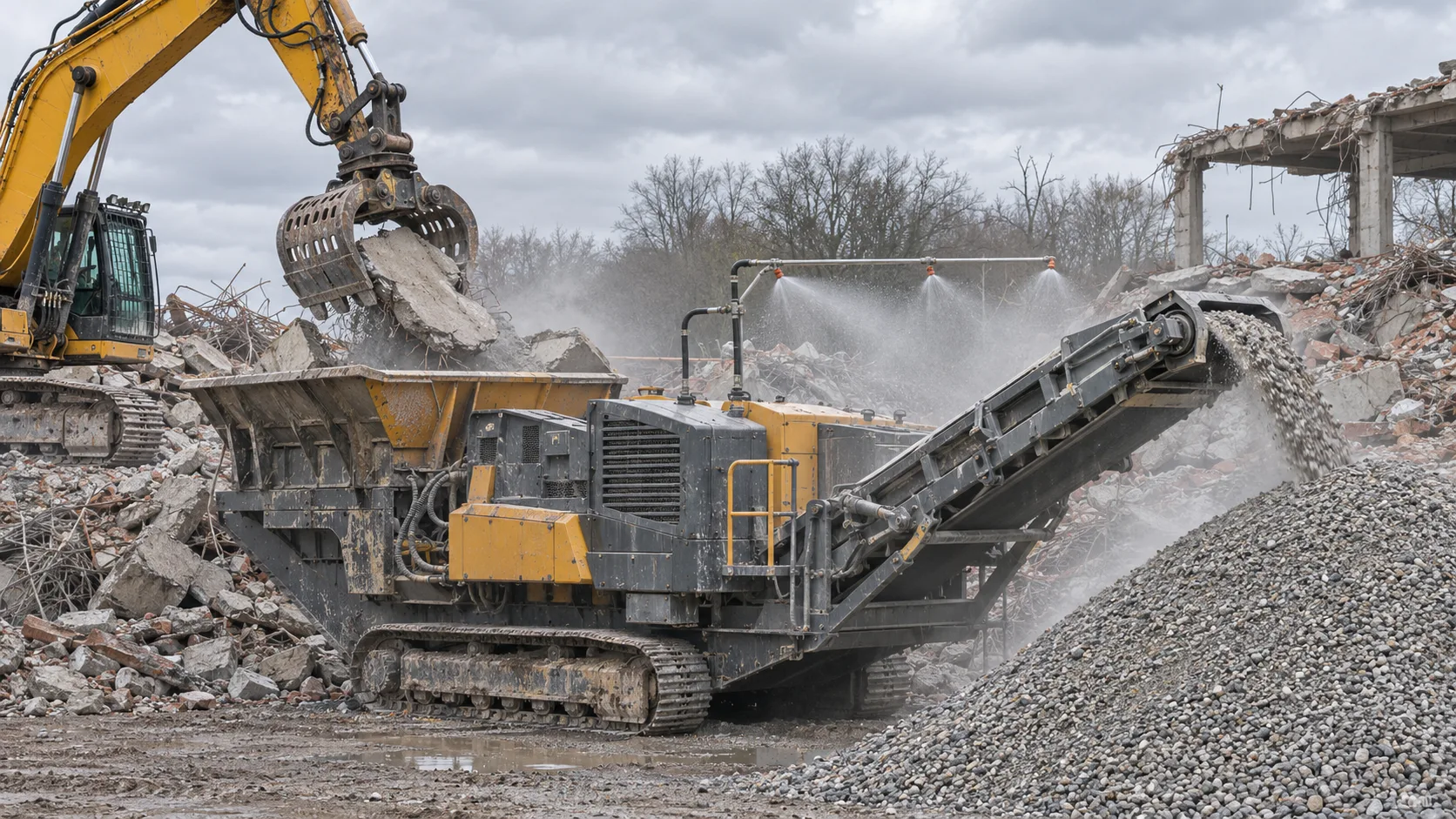
Every demolition and reconstruction job produces a pile that somebody has to deal with. Old concrete slabs, footings, curb, sidewalk, and broken asphalt can leave the site as truckloads of disposal, or they can come back as base course under the next parking lot. On-site crushing and screening is the difference between those two outcomes, and the decision comes down to volume, spec, space, and time.
A mobile plant is not a magic machine that turns rubble into money. It is a small quarry that travels to your site, and like a quarry it needs consistent feed, an achievable product spec, dust control, and enough material to justify setting up. This guide covers what the equipment does, what the material is worth, and where contractors get burned.
What an on-site plant actually does
A typical spread is a crusher, a magnet, and a screen. An excavator or loader feeds broken material into the hopper. The crusher reduces it, a magnet pulls rebar and steel off the discharge belt, and the screen splits the output into sizes. Oversize material can be recirculated back through the crusher in a closed circuit until it passes the target opening.
That flow matters when you specify the job. A single crusher pass gives you a range of sizes; a screen turns that range into products. If the material is going into a base course with a required gradation, the screen and the recirculating loop are doing as much work as the crusher. If it is going into a haul road subbase where a broad blend is acceptable, a simpler setup can be enough.
Know what is in the pile
Demolition concrete is not clean aggregate. It contains rebar and mesh, and often block, brick, tile, plaster, wood, gypsum board, plastic, and dirt. Each of those affects either the crusher, the product, or both. Rebar wraps around rotors and tears belts. Gypsum and organic material degrade the finished base. Dirt and clay blow the fines content out of spec.
Most recycled-aggregate specifications deal with this directly. Minnesota's aggregate specification, for example, limits bitumen content in recycled base materials to 3.5 percent, caps masonry block at 10 percent and brick at 1 percent, and limits other objectionable material such as wood, plant matter, plastic, plaster, and fabric to 0.3 percent. It also caps the material passing the No. 200 sieve at 6 percent for products that are 75 percent or more recycled concrete. Those limits tell you what the market expects: source-separate the pile, and expect to reject or hand-pick contamination.
Asphalt behaves differently. Reclaimed asphalt pavement, or RAP, contains bitumen that acts as a binder in a base blend, but too much of it reduces bearing strength. FHWA guidance for reclaimed concrete material recommends limiting RAP content to 20 percent where the two are blended, to avoid a loss of bearing capacity. If your pile is a mixed concrete-and-asphalt demolition blend, that ratio is a design decision, not an accident.
What recycled concrete is worth as base
Properly processed recycled concrete is a legitimate base and subbase material, not a consolation prize. FHWA's user guideline for reclaimed concrete material notes that the processed product is 100 percent crushed, angular, and locks up well, with California Bearing Ratio values reported from 90 to more than 140, comparable to crushed limestone. It also notes good stability, little post-compaction settlement, and free-draining behavior because of the lower fines content.
The differences from virgin stone are real but manageable. Absorption in the crushed fine fraction of air-entrained concrete runs 4 to 8 percent, compared with about 2 percent or less for virgin aggregate, and specific gravity is lower, roughly 2.0 for fines to 2.5 for coarse particles. Lower unit weight means more volume per ton, which is part of why the material is economically attractive. Higher absorption means the material wants more water during compaction, and a Proctor test run on the actual recycled product, not a borrowed virgin-stone curve, is the right call.
There is one known failure mode worth designing around. FHWA reports that free lime and unhydrated cement in some recycled concrete can form a white precipitate, sometimes called tufa, that clogs subdrains and blinds geotextile filters. Where the base will drain into a subdrain system, wash the coarse aggregate to remove dust and keep the geotextile from intersecting the drainage path out of the base. Where drainage is not involved, the risk is much lower.
Gradation is the spec that matters
Recycled concrete has to be crushed and screened to meet a recognized gradation, such as AASHTO M147 or ASTM D2940 for graded aggregate base, or the state DOT's own class bands. Those bands set percent passing at each sieve, including the No. 200 fines limit, and they are what the inspector will test.
The practical consequence is that the crusher's closed-side setting and the screen decks are chosen from the gradation, not from what looks about right. A jaw crusher set wide enough to keep up with the excavator may produce a product that fails the fines requirement or the top size. That is why a test run and a sieve analysis before full production is cheaper than re-crushing a stockpile that has already been placed.
Sampling discipline matters as much as the equipment. Sample from the belt or from multiple points in the stockpile, not from one shovel full at the edge. Segregation in a stockpile is normal, and a single grab sample will either flatter or condemn the whole pile. For a refresher on reading the results, see how to read a soil test report.
Choosing the crusher: jaw, impact, or cone
Jaw crushers are the default primary unit for demolition concrete. Two plates squeeze the material, the geometry is simple, and the machine tolerates dirty feed and stray rebar better than the alternatives. A common rule of thumb is a 6:1 reduction ratio, meaning the top feed size should not exceed about six times the desired output size, with typical closed-side settings from 2 to 7.5 inches. Run a jaw far beyond that ratio and throughput drops.
Impact crushers do better on asphalt and mixed construction and demolition debris. They reduce by striking rather than squeezing, can achieve reduction ratios up to about 12:1, and produce a more uniform, better-shaped product with adjustable curtains. They are less happy with highly abrasive material or heavy steel contamination, so a magnet and some feed discipline are essential.
Cone crushers are the precision tool: secondary or tertiary units for clean, pre-sized feed, capable of output down to about a quarter inch at high speed. They are rarely the right first machine on a demolition site, but they are the right answer when the product has to meet a tight, cubical spec from hard rock.
Screens follow the same logic. A scalping screen ahead of the crusher pulls dirt and fines out of the feed and keeps the chamber from packing. A double- or triple-deck screen after the crusher makes the products. A recirculating screen on the crusher itself keeps oversize in the loop and gives the tightest control over top size.
Setting up the plant on site
Layout is usually the constraint that decides whether on-site processing is viable. You need room for the plant, a feed area where an excavator can work safely, separate stockpiles for each product and for rejects, and a truck turnaround that does not require driving over the stockpiles. Add water for dust suppression and a settling area for the runoff, and the footprint grows again.
Feed discipline protects the equipment and the schedule. Do not drop slabs that are larger than the crusher opening, do not feed wet clay that bridges in the hopper, and do not run the excavator at a rate the crusher cannot absorb. A steady, sized feed produces more tons per hour than a stop-and-start pattern, and it dramatically reduces the jammed-hopper downtime that eats the day.
Stockpile separation is a quality control step, not housekeeping. Recycled concrete segregates, and blending a coarse pile with a fines pile by pushing them together with a loader rarely produces a spec product. Build the piles separately, let them drain, and load out from the face rather than the toe.
Dust, silica, and the rules that apply
Crushing concrete and rock generates respirable crystalline silica, and that is a regulated exposure, not just a nuisance. OSHA's construction silica standard, 29 CFR 1926.1153, applies to crushing machines. Its Table 1 control for crushers is wet methods plus operator isolation: water sprays or mists at the hopper, conveyors, screens, and discharge points, along with either an enclosed, positive-pressure cab or a remote control station positioned upwind.
OSHA's crushing-machine fact sheet gives the details that make the difference. Nozzles go upstream of the dust generation point, positioned to wet the material thoroughly, with droplet sizes in the 10 to 150 micrometer range and enough coverage that wind does not carry the spray away. The enclosed cab has to be well sealed and ventilated, with an intake filter rated at least MERV-16, and kept clean of settled dust. With those controls in place, the standard does not require respirators for that task.
Beyond Table 1, the standard requires a written exposure control plan, a designated competent person, training, housekeeping practices that do not re-suspend dust, and medical exams every three years for workers required to wear a respirator 30 or more days per year. Those obligations sit on the employer operating the plant, whether that is you or a subcontractor, so the contract should say whose plan it is.
Dust also leaves the site. Visible dust plumes across a property line generate complaints and, in some jurisdictions, citations. Water sprays, reduced drop heights, wind screens, and covered loads are the standard controls; the broader playbook is in dust control on a construction site.
The economics: when crushing beats hauling
The comparison is simple in structure. On one side, haul the rubble to a landfill or recycling yard and buy imported base. On the other, pay to mobilize a plant, crush the material, test it, and place it. The variables are the volume, the haul distance, the purchase price of base, the disposal fee, and the space and time available.
Do the volume math from solid dimensions, not from how big the pile looks. Concrete weighs roughly 145 to 150 pounds per cubic foot, so a cubic yard of solid concrete is about two tons. A 1,000-square-foot slab at 6 inches thick is 500 cubic feet, or about 18.5 cubic yards, which is roughly 37 tons of material. That is the mass the crusher has to process and the mass you would otherwise be hauling, before any bulking from broken rubble is considered.
Then divide by a realistic production rate from the equipment manufacturer for your feed material and target size, and add the time for setup, teardown, and moving the plant. A crusher that is rated at a high tonnage in limestone will not hit that number in rebar-laden slab with a wide setting. The honest calculation uses a conservative rate, adds wear parts and fuel, and includes the testing and the reject disposal that the sales sheet leaves out.
The break-even volume is usually higher than people expect, which is why crushing pays best on large demolitions, multi-building sites, and projects where imported base has a long haul. Below that threshold, hauling to a recycler who already has the plant set up is often the cheaper and faster answer. For the disposal side of the comparison, see demolition debris disposal and removing asphalt pavement.
Permits, stormwater, and neighbor issues
A mobile crusher is temporary, but it is not invisible. Local zoning and nuisance ordinances may limit operating hours, require a noise review, or treat a crusher as a temporary use requiring approval. Air quality rules vary widely: some states permit crushing operations by registration or general permit, and some require an individual permit depending on throughput and engine ratings. The only safe assumption is that you check before mobilizing.
Stormwater is the other common trip-up. Crushing produces fines, and a stockpile of recycled concrete is an exposed erodible surface. Keep stockpiles out of drainage paths and away from inlets, berm or cover them where required, and make sure the site's stormwater pollution prevention plan accounts for the new activity. The alkaline leachate from fresh concrete rubble is another reason not to let runoff leave the site uncontrolled; FHWA notes that some jurisdictions require stockpiles to be separated from watercourses for exactly that reason.
Where the site has a stormwater plan, the crusher pad and stockpiles belong on the plan's drawing. A pile that appears after the inspection is a finding waiting to happen. See what a SWPPP is for the framework, and storm drain inlet protection for the downstream guard.
Safety around the plant
Crushers have nip points, rotating shafts, and stored energy, and the feed opening is not a place to stand, ever. Guards stay on. The chamber is locked out and the rotor stopped before anyone reaches in, and no one stands on the feed hopper to break a bridge with a bar while the machine is running.
The excavator feeding the plant creates its own hazard zone. Establish a swing radius, keep ground personnel out of it, and never let a laborer work under a raised boom or between the machine and the hopper. Material can kick back out of the chamber, and rebar can whip off the belt. Hearing protection and high-visibility clothing are baseline, and the noise makes hand signals unreliable, so agree on radio or horn signals before the first bucket.
Stockpiles deserve respect as well. A pile that has been undercut by loading from the toe can collapse without warning. Load from the face, keep the slope at a stable angle, and keep the loader operator from digging a cave into the pile.
Quality control before the material goes down
Crushed material is only as good as its acceptance testing. Run a gradation on the product, run a moisture-density curve on the actual recycled blend, and then test compaction in the field the same way you would for virgin base. Acceptance criteria do not relax because the material is recycled; if anything, the variability of the feed makes testing more important.
Watch the moisture. Higher absorption means the material can look wet and still be below optimum, or can be over-watered and turn into a pumping mess. Mix it, test it, and give it time to equilibrate. Then compact in lifts thin enough for the roller to reach the required density, and proof roll the finished surface to catch soft spots before the pavement goes on. The lift and compaction basics are in how thick compaction lifts should be and subgrade, subbase, and base course.
When not to crush
- Small volumes. Mobilization and testing dominate, and the break-even never arrives.
- Heavily mixed debris. If the pile is half wood, drywall, and trash, you are running a sorting operation, not a crushing operation.
- Hazardous materials. Buildings that may contain asbestos or lead need a hazardous-materials survey and abatement before demolition; crushing contaminated rubble spreads the problem. State rules vary and are often stricter than the federal minimum.
- No space. A plant, feed area, stockpiles, and truck access need room. A tight urban lot usually fails this test.
- A spec that needs washed, high-quality aggregate. Recycling produces a good base material, not a substitute for clean structural concrete aggregate.
- Schedule pressure. Permitting, setup, test runs, and curing time all add days that a haul-off does not.
The bottom line
On-site crushing and screening is a volume business with a spec attached. If you have enough clean concrete or asphalt, room for the plant, and a base specification the product can meet, recycling keeps material on site, cuts hauling, and produces a base that performs. If any of those three is missing, hauling to a plant that already has the permits and the stockpile capacity is usually the better decision. Either way, decide before demolition starts, because the cheapest moment to separate clean concrete from mixed rubble is while it is still standing.