Demolition Debris Disposal

A demolition crew can knock a house down in a day, but the debris can sit on the lot for weeks and cost more to remove than the demolition itself. Demolition debris is heavy, bulky, and regulated in ways that surprise contractors who are used to dirt work. The difference between a clean, profitable teardown and a money-losing one is usually decided before the first wall comes down.
What Counts as Demolition Debris
Construction and demolition debris is the material generated by building, renovating, and tearing down structures, plus road and bridge work. EPA groups it into steel, wood products, drywall and plaster, brick and clay tile, asphalt shingles, concrete, and asphalt concrete. It is tracked separately from municipal solid waste, and the volume is enormous: EPA estimated about 600 million tons of C&D debris were generated in the United States in 2018, more than twice the amount of municipal solid waste.
Of that total, roughly 144 million tons went to landfills and about 455 million tons went to a next use — mostly aggregate, with smaller amounts to manufactured products, fuel, compost, and soil amendment. That is why recycling markets exist for concrete and metal, and why a single teardown can require several container swaps.
Weight, Not Volume, Sets the Rules
Every roll-off container has two limits: how much it holds and how much it can weigh. Contractors routinely plan around the first and get burned by the second. A 20-yard box that looks half empty can already be at its limit when it is full of concrete, brick, or asphalt shingles.
Solid concrete weighs roughly 4,000 pounds per cubic yard, and asphalt pavement is in the same range. Broken rubble has voids and is lighter per yard, but it is still several times denser than wood framing or drywall. That is why a hauler quotes a tonnage allowance with the container and charges overage per ton beyond it.
On a heavy demolition, order the container by weight first and volume second. If the load is mostly concrete, a smaller box hauled more often is usually cheaper and safer than an oversized box loaded past its rating — the same weight-versus-volume logic that governs how many trucks you need to haul dirt.
Sort Before You Load
Mixed debris is the most expensive debris. Once concrete, wood, metal, drywall, and household trash are blended in one container, the load generally goes to a C&D landfill or a mixed-waste processor, and the contractor pays full tipping plus any sorting fee. Separated loads can often go to a recycler at a lower cost, and scrap metal can return money.
The workable separation on a residential teardown is usually a short list: concrete, brick, block, and asphalt pavement for crushing; clean untreated wood for mulch or biomass; metal for scrap; asphalt shingles where a market exists; drywall as clean gypsum where accepted; and true trash — carpet, insulation, vinyl, painted or treated wood — in its own container.
Sorting costs labor, so the decision is not "always recycle." It is whether the tipping savings and scrap value exceed the labor and the extra container moves. On a large commercial teardown they usually do. On a small shed, they usually do not.
Roll-Off Sizes and What They Really Hold
Open-top roll-offs commonly come in 10, 15, 20, 30, and 40 cubic yards. The nominal size describes volume, and haulers publish a typical included weight allowance alongside it. As a rough industry pattern, a 20-yard container is often rated for about 2 to 3 tons, a 30-yard for about 3 to 5 tons, and a 40-yard for about 5 to 6 tons, with the exact numbers set by the hauler and route.
Those allowances are not generous when the load is heavy. Ten yards of broken concrete can weigh more than 15 tons, so a 20-yard container may hit its weight limit after only a couple of yards of solid rubble. Ask three questions before delivery: what is the included tonnage, what is the overage rate, and what can the truck legally scale at the gate.
Placement matters too. The truck needs a straight approach and firm, level ground, and the box has to sit clear of overhead lines, tree limbs, and the demolition drop zone. On a tight residential lot, that alone can dictate which size fits.
Concrete, Brick, and Asphalt
Masonry and pavement are the easiest materials to recycle and the most punishing to haul. Clean concrete rubble is routinely crushed and reused as aggregate base, and the economics improve sharply when the material never leaves the site. On a project with a large slab or driveway removal, an on-site crusher or a nearby recycler can turn a disposal cost into a base-course credit.
The catch is contamination. Concrete with rebar, soil, trash, or gypsum mixed in may be rejected or downcycled. If the material is going to a recycler, keep it clean and dry. If it is going to a landfill, expect to pay by the ton. Slab removal itself is covered in how to remove a concrete slab, and the recycled product is the same material discussed in is crushed concrete a good driveway base and gravel and stone sizes explained.
Wood, Drywall, and Shingles
Wood is the material most often wasted. Clean, untreated dimensional lumber can go to mulch, biomass, or salvage, while painted, treated, or engineered wood usually cannot. Soft-stripping salvageable doors, cabinets, flooring, and fixtures before demolition is the highest-value move on many older houses, and it shrinks the debris stream at the same time.
Drywall is heavy, breaks into dust, and creates sulfate issues in landfills, which is why some states restrict it and some recyclers accept clean gypsum. Asphalt shingles are recyclable in a limited number of markets, mostly as an asphalt supplement in road mix. Neither is worth separating unless a local outlet exists, so make the calls before the container arrives. Land clearing debris is a separate stream with its own rules — see land clearing methods compared and managing spoil piles on a construction site.
Asbestos Comes Before Demolition
This is the rule that stops projects. Under the federal asbestos NESHAP, 40 CFR Part 61 Subpart M, the owner or operator must thoroughly inspect the facility for asbestos — including Category I and Category II nonfriable material — before demolition or renovation begins. That inspection is not optional, and "we didn't think there was any" is not a defense.
If the combined regulated asbestos-containing material is at least 260 linear feet on pipes, at least 160 square feet on other facility components, or at least 35 cubic feet off facility components, the full removal and handling requirements apply. Regulated material generally has to be removed before any activity that would break it up, and written notification must be delivered at least 10 working days before work starts. If the amount of asbestos changes by 20 percent or more, the notice must be updated.
Removal is not a general contractor task. It requires trained workers, wet methods, leak-tight wrapping, labeling, and disposal at an approved site. The sequence is inspection, abatement, clearance, then demolition — and the schedule has to be built around it, not adjusted after the excavator shows up.
Lead, Mercury, Refrigerants, and Other Regulated Items
Houses built before 1978 may have lead-based paint, and debris that fails a leaching test can be classified as hazardous. Testing before demolition is cheaper than discovering the problem at the scale house. Refrigerants must be recovered by a certified technician before equipment is scrapped, and mercury-containing items — fluorescent lamps, older thermostats, switches — are managed as universal waste in many states. PCB-containing ballasts and capacitors from older buildings need separate handling, and any fuel oil, propane, or flammable-liquid tank must be removed or purged, not crushed in place.
Burning is not a disposal plan either. Federal rules prohibit open burning of residential, commercial, institutional, and industrial solid waste under 40 CFR 257.3.7(a), with narrow exceptions that include land clearing debris, and many states prohibit burning construction and demolition debris outright. Treat burning as a jurisdiction-specific activity that needs written confirmation.
Loading, Dust, and Site Practice
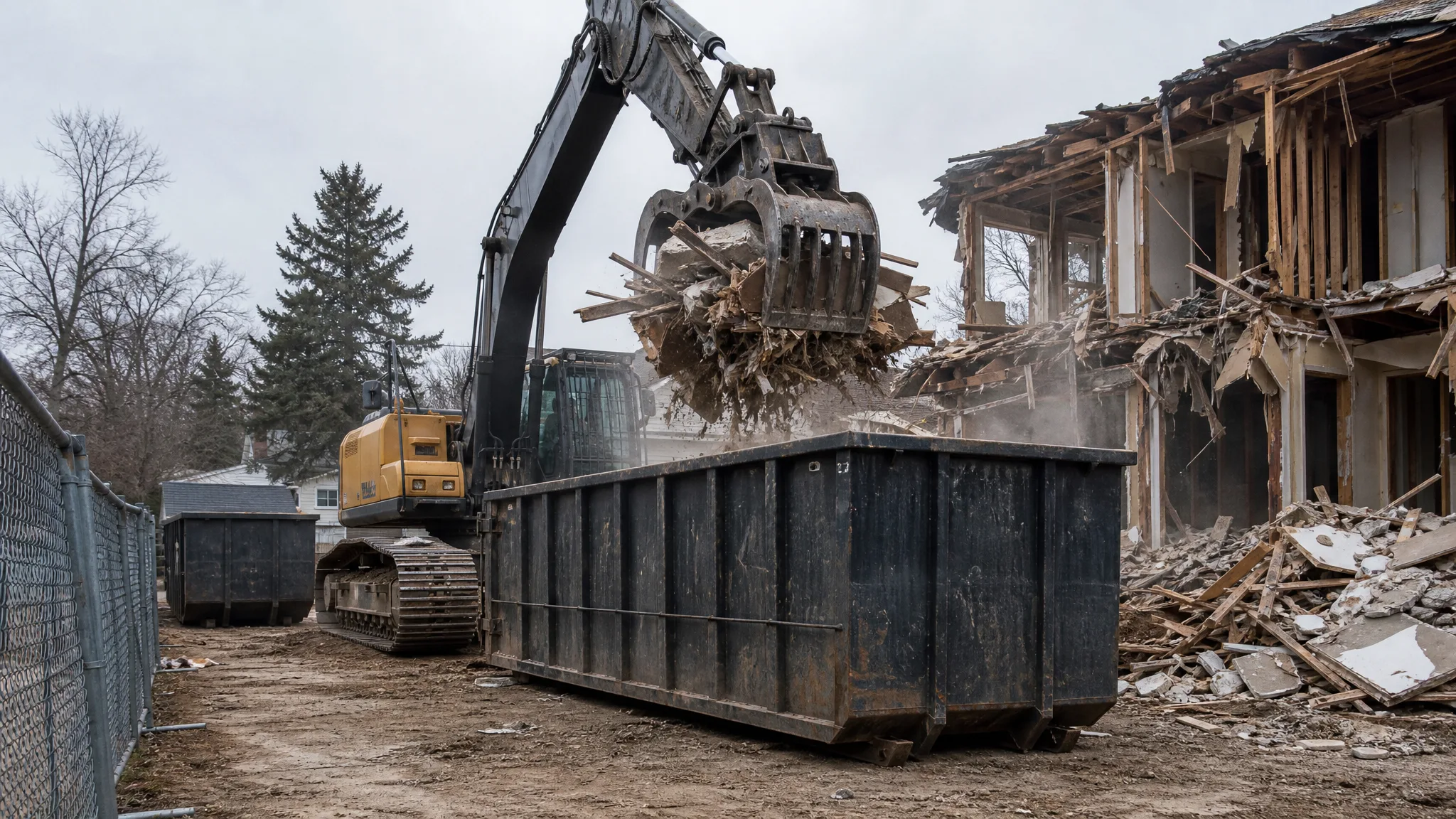
A demolition container is a work zone, not a trash can. Load heavy material low and centered over the axles, keep the load below the top rail so the hauler can tarp it legally, and never stack debris above the sides where it can fall on a worker or the road. An excavator thumb or grapple earns its keep here, and the container should sit where the machine can reach it without swinging over people.
Dust is the other constant. Tearing out plaster, drywall, and concrete generates fine particulate, and the controls that apply to earthwork apply here — water, reduced drop heights, and attention to wind direction. The practices in dust control on a construction site translate directly, and the site still needs track-out control at the entrance. Keep the debris area separate from excavation and backfill so neither stream is contaminated.
What Drives Disposal Cost
Disposal cost is not one number. It is the container rental, the haul, the tipping fee by weight, overage charges, extra swaps, special handling for regulated material, and the labor to sort. Distance to the accepting facility matters as much as the tip fee, because hauling is priced by time and fuel.
The controllable variables are weight, contamination, and the number of moves. A contractor who separates concrete, pulls metal, salvages before demolition, and sizes the container to the load will usually beat one who orders the biggest box available and fills it with mixed debris. Those savings belong in the estimate, and tracking them against actuals is what excavation job costing is for.
One more comparison is worth making. Debris is priced by weight, and dirt is priced by volume and weight together — the relationship covered in how much does a yard of dirt weigh. Contractors who understand both units stop being surprised by scale tickets.
Demolition debris is a logistics problem disguised as a demolition problem. Inspect first, abate what has to be abated, sort what has a market, size the container to the weight, and keep the load clean. The building comes down either way — see how contractors demolish a house — but the difference is what the debris costs on the way out.