Intelligent Compaction

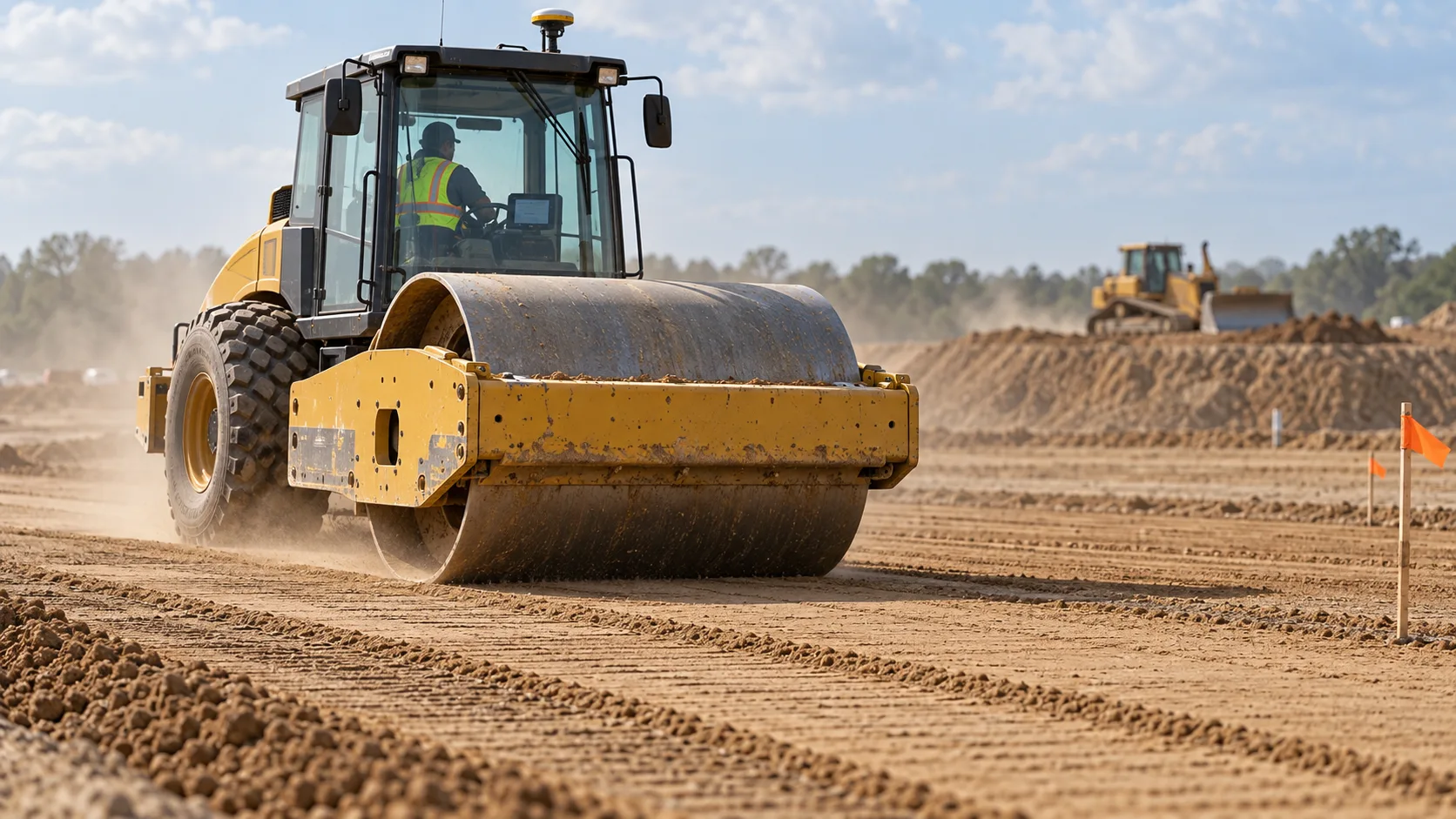
Compaction has always had a blind spot: the test tells you what one spot on the pad is doing, and the roller tells you nothing at all. Intelligent compaction closes that gap. An IC roller measures the ground it is rolling, in real time, and paints the result on a map in the cab, so the operator can see the soft spot before the next lift goes on top of it. It is one of the few earthwork technologies that changes both quality control and the way a crew works. Here is what it measures, what it does not measure, and how to use it without being fooled by a pretty map.
What Intelligent Compaction Actually Measures
An IC roller carries an accelerometer mounted on the drum frame. As the drum vibrates against the soil, the ground pushes back, and the accelerometer reads that reaction. A stiff, well-compacted layer pushes back harder than a loose one, so the signal changes with compaction.
An onboard computer converts that signal into a value, generically called an intelligent compaction measurement value, or ICMV. Different manufacturers use different names and different algorithms, but the principle is the same: the roller is continuously measuring the mechanical response of the material under the drum.
The FHWA's technical brief on ICMV describes the mechanism plainly. The harder the compacted material, the larger the reactive force, and the control system processes the acceleration signal into a measurement value. The measurement is not a lab result and not a density reading; it is a stiffness-related index, and that distinction drives everything else about how the technology should be used.
The Hardware on an IC Roller
A complete IC system is more than an accelerometer. It also includes high-precision positioning, usually RTK GNSS, so every measurement is tied to a location on the site; an onboard display showing a color-coded map of the pass count and measurement values; a data logger storing the run; and, on asphalt jobs, infrared temperature sensors.
Most existing vibratory rollers can be converted with a retrofit kit, and FHWA has noted that new IC-equipped rollers typically cost a few percent more than conventional equivalents. The 2013 FHWA executive summary put retrofit kits in the range of $50,000 to $75,000 depending on the manufacturer and features, which is dated pricing but still a useful order of magnitude.
The output is not just a screen. IC systems record pass counts, measurement values, vibration amplitude and frequency, roller speed, and position, and that data can be exported for review. On a DOT job, the data file is often part of the submittal.
ICMV Is Not Density
This is the point that gets lost in sales presentations. Conventional acceptance testing measures density, usually as a percentage of a Proctor maximum, using a nuclear gauge, sand cone, or similar method. ICMV measures a stiffness response over a footprint that is much larger than a spot test but still an index that must be correlated to actual measurements.
FHWA describes the footprint of an ICMV reading as roughly 2 meters by 0.3 meters, with an influence depth of roughly 0.5 to 1.6 meters depending on roller weight, vibration frequency, amplitude, and the stiffness of the material. Compare that to a nuclear gauge reading a small volume at a single point. The IC value sees more ground, including layers below the one being compacted, which is both its strength and its limitation.
The practical consequence: an IC roller can tell you where the ground is soft and where coverage is missing. It cannot, by itself, certify that a lift meets a density specification. That still requires conventional testing correlated to the IC data.
What Changes the Number Besides Compaction
ICMV is sensitive to the machine as well as the ground. Roller speed, vibration amplitude and frequency, drum type, and the number of passes all move the reading. So do soil type, moisture content, and the stiffness of the layer underneath.
That last factor matters more than most operators expect. A stiff layer below a loose lift will push the reading up even if the lift itself is not well compacted. A soft subgrade will drag the reading down even after the surface is tight. Interpretation requires knowing what is under the drum, which is one reason IC works best when it is paired with a geotechnical understanding of the site, as described in our guide to what a geotechnical report contains.
Roller behavior also distorts the signal. At high amplitude or on very stiff ground, the drum can lose contact with the surface between impacts, a condition operators call bouncing or double-jumping. FHWA notes that computed modulus values become unreliable when the drum decouples, which is exactly when an inexperienced operator is most likely to keep rolling and trust the screen.
The Test Strip and the Correlation
IC data is only meaningful against a target, and the target comes from a test strip. The standard approach is to build a test section with the actual material and the actual roller, roll it in measured passes, and test it with conventional methods at each pass count.
That produces two numbers: a target pass count and a target ICMV. FHWA's review of IC specifications describes the test section as required to establish target pass counts and target ICMV for a specific material or lift, with nondestructive density tests or cores used to correlate to the IC values.
Without that correlation, an IC map is a picture of relative stiffness with no defined pass or fail line. With it, the map becomes a coverage document. The same principle applies to any compaction program, which is why our articles on how soil compaction is tested and why compaction tests fail are worth reading alongside this one.
What IC Specifications Require on a DOT Job
Where a state DOT requires IC, the specification usually covers six areas: the IC system itself, a quality control plan, training, field operation requirements, data submission, and measurement and payment. The details vary by state, but the shape is consistent.
Two operational criteria show up often in FHWA's review. A minimum of 90 percent of an individual construction area must meet or exceed the optimal number of roller passes, and 70 percent must meet or exceed the target ICMV from the test section. Areas that miss both are flagged for investigation before the next layer goes down.
Field validation is also standard. GPS on the roller is checked against a handheld rover, with tolerances commonly in the 6- to 12-inch range and validation required daily. Temperature sensors are checked against an independent device to within about 5 degrees Fahrenheit on asphalt work. And conventional spot testing remains the basis of acceptance, even when IC data is required.
What IC Is Good For on a Private Site
Most CEX readers are not building interstate pavement, and that is fine. IC is useful on private work for the reasons that have nothing to do with a DOT submittal.
The first is coverage. A pass-count map shows exactly where the roller has been and where it has not, which is a real problem on a large pad where the operator's view is limited and the pattern drifts. The second is soft-spot detection. A weak area that would have been buried under three more feet of fill shows up as a low-value patch while it can still be fixed cheaply.
The third is evidence. When the owner, the geotechnical engineer, and the contractor disagree about whether a pad was compacted, a dated IC data file with GPS positions is more persuasive than a memory of what happened. The fourth is efficiency: fewer redundant passes on stiff ground, and more attention where the map says it is needed.
Used this way, IC complements the familiar field checks rather than replacing them, including proof rolling and the lift discipline described in how thick compaction lifts should be.
Where IC Goes Wrong
The most common failure is treating the map as an acceptance test. A green map is not a passing density test, and a contractor who stops spot testing because the screen looks good is building a liability.
The second is bad positioning. An IC map is only as accurate as its GPS setup, and a drifting base station or a skipped daily validation check can shift the entire map by feet. The data looks fine; it is simply in the wrong place.
The third is a bad target. If the test strip was built with different material, a different moisture content, or a different roller, the target ICMV may not apply to the production work. The fourth is moisture. IC measures stiffness, and wet soil can read stiff in the short term and lose that stiffness as it dries or as pore pressure dissipates, which is why the guidance in how wet is too wet to compact soil still governs.
The fifth is human. If nobody reviews the data until the end of the week, the value of real-time feedback is gone. The map has to be read while the roller is still on the pad.
How to Adopt It Without Wasting Money
Start with one machine and one job where the risk justifies the cost: a large pad, a parking lot subgrade, or a site with known soft spots. Rent or retrofit rather than buying new, and run conventional testing alongside so the correlation is established on your own material.
Build a real test strip, even on a private job, and write down the target pass count and target value. Train the operator on what the display means, not just how to turn it on. Validate positioning daily and keep the data files with the project records.
Then decide what the data is for. If it is a quality tool, it changes how the crew works. If it is a documentation tool, it protects the contractor when the questions come later. Either use is legitimate. What is not legitimate is buying the technology and continuing to compact by habit, because the machine will record exactly that.
The Bottom Line
Intelligent compaction turns a blind process into a visible one. It shows coverage, finds weak spots early, and produces a record that conventional testing never could. It does not measure density, it does not replace a test strip, and it does not excuse skipping spot tests.
Used with discipline, though, it earns its keep on any site big enough to have variability. Pair it with sound lift thickness, correct moisture, and a real understanding of the soil, and the pad you hand over will be the one you promised. For the wider picture, see choosing the right compaction equipment, soil stabilization for unstable subgrade, and drone surveying for earthwork.