Choosing the Right Compaction Equipment


Compaction is one of those jobsite tasks where the results stay invisible until they get expensive. A driveway that looks solid, a slab that looks level, and a trench that looks neatly backfilled can all be sitting on soil that never reached the density the job actually needed.
Most of that risk traces back to machine selection. A plate compactor, a jumping jack, and a vibratory roller are not interchangeable, and extra passes will not rescue a machine paired with the wrong material. This guide covers how to choose compaction equipment based on soil type, lift thickness, access, and the production you actually need.
Soil Type Comes Before Machine Type
Every compaction decision starts with one question: is the material granular or cohesive? Granular soils, including sand, gravel, crushed stone, and most engineered base courses, are held together mainly by internal friction between particles. They respond very well to vibration because the particles rearrange, interlock, and squeeze out air voids, which is the same mechanism behind the science of soil compaction on any grading project.
Cohesive soils, such as clay and silt, are held together by cohesion rather than friction. They absorb vibratory energy and can smear or deform instead of densifying, especially when they are wet. Cohesive soil needs a concentrated, high-impact blow delivered on a small footprint, which is a completely different working principle.
That single distinction explains most bad compaction decisions. A vibratory plate run across clay will polish the surface and leave material loose a few inches below it. A jumping jack on clean washed gravel will bounce around without achieving meaningful particle rearrangement. Neither machine is better; they are built for different ground.
Plate Compactors: The Granular Workhorse
Vibratory plates are the default choice for granular material. They range from roughly 100-pound single-direction units you can lift into a truck bed up to several-hundred-pound reversible machines with serious centrifugal force. Base plate widths commonly run from about 16 to 30 inches.
Use them for gravel and crushed stone base under slabs and driveways, paver bedding sand, granular backfill in trenches, and asphalt patch work on small areas. Loose lifts commonly land in the 4 to 8 inch range depending on machine weight and centrifugal force, and alternating pass directions between lifts helps you avoid leaving a soft plane in one direction.
Where plates fall short is clay and silt, tight spots around posts and utility structures, and anything requiring much depth of influence. If the ground clumps when you squeeze it, a plate is not the right primary tool. Which base material you are compacting matters just as much, and the same logic that decides whether crushed concrete works as a driveway base applies to how you compact it.
Jumping Jacks (Rammers) for Cohesive Soil and Trenches
A jumping jack, also called a tamping rammer, delivers high-impact blows through a small shoe, typically around 11 by 13 inches. Machines in this class are usually in the 140 to 200 pound range and produce several thousand pounds of impact force per blow.
That narrow, forceful footprint is exactly what clay and silt need, and it is also what makes rammers the standard choice for utility trench backfill with native soil. The shoe fits inside a normal trench width, so you can compact in lifts rather than dumping the full depth and hoping. The same approach shows up in detailed work like installing a French drain, where a gravel trench has to be packed in stages around a perforated pipe.
Rammers tolerate deeper lifts than plates in cohesive material, often up to about 12 inches, but the tradeoff is production. Each pass covers a small area, and the machine is awkward on wide open pads. Use a rammer where the material or the access demands it, not because it is the only machine on the trailer.
Vibratory Rollers for Volume Work
Once a compacted area gets into the thousands of square feet, hand-guided machines stop being practical and a roller becomes the only sensible answer. Smooth-drum vibratory rollers handle granular base, subbase, and large gravel areas such as parking lots, road base, and big building pads.
Sheepsfoot or padfoot drums are the cohesive-soil counterpart, using pointed feet to knead and densify clay in thick lifts rather than floating on top of it. Pneumatic-tired rollers are used mainly for asphalt and for proof rolling, where the goal is to expose soft spots rather than to densify new fill. That exposure step is worth understanding on its own, which is why proof rolling a construction site is usually scheduled before the final lifts go down.
Rollers compact in lifts that commonly run from about 6 to 12 inches, but drum weight, vibration settings, and material all move that number. Where a project specifies density, the specification and the manufacturer's chart control, not a rule of thumb.
Match Machine Size to the Job, Not the Trailer
A common mistake on small jobs is using the smallest machine available because it is convenient to transport. Underpowered compaction shows up as insufficient density no matter how many passes you make, and it wastes labor reworking the same lift. The opposite failure, an oversized machine working next to a foundation wall or over a utility line, creates its own problems.
Think in terms of access, area, and material. A tight residential lot with utility trenches favors a rammer plus a narrow plate. An open building pad favors a roller with a plate for edges and corners. Deep structural fill under a slab favors a roller working in controlled lifts, with a plate for the last few inches around penetrations, which is exactly the sequence described in preparing a site for a concrete slab.
Lift Thickness Drives Everything
Every compaction machine has a depth of influence, and material above that depth never gets the density you paid for. Over-thick lifts are the single most common cause of settlement that appears months after a project is finished.
As a practical starting point, plates work in lifts of roughly 4 to 8 inches, rammers can take cohesive lifts up to about 12 inches, and rollers typically handle about 6 to 12 inches. Where a project has a density requirement, those numbers come down further. Engineered structural fill under building pads is often placed in thinner controlled lifts and compacted to a percentage of maximum dry density, typically in the 90 to 95 percent range depending on the specification. Whether that fill is imported or native is itself a decision worth making early, and the comparison in select fill versus native soil covers the tradeoffs.
The governing standards are worth knowing by name. ASTM D698, the Standard Proctor test, and ASTM D1557, the Modified Proctor, define the maximum dry density and optimum moisture content a soil can reach under a given compactive effort. A specification that says 95 percent of Standard Proctor is a different target than 95 percent of Modified, and the equipment used to build the fill has to be capable of reaching it.
Pass Counts and Moisture Control
Compaction is not a matter of running over a lift once and moving on. Most specifications land somewhere around three to six passes per lift, and the practical signal that a lift is done is that the machine starts riding higher on the surface and the material stops visibly compressing underneath it.
Moisture matters as much as passes. Every soil has an optimum moisture content where particles slide past each other into a denser arrangement, and dry material simply will not compact no matter how much equipment you throw at it. On a dry day, water applied between passes is often what makes the difference between a lift that fails a density test and one that passes on the first attempt. The field signs of excess water are covered in detail in our guide to how wet is too wet to compact soil.
Wet ground is the other failure mode. Compacting saturated fill traps water, produces low dry density, and can pump and rut instead of tightening up. If the material is too wet, the fix is drying time, aeration, or blending drier material in, not more passes.
Tight Access, Trenches, and Edges
Real sites rarely offer clean, open, uniform ground. Fence lines, retaining walls, building corners, utility structures, and slopes all limit where a machine can work and how close it can get.
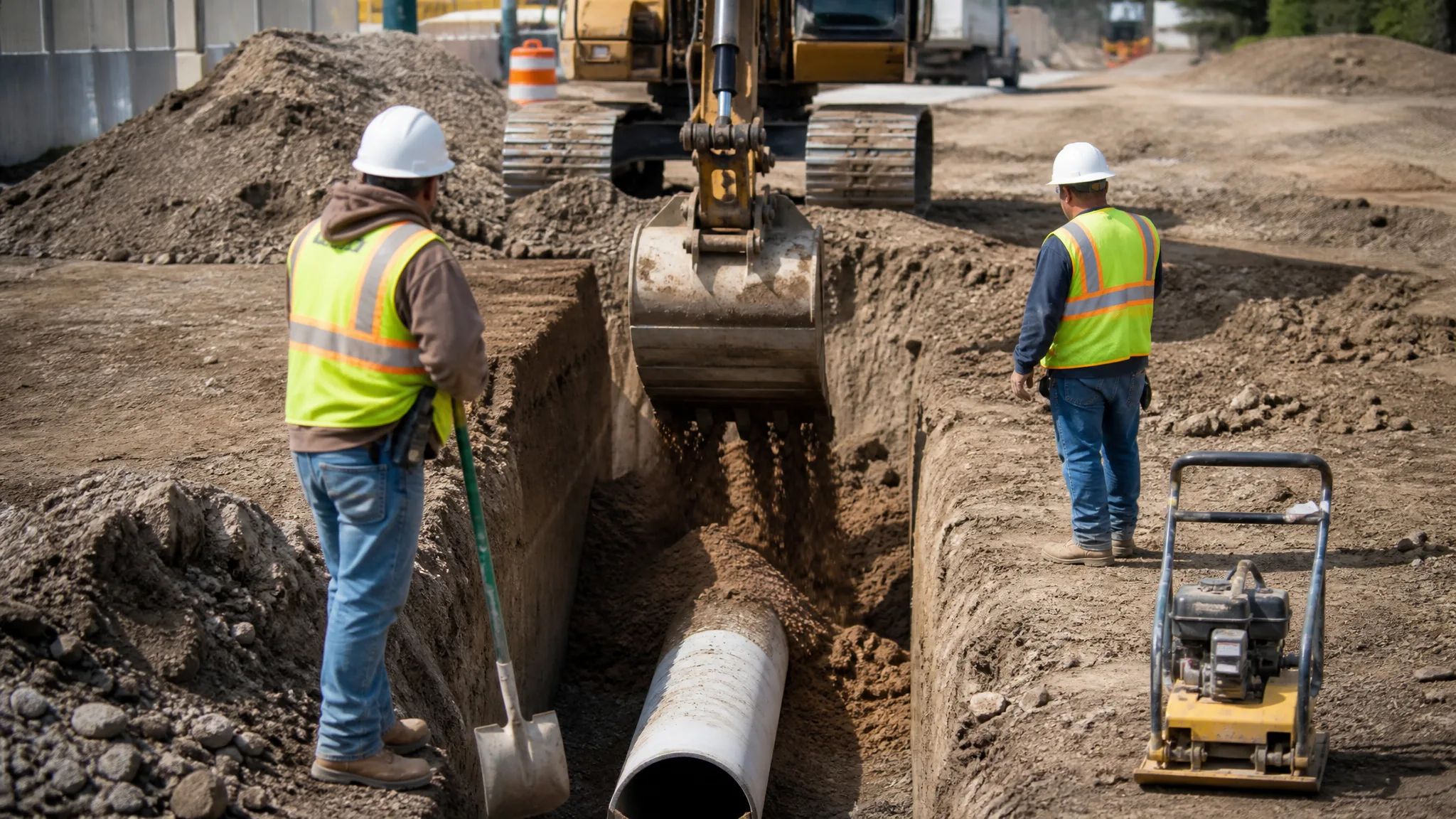
Plan for a small machine in addition to the primary one. Trench backfill is normally compacted with a rammer at the bottom and in the middle lifts, with a narrow plate used near the surface. Behind a retaining wall or against a foundation, hand-operated equipment and thinner lifts take over because heavy equipment cannot safely work that close, and because the fill right against a wall carries drainage responsibility as well as load. The lift sequencing for that work is described in our guide to backfilling a foundation.
Under slab areas, penetrations and reentrant corners need the same density as the middle of the pad. A plate left too long in one spot can also over-compact and create a hard, uneven surface, so corner work calls for short, overlapping passes rather than long dwell times.
Rent, Buy, or Subcontract
Compaction equipment is a good candidate for renting when the work is intermittent. A plate and a rammer are common enough to rent almost anywhere, cheap to transport, and rarely worth owning if you run them a few days a year.
Rollers are a different calculation. The machine is expensive, requires transport, and only earns its keep with steady volume. Contractors who place large amounts of fill regularly tend to own at least one roller; everyone else rents per job or subcontracts the compaction work along with the grading package. The same utilization math that governs renting versus owning an excavator applies here.
The right framing is cost per cubic yard placed, not rental rate per day. A machine that doubles production on a large pad usually pays for itself; on a single small trench, the labor cost of the crew standing around while a big machine is set up dwarfs the rental savings.
A Simple Selection Checklist
- Identify the material: granular (sand, gravel, crushed stone) or cohesive (clay, silt).
- Identify the application: open area, trench, or confined space against a structure.
- Match the machine class: vibratory plate for granular, rammer for cohesive and trenches, roller for large areas.
- Set lift thickness from the specification or, without one, from the machine's working range.
- Confirm moisture before rolling or tamping, and add water if the material is dry.
- Run passes until the surface stops compressing, then verify density if the project requires it.
Compaction rarely fails loudly. It fails quietly, months later, as a sunken driveway, a cracked slab, or a trench line that shows up as a dip across the yard. Choosing the machine to match the soil is the cheapest insurance available on those outcomes, and it costs far less than reworking a lift that was never going to pass.