Is Crushed Concrete a Good Driveway Base?


Crushed concrete is one of the most common questions we hear from landowners and builders planning a driveway: is it actually any good as a base, or is it just cheap? The short answer is yes, crushed concrete, properly called recycled concrete aggregate (RCA), performs very well as a driveway base when it is sourced clean and installed correctly. The longer answer matters more, because RCA's performance depends entirely on the quality of the material and the quality of the installation.
What Crushed Concrete Actually Is
Recycled concrete aggregate is exactly what the name says: concrete from demolished slabs, footings, sidewalks, curbs, parking lots, and roadways that has been crushed and screened into spec-sized aggregate. A crushing plant breaks the material down around any embedded steel, a magnetic separator pulls out rebar and wire, and screens sort the result into sizes such as 3/4-inch minus, 1-1/2-inch drainage stone, and larger base material.
The crushing process matters. The best RCA comes from suppliers that remove reinforcement and debris and screen to a consistent gradation. Cheap, poorly processed material with chunks of rebar, wire, or other debris can cause punctures and soft spots later, so where you buy it matters as much as what you pay.
Why It Works Well as a Base
RCA's strength as a base comes from three properties. First, crushed concrete particles are angular and irregular, unlike rounded river gravel, so they interlock under compaction instead of rolling past one another. That mechanical lock gives a compacted RCA base real stability under vehicle traffic.
Second, RCA contains residual cement powder from the original concrete. When the material is wetted and compacted, that cement can partially re-harden, creating a semi-bound layer that gets stronger over time, almost a hybrid between loose gravel and a solid slab. Third, a properly graded RCA layer drains well, letting water pass through instead of ponding on the surface, which is a major advantage for a material that sits outdoors in every season.
The Pros of a Crushed Concrete Driveway
The biggest advantage is cost. RCA typically sells 20 to 50 percent cheaper than quarried stone in many markets, and it is often the least expensive way to build a durable driving surface. It is also a genuinely green material, keeping thousands of pounds of concrete out of landfills and reducing demand for newly mined aggregate.
Performance follows close behind. A well-built crushed concrete driveway stands up to heavy loads, including loaded dump trucks and equipment, far better than ordinary gravel, and its drainage keeps it from holding water. In freeze-thaw climates, the open, porous structure handles frost movement better than a rigid paved surface, which is why RCA is standard base material under many roads and parking lots as well as driveways.
The Cons and Limitations
RCA is not a perfect material, and the limitations are worth knowing before you commit. Quality varies by source, and contaminated loads, material with heavy rebar content, or inconsistent sizing can behave badly. RCA particles are also more porous than virgin stone and absorb more water, which matters in applications where the material is mixed into new concrete, though it is far less of an issue in a compacted base course.
Appearance is the other common drawback. Crushed concrete has a gray, mottled, industrial look, and fine material can create dust in dry weather, so it is rarely chosen as a finish surface next to a front door. It may also contain pieces of embedded wire or other debris on the surface that are rough on tires and bare feet, and in some areas local rules restrict or regulate recycled aggregate use, so check with your supplier and local building department.
Base vs. Surface: Using the Right Layers
The key to a lasting RCA driveway is building it in two layers, the same way a contractor builds a road. The base layer should be 4 to 6 inches of larger crushed concrete, typically 1-1/2-inch to 2-inch minus material, which provides the structural backbone of the driveway. On top goes a surface layer of 2 to 3 inches of finer 3/4-inch minus material, which fills the voids in the base, compacts to a smoother riding face, and locks up denser than the coarse layer below.
That gives a typical residential driveway a total profile of roughly 6 to 8 inches of RCA. Commercial drives, agricultural access roads, and any surface that will carry heavy truck traffic should be built deeper, in the 8- to 12-inch range, with the heavier base material carrying the load.
Installing It Right
Installation quality decides whether an RCA driveway lasts or ruts out in two seasons. Start with the subgrade: clear vegetation and topsoil down to firm ground, and compact the bare subgrade before any aggregate goes down. On soft soils, a geotextile fabric between the subgrade and the stone keeps the base from migrating down into the dirt, the same principle our article on select fill vs. native soil describes for choosing what goes under a pad.
Place the base aggregate and compact it in lifts, wetting each lift to help the material lock together, then place and compact the 3/4-inch minus surface layer the same way. Multiple passes after watering produce the densest surface. Shape the driveway with a slight crown or a slope away from structures, typically about 1/4 inch per foot, so water sheds off instead of channeling down the drive, and finish the edges with a curb, timber, or stone border so traffic does not push material off the sides.
Compaction and Drainage Are the Difference-Makers
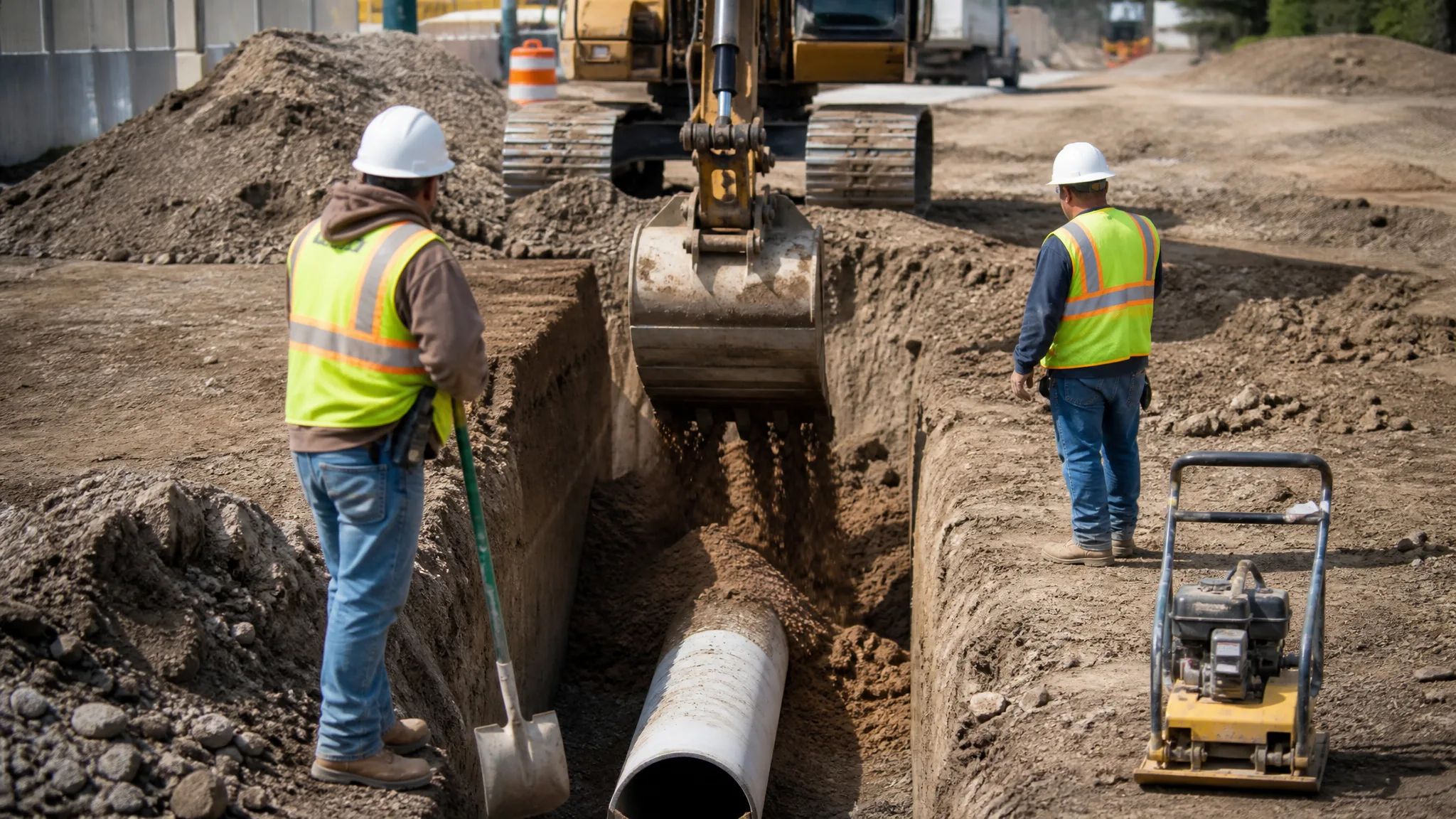
An RCA driveway is only as good as its compaction. Loose aggregate settles into ruts; compacted aggregate locks into a surface that carries trucks. That is why the material should be compacted in lifts at the right moisture content, exactly the principle covered in our guide to the science of soil compaction. A vibratory plate compactor handles small jobs; larger driveways call for a vibratory roller.
Drainage is the partner of compaction. Water is the enemy of every unpaved surface, softening the subgrade from below and washing fines from above, so grade the drive to shed water, direct runoff to a swale or ditch, and keep the driveway from dumping water against a house or garage. For the full picture on shaping ground so water behaves, see our article on creating effective drainage systems during excavation and the geometry of crowned roadways.
Maintenance and the Settling Period
One thing homeowners rarely expect: a crushed concrete driveway improves over its first year. As traffic and rainwater work the residual cement, the surface continues to lock up and harden, so expect to top off low spots with 3/4-inch minus material during the first 6 to 12 months. After that, a light top-dressing of 1 to 2 inches of surface material every year or two, plus occasional grading, keeps the riding surface fresh.
Compared with gravel, which migrates and needs constant re-grading, and asphalt, which needs resealing and crack repair, the maintenance load on RCA is modest, and it never needs the heavy equipment a full re-grade demands. When ruts or potholes do appear, patching is a dozer or skid steer job, not a paving crew job.
When RCA Beats the Alternatives
Choose crushed concrete for long rural driveways, agricultural and equipment access roads, parking areas, and anywhere a budget-conscious, load-bearing surface matters more than looks. It is also an excellent base course under asphalt, pavers, or a future concrete pour, where its strength is captured and its appearance is hidden. For short suburban driveways where appearance dominates, poured concrete or asphalt is usually the better fit, and RCA's rough, gray look makes it a poor choice right at the front of a house.
If you are removing an old concrete slab or driveway anyway, the economics get even better. Breaking and hauling the old concrete is a cost, but many contractors crush it on site or deliver it to a recycler, turning a disposal bill into a material credit, a process our guide to rock-breaking strategies for excavators covers from the equipment side.
The Bottom Line
Crushed concrete is a genuinely good driveway base, and for many property owners it is the best value on the market, but only when three things are true: the material is clean and properly screened, the subgrade is prepared and compacted, and the base is built in compacted lifts with drainage shaped in from day one. Skip any of those and no aggregate will save the driveway.
When you order, ask the supplier for clean 1-1/2- to 2-inch minus base and 3/4-inch minus surface material, figure out how many cubic yards you need before you order, and confirm your numbers with our calculators for soil volume and truckloads and dump truck capacity. And if the driveway is part of a larger build, remember the base course is only one layer of the story; weak spots below it will show through, just as they do in a failing building pad.