Handling Contaminated Soil on a Jobsite


The bucket comes up with soil that is the wrong color or the wrong smell, and the job changes in that moment. Stained dirt, a sheen on the water in the trench, buried drums, an old fuel line nobody knew about — any of these turns a straightforward cut into an environmental problem where the material cannot simply be pushed into a stockpile and hauled to the same place as the rest of the spoil. What happens in the next few hours decides whether the owner gets a clean, documented resolution or a regulator, a consultant, and a very expensive change order.
What Counts as Contaminated Soil
Contamination is not a visual category. Clean-looking soil can carry dissolved solvents, and visibly stained soil can be perfectly acceptable fill once it has been tested. The contaminants that show up most often on earthwork jobs come from a short list of past uses: petroleum products from underground tanks, fuel lines, and equipment yards; heavy metals from lead paint, battery disposal, smelter fallout, and fill that was never clean to begin with; chlorinated solvents from dry cleaners and machine shops; PCBs from old electrical equipment and hydraulic oil; salts and caustics from industrial dumping; and asbestos-containing debris in any fill that includes demolition rubble.
That matters because the term “contaminated” is used loosely in the field and has no single legal meaning. What actually governs the material is where it sits relative to two different yardsticks: the state’s cleanup standards for soil at that land use, and the federal definition of hazardous waste. Soil can fail the first and pass the second, and that difference is the difference between a special waste profile at a Subtitle D landfill and a manifested hazardous waste shipment.
Stop First, Sample Second
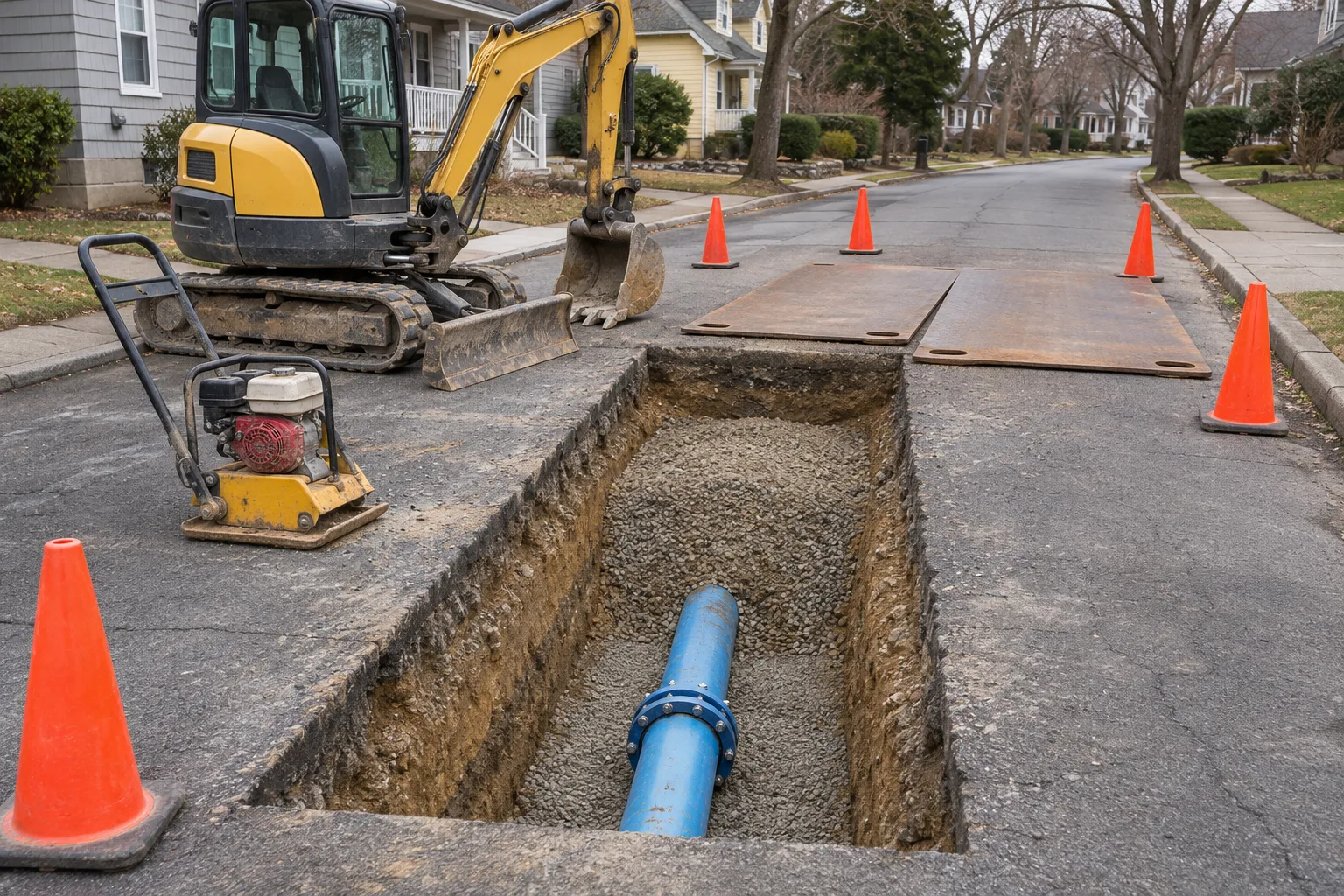
The instinct to keep production moving is the wrong one. When the material is visibly impacted, stop excavating that area, leave the material where it is, flag and barricade the limits, and keep equipment from tracking through it into clean areas. Notify the owner or the owner’s representative and the engineer in writing the same day. On a public job, notice requirements are usually measured in hours, not days.
Safety obligations arrive with the material. OSHA’s hazardous waste operations standard, 29 CFR 1926.65, covers cleanup operations required by a governmental body, corrective actions at RCRA sites, and voluntary cleanups at sites a government body has recognized as uncontrolled hazardous waste sites. Where it applies, general site workers need a minimum of 40 hours of off-site instruction plus three days of supervised field experience; workers who are on site only for a specific limited task, or who work in areas already characterized as free of exposure above permissible limits, need 24 hours plus one day of field experience; and everyone covered needs eight hours of refresher training annually. Equipment operators are not exempt because they stay in the cab — dust, vapours, and contaminated ground under the tracks are exposures.
Building a Sampling Plan That Holds Up
Do not sample by grabbing a jar from the most interesting-looking spot. A defensible characterization starts with a plan: where the samples will come from, how many, how deep, whether they are discrete or composite, and which laboratory methods will be run. Discrete samples are the default around a suspected source area, because compositing a hot spot with clean soil dilutes the result and hides the very thing you are trying to find. Compositing is for confirming that a large volume of material is uniformly clean.
The laboratory list follows the suspected source. Petroleum releases are typically run for volatile and extractable petroleum hydrocarbons plus BTEX; unknown fill is often run for RCRA metals and a leachability test; dry cleaner or solvent sites call for chlorinated volatile organics; older industrial ground may need PCBs, pesticides, or asbestos screening on the debris fraction. Every sample needs a chain-of-custody form, and the lab needs to be told the holding times — a sample that sits too long before extraction is a sample that will be re-collected at your expense.
Sample before you move material, not after. Once several thousand cubic yards are blended into a stockpile, the only reliable answer left is an average, and an average is what a landfill will price and a regulator will question.
Reading the Lab Results: Cleanup Levels vs. Hazardous Waste
The first comparison is to the state’s soil standards for the site’s current or planned use. Most states publish separate residential and non-residential numbers, and the residential numbers are far stricter because a child can ingest soil in a yard. Exceeding a cleanup standard does not automatically make the soil hazardous waste — it makes it soil that must be managed under the state cleanup program, which usually means disposal with an approved profile, or reuse under an approved plan.
The second comparison is the federal toxicity characteristic. Under 40 CFR 261.24, a waste is hazardous if the toxicity characteristic leaching procedure extract meets or exceeds the regulatory level for any listed contaminant. The metals limits are 5.0 mg/L for arsenic, 100.0 mg/L for barium, 1.0 mg/L for cadmium, 5.0 mg/L for chromium, 5.0 mg/L for lead, 0.2 mg/L for mercury, 1.0 mg/L for selenium, and 5.0 mg/L for silver. Among the volatiles, benzene is 0.5 mg/L and vinyl chloride is 0.2 mg/L. A result at or above the number carries a hazardous waste code — D008 for lead, for example.
Notice that this is a leaching test, not a total concentration. Soil can hold thousands of parts per million of lead and still pass TCLP if the lead is tightly bound in the matrix. That is why a total-metals result above a cleanup standard and a TCLP result below the regulatory level can both be true at once, and why the two numbers answer different questions.
Stockpiling Without Spreading the Problem
Excavated material that has not been characterized is a liability sitting in the open. Build the stockpile like a containment structure: on a graded pad that drains to a controlled point, with berms, a liner or an impermeable base where the state requires it, and a cover that survives wind and rain. Label it with the source area, the date, the estimated quantity, and the sampling status. Keep it out of drainage swales, out of the floodplain, and away from storm drain inlets — the same sediment and stormwater logic that applies to any disturbed area applies with more force to material under investigation.
Segregate by suspicion. Clean spoil from a different part of the site should never be pushed onto a suspect pile, both because it destroys the volume accounting and because it converts clean material into material that now needs testing and possibly disposal. Mixing is also a regulatory problem in its own right: the land disposal restrictions prohibit diluting restricted waste to meet a treatment standard, so blending dirty soil into clean soil to get under a number is not a management strategy.
Track tonnage from the start. Hauling is priced by weight, and the conversion from cubic yards depends on the soil, its moisture, and its swell. If you have not worked that math before, the relationship between volume and weight is covered in how much a yard of dirt weighs, and the axle limits that decide how much can legally leave the gate are in legal weight limits for hauling dirt.
Generator Status and the Hazardous Waste Paper Trail
If the soil is hazardous waste, the contractor or owner who generates it becomes a hazardous waste generator for that month, and the category depends on quantity. Under 40 CFR 262.13, a very small quantity generator produces 100 kilograms or less of non-acute hazardous waste in a calendar month, a small quantity generator produces more than 100 but less than 1,000 kilograms, and a large quantity generator produces 1,000 kilograms or more. A single truckload of contaminated soil can put a small excavating company into the large quantity category for that month.
That triggers an EPA identification number, accumulation time limits, container and pile standards, and a uniform hazardous waste manifest signed by the generator, the transporter, and the receiving facility. The transporter and the disposal facility both need to be permitted for the waste. Land disposal restrictions may require treatment before the soil can be landfilled, which is a facility decision that has to be confirmed before the trucks roll. Keep the signed manifests, the waste profiles, the lab reports, and the weight tickets together; they are the record that the material went where it was supposed to go.
Non-Hazardous Disposal and Beneficial Reuse
Most impacted soil on private dirt jobs is not hazardous waste. It is non-hazardous material that exceeds a cleanup standard, and it moves to a Subtitle D landfill under an approved waste profile, with the lab data attached to the profile application. The approval is not instant, and the facility may reject the load at the gate if the paperwork does not match the material, so the profile has to be in hand before the first truck is loaded.
Reuse is possible and often cheaper, but it is a permitted activity rather than a judgment call. States run voluntary cleanup and beneficial-use programs that allow soil to be placed as fill under an engineered barrier, at a permitted site, or with institutional controls such as a deed notice. What is not allowed is burying the problem deeper on the same parcel and calling it clean. A building pad placed over impacted soil without an approved plan, a cap design, and the required notice is exactly the kind of decision that surfaces at the next property sale.
What It Costs and Where the Money Goes
Contaminated soil costs far more per ton than ordinary spoil, and the gap is driven by three things: the disposal facility’s acceptance requirements, the haul distance, and the labour of handling material separately. Hazardous waste can cost many times what non-hazardous special waste costs, which is why characterization is worth doing carefully and why a small volume of genuinely hazardous material is worth keeping separate from a large volume of soil that only fails a cleanup standard.
The largest single cost lever is segregation. Every cubic yard of clean soil that gets mixed into a dirty pile multiplies the disposal bill. The second lever is schedule: profile approvals, lab turnaround, and facility appointments all take time that has to be built into the sequence. If the material is discovered mid-cut, the rest of the site work has to be re-planned around it, which is a sequencing problem as much as a disposal problem — the same reason earthwork sequencing matters on every job.
Contract Terms That Protect the Contractor
Nobody bids contaminated soil on purpose. The protection comes from the contract, and the clause that matters is the differing site conditions provision. A contractor who encounters a condition that differs materially from what the contract documents indicated — buried tanks, a dump layer, chemical staining — is generally entitled to an equitable adjustment, but only if notice is given within the time the contract allows and the condition is documented before it is disturbed. The mechanics of that process are covered in differing site conditions and change orders.
Price the work, not the fear. A unit rate per ton for excavation, loading, hauling, and disposal of impacted soil, with the characterization and profile costs carried as a separate line, keeps the change order defensible. Refuse to accept a broad indemnity for pre-existing contamination; the owner owns the condition that was there before you arrived. Require the owner to furnish any existing environmental reports, and read them before mobilizing.
Site Hygiene and Closeout
Housekeeping is part of the environmental control. Decontaminate buckets, tracks, and truck tyres before equipment leaves the affected area, contain wash water rather than letting it run to a storm inlet — the same principle behind concrete washout containment — and keep dust down with water or suppressant so contaminated fines do not leave the site as airborne dust. Provide wash facilities and a clean break area, and keep eating and drinking out of the work zone.
Closeout is a document set, not a handshake. The file should hold the sampling plan, the chain-of-custody forms, the laboratory reports, the waste profiles and approvals, the signed manifests, the weight tickets, and the as-built limits of the area that was remediated. If the material was left in place under an approved plan, the approval and any deed notice belong in the file too. That package is what protects the owner at resale and protects the contractor when the question comes back two years later.
Impacted soil is a problem of decisions, not of dirt. Stop, isolate, sample, characterize, then choose the disposal route the data supports — and write all of it down while it is happening.