How Much Does a Yard of Dirt Weigh?


Ask a dirt contractor how much a yard of dirt weighs and you will usually get a shrug and a number that starts with "depends." That is not evasiveness. A cubic yard measures volume, while weight depends on soil type, moisture content, and how tightly the material is packed, and the same 27 cubic feet can legitimately weigh anywhere from about 1 ton to nearly 2 tons. What follows is how that range breaks down, which numbers to plan with, and why the difference matters when you are pricing a truckload or ordering fill.
The Short Answer: Roughly 1.1 to 1.5 Tons Per Cubic Yard
For the materials most projects move — moist topsoil, common fill, and mixed subsoil — plan on about 2,200 to 3,000 pounds per cubic yard, or 1.1 to 1.5 tons. Landscape supply yards typically quote around 2,200 pounds for a yard of moist topsoil and roughly 2,500 pounds for a yard of dry fill dirt, and those figures hold up well in the field.
Geotechnical references run heavier because they describe soil in place rather than screened and stockpiled material. Standard reference values used by engineers put loose uniform sand at about 90 pounds per cubic foot, dense uniform sand near 109, and stiff glacial clay around 106. Multiply by the 27 cubic feet in a yard and those translate to roughly 2,400 to 3,000 pounds per cubic yard for the same handful of soils.
What a "Yard of Dirt" Actually Means
A yard of dirt is one cubic yard: 3 feet by 3 feet by 3 feet, or 27 cubic feet. It is a volume measurement, not a weight, which is why suppliers sell topsoil and fill by the yard and haulers charge by the load. The two units only line up after you apply a density factor.
If you are comparing a price per yard against a price per ton, get the conversion straight before you trust either number. At 1.25 tons per yard, one ton is about 0.8 cubic yards; at 1.4 tons per yard, one ton is closer to 0.7 cubic yards. Guessing wrong in either direction can swing a bid by hundreds of dollars on a job that moves a few hundred yards.
Coverage math that keeps an order honest
A cubic yard spread 3 inches deep covers roughly 100 square feet. That is the fastest sanity check available: 1,000 square feet of lawn at 3 inches of topsoil needs about 10 cubic yards, which is roughly 12 to 13 tons of moist soil once the material is in the truck. If you are working from a plan instead of a pile, the same math runs in reverse when you calculate excavated soil volume and truckloads.
Soil Type Drives the Baseline Weight
Mineral composition and gradation set the starting point. Sand and gravel particles are dense and slide into a tight volume, clay is heavy and holds water, and organic matter is light and porous. That is why a yard of screened topsoil and a yard of wet clay can differ by close to half a ton.
- Topsoil, moist: about 2,200 pounds per yard, lighter when screened and dry
- Fill dirt, dry: roughly 2,400 to 2,600 pounds per yard
- Sand: roughly 2,400 to 3,100 pounds per yard depending on gradation and density
- Stiff clay: about 2,800 to 3,000 pounds per yard
- Compost or garden blends: as light as 1,600 pounds per yard, so use the low end of any estimate
Treat these as planning values, not test results. A supplier who sells thousands of yards a year knows their pit, and a geotechnical report knows your site. When a number has to be right, use one of those rather than a rule of thumb.
Moisture Changes the Weight More Than Anything Else
Water weighs about 8.3 pounds per gallon, and soil holds a surprising amount of it. A dry yard of fill that leaves the pit at 2,400 pounds can come off the truck at 2,700 to 2,900 pounds after a soaking rain, and saturated material pushes past 3,000 pounds without changing its volume at all.
This is why the same pile weighs differently in July and October. It is also why experienced contractors ask whether the material is coming from under cover, how long it has been stockpiled, and whether it rained the day before delivery.
Bank, Loose, and Compacted Yards Are Not Interchangeable
Soil in its natural, undisturbed state is called bank material. Once excavated it bulks up or "swells," because the digging breaks the natural structure and adds voids. Typical swell runs 20 to 30 percent, with sand at the low end and clay or dense subsoil at the high end. Ten bank yards of clay come out of the ground as roughly 12 to 13 loose yards, which is the same balance that drives cut and fill decisions on a grading job.
The mass does not change, only the volume, and that flips the per-yard weight around. A loose yard weighs less than a bank yard because the same tonnage occupies more space. This is the single most common source of confusion when a contract is written in yards and the truck scale reads tons, and it is worth settling before the first load moves. Ordering topsoil, backfill, or borrow against excavated volumes is a good way to get the quantities wrong in your favor or against it.
Why Dirt Weight Matters for Truckloads
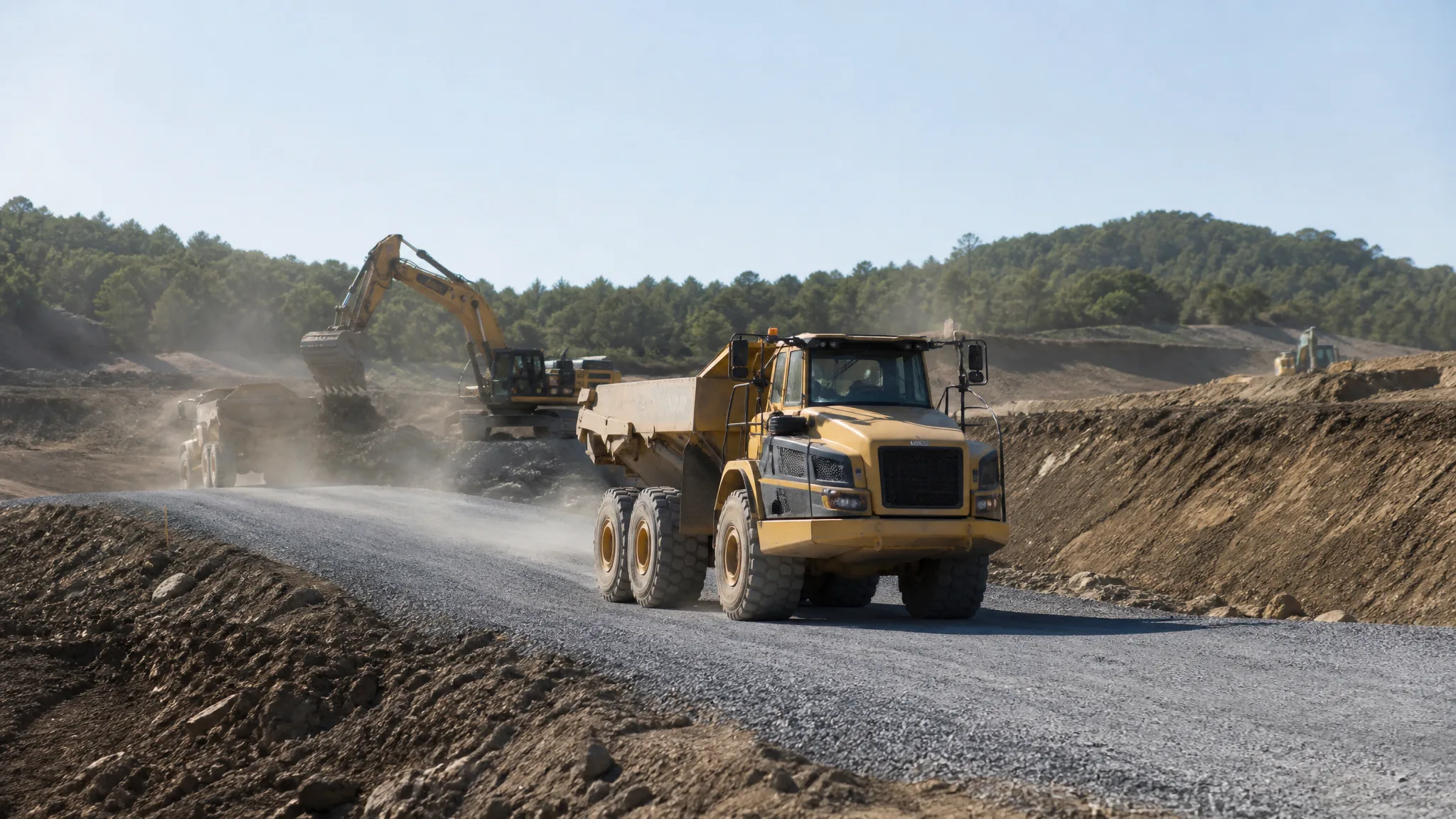
Legal loads are governed by axle weight, not by how much the bed will hold. Federal bridge law caps a pair of tandem axles spaced 8 feet or less apart at 34,000 pounds combined, and gross vehicle weight on the interstate system tops out at 80,000 pounds, with states applying their own tables on top of that. In practice a tandem-axle dump truck hauls roughly 12 to 16 tons, a tri-axle roughly 18 to 22 tons, and a single-axle truck around 6 to 10 tons, which is why how many yards a dump truck holds changes with the material in the bed.
Put those limits next to the density numbers and the trap becomes obvious. Fourteen loose yards of wet clay at 1.5 tons per yard is 21 tons, which is a legal overload for a tandem truck that still has room in the bed. Haulers load to weight, so the yards per load you were quoted may not be the yards you receive.
If hauling is a big line item, quote the job in tons and convert to loads from there. It also helps to confirm whether the truck can legally reach the site, since weight-restricted roads and bridges are common around residential developments.
Ordering Fill and Topsoil Without Overpaying
Most suppliers price by the cubic yard, so the fair comparison starts with a conversion to tons. Ask what the material weighs per yard, whether the price includes delivery, and what the minimum order is. For large orders, ask for the weight ticket on the first few loads and compare it to what you assumed.
Price per yard also hides quality differences. Screened topsoil that was stripped and stockpiled properly, unscreened fill, and blended garden mix are not substitutes, and the cheaper pile often carries more rock, debris, or clay. For structural work the material has to meet the fill specification, so it is worth knowing how select fill compares with native soil before you order.
Weight and Compaction Specifications
Compaction specs are written as a percentage of maximum dry density, determined by ASTM D698 (Standard Proctor) or ASTM D1557 (Modified Proctor). Density is measured against those lab values, and moisture content is part of the result, so a heavier wet yard does not mean better compaction. Fill that is too wet to compact rolls up under a roller and tests low on dry density no matter how much weight is in it.
That is the practical link between soil weight and site work: the density the lab reports is dry density, not the number on the scale at the pit. Contractors who understand the difference plan moisture, lift thickness, and the right compaction equipment around the weather rather than around tonnage.
A Quick Reference You Can Actually Use
- One cubic yard equals 27 cubic feet of material
- Typical planning weight: 1.1 to 1.5 tons (2,200 to 3,000 pounds) per yard
- One ton is roughly 0.7 to 0.9 cubic yards, depending on material
- One yard spread 3 inches deep covers about 100 square feet
- Excavated soil bulks up 20 to 30 percent, so bank yards and loose yards differ
- A tandem dump truck hauls about 12 to 16 tons legally; a tri-axle about 18 to 22
None of these numbers replace a scale or a lab test, but they will keep an estimate in the right neighborhood and flag a bid that was built on the wrong density.
How to Get a Number You Can Count On
Start with the range, narrow it with the material type, and then confirm it with weight tickets from the pit or an actual moisture and density test on the job. Read the soil information for your site before you bid, and if you are estimating an excavation job, carry a contingency for wet weather and heavier-than-expected soil. Both are common, and both show up as extra loads rather than extra yards.
Get the order of operations right and the weight question answers itself: know the volume from the plan, know the material from the soil report or the supplier, apply a realistic density, and convert to loads before the first truck pulls onto site.