Legal Weight Limits for Hauling Dirt

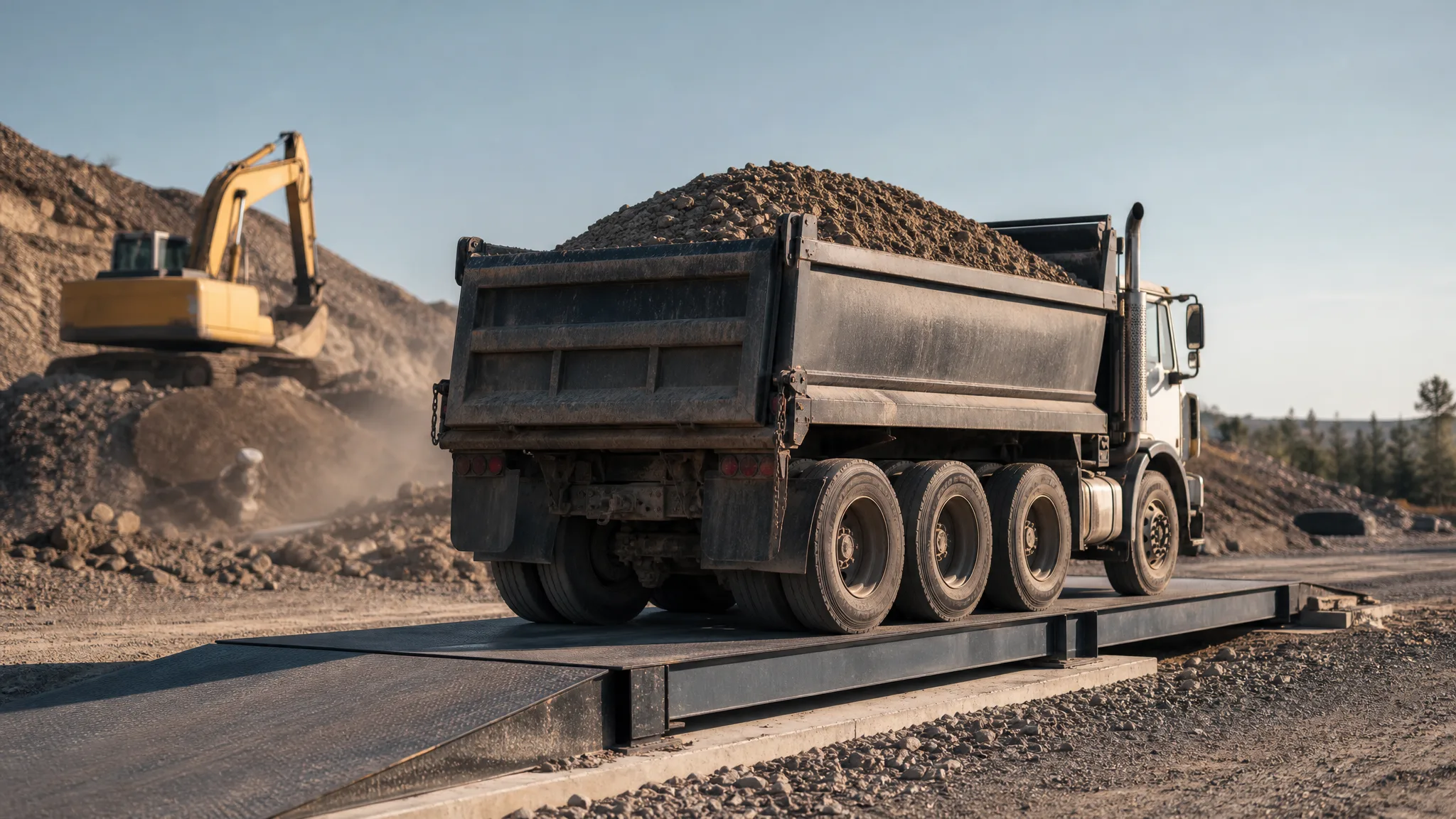
Every dirt job ends the same way: material has to leave the site on a truck, and that truck has to be legal on a public road. Most hauling problems are not excavation problems at all. They are weight problems, and they get discovered at a scale house or on the shoulder with a set of portable scales under the axles. Understanding how the limits are built, rather than memorizing one number, is what lets an operator load a truck heavy enough to make money and light enough to stay out of trouble.
The Four Numbers That Govern Every Load
Federal weight law for the Interstate System rests on four separate limits, and a load has to satisfy all of them at once. Under 23 CFR 658.17, the maximum gross vehicle weight is 80,000 pounds, the maximum on any single axle is 20,000 pounds, and the maximum on a tandem axle group is 34,000 pounds. The fourth rule is the bridge formula, which caps the weight carried by any group of two or more consecutive axles based on how far apart they are.
The definitions matter as much as the numbers. A single axle means one axle, or a group whose centers are spaced no more than 40 inches apart. A tandem is two or more consecutive axles spaced more than 40 inches but not more than 96 inches apart. Spread axles beyond 96 inches stop being a tandem for this purpose and start being treated as separate axles tied together by the bridge formula. That is why a sliding trailer tandem can be legal in one position and overweight in another without a single pound being added.
Why the Bridge Formula Exists
Bridges are not stressed by total weight alone. They are stressed by how tightly that weight is concentrated along the span. A short, heavy truck can load a bridge member harder than a long truck of the same gross weight, because the long truck spreads its load over more of the structure. Congress addressed that in 1975 by tying allowable weight to axle spacing instead of writing a single flat cap.
The formula is W = 500 [LN / (N - 1) + 12N + 36], where W is the maximum weight in pounds on the axle group rounded to the nearest 500, L is the distance in feet between the outermost axles in the group, and N is the number of axles in the group. The Federal Highway Administration publishes the resulting bridge table, and the published values are easier to use in the field than the algebra.
Some reference points from the FHWA bridge table show how sharply spacing changes the answer. A three-axle group spanning 20 feet is allowed 51,000 pounds. A four-axle group spanning only 9 feet is allowed 42,500 pounds, even though it has more axles, because the axles are bunched together. A four-axle group spanning 35 feet is allowed 65,500 pounds. A four-axle group spanning 23 feet is allowed 57,500 pounds.
Three Checks, Not One
A dump truck and trailer is never judged on a single total. Compliance is checked on individual axles, on each tandem, on the gross weight, and then on several overlapping axle groups. The FHWA guidance identifies the critical groups on a five-axle combination as axles 1 through 3, axles 1 through 5, and axles 2 through 5. On a straight truck the critical check is usually the group of closely spaced axles at the rear, not the whole vehicle.
That is why a truck can weigh under 80,000 pounds and still be illegal. If the trailer tandem is carrying 36,000 pounds, the gross number is irrelevant; the vehicle is overweight on that group. Loading a dump box so the weight sits over the rear axles rather than spread through the middle is the single most common way an operator creates an overweight condition while believing the load is fine.
Working Out Payload From Tare and Rating
Legal payload starts with the truck, not the pile. The gross vehicle weight rating on the certification label is the manufacturer's limit for that chassis, and it is frequently lower than the highway limit. Axle ratings on the same label are usually the binding constraint, because steering axles and rear axle groups are rated individually.
The arithmetic is straightforward once the truck is scaled empty. Take the loaded limit for each axle and group, subtract the empty weight measured at that same position, and the remainder is the payload that position can accept. The smallest of those remainders controls the load. A truck with an 80,000-pound rating and a 25,000-pound empty weight has 55,000 pounds of paper capacity, but if the rear group can only absorb another 38,000 pounds and the steering axle is already near its rating, then 38,000 pounds is the real number before the bridge formula is even applied.
Tare weight is not a fixed value, either. Fuel level, the driver, tools, a full DEF tank, mud on the frame, and a different trailer all move it, so contractors who haul daily scale the empty truck once with typical fuel and gear and keep the sheet in the cab.
Why Dirt Is a Hard Load to Keep Legal
Dirt is dense, and density is invisible from the seat. A cubic yard of ordinary soil typically runs somewhere around one to one and a half tons, and wet clay, rock, or saturated spoil runs heavier. A dump box that is comfortable with a light load of mulch or debris will be badly overweight with the same volume of wet subsoil.
Volume capacity and weight capacity are unrelated numbers. A body rated at 16 cubic yards will physically hold 16 yards of anything, which is why body size alone says very little about legal payload. If the material weighs more per yard than the truck can legally carry, the box fills and the scale says no. Working backward from legal payload to a maximum volume for the material on that job is the only reliable approach, and it has to be redone when the material changes from dry topsoil to wet spoil.
The volume side of the same problem is covered in soil swell and shrinkage factors, and the density question in how much a yard of dirt weighs. Both feed the loading decision, because a bank yard in the ground is not a loose yard in the box. Turning those volumes into a trip count is the work described in calculating excavated soil volume and truckloads and in excavation takeoff methods.
Loading to the Scale, Not to the Box
Experienced loaders do not fill a truck and hope. They count buckets. If a machine's bucket holds a known volume and the material has a known weight per yard, the number of passes to reach legal payload can be calculated in advance and marked on the wall of the scale house or the cab. The same logic that sizes a fleet for a dirt-hauling job starts here, with the legal payload of one truck.
Two habits make that work in practice: keep the load centered or slightly forward rather than heaped over the tailgate, and treat a heaped load as a warning sign rather than a goal. A load level with the sides is usually close to legal for dense material.
When a truck is running near the limit, a small scale on site pays for itself quickly. Portable axle scales are inexpensive compared to the cost of an overweight citation, an off-load, and a lost half day. The regulations allow a scale allowance for portable wheel-load weighers because their accuracy is generally within 2 or 3 percent, but the same section caps any allowance at 5 percent and states that the weight limits include all tolerances. Relying on that margin is not a plan.
Permits, Overweight Loads, and Nondivisible Loads
States may issue special permits for nondivisible vehicles or loads without regard to axle, gross, or bridge formula requirements, which is how a 90,000-pound excavator moves on a lowboy. The permit is route-specific and often comes with conditions: approved roads, escort requirements, travel windows, speed limits, and bridge clearances. A permit for one corridor does not authorize a shortcut.
A divisible load of dirt is a different matter. Spoil, gravel, and aggregate can be split across trucks, so overload permits generally are not available for them; the material has to be re-loaded or the excess off-loaded. That distinction surprises contractors who are used to permitted equipment moves. Dirt is never nondivisible.
State limits also vary off the Interstate System, and posted bridge limits can be lower than the statutory maximums regardless of what the truck weighs. Local roads, residential subdivisions, and older bridges are where legal loads still get turned around.
Covering the Load and Keeping It On the Truck
Federal cargo securement rules require that a commercial vehicle be loaded, equipped, and secured so the cargo cannot leak, spill, blow, or fall from the vehicle, and so that the load cannot shift enough to affect stability or maneuverability. For dirt and aggregate that means a body in good condition, a tailgate that latches, and a load that is not mounded above the sides. Most states add their own cover or tarp requirements for loose material on public roads, and enforcement is often tied to spill complaints from the public rather than to a scale.
Spillage is a cost as well as a violation. Material lost over the tailgate is material the customer paid to move.
What an Overweight Ticket Really Costs
The citation is the smallest part of the bill. Hauling is already one of the biggest line items in excavation cost per cubic yard, and an overweight stop adds crew time, machine time, and rework on top of it. An overweight truck is typically held until the excess is removed, which means either calling another truck to the scale or shoveling material off on the spot. The crew, the machine, and the downstream trucks all wait. Repeated violations can affect a carrier's safety rating and insurance, and some jurisdictions treat egregious overloads as more than a civil matter.
There is also a cost that does not show up on a ticket. Overloaded trucks wear out springs, bushings, wheel seals, tires, brakes, and frames faster, and braking distance grows with every pound.
A Practical Weight Compliance Checklist
- Scale the empty truck with normal fuel and gear, and record the weight at each axle and axle group.
- Read the certification label and note the GVWR plus every axle and tandem rating; the lowest governs.
- Convert legal payload into a maximum volume for the specific material being hauled that day.
- Measure the axle spacing on the loaded combination and check the bridge table for the critical groups.
- Keep the trailer tandem where the bridge formula is satisfied, and re-check it after any adjustment.
- Count buckets or passes to the calculated load rather than filling to the top of the box.
- Keep the load level or slightly forward, never heaped over the tailgate.
- Confirm the route, posted bridge limits, and any permit conditions before the first load leaves.
- Tarp or cover loose material as required, and fix tailgate leaks before they become a complaint.
- Scale the first few loads of any new material to confirm the density assumption was right.
None of this requires a compliance department. It requires one sheet of paper with the truck's empty axle weights on it, a density figure for the material, and the discipline to load to the number instead of to the box. Contractors who haul dirt for a living already know the math, the same way they know the assumptions behind a hauling and excavation estimate. The ones who get caught are usually the ones who never wrote it down.