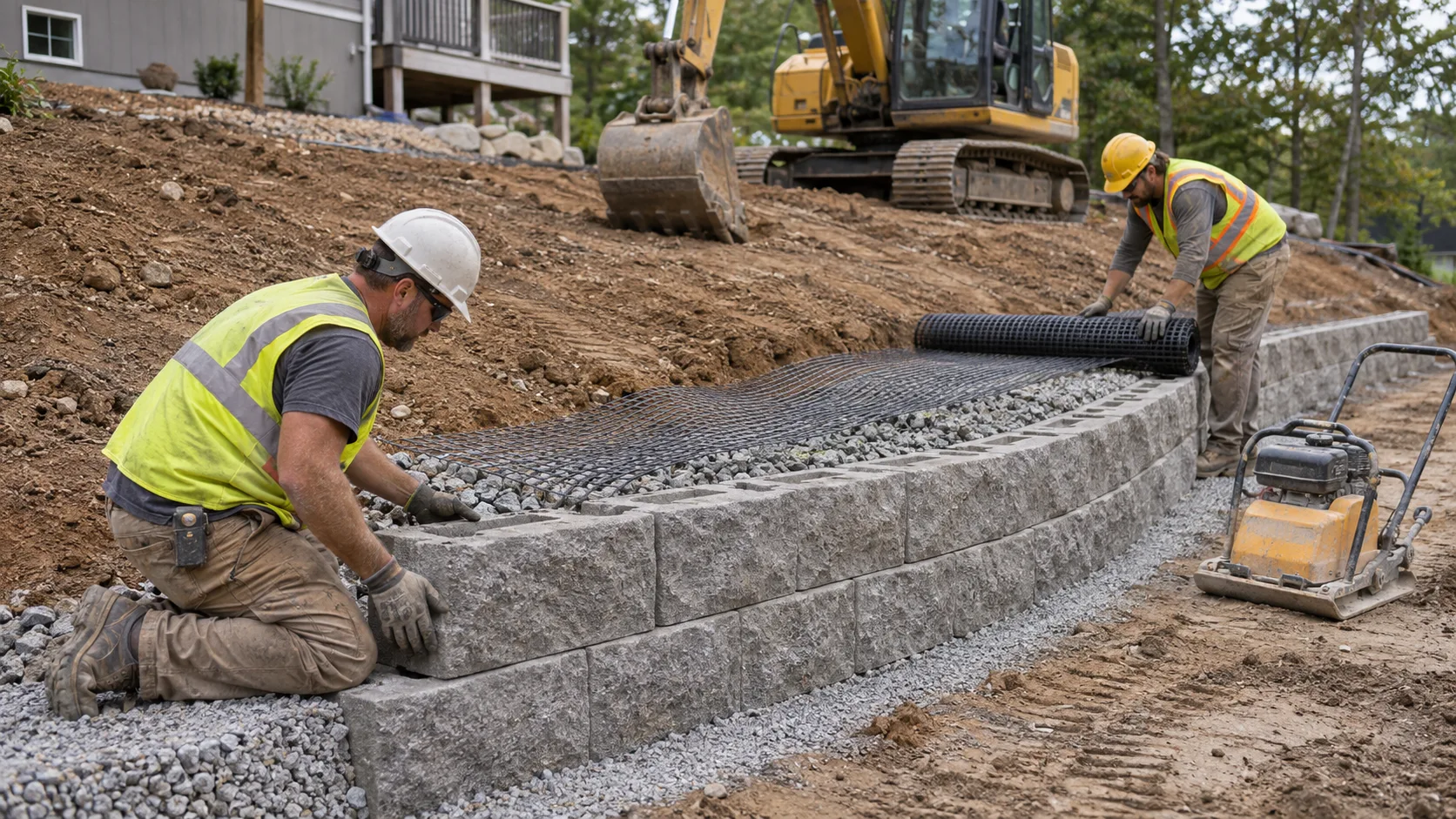
Permeable Pavement Installation

Permeable pavement is not a paving product with holes in it. It is a stormwater system with a driving surface on top, and the surface is the least important part of the assembly.
Pervious concrete, porous asphalt, and permeable interlocking pavers all work the same way: water passes through the surface into an open-graded stone reservoir, then infiltrates into the subgrade or drains out through an underdrain. Get the subgrade, the stone, and the construction sequencing right and the system lasts. Get them wrong and it plugs in a season.
Three Surfaces, One Working Principle
The differences between the three common permeable surfaces are mostly in how water gets through them. Pervious concrete has little or no fine aggregate, so the voids run through the slab itself. Porous asphalt uses an open-graded mix with a high void content. Permeable interlocking pavers pass water through the joints between units, with a small stone-filled gap doing the work.
What all three share is a structural and hydraulic dependence on the layers below. The pavement surface takes the traffic load and filters the first contact with water. The open-graded reservoir below it holds the design storm volume. The subgrade accepts the water or the underdrain carries it away. None of those layers works without the others, which is why a permeable surface over a compacted, clay-rich subgrade is a very expensive puddle.
Start With the Subgrade, Not the Pavement
Wisconsin's stormwater technical standard for permeable pavement calls for subgrade slope to be as flat as possible and no greater than 2 percent. Above that, the design has to break the reservoir into cells so water does not seep out through the downgradient portion of the pavement instead of being stored and infiltrated evenly.
Equally important is what not to do. Densifying the subgrade to a conventional pavement spec reduces its porosity and permeability below the design values, and the standard names that problem directly: over-compaction. The subgrade needs to be stable enough to build on and permeable enough to function, and those two goals pull against each other.
That usually means proof rolling to find soft spots rather than beating the whole area into submission, and scarifying any surface that has been smeared or sealed by tracking. Where the native soil will not take water at the required rate, the design changes — a deeper reservoir, an underdrain, or a liner — it does not get ignored.
The Open-Graded Reservoir and What Clean Stone Means
The reservoir is washed, open-graded crushed stone or crushed gravel with no more than 5 percent passing the No. 200 sieve, and a minimum porosity of 30 percent measured under ASTM C29. Those two numbers are the whole point of the layer: enough void to store water, and few enough fines that the voids stay open.
"Washed" is not a marketing word here. Dirty stone with a high fines content will hold water in the short term and lose most of its storage capacity as the fines migrate. If a load arrives dusty or with visible crusher dust coating the particles, reject it or wash it before it goes in the hole.
Wisconsin's criteria also set a minimum reservoir depth of 12 inches regardless of whether an underdrain is present, and require at least 5 inches of clean aggregate below open-jointed pavers, whether that thickness comes from the joint fill, the bedding course, or a combination of both. The gradations involved are the same ones used for drainage stone everywhere, covered in gravel and stone sizes explained.
A separation geotextile between the reservoir and the subgrade is common practice where fines migration is a risk. It keeps the subgrade from pumping into the stone while still allowing water through.
Sizing the Storage Volume
The reservoir has to hold the runoff from the design storm, less whatever infiltrates while the storm is falling. The arithmetic starts with volume: contributing area times rainfall depth times a runoff coefficient. For impervious contributing area, that coefficient is close to 1.
Then convert to stone volume by dividing by the porosity. Take 1 inch of rain falling on 1,000 square feet of contributing impervious area, with no credit for infiltration during the storm. That is 1,000 square feet times 1/12 foot, or about 83 cubic feet of runoff. At 30 percent porosity, the stone has to be about 278 cubic feet, which at 1 foot of reservoir depth is roughly 278 square feet of pavement.
That example is deliberately simple, and a real design adds direct rainfall on the pavement itself, subtracts infiltration during the storm, checks the drain-down time, and follows the method in the local stormwater manual. The point is that the reservoir depth is a calculated number, not a default. Most manuals publish a required drawdown period, and a system that holds water for days is a mosquito habitat with pavement on top.
Underdrains, Liners, and When Water Has Nowhere to Go
Where the subgrade is low permeability, or where infiltration is restricted by regulation, the system is built with an impermeable liner and an underdrain. The liner — compacted clay or a geomembrane such as HDPE — stops water from migrating, and the underdrain at the bottom of the reservoir carries it to a controlled outlet. The pavement then functions as detention rather than infiltration, which is still a legitimate stormwater solution.
The underdrain needs slope to its outlet, cleanouts or inspection ports at the ends, and an outlet that cannot be blocked. A lined system with a plugged underdrain has no way to empty, and the first significant storm will show it.
Infiltration systems also need setbacks. Wisconsin's standard requires at least 10 feet from adjacent building foundations where a hydraulic connection is possible, and 50 feet from a septic system dispersal cell. Those distances exist because putting stormwater into the ground next to a foundation or a drain field creates problems that are far more expensive than the pavement.
Protect the System During Construction
Permeable pavement should be one of the last things built on a site, because everything upstream of it is a sediment source. Stockpiling soil or construction material on the surface is explicitly prohibited, and for good reason: the reservoir has no way to clean itself once fines are worked into the stone.
Before the pavement goes down, the contributing drainage area should be stabilized, sediment controls should be in place and functioning, and runoff should be diverted away from the pavement footprint. If the reservoir does get contaminated before surfacing, the stone has to be removed and replaced, not washed in place.
This is the same sequencing discipline that governs the rest of site work, and it overlaps heavily with the stormwater controls covered in what is a SWPPP and storm drain inlet protection.
Equipment traffic on the completed reservoir is a separate problem. Tracked machines and loaded trucks will crush the open-graded stone and mix it with the subgrade, so access is planned around the pavement, not across it.
Placing Pervious Concrete, Porous Asphalt, and Pavers
Pervious concrete is placed with a low water-to-cement ratio and very little sand, struck off, and consolidated with a light roller rather than the vibration a conventional slab gets. Too much vibration drives the paste down and seals the surface. It also needs a proper moist cure, typically about seven days, because the open structure loses water quickly.
Porous asphalt is placed at the temperature the mix design requires and rolled with a light roller. Heavy breakdown rolling closes the surface voids, which defeats the entire purpose. The mix also has to come from a plant that actually produces open-graded material, not a standard surface mix with the fines turned down.
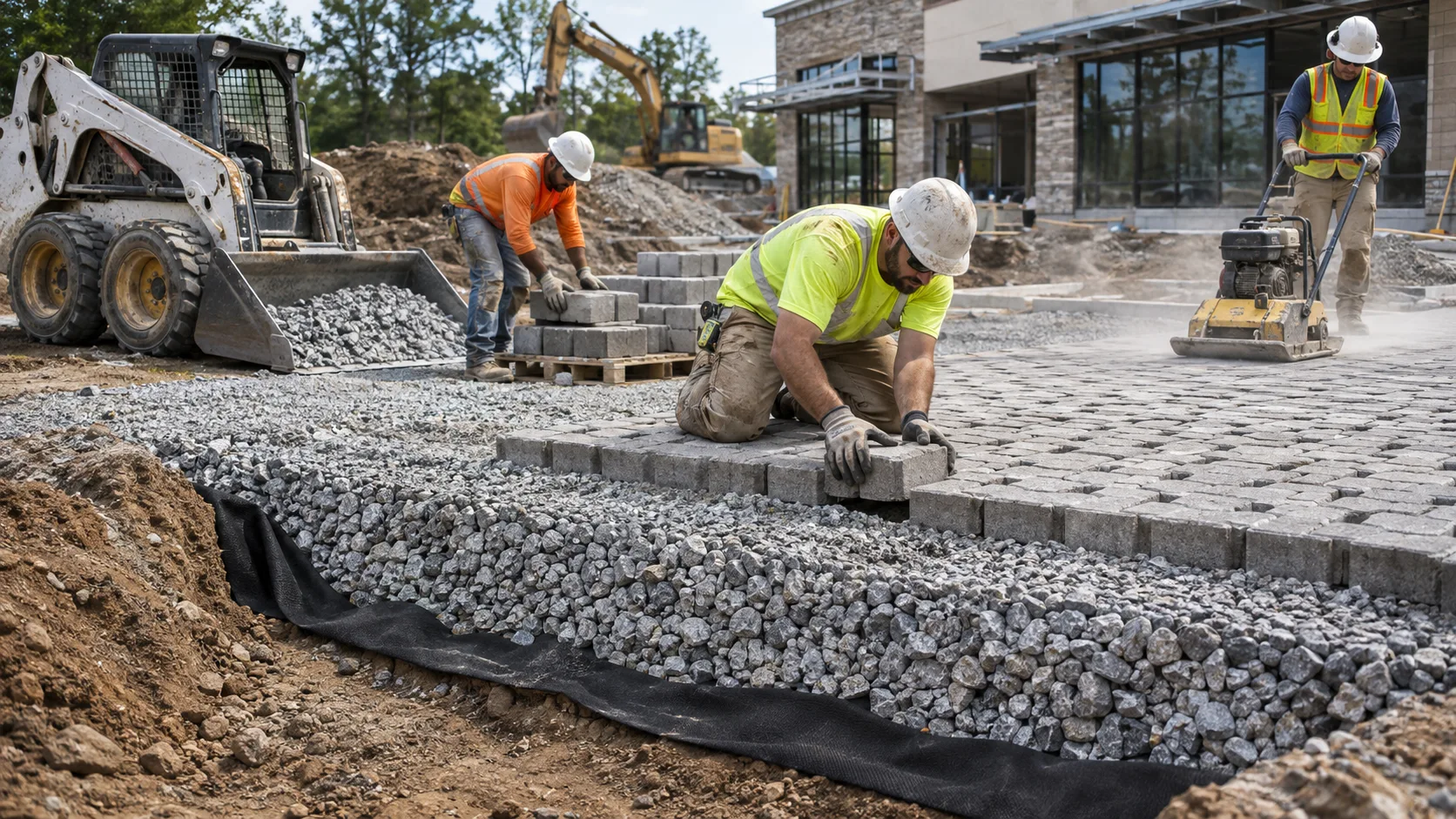
Permeable pavers go down on a clean aggregate bedding course, with the joints filled with the specified small stone and the whole field compacted with a plate compactor to seat the units. Edge restraint is critical — pavers without a proper edge will spread under traffic and open the joints wider than the design allows.
In all three cases, the acceptance test is the same. Wisconsin's standard requires a surface infiltration rate of at least 100 inches per hour at completion, tested under ASTM C1701 for pervious concrete and porous asphalt or ASTM C1781 for permeable pavers. Below 10 inches per hour in service, the surface is considered failed.
What You Cannot Do On or Near Permeable Pavement
The list of prohibited activities is short and absolute in the Wisconsin standard: no stockpiling of soil or other clogging material on the surface, no seal coating, and no sand for deicing.
Run-on is restricted too. Water from industrial storage and loading areas, vehicle fueling and maintenance areas, construction sites and other disturbed land, agricultural land, and unstable landscape areas cannot be directed onto permeable pavement. The exception for landscapes requires a grass filter strip with a slope under 5 percent and a flow length of at least 5 feet.
The pavement itself cannot be used in industrial storage and loading areas or in vehicle fueling and maintenance areas, because the spill and loading risk is incompatible with infiltration. Lined systems with subsurface drainage can be used where infiltration is prohibited, but the prohibited source areas still apply.
Winter maintenance is the practical limitation most owners notice first. Plowing is fine with care, but sanding fills the voids, and salt still runs off with the meltwater. Many owners budget on accepting a rougher winter surface rather than filling the system with grit.
Maintenance: The Part That Decides the Life Span
Permeable pavement clogs slowly from the top down, and the model inputs in the Wisconsin standard say a lot about how it behaves: a surface clogging capacity of 0.6 pounds per square foot and a cleaning efficiency of 50 percent. In plain terms, the surface can absorb a certain amount of dirt, and routine cleaning removes about half of the accumulated load each time.
Annual inspection is the minimum, covering both pavement condition — settlement, deformation, cracking — and surface infiltration. Where the rate is dropping, cleaning is the fix, and it means vacuum sweeping or regenerative air sweeping, not blowing debris around with a leaf blower. Pressure washing only helps when the water and loosened material are recovered.
Where a section has failed outright, the standard's guidance is to restore the infiltration rate to an acceptable level for the remaining service life, or replace the section. Cutting out and replacing a small area is usually cheaper than trying to rehabilitate a reservoir that has been contaminated from below.
Inspection and Acceptance Checklist
Before signing off a permeable pavement installation, confirm:
- Subgrade slope is 2 percent or flatter, with cells or an alternate design where it is steeper.
- The subgrade has not been over-compacted or smeared, and infiltration was verified where required.
- Reservoir stone is washed and open-graded, with no more than 5 percent passing the No. 200 sieve and at least 30 percent porosity.
- Reservoir depth meets the design, and never less than 12 inches.
- Separation geotextile is in place where fines migration is a risk.
- Underdrains, if used, are sloped, clean, and discharge to a functioning outlet.
- Setbacks to foundations and septic systems are met.
- Contributing areas are stabilized and sediment controls are working.
- Surface infiltration tests at or above 100 inches per hour at completion.
- No seal coating, sanding, or stockpiling has occurred on the finished surface.
For the site-work context around a permeable lot, see building a commercial parking lot and subgrade, subbase, and base course. The same storage-and-drainage logic appears at a smaller scale in installing a dry well and building a rain garden, and the paving side is covered in compacting asphalt pavement.