Jobsite Fuel Storage and Refueling

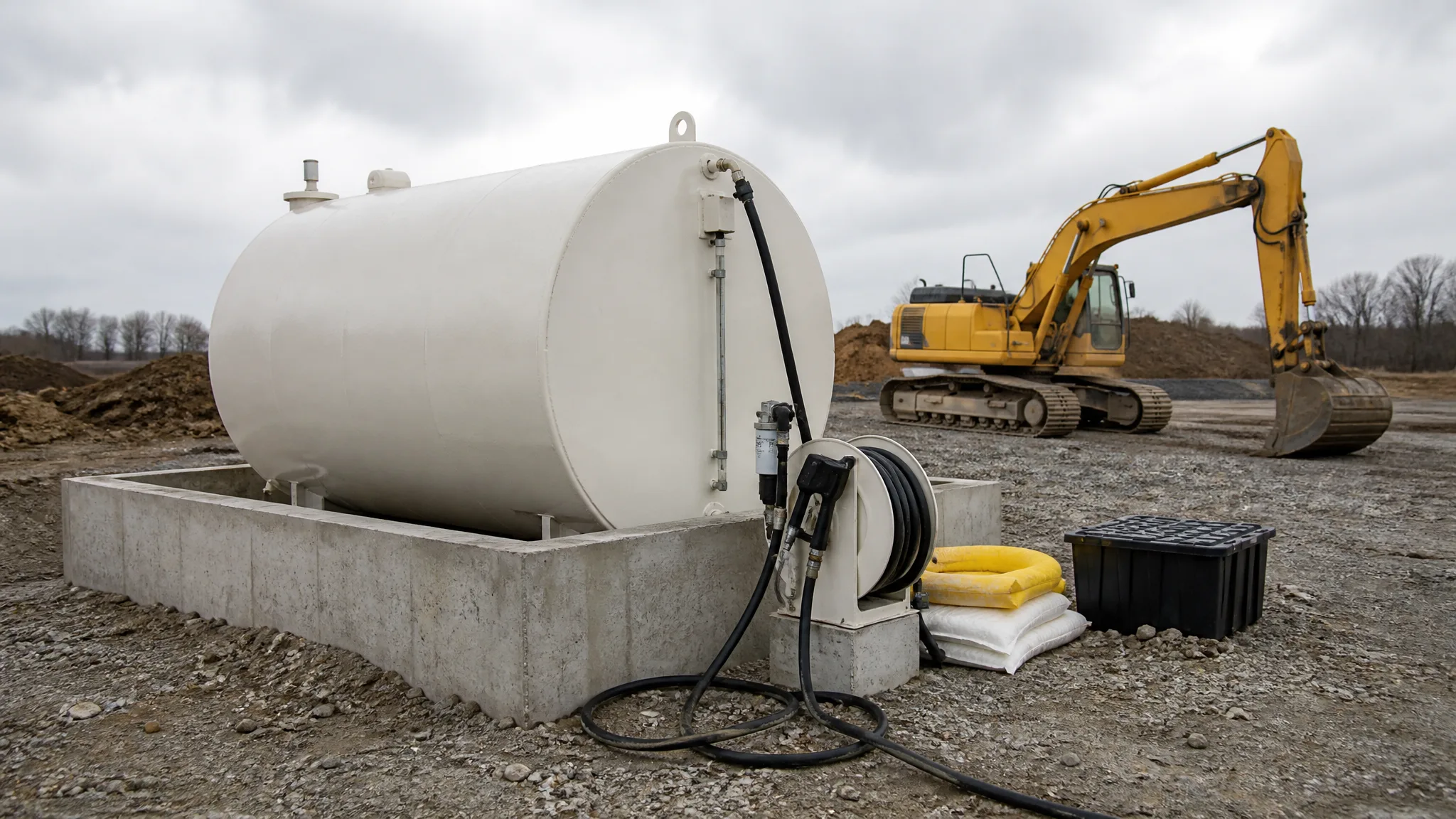
A fuel tank on a jobsite looks like the simplest piece of equipment on the site. It has no hydraulics, no undercarriage, and nothing to grease. That simplicity is exactly why it gets neglected, and why a 500-gallon tank sitting on gravel with a hose draped over the side can create more regulatory exposure than the excavator it feeds. Fuel storage is a containment problem, a fire problem, and a paperwork problem, and all three are settled long before the first nozzle is opened.
What Counts as Fuel Storage on a Jobsite
Contractors tend to think of fuel storage as "the tank." Regulators count every container. Under the federal spill prevention rules in 40 CFR 112.1, the capacity that matters is the facility's aggregate aboveground oil storage, and only containers of 55 gallons or more are counted. A 500-gallon skid tank, a 300-gallon transfer tank in a service body, a 250-gallon tank on a trailer, and a stack of 55-gallon drums all add together.
Two exclusions are worth knowing because they are commonly misunderstood. A motive power container, meaning the fuel tank that is part of a vehicle or machine and supplies its own engine, is not counted toward that total. Neither is a container under 55 gallons. What is not excluded is the transfer of fuel into those containers at a regulated facility, which is why the fuel point itself still has to be managed even when the machine tanks are exempt.
Diesel is oil for the purposes of these rules. It does not need to be crude oil, waste oil, or something exotic. Any petroleum product that could reach navigable water or an adjoining shoreline in quantities that may be harmful is covered.
When an SPCC Plan Is Required
The trigger is a combination of capacity and location. A facility subject to the rule that stores more than 1,320 gallons of oil in aboveground containers of 55 gallons or more needs a Spill Prevention, Control, and Countermeasure plan, often shortened to SPCC. The same applies where completely buried storage exceeds 42,000 gallons. The rules apply to non-transportation-related facilities that could reasonably be expected to discharge oil into navigable waters or adjoining shorelines, and "reasonably be expected" is evaluated on geography, drainage, and proximity, not on whether a dike happens to exist.
In practice, a single 500-gallon tank on a site with a storm drain at the property line is a much bigger concern than a 1,000-gallon tank in a lined, diked compound far from any water. A contractor running several jobs can cross the threshold without realizing it, because the count follows the operation, not the individual site. State rules are frequently stricter than the federal minimum and sometimes apply at lower volumes, so the federal threshold is a floor, not a safe harbor.
Where a plan is required, it has to be prepared and implemented before the storage is in service, and it must be maintained and amended when the operation changes. Smaller facilities can often self-certify rather than hiring a professional engineer, but the conditions that allow that are specific and set out in 40 CFR 112.3, so the certification path should be confirmed before it is relied on.
Sizing Secondary Containment
Secondary containment is the part everyone underestimates. The requirement in 40 CFR 112.8(c)(2) is that aboveground tank installations provide a secondary means of containment for the entire capacity of the largest single container, plus sufficient freeboard to contain precipitation. The dike, curb, or pit also has to be sufficiently impervious to actually hold the oil.
Read that literally. If two 500-gallon tanks sit in one compound, the containment does not need to hold 1,000 gallons; it needs to hold 500 gallons of product plus rain. But if the tank has a 550-gallon nominal capacity, the containment is sized on the tank's capacity, not on the amount normally kept in it. Many jurisdictions ask for 110 percent of the largest container as a practical margin, and local stormwater rules may add their own requirements on top.
Freeboard is where containment designs fail. A berm that holds the product but fills with six inches of rainwater before the spill arrives is not containment. Drainage has to be managed deliberately: a manual valve kept closed, an inspector checking the sump before opening it, and never a flapper or automatic drain that can pass oil downstream. Any water removed from a containment area should be inspected first, and if there is any doubt, it should be treated as oily water rather than pumped to a storm drain.
Choosing the Tank
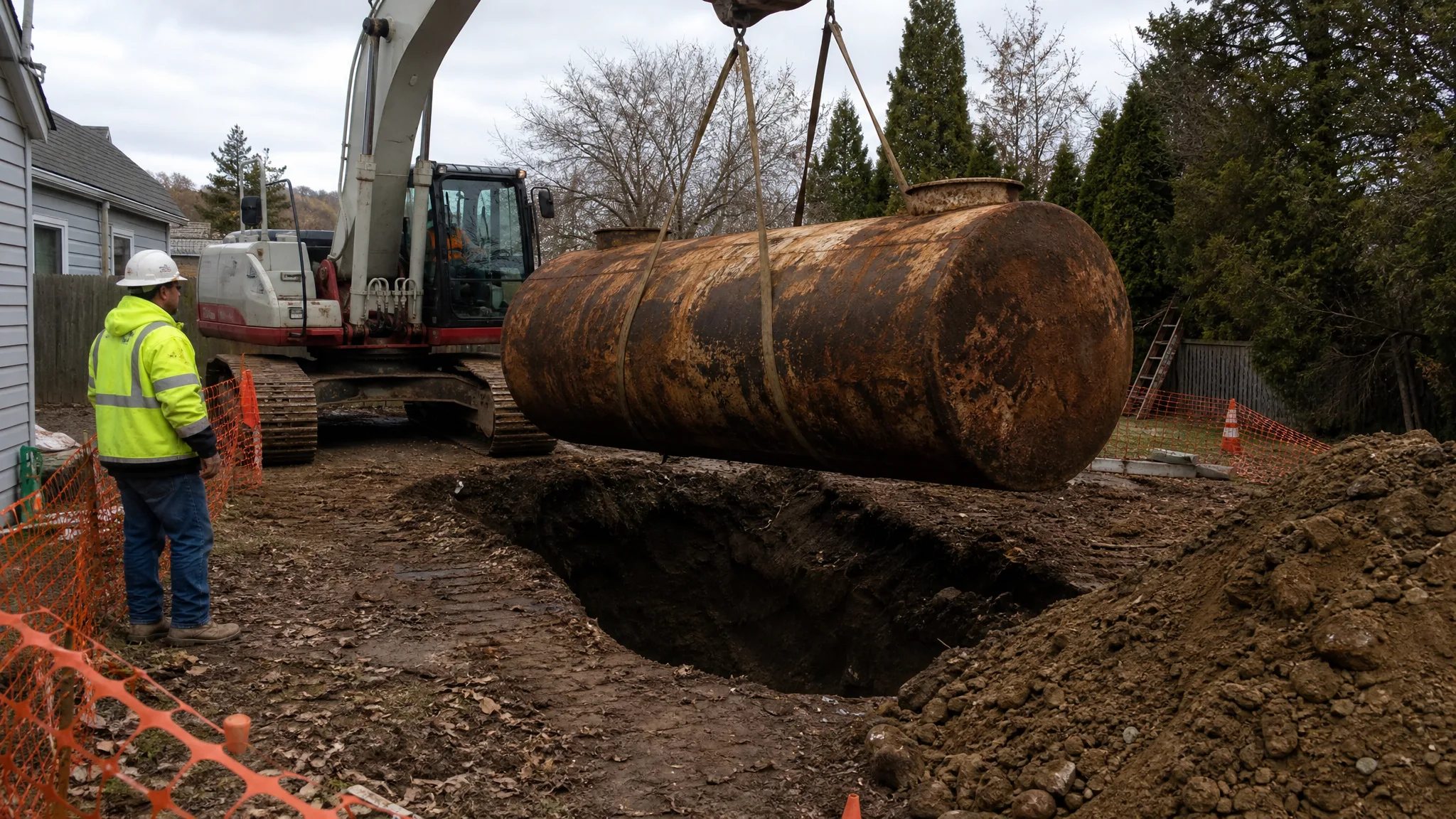
For most excavation and site work, the practical choice is a double-walled skid-mounted tank or a single-wall tank inside a lined containment berm. Double-wall construction gives integral containment, which simplifies siting but complicates inspection, because a leak into the interstitial space is easy to miss unless the tank has a monitoring provision. Single-wall tanks are easier to inspect and cheaper to buy, but they depend entirely on the berm being intact and correctly sized.
Tanks intended for fuel should be listed for the service and equipped with the normal safety fittings: a fill connection, a vent sized for the fill rate, a gauge, an overfill prevention device, and a pump or dispenser rated for the product. A used tank of unknown history is a liability, especially one that previously held something other than diesel. Residue, scale, and internal corrosion do not improve with a change of contents.
Siting is part of the equipment decision: keep the tank away from storm drains, ditches, watercourses, and low spots that drain toward them, and out of traffic paths or behind bollards. Provide access for a vacuum truck, because a spill that cannot be pumped out becomes a much larger event.
Refueling Rules That Come From OSHA
OSHA's construction standard for flammable liquids, 29 CFR 1926.152, applies to liquids with a flash point at or below 199.4 degrees Fahrenheit. Diesel's flash point varies by grade and typically falls below that ceiling, so the standard's service and refueling provisions generally apply to diesel dispensing on a construction site, not just to gasoline.
The requirements are mostly common sense written as rules. The motors of all equipment being fueled must be shut off during fueling. No smoking or open flames are permitted in fueling areas, and conspicuous signs must say so. Dispensing nozzles must be an approved automatic-closing type without a latch-open device, which is why a nozzle wired or taped open is a violation and not a shortcut. A clearly identified, easily accessible switch must be provided away from the dispenser to shut off power to all dispensing devices in an emergency. At least one 20-B:C rated extinguisher must be within 75 feet of each dispenser.
For the more volatile products, the standard requires electrical interconnection, or bonding, when transferring Category 1, 2, or 3 liquids between containers, and it separates transfer areas handling more than five gallons at a time from other operations by 25 feet or an hour of fire resistance. Outdoor container storage has its own limits, including pile sizes, clearance from buildings, and a graded surface or a curb at least 12 inches high to divert spills.
The Transfer Point: Drips, Static, and Overfills
Most fuel releases on a jobsite are small, repetitive, and entirely preventable. They come from a dripping nozzle, an operator topping off a tank until it vents, a hose dragged over sharp debris, or a tank filled while nobody is watching the gauge. A drip pan under the connection and a policy of never leaving a transfer unattended eliminate a large share of them.
Overfilling is the expensive one. Diesel expands as it warms, so a tank filled to the brim in the cool morning can push product out the vent by afternoon. Tanks are normally filled to a safe level below the top, and the fill rate should match what the vent can handle. If a tank has a high-level alarm or automatic shutoff, test it rather than trusting it.
Hoses deserve more respect than they get. They should be rated for the product, inspected for cracking and soft spots, kept off the ground when not in use, and holstered so residual fuel does not drain onto the gravel.
Spill Response: The First Five Minutes
Stop the transfer first. Close the valve, shut off the pump, and do not restart it to "clear" a problem. Then contain what has already escaped: absorbent socks or booms at the downhill edge, a drain cover or a berm of absorbent on any storm inlet, and a temporary dike of soil if that is what is available. Do not hose it down. Washing a spill into a drain turns a small cleanup into a reportable discharge.
Keep ignition sources away, especially if the release is gasoline or a blended fuel, and keep people who are not part of the response out of the area. Recover the contaminated absorbent and soil, containerize it, and dispose of it properly rather than spreading it out to disappear. A discharge that produces a sheen on navigable water is reportable, and the National Response Center is the federal reporting point; state environmental agencies usually require their own notification as well.
The site's stormwater plan should already account for the fuel point. If it does not, the fuel area is a gap in the SWPPP that an inspector will find. The same containment thinking applies to other wet materials on site, as covered in concrete washout on a construction site, which is a discharge problem with a very different chemistry and the same instinct to let it run downhill.
Cold Weather, Water, and Fuel Quality
Fuel storage problems show up as equipment problems. Condensation forms on the inside of a partly empty tank as temperatures cycle, and that water collects at the bottom where the pick-up tube lives. In freezing weather it turns to ice and blocks a filter; the rest of the year it supports microbial growth that fouls tanks and injectors. Keeping tanks reasonably full, drawing samples from the bottom before a cold snap, and changing filters on schedule prevents most of it.
Winter blends matter as well. Diesel that flows in October can gel in January, and a machine that derates or shuts down on a cold morning is usually a fuel issue before it is a mechanical one. The equipment side of that is covered in cold weather earthwork and in the excavator daily maintenance checklist, but the fuel has to be right before any of that maintenance can help.
Volume also drives cost. Contractors tracking heavy equipment cost per hour already know what a gallon of diesel does to the hourly rate, so size the tank on burn rate and delivery frequency rather than buying the biggest one available. For consumption reference, see how much fuel an excavator uses per hour.
Fuel Theft and Site Security
A tank full of diesel is a target, and the loss is rarely just the fuel: locks get broken, valves get left open, and the resulting spill becomes the contractor's problem. Locking caps, a fenced compound, lighting, and a valve that locks closed all raise the effort required, and fuel-level monitoring catches a slow loss that would otherwise be blamed on consumption.
The same layered approach used for machines applies here; preventing heavy equipment theft covers the broader picture. Fuel theft and equipment theft usually happen on the same nights, to the same sites.
A Refueling Setup Checklist
- Add up every aboveground container of 55 gallons or more, including transfer tanks and drums, and compare the total to the applicable threshold.
- Confirm whether federal, state, or local rules require a plan, permit, or certification for that volume.
- Size containment for the largest single container plus freeboard for rainfall, and verify the liner or dike is impervious.
- Site the tank away from storm inlets, ditches, watercourses, and low ground that drains toward them.
- Protect the tank from vehicle impact and provide vacuum truck access for cleanup.
- Inspect the tank, fittings, containment, and hoses on a written schedule and keep the records.
- Equip the fuel point with a drip pan, absorbent, drain covers, and a 20-B:C extinguisher within 75 feet.
- Post no-smoking signs, keep a remote emergency shutoff accessible, and confirm nozzles are automatic-closing without a latch-open.
- Shut engines off during fueling, never leave a transfer unattended, and fill to a safe level rather than to the top.
- Keep a spill kit stocked, train the crew on the first five minutes, and know the reporting contacts before they are needed.
Fuel storage is one of the few parts of an earthwork operation that can be made almost risk-free with a modest amount of money and a small amount of attention. The tank, the containment, and the habits around the nozzle are all within the contractor's control. What is not within anyone's control is where a spill goes once it leaves the gravel, which is why the work is worth doing before the tank is set.