Wheel Loader Basics

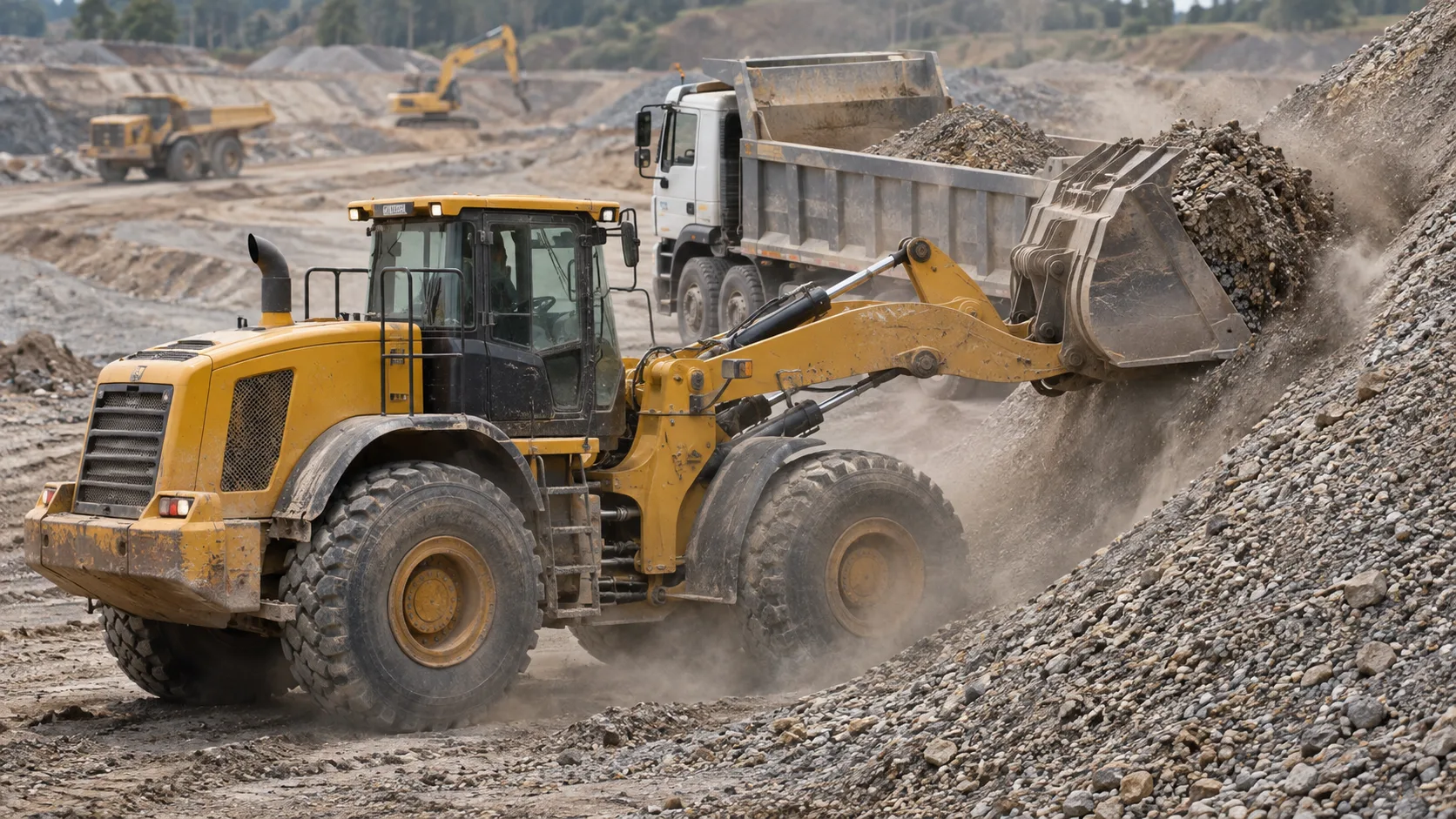
A wheel loader is the machine most earthwork crews underrate until the day the excavator is busy and a dump truck is waiting. It does not dig below grade, it does not push a blade, and it will not finish a grade to a tenth — but it will pick up loose material, carry it a hundred feet, and put it exactly where it needs to go, all day, at a cycle time most other machines cannot match. Understanding what the machine is actually built to do, and the handful of numbers that describe it, is what separates a loader that earns its keep from one that burns fuel and tires.
What a Wheel Loader Is Built to Do
A wheel loader is a rubber-tired machine with a bucket mounted on two lift arms at the front of an articulated chassis. Its working surface is the ground it stands on. It lifts material that has already been loosened or stockpiled, carries it, and dumps it — into a truck, a hopper, a trench, a spread area, or back onto the pile.
That distinction matters on a site plan. An excavator digs below the working surface and swings material without traveling. A wheel loader travels, and travel is both its advantage and its cost. On short carries it beats almost anything for cost per ton. As the carry distance grows, the cycle time grows with it, and the economics slide toward an excavator loading trucks instead.
Typical work for a loader includes loading highway trucks and articulated haulers from a stockpile or a loose lift, backfilling and spreading, cleaning up after excavation, maintaining haul roads and site entrances, moving aggregate and select fill, and handling anything that arrives on a pallet when forks are on the machine. If you are comparing machine classes, the same load-and-carry logic that separates a skid steer from a compact track loader also decides whether a wheel loader is the right step up.
The Anatomy That Decides How It Performs
Four parts of a wheel loader do most of the work, and each one changes how the machine behaves in the pile.
The articulation joint. The machine steers by bending at the middle, not by turning its wheels. That is why a wheel loader can work in a space that looks too tight for its length, and why the rear tires track almost exactly where the front tires went. Manufacturers publish the steering angle — Yanmar, for example, rates the articulation on its compact V80 at 40 degrees — and more angle means a tighter turning circle and a shorter cycle.
Rear axle oscillation. The rear axle rocks to keep all four tires loaded on uneven ground. On a rough site this is the difference between traction and wheel spin, and it is one of the first things to check on a used machine, because a seized oscillation joint turns a loader into a three-wheeled machine that loses grip.
The linkage. Z-bar linkages favor breakout force and dump speed; parallel or tool-carrier linkages keep the attachment level through the lift, which is what you want for forks and some grading attachments. Two loaders of identical size and weight can feel completely different depending on which linkage they carry.
The bucket. Width, profile, cutting edge, and teeth are matched to material. A general-purpose bucket handles most aggregate and soil work; a wider light-material bucket moves more volume of low-density material; a heavier-duty rock bucket trades capacity for survival in stone. Bolt-on edges and teeth are consumables, and the way a bucket is set up matters more to production than most operators expect.
Bucket Capacity, Fill Factor, and the Numbers That Matter
Bucket capacity is quoted two ways. Struck capacity is the volume inside the bucket up to the cutting edge. Heaped capacity adds the material piled above the edge, and loader buckets are normally rated with a 2:1 angle of repose under SAE J742. Excavator and backhoe buckets are commonly rated on a 1:1 heap, so a 3-cubic-yard excavator bucket and a 3-cubic-yard loader bucket are not holding the same volume of material. When you compare machines across families, compare in tons, not in bucket yards.
Fill factor is the share of that rated volume you actually use. Cat defines it simply as the percentage of available volume in a bucket that is actually used, and in the field it is set by how well the bucket penetrates, the machine's breakout force, the rack-back angle, the bucket profile, and whether the edge carries teeth or a bolt-on cutting edge.
Production then comes out of the standard loader formula:
Production (loose cubic yards per hour) = bucket capacity × fill factor × cycles per hour × job efficiency.
A worked example: a 3.5-cubic-yard bucket, running at a 0.95 fill factor, completing 40 cycles an hour, at a 50-minute hour (0.83 efficiency) moves roughly 110 loose cubic yards an hour. Change the fill factor to 0.80 and the same machine and operator drop to about 93. Nothing about the machine changed; the bucket simply was not full.
Then check the weight. Light material lets you fill the bucket by volume, but wet clay, saturated spoil, and dense aggregate can reach the machine's rated load before the bucket is visually full. A loader that is loaded to its weight limit is at its limit, no matter how much air is left in the bucket. That is the same payload arithmetic that governs how many yards a dump truck holds once the material is on the road.
The Loading Cycle, Step by Step
Cycle time is where loader productivity is won. The sequence below is the one Caterpillar teaches in its operator material, and it is worth running through with any new operator before they touch the pile.
- Approach the stockpile straight on, with the bucket slightly raised as it enters the pile.
- Enter at the toe of the pile and work upward rather than diving into the middle of the face.
- Hoist the bucket as it penetrates, so the load rolls back into the bucket instead of being pushed.
- Rack the bucket back fully before reversing — a bucket that is not curled spills on the way out.
- Back out just far enough to clear the pile, turn in a tight V, and drive to the truck or dump point.
- Dump centered, then return to the pile on the same short path.
Two habits sit under all of that. Keep the machine straight, not articulated, when the bucket goes into the face — Cat's guidance is explicit that digging while articulated puts more stress on the machine. And stay in first gear while loading; Cat's rule of thumb is that if you feel you need second, you are probably working too far from the face or the truck.
Truck Spotting and the V Pattern
Most loader work on an earthwork site ends in a truck bed, so the truck driver and the operator are running one cycle together. The pattern that works is a V: the loader works the face left to right, opening a pocket for trucks to back into at roughly 45 degrees to the face.
Why 45 degrees? Because the alternative is a 180-degree turn every pass. At 45 degrees the loader can back out of the pile, turn through a tight V, and arrive at the bed with almost no wasted travel — Cat's guidance is that tire rotation should stay under one to one and a half revolutions in each direction. On parallel digs, where the face is narrow and advances right to left, spot the truck 15 to 20 degrees off perpendicular instead, which sets up the same V.
Three more details separate a smooth cycle from a slow one. Work the face the width of two buckets so you do not cut a slot in the pile. Leave the loader slightly articulated — about 5 degrees — as you approach the truck, so that when you drop into reverse you are already turning. And once the bucket is raised, keep that articulation small: industry operating guidance is to limit the loader articulation angle to about 5 degrees when the bucket is up.
Load placement matters as much as speed. Center the material in the body, and if you are loading large rock, put a bucket of smaller material in first to cushion it. Axle weight is what gets checked at the scale house, and a load piled against the tailgate is a citation waiting to happen. The same discipline applies when an excavator is doing the loading instead.
Working a Stockpile Without Wrecking It
A stockpile is a structure, even if it looks like a pile of dirt. Undercut the face and it becomes an overhang that can bury a machine; climb on top of it and you are one collapse away from a serious incident; scrape the floor in front of it and you contaminate material that somebody is paying for.
The do list from Cat's stockpile guidance is short: keep the work floor smooth and drained, keep movements small and fluid, keep the heel of the bucket slightly raised to limit wear, and work in a tight V. The don't list is just as short and considerably more important: do not climb the machine on top of the stockpile, do not deeply penetrate the pile, do not undercut the face, do not scrape the ground in front of it, and do not over-raise the bucket above platform height.
If you have to ramp the pile, the ramp has to be a grade the loader can climb without the rear of the machine dragging, with berms on the ramp and the top, and the ramp material compacted when the work is done. A stockpile that is being worked every day is a piece of site infrastructure, and it should be built like one — which is the same reasoning behind a properly built construction haul road.
Load-and-Carry Distance Decides the Machine
A wheel loader is at its best when the carry is short. Fifty to a couple of hundred feet, one turn, dump, return — that is a loader cycle, and few machines can beat it for cost per yard. Push the carry out to a quarter mile and the arithmetic changes: the machine spends most of its time traveling empty or loaded instead of working, and an excavator loading a matched truck fleet will usually win.
That crossover is worth calculating before anyone commits to a machine. Compare the loader's cycle time at the actual one-way distance against an excavator's swing time plus the truck's round trip. If the haul is long enough that the truck count starts to matter, the fleet math in how many trucks you need to haul dirt is the same math you need here.
Stability, Rated Load, and the Loads That Tip a Loader
Wheel loaders tip over in two directions, and both are predictable. Longitudinal tipping happens forward over the bucket, usually with the arms raised and the machine on soft or sloping ground. Lateral tipping happens to the side, usually in a turn with a raised load, or on a side slope with a full bucket.
Manufacturers publish a tipping load, and a rated load that is a fraction of it — typically quoted at full turn, which is why the number on the chart is lower than the load you can pick up with the machine straight. Three habits keep a loader inside those numbers: carry the bucket low, keep the load within the rated capacity at the articulation angle you are actually using, and slow down before you turn.
Ground conditions belong in the same conversation. Ruts, soft shoulders, trench edges, and uncompacted fill are all places where a loaded loader can roll. Keep the machine back from excavation edges, and treat every person on foot within the working radius as a hazard that the operator has to account for — the same rules that govern working safely around heavy equipment apply to the loader as much as to anything else on site.
Tires, Wear, and the Daily Cost Nobody Budgets
On a wheel loader, tires are a major operating cost, and most of the wear is caused by the operator and the floor rather than by the material. Wheel spin in the pile grinds tread away in a hurry. Spinning on sharp rock cuts tires. Turning repeatedly on an abrasive, uncleaned floor scrubs the tread off the outside shoulder.
Cat's guidance covers most of it: maintain a smooth work floor, keep it drained so you can see debris, and remember that wet rock cuts tires more easily than dry rock. Tire pressure, ballast, and the correct tire for the application matter too, but the floor and the operator's right foot are where most of the money goes. For the wider picture on what a machine actually costs to run, see how much heavy equipment costs per hour.
Buying, Renting, and What to Check on a Used Loader
Size the machine to the job, not to the brochure. Work backward from the truck payload and the material: how many passes do you want per truck, what does a bucket of that material weigh, and what is the rated load at full turn? Then match the bucket to the material — a bucket that is too wide for the density will limit you by weight, and one that is too narrow will limit you by volume.
On a used machine, the inspection list is short but specific: play in the articulation joint and center hinge, lift and linkage pin wear, bucket floor and edge wear, tire condition and matching, transmission and axle behavior under load, and whether the oscillation joint actually moves. A loader with a worn center hinge will steer sloppily and chew pins forever. If you are moving the machine between jobs, choosing an equipment trailer matters as much as the loader itself, and the legal weight limits for hauling decide what you can legally put on the deck.
Operator Habits That Hold Up
The best loader operators on any site look boring. They run the same tight V every cycle. They keep the bucket low when they travel. They never dig into a face with the machine articulated. They stop and clean the floor when a truck is late instead of idling. They know what a full bucket weighs in the material they are working, and they never let the truck driver decide how much goes on.
None of that requires a bigger machine. It requires an operator who understands that a wheel loader is a load-and-carry tool, that its production lives in the cycle, and that the pile, the floor, and the truck are all part of the same system.