What to Do If You Hit a Utility Line

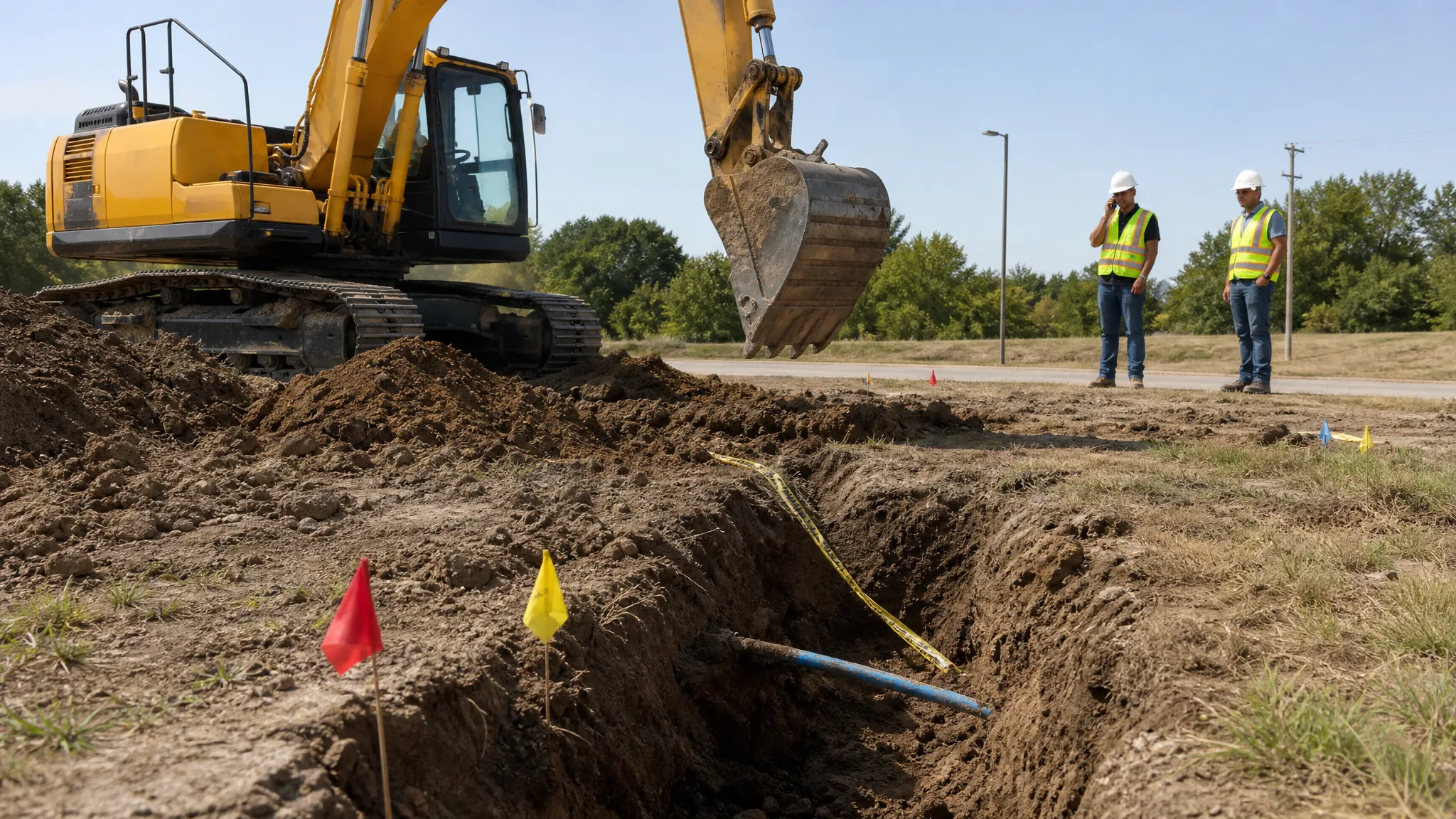
Almost every excavator operator has felt the thud of a bucket finding something it should not have. A utility strike is not just an expensive mistake — it can be a life-safety emergency that escalates in seconds. What separates a bad afternoon from a catastrophe is what the crew does in the first five minutes.
This guide covers the response sequence for the most common underground utilities, the reporting obligations that follow, and the documentation that decides who pays.
Stop Work and Secure the Area
The first move is always the same: stop the machine. Idle it down, set the controls neutral, and do not move the bucket, boom, or tracks until someone has assessed the situation. A running machine is an ignition source, a vibration source, and a machine that can pull a damaged pipe apart if it moves.
Next, keep people out. Establish an exclusion zone, account for every crew member, and stop other work in the area — including compaction, cutting, and truck traffic. If the strike is near a sidewalk, road, or building entrance, hold pedestrians back before a crowd forms; the separation principles in working safely around heavy equipment apply here with higher stakes.
Do not backfill, cover, or "make it safe" by pushing dirt over the damage. That instinct destroys evidence and can trap gas or pressurize a broken line — and the lift and compaction rules in backfilling a utility trench assume an intact pipe. The competent person should re-evaluate the excavation itself, because a water main break can saturate trench walls in minutes and a gas release can create a hazardous atmosphere.
Gas and Flammable Liquids: Evacuate First
Natural gas and petroleum pipelines are the highest-consequence strikes, because the danger extends well beyond the trench. Distribution gas is odorized with a rotten-egg smell, but transmission pipelines may not be. Treat any hissing, roaring, or blowing sound, a white cloud or fog, bubbling water, dead vegetation, or an oily sheen as confirmation until proven otherwise.
Natural gas is lighter than air and dissipates upward, while heavier petroleum products collect in low spots — trenches, basements, and storm drains. That difference matters when you decide where to send people.
Eliminate every ignition source before anyone moves: shut down the equipment, stop vehicles, put out cigarettes, and keep cellphones off until you are clear. Do not start a vehicle to leave — the starter and exhaust are ignition sources. Walk out, stay upwind and uphill, and call 911 from a safe distance.
Notify the pipeline or gas operator as soon as it is safe. Their number is usually on the marker posts along the right-of-way, on the meter set, or on the locate ticket. Never try to stop a leak, never bury it, and never operate a pipeline valve — turning the wrong valve can create a worse problem upstream. The contractor's job is to secure the area until responders and the operator take control.
Underground Electric: Stay on the Machine
Treat every underground electric line as live, even after it trips. A line that flashed and went quiet can be re-energized automatically, and the ground around a fault can be energized in expanding rings, which is why nobody should walk toward the machine. The protection rules in trenching for underground electrical lines make contact less likely, but nothing about a compliant installation makes it safe.
If the equipment is in contact with an energized line and the operator is still in the cab, the safest option is usually to stay there. Try to move clear only if it can be done smoothly, without pulling the line or creating a second contact. If it cannot, the operator stays put — energized, but protected, like a bird on a wire — while someone calls the utility and warns everyone else away.
If fire forces the operator out, the exit technique matters. Jump clear with both feet together, land without touching the equipment and the ground at the same time, and shuffle away with feet close together, never more than toe-to-heel apart. Running or walking with a normal stride is how people get electrocuted after they have escaped the cab.
No one approaches the machine, and no one touches the operator, until the utility confirms the line is de-energized. Overhead lines are a related hazard covered in excavating near overhead power lines.
Water, Sewer, and Fiber
Pressurized water can cause serious injury and can undermine a trench wall or roadway in minutes. A scratch or nick on a high-pressure line is enough to start a break later, so even a near miss gets reported. Do not close valves to stop the flooding — the wrong valve can affect fire flows. Depth and bedding rules are covered in excavating for water and sewer lines.
Sewer strikes carry a different hazard. Wastewater contains pathogens, and sewer gas is flammable, so keep flames and sparks away and keep people out of the spill. Fiber and communications lines are often buried just below the surface. A strike can take out cell service and 911 routing for an entire area, and the cut end of a damaged fiber line should never be inspected by eye — the laser can injure you. Fiber is also frequently unrepairable in the field and has to be replaced.
Who to Call, and in What Order
Life safety comes first. Call 911 for a gas release, fire, electric contact, injury, or flooding that threatens a road or structure. Everything else waits.
Then call the facility owner. They own the repair, they control the isolation, and they need to know before anyone digs around their asset. The number is on the locate ticket, the meter, the pedestal, the valve box, or the pipeline marker.
Then file the damage report with the one-call center. Most states require the excavator to notify both the facility owner and the notification center, and the deadlines are short — often immediately, and commonly within 24 hours. Some states also require a written report within a set number of days. Do not guess the deadline: report the same day and keep the confirmation number.
After that, notify the general contractor or property owner, your safety lead, and your insurer. Do not hire an outside contractor to repair a utility without the owner's authorization.
What Counts as Damage
Crews get into trouble by assuming damage means a break. It does not. A nick, gouge, dent, scrape, crushed coating, cut tracer wire, or a moved valve box is damage, and it must be reported. A dented gas service or a gouged pipeline coating can fail months later, and the excavator who did not report it owns the consequences.
OSHA requires underground installations to be protected, supported, or removed as necessary while the excavation is open. After a strike, that obligation does not disappear — but the utility owner decides how the line gets supported. Leaving a spanning pipe unsupported while the crew keeps digging is how a small strike becomes a break.
What Not to Do
- Do not backfill or cover the damage. It hides evidence and can trap gas or load a broken pipe.
- Do not try to repair the line yourself. The repair is the owner's call, and a bad patch shifts liability onto you.
- Do not operate valves or switches. The wrong operation can affect other customers or emergency flows.
- Do not restart excavation nearby. The line may run where the marks did not show.
- Do not let anyone into the trench to inspect. A saturated wall or a gas pocket does not care that someone is "just looking."
- Do not post photos or commentary on social media. It becomes evidence and will be read out of context.
Document the Strike
Documentation starts before the bucket touches the ground. Photograph the locate marks and the ticket before digging, keep the positive-response record, and save the white-line photos. If the marks were faint, missing, or did not match the ticket, that record is the difference between a shared claim and a sole-source claim.
After the strike, write down the time, location, utility type and owner, depth, the part contacted, the machine and operator involved, who called whom and when, and the names of every witness. Photograph the damage before anything moves and again after the utility exposes it. Keep the ticket, the 811 confirmation, and the damage-report number together.
Do not discard the damaged section or the spoil until the owner releases it, and get short written statements from the operator, the spotter, and anyone else on site the same day, while the sequence is still fresh.
Who Pays
State damage-prevention statutes generally allocate repair costs based on conduct, not on who swung the bucket. An excavator who called 811, waited the required time, stayed outside the tolerance zone, and hit a line that was mismarked or unmarked is usually in a strong position to have the repair covered by the facility owner. An excavator who dug without a ticket, dug outside the ticket area, or used mechanical equipment inside the tolerance zone is usually holding the bill.
Contract terms can move that risk around: some owner contracts put utility damage back on the contractor regardless of fault and require notice within hours. Read those clauses before mobilization.
Do not assume insurance is a safety net. Report the strike to your carrier promptly, follow their documentation instructions, and let them communicate with the utility's claims department. Admitted fault in a phone call or text can complicate a claim that would otherwise have been defensible.
Preventing the Next Strike
Nearly every strike is preceded by a shortcut. The prevention list is not glamorous, but it works:
- Call 811 before you dig, with enough lead time. Many states require two to three business days' notice, and OSHA requires contact within established local response times.
- White-line the actual excavation area so locators mark the right ground, not the whole parcel.
- Compare every mark to the ticket. If a facility on the ticket has no mark, or a mark has no ticket entry, stop and call the center.
- Re-call when the scope changes — expanded limits, a new trench route, or a revised pad needs a new ticket.
- Re-call when marks fade or the site is regraded. Ticket validity expires, and grading buries paint and flags.
- Hand dig, pothole, or vacuum excavate inside the tolerance zone. The Common Ground Alliance defines it as the width of the facility plus 18 inches on either side, though many states use different distances — follow the stricter local rule.
- Brief the operator and keep the ticket in the machine. Depths on a ticket are approximate; never treat them as a clearance.
A strike is a bad day. A strike followed by a delayed call, a buried line, or an unrecorded ticket is a bad year.