Sheet Piling for Deep Excavations

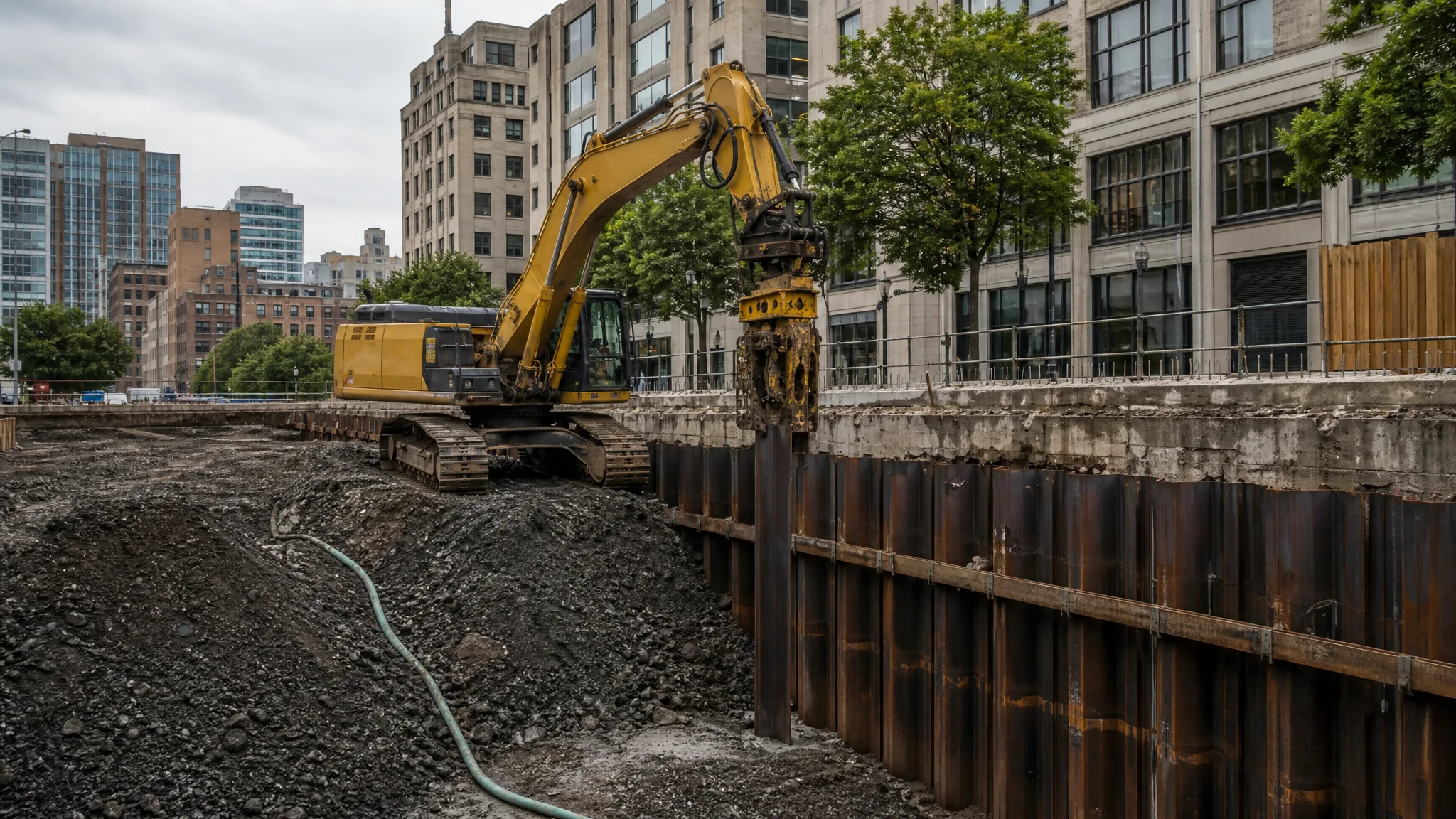
A sheet pile wall is what a contractor reaches for when an excavation has to go deep, stay tight, and hold back water at the same time. Unlike a trench box, which shields workers inside a hole that is already being dug, sheet piling is driven into the ground before excavation and becomes part of the soil support system itself. On urban sites, waterfront work, and any cut that runs below the water table, that difference often decides whether the job is buildable at all.
What Sheet Piling Actually Does
Sheet piles are steel sections with interlocks along both edges. Driven side by side they form a continuous vertical wall that does two jobs at once: it resists lateral earth pressure from the retained ground, and it restricts groundwater movement into the cut. The second job gets overlooked.
Because the wall goes in ahead of the dig, the soil outside the cut is supported before it moves. The piles act in bending, so a short wall can cantilever on its own embedment. As depth increases the wall needs help — walers and struts across the cut, or tieback anchors grouted into the retained soil. Sheet piling also shows up in cofferdams, bulkheads, flood walls, and containment work where the wall is the finished structure.
When Sheet Piles Beat a Trench Box
A trench box is a shield, not a support system. It protects the people inside it but does not hold the soil — the trench still has to be dug wider than the box, and the ground around it still moves. That is fine on a utility run through open ground and painful on a narrow right-of-way.
Sheet piling takes far less width, supports the soil rather than just deflecting it, and can cut off water. The tradeoffs are cost, specialty equipment, vibration, and the fact that a wall has to be designed. If you are comparing systems for a straightforward trench, start with choosing a trench protective system and when trench protection is required.
Other retained walls compete on the same ground: soldier piles with lagging, secant or contiguous pile walls, soil nails, and top-down construction. The decision comes down to depth, groundwater, proximity to the neighbors, available room, and whether the wall stays permanently. On crowded lots, tight-access excavation constraints often settle the argument before cost does.
The Main Types of Sheet Pile Wall
- Z-piles have an asymmetric section with interlocks on opposite sides and are usually driven in pairs. They deliver a lot of section modulus per pound of steel and dominate deep cuts and permanent waterfront walls.
- U-piles are symmetric with both interlocks on the same side. They are heavier per foot of wall but give more bending resistance for very high lateral loads, and paired U-sections can be arranged into box piles at corners.
- Flat or straight-web sheets are light-duty sections used for shallow cuts, cutoff walls, and situations where bending demand is modest.
- Combination walls pair heavy H-piles that carry vertical load with Z-panels spanning between them, which suits bridge abutments and structures that need both bearing capacity and earth retention.
Vinyl sheet piles cover cases where the requirement is cutoff and corrosion resistance rather than structural bending. Whatever the section, the design has to match the wall's job: a cutoff wall and a braced structural wall are not the same animal, and the geotechnical report is what tells you which one you are building.
What OSHA Requires Before the First Pile Goes In
Under 29 CFR 1926.652(a)(1), every employee in an excavation must be protected from cave-ins by an adequate protective system. Sheet piling falls under the support-system and shield-system rules in paragraphs (c), (d), (e), and (g) of that section, and the design has to follow one of four paths: the appendices, the manufacturer's tabulated data, other tabulated data identifying the approving engineer, or a professional engineer's design.
Depth is where crews get caught. Excavations deeper than 20 feet require a registered professional engineer's design, and that depth is measured from the original ground surface — not from the bottom of an upper slope or bench. For shallower cuts with vertically sided lower portions, OSHA's appendix figures call for the shield or support to extend at least 18 inches above the top of the vertical side, which also serves as falling-object protection.
Two more rules matter in the field. Damaged members must be evaluated by a competent person, and anything that cannot be assured to carry its load comes out of service until a professional engineer approves it. And when piles are driven inside an excavated pit, 1926.603(c)(3) requires the pit walls sloped to the angle of repose or sheet-piled and braced — Subpart P still applies underneath. Permits and plan review sit on top, as covered in excavation and grading permits.
How Sheet Piles Get Installed
There are three driving systems. Impact hammers strike a driving cap on the pile head and remain the tool of choice where ground gets dense. Vibratory drivers clamp to the pile top and oscillate it, temporarily reducing friction along the shaft and at the interlocks, which makes them fast in granular soils and much less effective in stiff clay. Pressing rigs jack the pile into the ground using the adjacent piles for reaction — the quietest and lowest-vibration option, and the usual answer next to hospitals, labs, and old masonry.
Layout matters as much as the hammer. Piles are set out on a survey line and held in a guide frame or template. Pitch-and-drive installs them one at a time — simple, but the wall can lean forward and individual piles rotate, since each hangs on a single interlock while being driven. Panel driving threads several piles in a guide frame and drives them in stages, which holds verticality and allows longer piles in harder ground.
Interlocks need attention before they go in the ground: clean them, check engagement, and use the specified lubricant or sealant. A wall that will not close at the corner because of accumulated lean is a demolition problem, not an adjustment. Handling steel sections safely around the cut is its own discipline; working safely around heavy equipment covers the ground-crew side.
Getting Through Difficult Ground
Refusal is the most common field problem. Boulders, old foundations, abandoned utilities, and shallow bedrock all stop a pile short of design embedment — and a pile that stops short is a design change, not a field detail. Pre-drilling at the interlock locations, drill-and-drive, and pre-augering are the standard answers, along with removing the obstruction outright.
Jetting and pre-augering deserve a warning. Both change the in-situ soil around the piles, which changes skin and interlock friction, so the design has to account for the method chosen — and both can create preferential flow paths, which is irrelevant on a dry site and serious where the wall is also the cutoff.
Bracing, Tiebacks, and Excavation Sequencing
A cantilever wall only works to a limited depth before deflection and bending become unreasonable. Past that point the wall gets walers and struts across the cut, rakers bearing on a braced footing, or tiebacks grouted into the retained soil behind the failure surface. Tiebacks need bond length, testing, and often a neighbor's agreement.
Sequencing is where deep cuts fail. Excavation proceeds in lifts down to each brace level, the brace goes in, and only then does the next lift start. Digging to the bottom and bracing afterward removes the support the wall was designed around.
Keep equipment, spoil, and material out of the surcharge zone at the top of the wall. OSHA's two-foot minimum setback for materials and equipment is a floor for spoil piles, not a design number — the engineer's assumed surcharge is what governs. And never undercut the toe: the passive resistance below the excavation line is what keeps the wall from kicking in.
Groundwater Cutoff: What the Interlocks Really Do
A well-driven wall reduces groundwater flow but does not eliminate it. Joints leak, particularly in gravel and cobble, on curved alignments, and wherever piles have gone out of plumb. Plan for seepage with sumps and pumps rather than being surprised by it — dewatering an excavation is a companion scope, not a substitute for a cutoff.
Watch what pumping does outside the cut. Lowering the water table next door consolidates soft soils and shows up as settlement in foundations and pavements you never touched. On sensitive sites, observation wells and a drawdown limit belong in the plan.
Monitoring the Wall and the Neighbors
Deep support systems get instrumented: settlement and movement points on adjacent structures and pavements, inclinometers in the retained soil, crack gauges on finishes, observation wells for groundwater, and vibration monitors where the driving method is energetic. A baseline survey before work starts is what makes those readings meaningful.
Vibration limits usually come from the specification, a local ordinance, or the engineer, and method selection controls vibration better than monitoring does — pressing instead of vibratory driving removes most of the complaint.
Most importantly, the readings need a decision rule attached before excavation begins. A trigger value that stops the work, requires backfill or an added brace, and notifies the engineer turns instrumentation into protection. On sites next to existing buildings, this overlaps directly with working safely near existing foundations.
Extraction, Reuse, and Common Failure Modes
Temporary walls are usually pulled and reused, and extraction needs the same discipline as installation: backfill progresses with the pull, members come out from the bottom up and are released slowly so you can watch for movement, and the void gets filled rather than left as a channel. Piles that will not come out get left in place and cut off below grade with the engineer's and owner's written agreement — and the location recorded, because a buried steel stub is a future utility strike.
The failures worth memorizing are consistent. A wall that leans out of tolerance and will not close at the corner. Interlocks that separate and leave a gap that leaks. Toe heave in soft clay under the excavation line. Settlement behind the wall from ground loss during driving. A strut overstressed because spoil got pushed to the edge. And damaged piles driven anyway because the crane was already set up. Every one of them traces back to a decision made before the first pile was pitched.