Protecting Trees During Excavation and Grading


Every builder has seen it: a mature oak left standing through a project, then dead six years later. Trees rarely die on the day the excavator arrives. They die from compacted soil, changed grades, and severed roots, damage that accumulates invisibly and shows up in the canopy long after the crews have left. On projects where keeping the trees is part of the value, tree protection is a grading plan problem, not a landscaping afterthought.
Why Trees Decline After Excavation and Grading
Three mechanisms account for most construction tree deaths: soil compaction, grade changes, and root severance. Heavy equipment squeezes the air out of the soil, fill smothers roots, and trenching or cutting removes them outright. Any of the three can kill a tree, and most projects deliver all three at once.
The damage is delayed, which is what makes it dangerous. Compaction and root suffocation often take months or years to show, so the symptoms arrive after the warranty period and the connection to the job is hard to prove. Involve an ISA certified arborist during planning, when moving a driveway or a utility line a few feet is still cheap.
Where Tree Roots Actually Live
Feeder roots, the fine roots that take up water and nutrients, are concentrated in the top 6 to 18 inches of soil. They spread far wider than most people expect, frequently two to three times the height of the tree, well beyond the canopy edge. The structural roots near the trunk are just the visible minority.
The practical conclusion is uncomfortable for anyone planning grading: a shallow cut a few inches deep across a lawn can remove a large share of a mature tree's root system. The biological root zone for most open-grown trees extends roughly to the dripline and often beyond it, so a protection boundary drawn at the canopy edge is a minimum, not a generous allowance.
Sizing the Tree Protection Zone
The most common formula is one foot of radius for every inch of trunk diameter, measured at 4.5 feet above grade (DBH). Texas A&M Forest Service recommends fencing roughly one foot from the trunk for each inch of trunk diameter, and municipal tree protection ordinances typically call for 1, 1.25, or 1.5 feet per inch. At the stricter 1.5 ratio, a 20-inch tree needs a 30-foot radius of protected ground, and many codes set a minimum radius of 6 feet no matter how small the tree.
Species and site condition matter too. A young, healthy tree on a good site might tolerate a zone of about twice its trunk diameter in feet, while an old, sensitive tree on a poor site may need four times or more. A 24-inch white oak on a difficult site can justify a protection radius approaching 100 feet. That is a judgment call for an arborist, but the direction of the answer is always the same: protect more ground than feels necessary.
Fencing, Signage, and What Never Goes Inside the Zone
Tree protection fails for social reasons more often than technical ones. A boundary that is not visible, not enforced, and not written into the specs will be crossed by the first delivery driver who needs somewhere to turn around. Use sturdy fencing, chain link or welded wire on driven posts, not flagging tape, and mount protection-zone signs on it.
Once the fence is up, the list of prohibited activities inside the zone is simple and absolute:
- No trenching, digging, or soil disturbance of any kind
- No storing of building materials, waste, excess soil, paint, or supplies
- No parking or idling of vehicles and equipment
- No stockpiling of spoil, mulch, or demolition debris
- No grade changes, either cutting or filling
Put those rules in the site plan and attach a fine for violations, then keep the fencing in place until the last trade has left. Protection that comes down when the excavator finishes is protection that misses the concrete, plumbing, and landscaping phases, which are just as damaging.
Compaction: The Damage You Cannot See
Roots need pore space. When equipment weight closes those pores, oxygen and water stop moving, and the fine roots that feed the tree die back. The soil looks unchanged from the surface, which is exactly why compaction does so much quiet damage on residential and commercial sites.
The mitigation is routing, not machinery. Designate one construction entrance, one equipment route, one parking area, and one material storage area, and keep everything else out of the root zones. Where a route has to cross a protection zone, lay down temporary mats or a geotextile and gravel working platform to spread the load, then aerate the soil after construction to restore some of what was lost.
Grade Changes: Cutting and Filling Around Trees
Raising the grade is the faster way to kill a tree. Adding as little as 2 to 3 inches of fill over a root zone can suffocate feeder roots by cutting off gas exchange, and Texas A&M Forest Service guidance suggests no more than about 2 inches of fill in any single year where raising grade is unavoidable. Deeper fills need an engineered alternative such as an open-joint retaining wall set out from the trunk, or an aeration system of pipe and gravel to keep air moving through the root zone.
Lowering the grade is just as hard on trees, because it removes both roots and the nutrient-rich topsoil they live in. If a cut inside the root zone cannot be avoided, root prune at least four to six months before construction and irrigate before, during, and after the pruning so the tree is not fighting drought at the same time it is regrowing roots.
Grade changes also redirect water. A new pad or swale can leave one side of a tree wet and the other dry, and neither extreme is good, which is why how much slope a yard needs for drainage has to be worked out around the trees you keep. The same cutting and filling shows up in rough grading versus finish grading, so walk the drainage implications of any grading plan near preserved trees before the first bucket of dirt moves.
Digging Near Roots: Excavation, Trenching, and Utilities
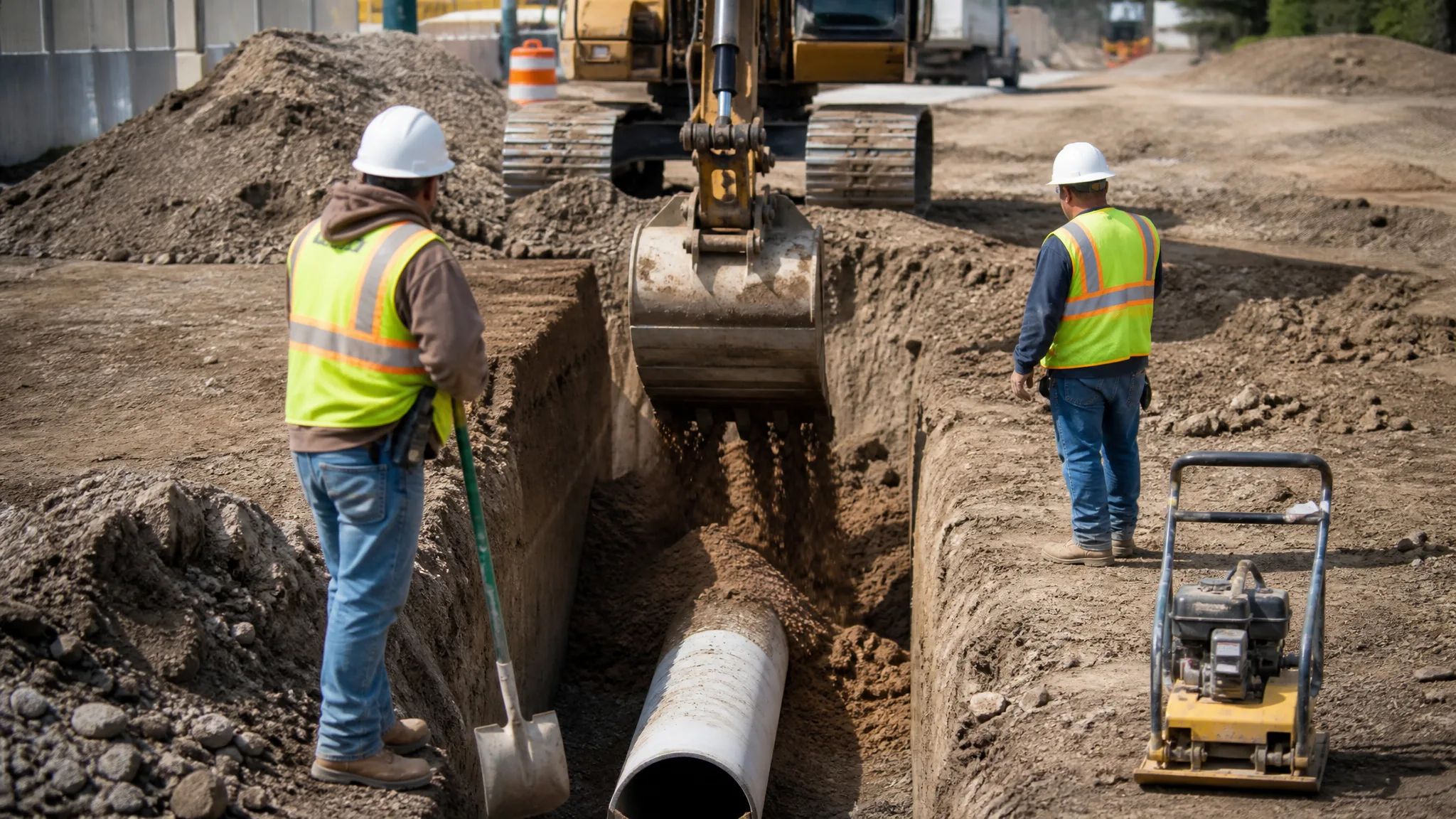
Trenching is the most destructive common operation near trees, because it cuts a continuous line through the root plate. Reroute utilities away from preserved trees whenever the design allows it, and tunnel or bore instead of trenching where it does not. Illinois Extension guidance suggests tunneling at least 2 feet out from the trunk and at least 2 feet below grade to limit root damage, a route that is far easier to plan once you call 811 before you dig and map the water and sewer line trenches early.
Inside the protection zone, switch methods rather than pushing harder. Hand digging, pneumatic excavation, and vacuum or hydro excavation remove soil without slicing through roots. If roots must be cut, have an arborist prune them with clean cuts at the right location rather than letting a bucket rip them. When a machine has to work close to a preserved tree, work from outside the zone inward, keep the machine on mats, and never push spoil up against the trunk.
Planning and Permits Before You Clear or Grade
Tree preservation starts with an inventory: species, size, condition, and location for every tree on the site. Decide removals in the design phase, taking out trees with trunk rot, severe lean, major disease, or poor form before construction starts, since a failing tree is cheaper to remove now than after it drops a limb on a new roof. Then mark the trees that stay and draft preservation specifications with clear prohibitions and penalties. Most of that work is a grading and site preparation exercise, and clearing a wooded lot is priced accordingly, so it pays to understand what drives land clearing cost before the scope is set.
Many municipalities require a tree protection plan, a permit, or a tree survey before clearing, and fines for damaging protected trees can be steep. Check the local ordinance before the clearing crew arrives, because retroactive compliance is not usually an option. Where individual trees do have to come out, removing them with a mini excavator is often the least disruptive approach, and the right mini excavator for land clearing keeps the machine footprint away from the trees you are keeping.
Monitoring Through Construction
Assign someone to walk the site regularly and inspect the protection zones, and treat the fence as a hard boundary rather than a suggestion. Photograph any violation immediately and notify the responsible contractor in writing, since damage that is documented early is far easier to resolve. A visible tree manager on site changes behavior more reliably than a note in the specs.
Where damage does occur, get repairs started right away. Broken limbs should be pruned properly, compacted areas aerated, and washed-out root zones stabilized before the next rain. Then keep the protection fence up until every crew is gone.
Post-Construction Care That Saves the Tree
Trees that survive construction often spend years recovering, and the care in that window decides the outcome. Water during dry periods for the first couple of seasons, aerate compacted soil, and apply a 2- to 4-inch mulch layer that stays a few inches away from the trunk. Avoid heavy fertilization of a stressed tree, which pushes top growth the damaged roots cannot support.
Watch for leaf wilt, early fall color, dieback, and stunted growth, and give a declining tree several seasons before writing it off. Most trees injured by construction can recover if the soil and root conditions are corrected, but only if someone is still paying attention after the punch list is closed.