Loading Trucks with an Excavator

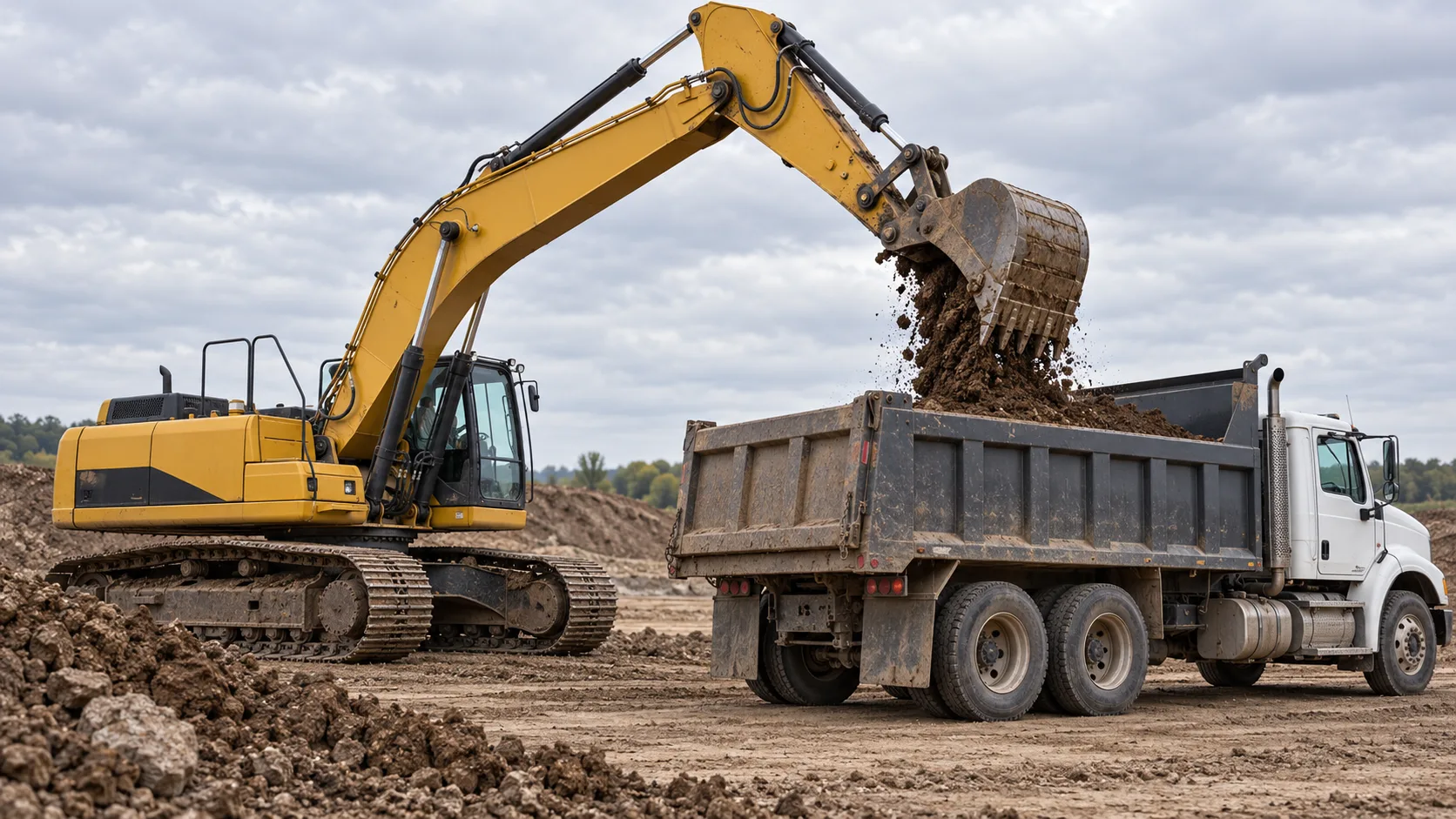
A dump truck that fills in four passes and one that fills in seven can be the same truck, the same material, and the same operator on the same day. The difference is usually where the truck parked and how the bucket was worked. Loading is the one part of the haul cycle an excavator operator completely controls, and it is where the money and the injuries both concentrate.
This guide covers the practical side: how to spot a truck, how many passes it should take, where the load belongs in the bed, and the safety rules at the face.
Why the Loading Pass Decides the Day's Production
Truck cycle is load, haul, dump, and return. The excavator only touches one of those four phases, but it is almost always the most expensive machine on the site, and every minute it spends waiting on a truck cannot be recovered later in the shift. Most throughput problems contractors blame on the truck fleet are really loading problems: a bad spot, an undersized bucket, a swing that takes too long, or a pass count nobody calculated.
Loading is also where people get hurt, usually because someone stood where they should not have or a load went over a cab. That part is a routine problem, not a hard one.
The Spot Decides the Cycle
An excavator cycle has four movements: dig, swing loaded, dump, and swing empty. Only the dig produces dirt. Swing is pure overhead, which is why truck position matters more than almost anything else an operator does.
Spot the truck so the loaded swing stays at roughly 90 degrees or less, and so the swing is the same every pass. A consistent short swing lets the operator build rhythm; a truck parked at an awkward angle forces a different motion on every bucket. Keep the truck close to the digging face, but outside the arc the counterweight sweeps when the house rotates.
Visibility into the bed decides the loading pattern. Caterpillar's own guidance is to load front to back when a large excavator has a clear line of sight into an articulated truck's bed, and to start in the center and work outward when a medium excavator is loading a tandem and cannot see the whole bed. Mini excavators are almost always center-out for the same reason.
If the machine is working below the truck, bench loading is the better answer. Build or use a bench with its top at about rail height on the truck being loaded. That puts the operator's eye above the bed, shortens the lift, and removes the guesswork about where the bucket is emptying.
How Many Passes Should Fill the Truck?
Most earthmoving contractors work toward three to five excavator passes per truck. Below three, the truck is probably too small for the machine and you will need more trucks than the job justifies. Above six, the truck sits parked while the excavator keeps working, and the waiting eats the payload advantage.
The pass count is not a rule to hit for its own sake. It falls out of three numbers: bucket volume, bucket fill, and material density. Payload per pass equals bucket capacity times fill factor times density. Fill factors commonly run around 0.85 in sticky clay, where material clings and will not heap, up to about 1.1 in loose free-flowing material that piles above the lip.
Then divide the truck's legal payload by the tons per pass. Suppose the truck's legal payload works out to 14 tons after tare, the bucket is 1.5 cubic yards, fill is 0.90, and the clay runs about 1.4 tons per cubic yard. That is roughly 1.9 tons per pass, so about 7.4 passes, or eight real buckets.
Eight passes is a signal, not a failure. Either the bucket is small for that truck, the truck is large for that machine, or the material is heavier than the machine was matched to. The fix is a bigger bucket, a smaller truck, or a second truck cycling behind the first. The wrong fix is overloading the bed to get the count down.
Load the Bed, Not the Axles
A dump truck does not care how much dirt is in the box. It cares where that weight sits. Loading everything against the tailgate puts the mass behind the rear axle group and can unload the steer axle enough to make steering vague. Loading everything against the headboard overloads the steer axle and the frame.
Center the load left to right and distribute it front to rear. On highway trucks, axle splits are exactly what inspectors look at, so an evenly spread load is both a handling decision and a compliance decision. If you want the legal side of that in detail, see our guide to legal weight limits for hauling dirt.
Never dump over the cab or onto the cab shield. OSHA requires haulage vehicles loaded by loaders, power shovels, or similar equipment to have a cab shield or canopy adequate to protect the operator from shifting or falling materials. Falling dirt is not a theoretical hazard; a bucket released too early sends a wave of material forward, and the shield is the only thing between it and the driver.
Bucket Habits That Shorten the Cycle
A full bucket beats a fast bucket. An operator filling to 85 percent of rated capacity needs more than three passes to do what three full buckets would do, and the extra pass costs more time than the speed saved. Load the bucket completely, then move. Dump from a height that clears the rails without hammering the bed: too high raises dust and throws material over the sides, too low drags the bucket against the rails.
Bench Loading and Working From a Pile
When the material is already in a stockpile, the pile is the bench. Work the face so the bucket comes out of the pile with the stick in and the load close to the machine, then swing. Undercutting the pile is how material sloughs onto a truck, and it is also how a face collapses on a machine parked too close. Keep the truck out from under any overhang and trim a steep face back before bringing trucks in.
Where the Truck Must Never Be
The first no-go zone is the swing arc. Nobody stands inside it, including the truck driver, the spotter, and anyone waiting to approach the machine. The counterweight is unforgiving and the operator's blind side is real.
The second is under the load. OSHA's excavation standard is blunt: no employee may be permitted underneath loads handled by lifting or digging equipment, and employees must stand away from any vehicle being loaded or unloaded to avoid being struck by spillage or falling material. The operator may stay in the cab only when the vehicle is equipped with a cab shield under the motor vehicle standard.
The third is the edge. Equipment and excavated material must be kept at least two feet from the edge of an excavation, or restrained well enough that they cannot fall or roll in. When mobile equipment works near an edge and the operator does not have a clear view of it, a warning system such as barricades, signals, or stop logs is required. Spot trucks on solid, level ground, not on fresh fill, and chock them if the ground has any fall to it.
Signals, Radios, and the Ground Person
Agree on signals before the first load, and prefer a radio to hand signals and hand signals to assumptions. One person should be designated to direct trucks, standing where the operator can see them at all times, outside the swing arc and outside the path a truck backs along.
Truck drivers should stay in the cab or in a designated safe area while loading. If a driver has to get out, that happens before the truck is spotted, not while the bucket is in the air.
Spillage, Dust, and the Haul Road
Spillage looks like a housekeeping problem and behaves like a cost problem. Material over the rails ends up on the haul road, then on the pavement, then in a cleanup bill or a citation. Federal cargo securement rules prohibit loads that leak, spill, blow off, or fall from the vehicle, and many states add tarp requirements on top.
Keep the bed inside the rails, latch the tailgate, and clean up at the face rather than at the gate. Dust follows the same logic: water the loading area and the haul road, keep dump heights low, and slow trucks down where the surface is dry. Our guide to dust control on a construction site covers the practical options.
Haul road condition feeds straight back into loading. A rough, rutted road slows loaded trucks, stretches the return time, and forces the excavator to wait. If the fleet math says you need four trucks and you are running six, the road is often the reason. See building a construction haul road for the grade, crown, and maintenance side of that.
A Loading Sequence You Can Run Every Day
- Brief the spot. Confirm where trucks enter, where they exit, and who is directing them.
- Set the bench or the floor. Get the machine on stable ground with the working level at a consistent height.
- Mark the swing limit. Clear the arc and make sure nothing, including the spoil pile, sits inside it.
- Confirm the payload. Know the truck's legal payload before the first bucket, not after the scale.
- Count the passes. Load in a fixed pattern and say the count out loud so the driver knows when to pull out.
- Trim the last bucket. Spread the final load rather than dumping it in one spot.
- Signal the truck out. Wait for the driver's acknowledgement and keep people clear of the departure path.
- Clean the face. Push spillage back before the next truck spots, so the pattern stays consistent.
None of this requires a bigger machine. It requires a spot that shortens the swing, a bucket that fills completely, a load that sits where the axles can carry it, and a crew that knows where not to stand. Those four things are usually worth more than the next size class of excavator.
If you are still working out how the machine and the fleet fit together, start with how many trucks you need to haul dirt and how many yards an excavator can move per hour. Both use the same production math this article relies on, and both are worth checking before you commit to a truck count. Bucket volume and truck body volume are also not the same cubic yard once material is dug, so soil swell and shrinkage factors and how many yards a dump truck holds will change the pass count you calculated.
On larger sites, the choice between articulated and rigid haul trucks changes the spotting pattern as well as the payload. Keep the human side in view too: working safely around heavy equipment covers the walking and signalling habits that keep a loading face from becoming an incident, and a quick coupler that lets you swap buckets in minutes is often the cheapest fix for a pass-count problem that starts with the wrong bucket. See excavator quick couplers if that is where your bottleneck actually lives.