Lifting with an Excavator

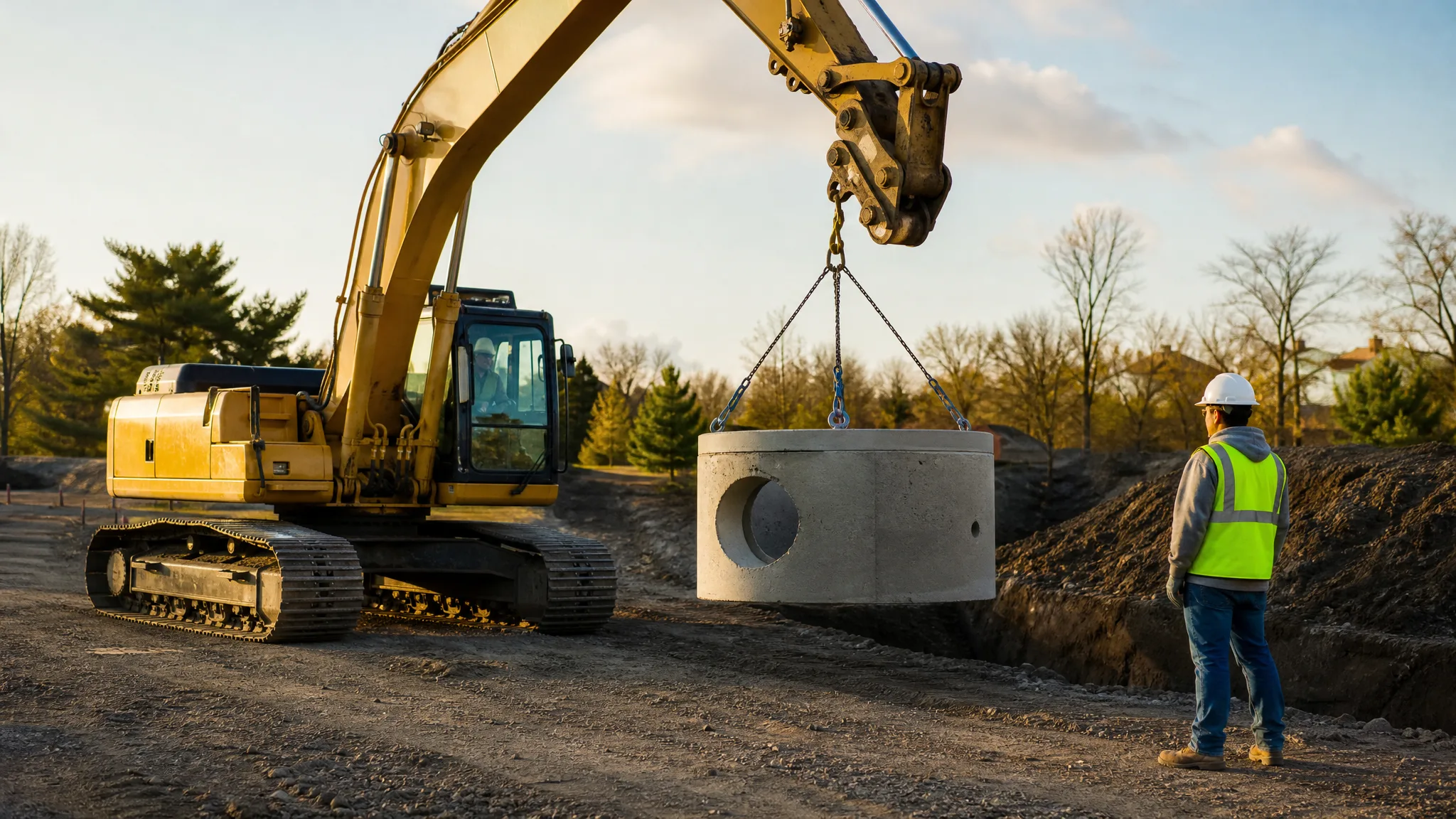
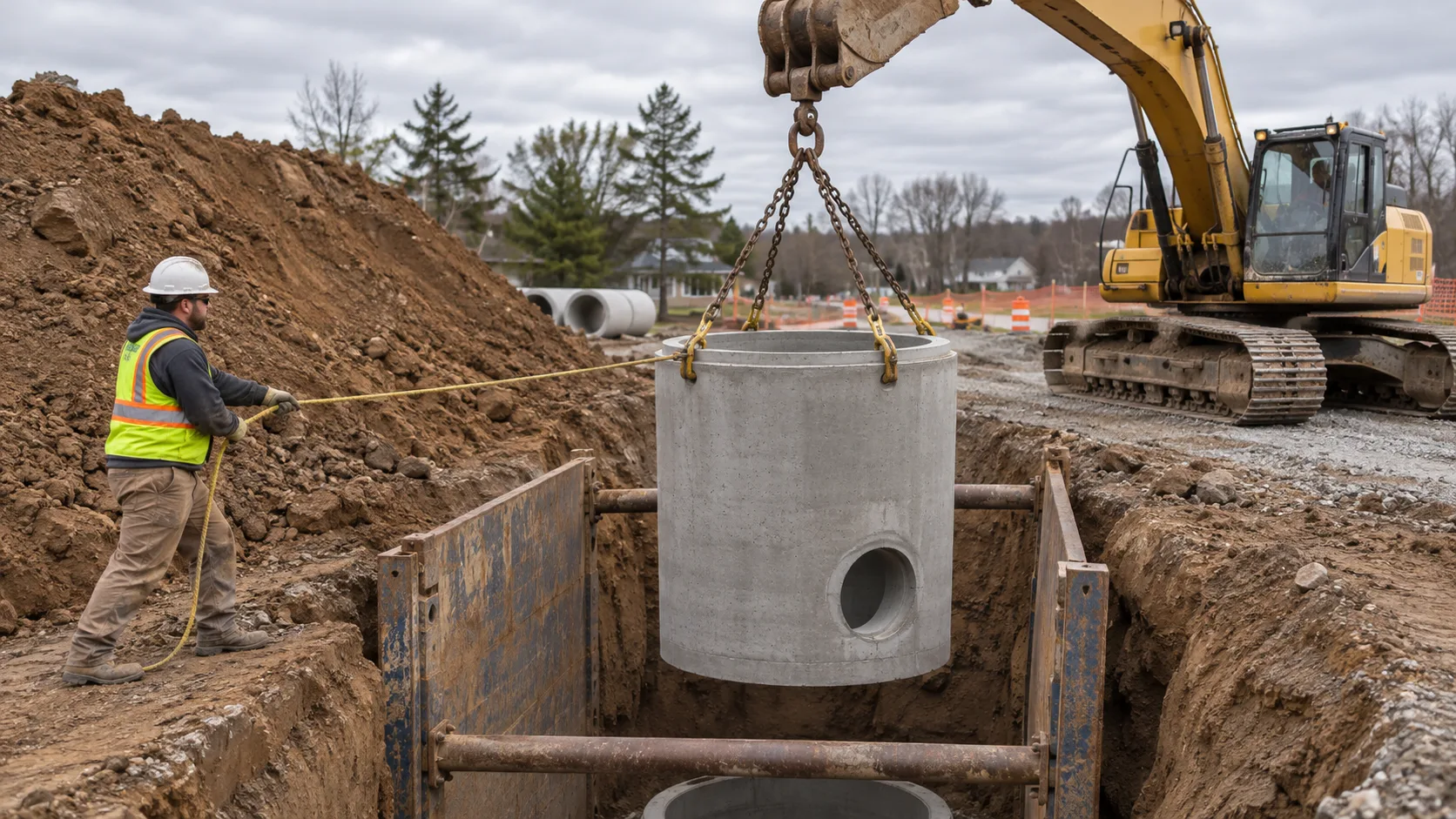
An excavator spends a surprising amount of its working life as a lifting tool. Crews use them to set precast structures, lower pipe into trenches, place trench boxes, move jersey barriers, and pick steel. A well-run lift is fast and controlled. A poorly planned one ends with a dropped load, a damaged machine, or a tipped excavator.
The catch is that an excavator is not a crane. It has no outriggers, usually no load-moment indicator, and no boom hoist. Its capacity changes with the radius, height of the lift point, boom and stick configuration, counterweight, and the ground under the tracks. Treating it like a crane because it can pick something heavy is how operators get into trouble. The basic controls are covered in how to operate an excavator, but lifting adds a separate set of limits.
An Excavator Is Not a Crane
An excavator's lifting limit is set by two things: tipping stability and hydraulic capacity. Whichever is lower at a given radius controls the lift. The manufacturer's lift chart is the only legitimate source for that number, and it is specific to a machine configuration.
A chart from a different machine is not a substitute, and neither is experience with a similar-sized excavator. Boom length, stick length, track gauge, counterweight, and bucket weight all move the number. Find the chart for the machine you are sitting in before the load leaves the ground.
Start With an Honest Load Weight
Every lift starts with a number, and guessing it is the most common way to overload a machine. Precast suppliers publish piece weights. Pipe weights per foot come from the manufacturer. Concrete is roughly 150 pounds per cubic foot, so a 4-by-4-by-4-foot block is about 9,600 pounds before rigging.
Then add everything hanging below the lift point: slings, shackles, spreader bar, lifting eye, and any attachments. On a small excavator, 200 pounds of rigging can be a meaningful share of the capacity. The load's center of gravity matters too. An off-center pick shifts the effective radius and can rotate the load once it is in the air.
Reading the Lift Chart
A lift chart is a grid. One axis is the lift radius, measured from the swing centerline to the vertical load line through the load's center of gravity. The other is the height of the lift point above the ground. Find the cell where the two meet and that is the rated capacity for that configuration.
Most charts separate over-front and over-side lifts. Over-front is more stable because the machine's weight and track length work in your favor. Over-side capacity is lower, sometimes dramatically, because the load is working against the narrow dimension of the undercarriage.
Modern charts are usually rated to ISO 10567, which sets the published capacity at the lesser of 75 percent of the tipping load or 87 percent of the machine's hydraulic lift capacity. Those margins are already built in; they are not capacity you can reclaim on a good day. The chart also assumes firm, level ground and a static load.
Set Up on Ground That Can Take the Load
An excavator on soft ground is a different machine. Tracks can sink, the machine can list, and the effective radius can change as the load comes up. Set up on firm, level, uniform ground, and check for backfilled utility trenches, soft spots, and voids under the tracks.
Steel plates or timber mats spread the load when the ground is marginal. Orient the machine so the lift is over the front where possible, and keep the swing path clear of people, structures, and overhead lines. The clearance rules for energized lines are covered in excavating near overhead power lines. Working on a slope changes stability and should be treated as a separate engineering question rather than a normal lift; the basics are in working on slopes with an excavator.
Rig From a Rated Lifting Point
Use the lifting eye, ear, or hook that the manufacturer provides on the bucket, coupler, or attachment. Bucket teeth are not lifting points. Wrapping a sling around a tooth or hooking a shackle to a tooth puts an unrated, point-loaded connection into the lift. If the machine runs a coupler, confirm that the coupler and the attachment are rated for the lift, and that the safety lock is fully engaged; the different designs are compared in excavator quick couplers.
Every component in the rigging needs a marked working load limit at or above its share of the load: shackles, hooks with safety latches, master links, and slings. OSHA's rigging rule, 29 CFR 1926.251, requires slings and all fastenings to be inspected before use on each shift by a competent person, defective gear to be removed from service, and loads never to exceed the marked safe working load. It also prohibits makeshift hooks made from bolts or rods, knots in slings, shock loading, and pulling a sling out from under a load that is resting on it.
Match the sling to the load. Chain handles abrasion and sharp edges, wire rope is stiff and durable, and synthetic web is light and won't mar finished surfaces but cuts easily. Pad every sharp corner, and keep hands and fingers out of the gap while a sling is being tightened. Thumbs and grapples hold material, but they are not substitutes for rated rigging; see excavator thumb attachments.
Sling Angles Steal Capacity
A sling does not care what it is rated at 90 degrees; it cares about the angle it is actually working at. As the angle from horizontal drops, tension in each leg rises. The load angle factor is 1.0 at 90 degrees, 1.155 at 60 degrees, 1.414 at 45 degrees, and 2.0 at 30 degrees.
Take a 10-ton load on two legs. At 60 degrees, each leg carries about 5.8 tons. At 30 degrees, each leg carries 10 tons, which means a sling rated for 6 tons is now overloaded even though the load never changed. Angles below 30 degrees are generally not recommended.
Hitch type matters too. A choker, basket, and vertical hitch each have separate ratings on the sling tag, and the tag rating for the hitch you are using is the one that applies. Keep the hook over the center of gravity, use a spreader bar for wide loads, and re-check the angle after the load comes off the ground.
Keep the Load Close and the Machine Smooth
Capacity falls as radius grows, so lift close to the machine and keep the load low. Extending the stick to reach a load at the far edge of the chart is exactly how an excavator ends up on its side. Bring the load in before you swing, and keep it as low as the site allows. Tracked and wheeled machines behave differently under a side load, and that comparison is worth reading before you assume a wheeled machine will feel the same as a crawler: tracked vs. wheeled excavators.
Swing starts and stops should be slow and deliberate. A suspended load keeps moving after the machine stops, and that pendulum adds dynamic force at the worst possible radius. Taglines help control rotation and keep the load from spinning into the boom or a structure. Wind matters more than most operators expect on pipe, panels, and anything with a large surface area.
Never swing a load over people, truck cabs, or an open trench. Keep the rear counterweight swing area clear as well, especially on machines with conventional tail swing. If the load has to travel, keep it low and follow the manufacturer's guidance on traveling with a suspended load. The same separation rules that keep crews safe around digging equipment apply here, and they are laid out in working safely around heavy equipment.
Signals and the Crew
One person should be designated to give signals. Hand signals or radio both work, but the operator needs a single source of direction and a clear stop signal. If a signal is unclear, the operator stops and waits rather than guessing.
Set an exclusion zone under and around the load, and keep everyone who is not rigging out of it. Nobody puts hands on a suspended load to steady it. High-visibility clothing and a spotter help, but distance and a shared plan are the real controls. If the machine works near a spoil pile or trench edge, keep the tracks back where the ground is competent; the setback rules are in how far spoil piles and equipment must be kept.
Never Lift People With the Bucket
OSHA's hoisting-personnel rule, 29 CFR 1926.1431, starts with a prohibition: equipment may not be used to hoist employees unless the employer can show that conventional access, such as a ladder, stairway, aerial lift, or scaffold, would be more hazardous or is not possible. When hoisting is allowed, employees must be in a compliant personnel platform, the machine must be level within one percent, and the total load must not exceed 50 percent of the rated capacity.
A bucket is not a personnel platform. Standing in a bucket, riding the thumb, or strapping a worker to a sling is not a shortcut; it is an uncontrolled fall waiting to happen. Use the right access equipment, and if a personnel platform is genuinely required, treat it as a formal lift.
A Pre-Lift Checklist
- Load weight known, including rigging and attachment weight.
- Lift chart checked at the actual radius, height, and machine configuration.
- Ground level, firm, and free of voids; mats or plates used where needed.
- Rated lifting point used; slings, shackles, and hooks inspected and marked.
- Sling angles at 45 degrees or steeper, or capacity recalculated for the angle.
- Exclusion zone established, one signal person, taglines ready.
- Lift slow and low; stop if the load shifts or the machine feels light.
Most excavator lifting accidents are not mysterious. They come from an unweighed load, a chart that was never opened, a sling at a bad angle, or a machine set up on ground that could not hold it. Checking those four things before every pick takes a few minutes and removes most of the risk.
The machine itself deserves the same attention. A used excavator with a tired undercarriage or a cracked boom mount is not the machine the lift chart describes, so a pre-purchase inspection and routine undercarriage checks are part of lifting safety, not just maintenance. Start with buying a used excavator: what to inspect and excavator undercarriage wear and maintenance if you are not sure of the machine's condition.