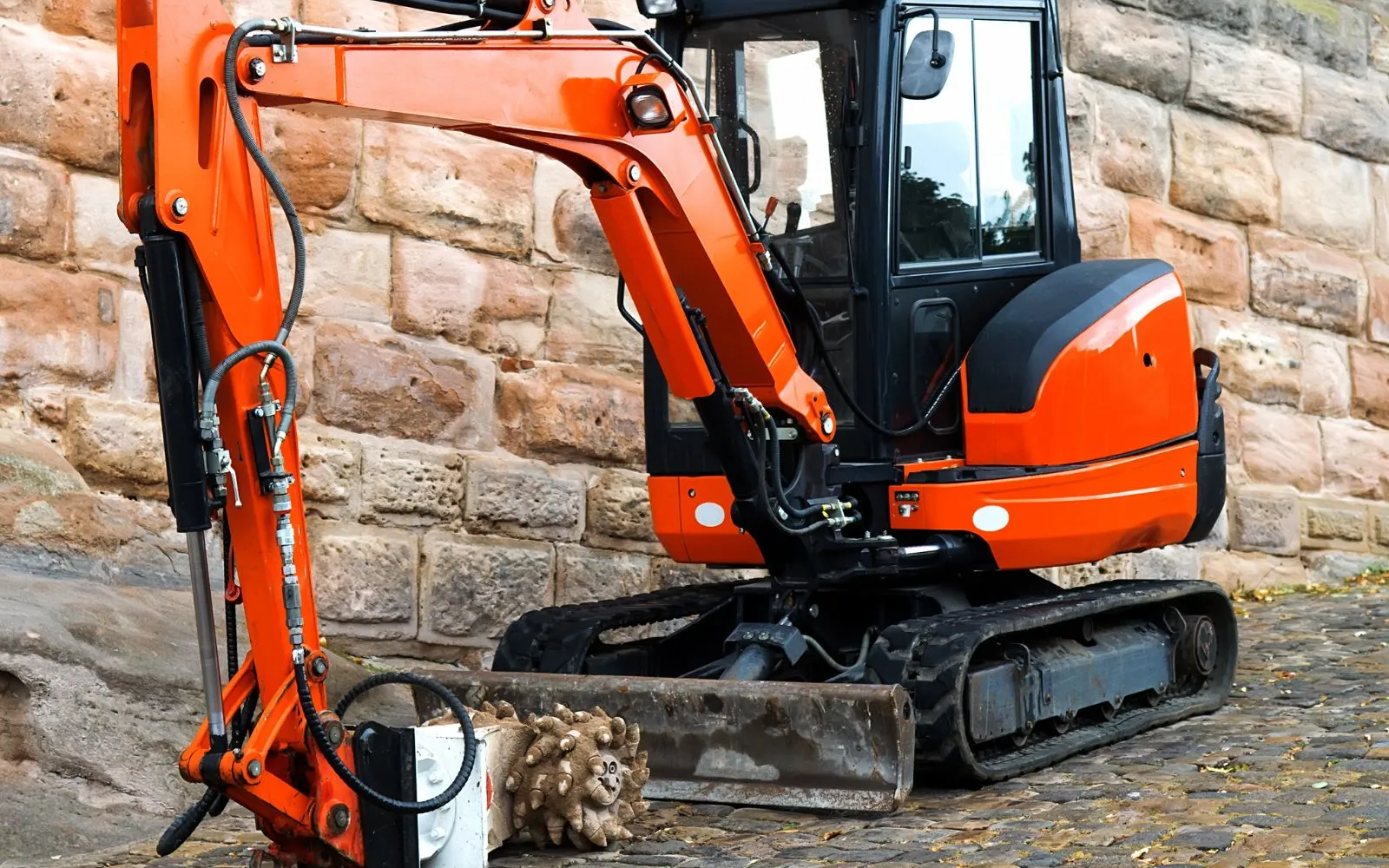
Land Clearing Methods Compared

Clearing is the first real dirt-moving decision on almost any project, and the method you choose shapes the cost, the schedule, the soil you are left with, and how soon you can build. The question is rarely "what is the cheapest way to knock down trees" and more often "which method leaves the ground in the condition my next step requires." Two bids can look identical on a per-acre basis and land thousands of dollars apart once debris, grading, topsoil, and erosion repair are added in.
Why the Method Matters More Than the Price Per Acre
The method decides what the ground can do afterward. A pasture that can be seeded next spring is a very different outcome from a building pad that has to be stripped down to clean, compacted subgrade with every root removed. A dozer crew and a forestry mulcher can both leave you with "cleared land," and only one of those results will pass a foundation inspection.
That is why the method should be chosen from the end use backward, not from the hourly rate forward. Land use, tree size and density, terrain, access, and what happens after clearing all narrow the field before price is even discussed.
The Main Methods at a Glance
Most land clearing falls into half a dozen approaches, and the best operators mix them on a single job.
- Forestry mulching: one track-mounted machine grinds standing trees, brush, and stumps into mulch that stays on site.
- Bulldozing and grubbing: a dozer pushes trees into piles and an excavator pulls stumps and roots out of the ground.
- Excavator with a root rake or thumb: surgical work around keeper trees, piling, sorting, and wet ground.
- Chainsaw and hand clearing: small lots, selective removal, and spots equipment cannot reach.
- Bush hogging: a heavy rotary mower for fields, pastures, and light brush.
- Controlled burning: a managed fire for large, open, low-risk tracts, usually to dispose of piled debris.
Forestry Mulching: One Machine, Mulch Left Behind
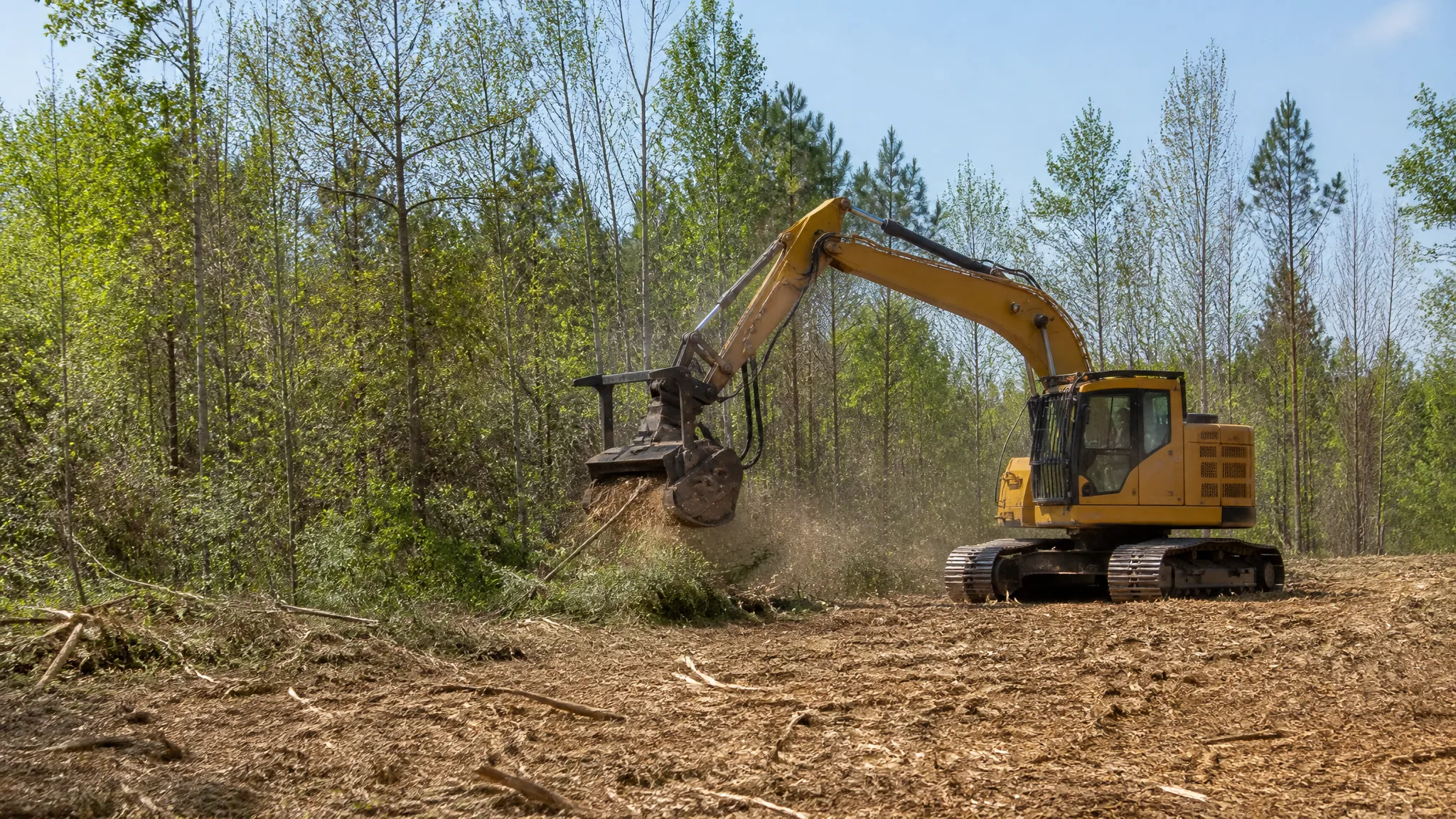
A forestry mulcher is a track-mounted carrier with a high-speed drum covered in carbide teeth that grinds standing vegetation down to ground level in a single pass. The mulch is ejected downward and left on the surface, typically two to four inches deep. Nothing is hauled and nothing is burned.
Tree diameter is the main limit. Mulchers handle roughly 8 to 12 inches efficiently, and larger timber usually needs a chainsaw crew first. Because the machine does all the work, production is fast; published contractor guides put typical output around one to three acres per day on brushy ground.
The mulch layer protects the soil surface, which matters most on sloped or clay-heavy ground where bare dirt erodes quickly. Root systems below grade stay in place and hold soil while new vegetation establishes. The attachment itself is a common one; we cover it in skid steer mulcher attachments.
Bulldozing and Grubbing: Bare Ground, Roots Out
Traditional clearing is a multi-step operation: fell the large trees, push the debris into windrows or piles with a dozer, grub the stumps and roots with an excavator, then burn, chip, or haul what is left. A feller-buncher may come first when there is merchantable timber worth recovering, and the timber value can offset part of the clearing cost.
The advantage is completeness. Grubbing removes the root systems entirely, which is what a building footprint, road subgrade, or any surface that must be graded and compacted actually requires. The trade-off is bare, disturbed soil exposed to rain until it is graded and stabilized, plus a debris-disposal bill that simply does not exist with mulching.
The excavator side of that work is where the precision lives, which is why our guide to mini excavator tree removal is worth reading before a small-lot clearing job.
Excavators, Root Rakes, and Light Methods
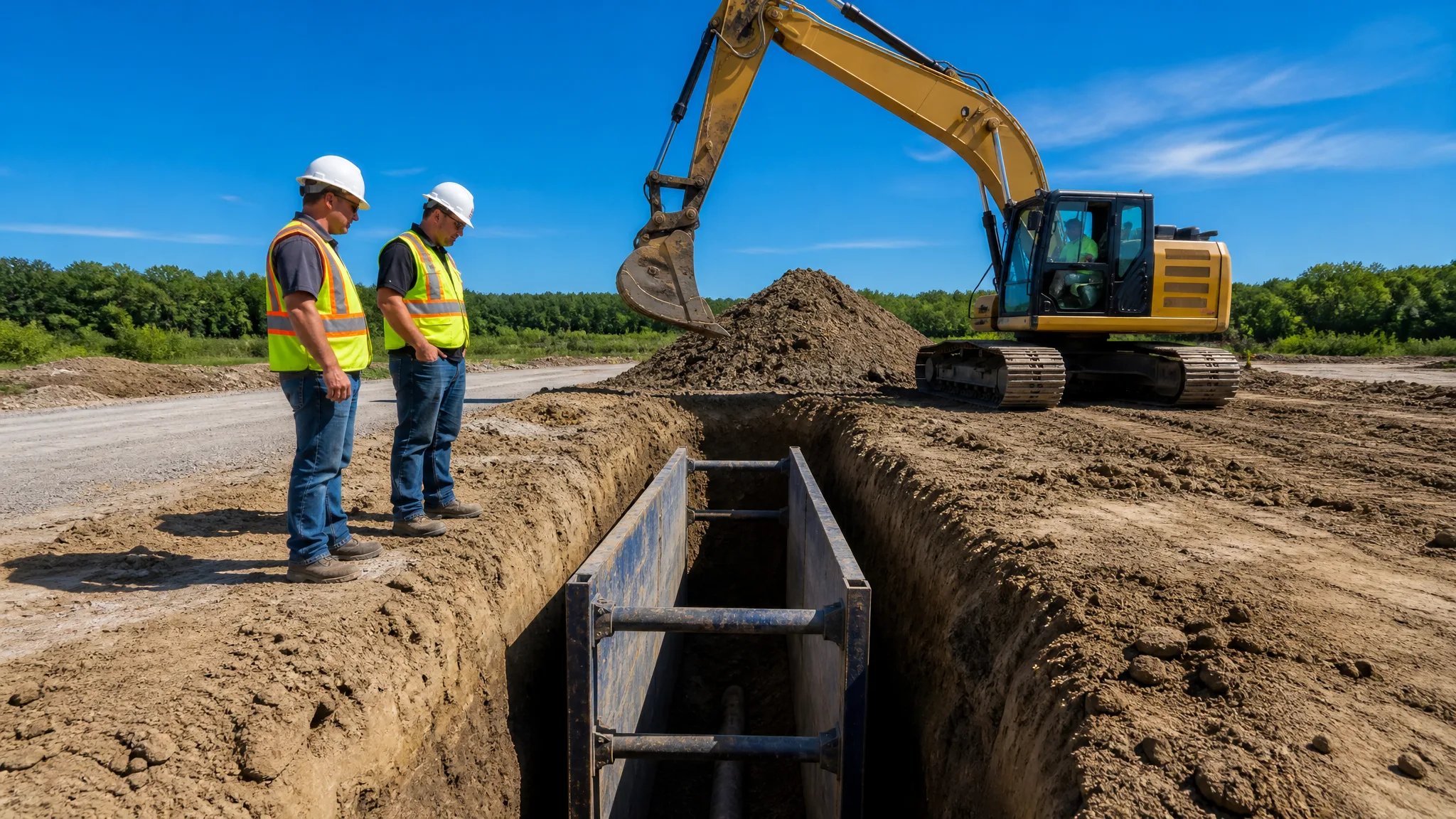
An excavator with a root rake, grapple, or thumb is the tool for work that is more surgical than bulk. It can pull individual stumps next to trees you want to keep, sort clean burn piles from dirt, and reach into wet or soft ground where a dozer would smear the surface. Because the machine reaches without driving over the entire site, it also limits compaction and rutting.
Not every job calls for iron at all. Bush hogging handles fields, pastures, and light brush with a rotary mower and is as much a maintenance method as a clearing one. Chainsaw and hand clearing fit small lots, selective thinning, and areas equipment cannot reach, though it is slow and labor-intensive. Controlled burning covers large open tracts cheaply but depends on dry, calm conditions and careful supervision; as a standalone method it is risky, and it is usually best used to dispose of debris a machine has already piled.
Cost: Where the Money Actually Goes
Published contractor ranges put forestry mulching at roughly $1,500 to $5,000 per acre and traditional clearing at $3,000 to $8,000 or more per acre. Mulching is often quoted by the hour, commonly $150 to $500, with acre-sized jobs running three to six hours of cutting time plus mobilization. For a full breakdown of what drives those numbers, see how much land clearing costs.
Traditional clearing tends to run higher not because of the base rate but because of everything after it. A representative three-acre breakdown adds chainsaw work, dozer piling, excavator stump grubbing, debris hauling or a burn permit, a grading pass, and often topsoil replacement. Those ancillary costs are what turn a "cheaper" per-acre quote into a larger final bill.
Speed and How Soon You Can Use the Ground
Mulching typically clears one to three acres per day, while traditional clearing with piling, burning, and haul-off runs slower, around half an acre to two acres per day, and the debris phase can extend the timeline further. Site readiness differs too.
Mulched ground can often be seeded or put to use almost immediately, and heavy equipment can usually cross it sooner. Bare ground left by traditional clearing needs grading and, on many sites, a settling period before heavy use, which is one more reason to plan the sequence carefully in a grading plan.
Stumps, Roots, and Building Pads
Stumps are where the two approaches diverge most. A mulcher grinds a stump down to near ground level but does not grub the root ball, and it does not reach the eight to twelve inches below grade that a dedicated stump grinder can. Any area that will be graded or built on usually needs follow-up stump grinding after mulching.
Traditional clearing pushes the root balls out entirely, which is what structural site prep calls for, but it leaves a pile of stumps and roots that has to be burned or hauled. Neither method makes the stump question disappear. One hides it under mulch, the other moves it into a pile, and only one of those is acceptable under a building slab. Once a pad is stripped, the fill that replaces the removed material matters as much as the clearing itself, which our guide on topsoil stripping and stockpiling covers.
Erosion, Soil, Permits, and What Comes Next
On bare, freshly dozed ground the first heavy rain can move a lot of topsoil, especially on slopes and clay soils, which is why silt fence, stabilization, and reseeding matter immediately after traditional clearing. Mulch behaves like a temporary erosion blanket while new growth establishes, so it is usually the better choice where a slope drains toward a creek, pond, or neighboring property. Installing sediment control after the fact is harder than planning it up front, and our guides to installing a silt fence and seeding and stabilization after grading cover the practical side.
Clearing that touches streams, wetlands, or their buffers can trigger federal and state permitting, and many jurisdictions have tree ordinances, burn rules, and erosion-and-sediment requirements for larger disturbances, often tied to a stormwater plan. Check local requirements before any machine arrives, especially near water. Our overview of what a SWPPP is explains the stormwater side.
Mulching is also the quieter neighbor. One machine working for a day is far less disruptive than a week of chainsaws, trucks, and burn smoke on a residential lot. On shared roads, fewer heavy loads means less wear and fewer complaints, and for trees you intend to keep, plan the protection early using our guidance on protecting trees during excavation and grading.
Choosing Your Method
A simple decision path covers most jobs. Match the method to what the ground has to become, then check cost and schedule.
- Building pad, road, or anything to be graded and compacted: grub the roots. Mulch alone will not do it.
- Overgrown pasture, brush, trails, or selective clearing: forestry mulching.
- Wet, soft, or tight-access ground: excavator with a rake or thumb.
- Fields and light brush on a maintenance schedule: bush hogging.
- A few trees on a small lot: chainsaw and hand clearing, or a compact machine. See the best mini excavator for land clearing.
- A slope or drainage feature nearby: favor mulch to limit erosion.
Whichever route you take, the goal is the same: cleared ground that is ready for the next phase without a surprise bill or an erosion problem three months later. Decide based on the end use first, and the method usually picks itself.