Installing a French Drain


A soggy yard, a wet basement, or water standing against the foundation usually traces back to the same problem: water has nowhere to go. A French drain gives it somewhere — a gravel-filled trench with a perforated pipe that intercepts water and carries it away before it pools. Here is how the system works and how to install one that keeps working.
What a French Drain Actually Does
A French drain is a trench filled with gravel that contains a perforated or slotted pipe, usually wrapped in filter fabric. Water seeps through the soil and the gravel envelope, enters the pipe through its perforations, and flows under gravity to a discharge point. Unlike a surface drain that catches water at one spot, a French drain collects water along its entire length.
The name comes not from France but from Henry Flagg French, a 19th-century New England lawyer and farmer who popularized the technique in an 1859 book, Farm Drainage. The basic design — gravel, pipe, downhill slope — has not changed much since. You will also hear it called a curtain drain, perimeter drain, or weeping tile.
When a French Drain Is the Right Fix
French drains solve water problems at the source, which is why they beat surface patches. Watch your yard during and after a heavy rain: the spots that stay saturated long after the storm are telling you where water collects. Common uses include foundations, basements, and crawlspaces, soggy lawns and landscaped beds, retaining walls, and hardscape areas like patios and driveways.
They are most useful for groundwater and shallow subsurface water. If the problem is a downspout dumping on the wrong side of the house, fix the downspout first — no drain out-runs a flowing outlet. For the wider picture, see creating effective drainage systems during excavation and how much slope a yard needs for drainage.
Plan the Route and Find the Outlet First
Before you dig a foot, decide where the water is going. A drain with no working outlet is just a long, expensive hole that fills up. Options include daylighting the pipe to a lower area of the property, discharging to a dry well or infiltration area, or connecting to a storm system where local rules allow. A culvert-style outlet through a bank is one option — see installing a driveway culvert for how pipe crossings are handled.
Discharging onto a neighbor's property or into a storm sewer without permission can create a legal problem, and many municipalities require a permit once you connect to public drainage. Check local rules early. Also call 811 to have buried utilities marked before any excavation, and hand-dig with care inside the tolerance zone — the calling 811 guide covers that process.
Trench Depth and Width
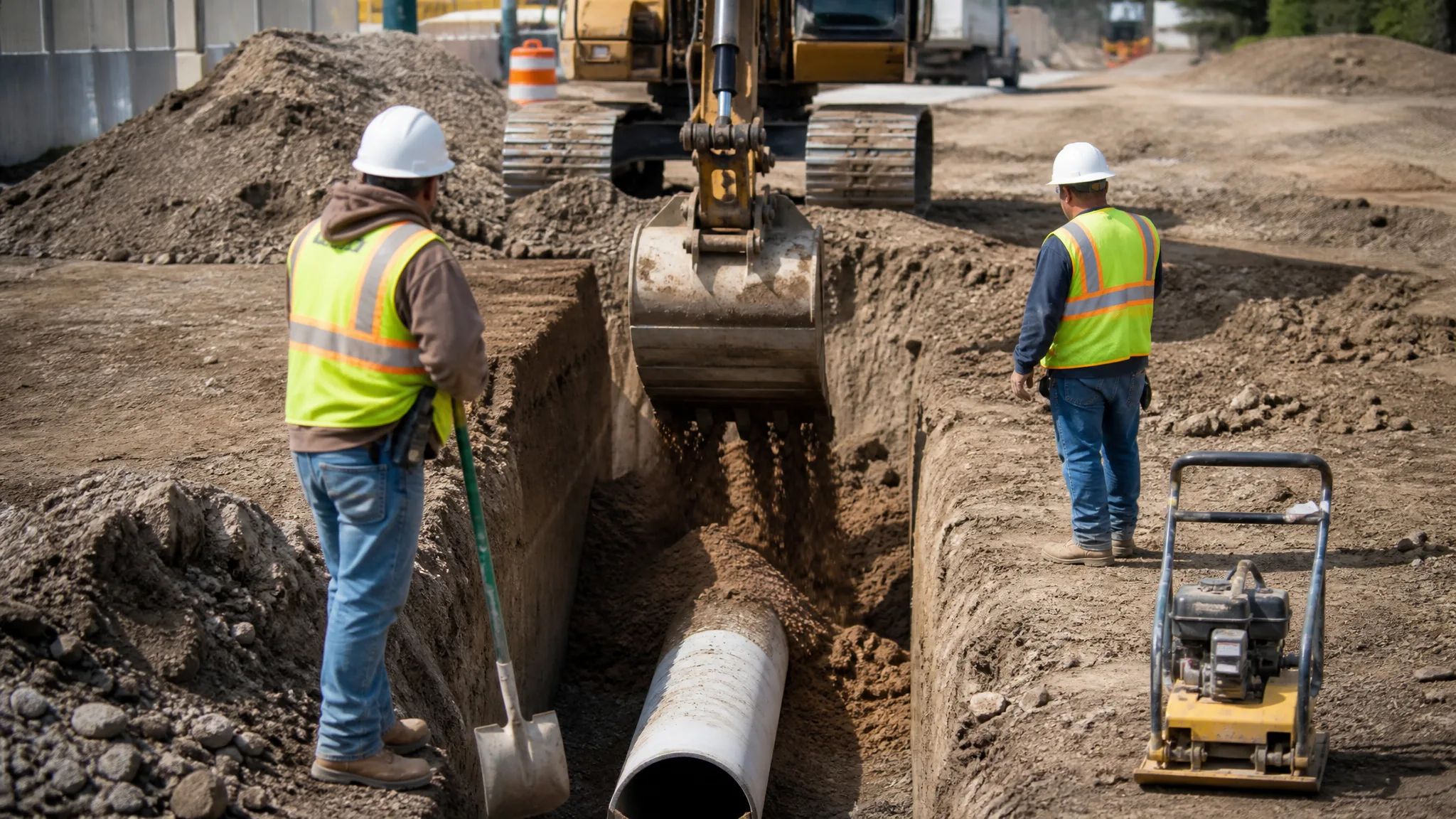
For typical residential yard drainage, a trench about 12 inches wide and 18 to 24 inches deep is the common standard. That gives room for a 4-inch pipe with a solid gravel envelope around it. Foundation drains that intercept water at footing level run deeper — often 24 to 36 inches — so the pipe sits below the footing.
Keep the trench bottom consistent so the pipe does not sag. A trenching shovel makes clean edges; for runs over roughly 30 feet, a rented trencher saves a lot of time. Where water arrives from an uphill direction, placing the drain uphill of the wet area lets it intercept the flow before it gets there. The techniques are the same ones covered in trenching techniques for different soil types.
Lay the Filter Fabric
Line the trench with non-woven filter fabric, leaving enough excess on both sides to fold over the top once the gravel is in. The fabric is what keeps fine soil particles from migrating into the gravel and clogging the system — the reason an install without it often fails within a few seasons.
Think of the finished assembly as a burrito: pipe and gravel wrapped tight so nothing unwanted gets in. In clay soils especially, skip the fabric and the drain will silt up and stop draining. The same sediment-control logic drives erosion best practices like installing a silt fence.
Set the Pipe at the Right Slope
The pipe must fall toward the outlet. Use a minimum slope of about 1 percent — roughly 1 inch of fall per 8 feet of run — and many installers work closer to 1/4 inch per foot, about 2 percent, for better flow. Check the slope with a level and string line as you go, not after the trench is backfilled.
A 4-inch perforated pipe handles most residential applications; large, water-heavy sites may need a bigger diameter. Set the pipe with its perforations facing down, resting on a bed of gravel so it is fully supported along its length. Flexible corrugated pipe and rigid PVC both work: rigid PVC holds slope better in long runs, while corrugated is easier to route around curves.
Add and Wrap the Gravel
Cover the pipe with washed gravel — 3/4-inch clean stone is the usual choice — filling the trench at least 12 inches over the pipe. Round the gravel to a slight crown, fold the filter fabric over the top, and overlap it. Then backfill with soil on top.
Washed stone matters: the fines in crusher run can work into the pipe and reduce flow. Estimate the gravel by volume — length × width × depth ÷ 27 gives cubic yards — and add a cushion, since gravel settles. A 50-foot trench at 1 foot wide by 2 feet deep runs about 3.7 cubic yards, or roughly 5 tons. For stone placement and grading logic, see building a gravel driveway.
Backfill, Restore, and Protect the Outlet
Backfill over the wrapped gravel with native soil, mounding it slightly so the soil sheds water rather than pooling on top. Restore the surface, and make sure the outlet is protected — a pop-up emitter, riprap, or a splash area that will not erode. A clogged or buried outlet is the single most common reason a working drain stops working.
Keep an inspection point or cleanout at the high end so you can check the system later. Avoid driving heavy equipment over the finished run, which can crush the pipe or compact the gravel envelope. On wet sites, pairing a drain with proper dewatering methods keeps excavation workable.
Common French Drain Mistakes to Avoid
Most failures come down to a handful of avoidable errors:
- No outlet, or an outlet that drains uphill — water only moves downhill.
- Flat or back-sloped pipe — a sag holds water and traps sediment.
- Skipping filter fabric, which lets fines clog the gravel and pipe.
- Using dirty or fine gravel instead of washed stone.
- Discharging onto a neighbor or into a storm system without permission or a permit.
- Digging before 811 locates and striking a utility.
- Making the trench too shallow to intercept the water it is meant to catch.
DIY vs. Hiring an Excavation Contractor
A short, shallow drain in an easy-access yard is a reasonable DIY project for a homeowner with a shovel and a weekend. Longer runs, deep foundation drains, clay soils, or any dig near utilities are better handled by an excavation contractor with a trencher or mini excavator — the work goes faster, the slope gets set correctly, and the spoil gets handled.
Professional installation commonly runs around $20 to $30 per foot, depending on materials, access, and depth. Drains behind walls and structures tie into the same water logic as excavating for a retaining wall and the role of hydrology in excavation and grading.
Whatever route you take, the principle is the same: intercept the water, give it an easy downhill path, and keep soil out of the system. Do that, and the drain keeps quietly doing its job for years.