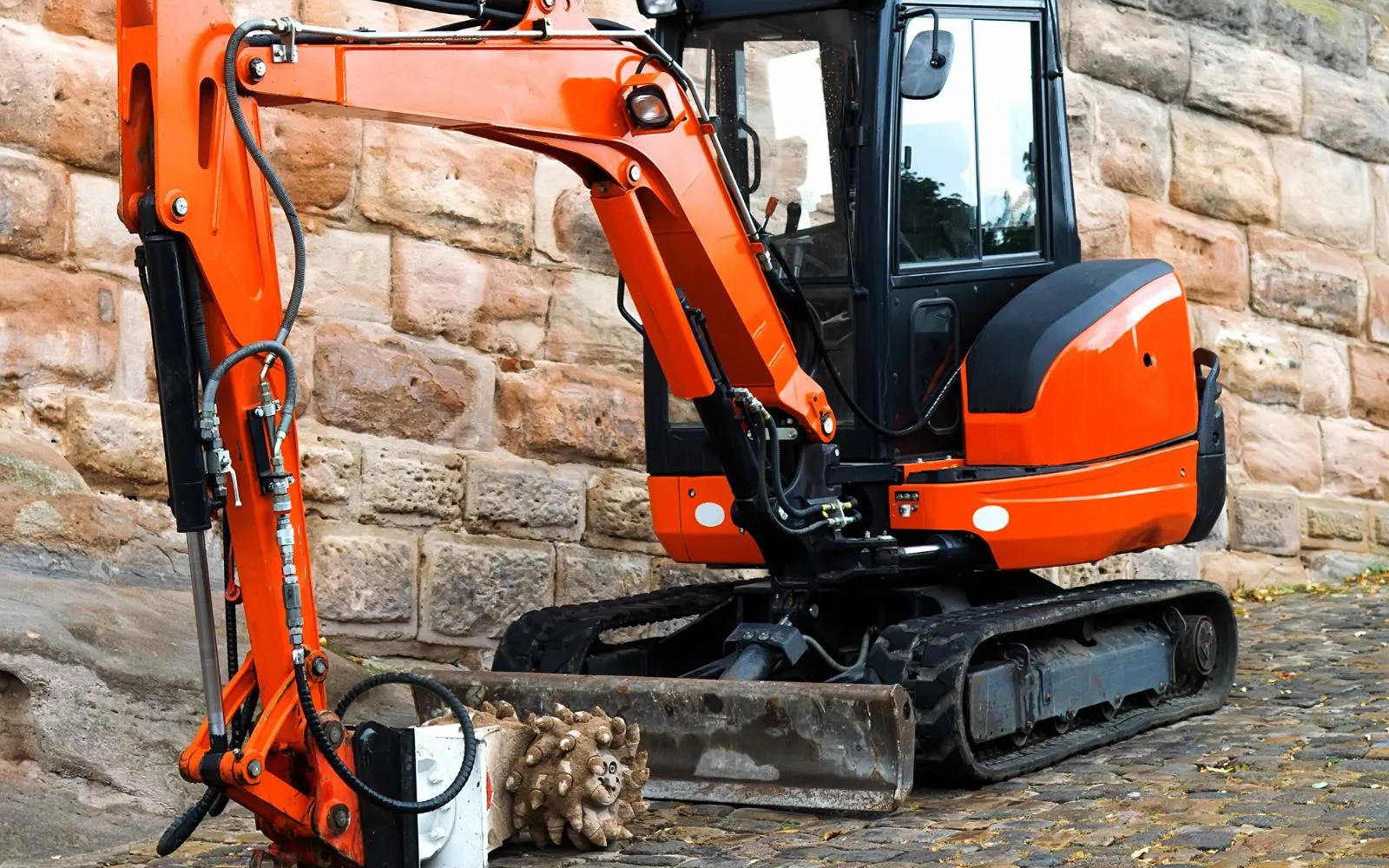
How to Remove a Tree Stump

A tree stump is not just an eyesore. It is a trip hazard, a mower killer, a rot pocket under a future patio, and often the reason a lawn never quite grades out. Removing it is straightforward once you match the method to the stump, the site, and what you plan to put there afterward.
The four workable options are grinding, pulling with an excavator, digging by hand, and letting the stump decay in place. Each one leaves the site in a different condition, and that difference matters more than most homeowners expect.
Decide What the Spot Has to Do Next
Start with the end use, because it sets the depth and the cleanup. If the spot will become lawn, a ground stump with the chips removed and topsoil brought in is usually enough. If it will carry a patio, shed, driveway, or equipment pad, the wood and the loose root zone need to be gone far enough that the subgrade will not settle.
Replanting a tree in the same hole is a different problem again. The old root system keeps decaying for years, leaving voids that change how water moves through the soil, so the site needs time and soil improvement rather than a direct swap.
If the answer is "nothing, it is out in the pasture," leaving it may be the right call. A dead stump is habitat for insects, birds, and small mammals, and it costs nothing.
Check What's Underground First
Stump work is excavation, even when the tool is a grinder. Call 811 before any machine goes near it, and give the locate service the time your state requires. Public utilities are marked at no cost to the caller, and the marks are an approximate guide rather than a guarantee of depth or exact alignment.
The bigger risk is usually private. Irrigation lines, landscape lighting, invisible fencing, septic components, fuel lines, and shop or barn feeders typically are not marked by the public locate service because they are on the private side of the meter. Anyone who has cut a buried sprinkler main while grinding a stump knows how quickly a cheap job becomes a repair.
That risk is not only about pipes. Stumps near a foundation, retaining wall, driveway, or sidewalk need extra care, because the roots you are cutting may be part of what is holding the soil under that structure. If the stump sits within a few feet of a wall or a slab, get someone who understands foundations to look at it before you start pulling.
Stump Grinding: The Default Choice
Grinding is the quickest, easiest, and safest option for most stumps, and it is what most arborists will recommend. A purpose-built grinder chews the stump and the large lateral roots down to roughly 8 to 12 inches below grade, according to Iowa State University Extension, and the work is usually measured in hours rather than days.
Two things surprise people afterward. First, the grinder leaves a hole full of wood shavings, and most arborists do not remove that material or fill the hole unless you ask and pay for it. Second, that chip pile is not harmless fill. The extension service warns that grinding debris drastically changes soil structure, moisture-holding capacity, and nutrient balance, which makes it hard for new turf or plants to establish.
Grinding also does not remove the root system. It removes the stump and the big laterals near it, which is enough for mowing and most landscaping, but deep roots and roots running under a slab stay where they are. On species that sucker aggressively, grinding alone can trigger a ring of new shoots around the hole.
Access decides feasibility as much as stump size does. A grinder needs a clear path through the gate, room to swing, and no overhead conductors or low branches in the way. If the machine cannot get to the stump, the job becomes a different job.
Pulling a Stump With an Excavator
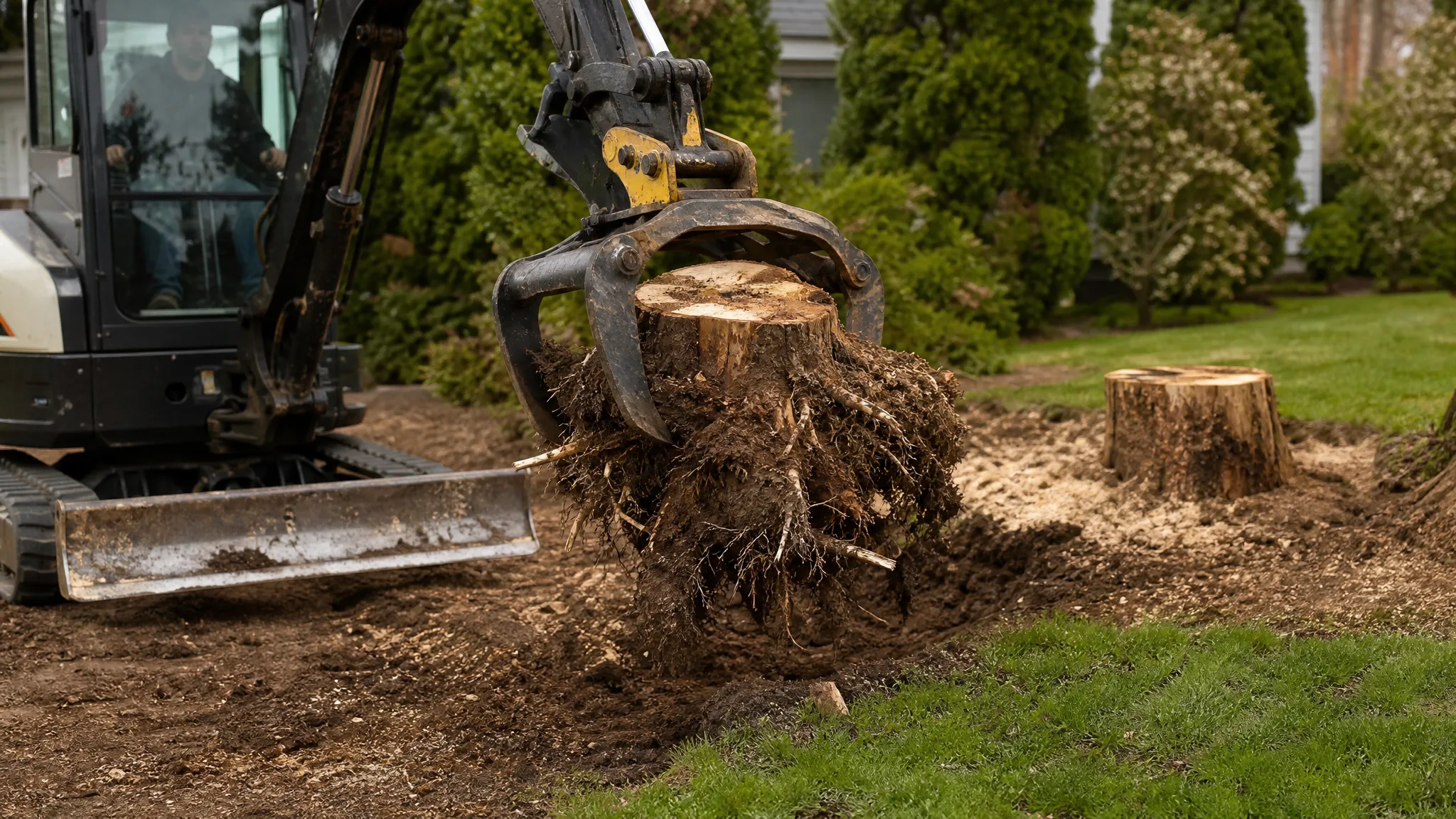
Pulling gets the whole root plate out, which is what you want when the spot will carry a structure, a driveway, or a planting bed that cannot tolerate settling. It also removes the stump in one piece, so there is no chip pile to deal with and no slow decay under the finished grade.
The method is straightforward but not gentle. Dig a trench around the stump to expose the lateral roots, sever the ones the bucket cannot break, and work the stump loose rather than trying to rip it straight up. Root plates are wider and heavier than the visible trunk suggests, and species differ enormously: some hold with a deep taproot, others with a broad mat of laterals.
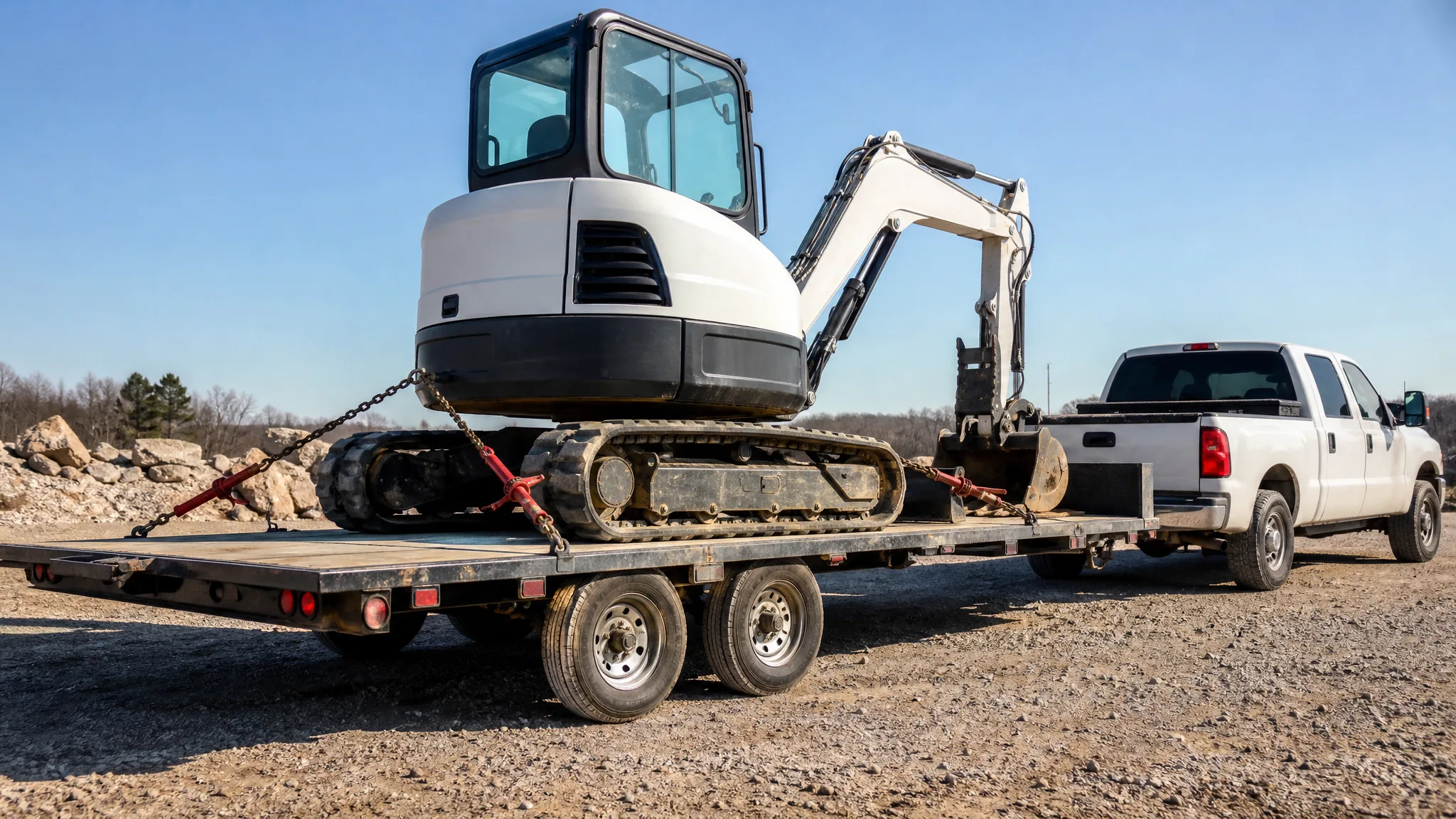
Leaving several feet of trunk standing gives the operator something to push and pull against, which is exactly the leverage the extension service describes for hand digging. Small stumps are often quicker with a compact machine, and the same limits that govern mini excavator tree removal apply once the trunk is gone. On a machine, that same height creates a tipping risk if the bucket is used to lever against a root that will not give. Keep the load close, work from stable ground, and never lift a root ball over a person or a truck cab. The same lift-chart discipline that applies to pipe and precast applies here.
Expect damage. Pulling a stump tears up turf, leaves a crater far wider than the stump, and produces a root ball that has to go somewhere. That spoil has to be handled like any other excavated material, whether it is staged and hauled off site or burned into the backfill plan. On a finished residential lot, that means protecting the lawn you are keeping, planning a haul route before the machine arrives, and having fill ready to bring the hole back to grade.
Digging a Stump by Hand
Hand digging is realistic only on smaller stumps, roughly 12 inches in diameter or less according to Iowa State Extension. It is labor-intensive but fast on the right stump, and it needs no machine access.
The technique is to trench one to two feet deep around the stump, cut every lateral root you expose with a saw, and then pry the stump over with a long bar so you can reach the roots underneath. Leaving the stump four to six feet tall rather than cutting it at grade gives you the leverage to move it. Fill the hole with topsoil and settle it in lifts rather than dumping it in one pass.
Chains and ropes deserve a warning here. The extension service specifically cautions that a chain which slips or breaks under tension can injure people and damage property. The same rule applies to any load under tension: stay out of the line, use rated hardware, and never let anyone stand downhill of the pull. If you are pulling with a vehicle, use rated rigging, keep bystanders out of the line, and treat the cable like it can fail at any moment.
Decay in Place
Natural decay is cheap, safe, and slow. Depending on soil moisture, the presence of wood-decay fungi, and the species, a stump can take ten years or more to reach the point where it breaks apart easily.
You can shorten that considerably. Cut the stump as low as possible, then drill one-inch holes no more than 12 inches apart and at least 10 inches deep to open more surface to fungi. Fill each hole with about four ounces of slow-release fertilizer, top it off with topsoil, and cover the stump with soil or sod. High-nitrate formulations promote the fastest decay, and the extension service notes that after this treatment the stump can usually be broken up with a spade in one to three years.
Commercial stump-removal products are mostly the same idea in a bottle, typically potassium or sodium nitrates. Follow the label, and keep them away from desirable plants.
Burning is the one method to skip. Accelerants can leach into soil, stump fires can burn for days and are hard to control, and many jurisdictions prohibit open burning outright.
What to Do With the Chips and the Hole
If the stump was ground, remove the chips before you do anything else. They are not soil, they will not behave like soil, and plants set directly into them struggle. Shovel the material out, haul it to a compost site or use it as mulch somewhere it will not be planted into, and bring in topsoil to fill the hole.
Fill in lifts and settle each one. A hole backfilled in a single dump will leave a depression within a season, which is the same failure mode that makes post holes and utility trenches settle. Mound the fill slightly above grade so it can consolidate to level, then re-seed or sod.
If the stump was pulled, the hole is larger and the subgrade is looser. Compact the bottom before filling, keep the fill free of wood fragments, and grade the surface so water drains away from whatever is nearby rather than into the old root cavity.
Stopping Resprouts
Some species send up shoots from the stump or from roots after the top is gone, and cutting those shoots without treating the stump just wastes the plant's stored energy for a while. The reliable approach is to treat the living cambium, the ring of tissue just under the bark, with an herbicide labeled for stump treatment.
Clean sawdust and soil off the cut surface first, apply to the cambium ring rather than the dead heartwood, and repeat the treatment on any new sprouts until they stop emerging. Glyphosate, triclopyr, and imazapyr are the common active ingredients. Avoid picloram products such as Tordon, which leach readily and persist in soil long enough to damage nearby plantings.
What Drives the Price
Grinding is normally priced by the stump's diameter measured at its widest point, which is why two stumps of the same height can price very differently. Ask for that per-inch or per-diameter price up front, and ask what it includes.
Chip removal, hole filling, and hauling are usually separate line items. So is access difficulty: a stump behind a fence, on a slope, or surrounded by landscaping takes more time and sometimes a smaller machine.
Pulling is priced differently again, because it involves excavation, a root ball to dispose of, and fill to bring the hole back to grade. The volume of spoil and the cost of fill often matter more than the stump itself, particularly when the root ball has to leave the site. On a larger job, stripping and stockpiling topsoil before the machine arrives keeps the good material available for the repair.
When to Call a Pro
Call someone when the stump is large, when the machine cannot reach it safely, when it sits close to a foundation, retaining wall, driveway, or utility, or when the debris has to be hauled and the hole restored. Grinding near buried services and pulling near structures are both jobs where a mistake is expensive. If the stump sits where a machine has to lift or swing a load, excavator lift charts and rigging rules apply to the root ball too.
For a small stump in an open yard with nothing buried nearby, hand digging or a rented grinder is a reasonable weekend project.
Whichever method you choose, finish the job properly: get the wood out of the planting zone, fill and settle the hole, restore the grade, and deal with resprouts before they get established. A stump is easy to remove. A stump that was removed badly can take years to fix.