How to Choose an Excavation Contractor

Hiring an excavator is not like hiring a painter. The work happens below grade, most of it gets covered up, and the mistakes that matter most — a pad built over soft fill, a trench backfilled without compaction, a drain line with a flat spot — usually show up months later as a crack in a foundation or a puddle that never dries. Choosing an excavation contractor deserves more scrutiny than almost any other trade on a residential or light commercial job.
Why Excavation Is a Different Kind of Hire
Three things make earthwork unusually risky to buy. First, the work is invisible after the fact: nobody can look at a finished driveway and tell whether the subgrade was proof rolled or whether the spoil was pushed back in without a compaction pass. Second, the ground itself is the variable. Rock, groundwater, buried debris, and unsuitable soil are all discovered during the work, not before it, which is why the contract and the bid structure matter as much as the hourly rate.
Third, excavation is one of the highest-consequence trades on any site. OSHA describes excavation and trenching as among the most hazardous construction operations, and the agency requires a protective system in any trench five feet deep or more unless the excavation is entirely in stable rock. A contractor who is casual about that is casual about your project too.
Define the Work Before You Call Anyone
You cannot compare bids that describe different jobs. Before you call a single contractor, write down what the work actually includes: clearing and grubbing, topsoil stripping and stockpiling, cut and fill to a defined grade, trenching for utilities, haul-off or on-site spoil placement, imported fill, gravel, erosion controls, dust control, and restoration of disturbed areas.
Then decide who is responsible for the pieces that get left out of bids. Survey and staking, the grading permit, utility locates, compaction testing, and disposal fees are the usual gaps. If one bidder includes the permit and another expects you to pull it, the numbers are not comparable. A grading plan and a clear scope statement are the only ways to make three quotes mean the same thing.
Also settle the standard of finish. "Rough grade" and "finish grade" are different products, and a pad that is two inches out is a problem for the concrete crew, not the excavator. Put the tolerance in writing.
Verify the License, Not the Logo
Licensing for excavation and site work varies widely. Some states license general contractors and specialty trades with a formal exam and a public lookup; others require only a home-improvement registration, and some regulate the work through local permits instead. The point is not which system your state uses — it is that you check it yourself rather than accepting a logo on a truck door.
Search the state or county licensing database by the company's legal name and by the individual's name, not just the trade name. Confirm the license is active, that it covers the class of work you are buying, and that no disciplinary actions are posted. The Federal Trade Commission advises consumers to confirm a contractor's license with state or county government and to ask for proof of insurance.
The contract should carry the contractor's name, address, phone number, and license number. The FTC lists those among the items a written agreement should contain, along with estimated start and completion dates and any promises made during the sales conversation.
Insurance and Workers' Compensation: Certificates, Not Promises
Ask for a certificate of insurance and read it. You want general liability, commercial auto, and workers' compensation, with current effective dates. A certificate is only evidence — the stronger move is to have your own agent or the insurer's agent confirm the policy is in force and that the limits are what you expect.
Workers' compensation is the coverage owners underestimate. If a laborer is injured in a trench on your property and the contractor carries no comp coverage, the claim can reach back to the property owner or the general contractor in many states. Most states require employers to carry it; a handful of exceptions exist, and they are narrow. An excavation contractor who cannot produce a comp certificate is a contractor whose crew is one injury away from becoming your liability.
If you are hiring them as a subcontractor on a larger job, the safety exposure is shared. Under OSHA's multi-employer citation policy, a controlling employer can be cited for a hazard created by another employer on the same site when it had the authority and ability to correct it. That is why general contractors collect certificates, safety programs, and trenching procedures before mobilization rather than after an incident.
Ask Who Will Be Running the Machine
The company you hire is not always the crew that shows up. Ask directly whether the operator is an employee or a subcontractor, how many years they have run that class of machine, and who supervises them. On small residential jobs it is common for an owner-operator to bid the work and a hired hand to perform it.
Then ask about trench safety in plain language. How do they protect trenches over five feet? Do they own a trench box or shore as needed, and who inspects the excavation each day? OSHA requires a competent person to inspect excavations, adjacent areas, and protective systems before work begins and as conditions change. A contractor who answers with a shrug is telling you something useful. For background, see when trench protection is required and what a competent person actually does.
Compare Bids on Scope, Not on the Bottom Line
A useful bid is itemized: quantities, unit prices, mobilization, haul-off, imported material, and a clear list of exclusions. Lump sums hide the parts that change. Ask every bidder to price rock excavation and unsuitable soil removal as unit rates per cubic yard, because those are the two line items that turn a fixed price into a change order.
The FTC's guidance on estimates is simple and still correct: a written estimate should describe the work to be done, the materials, the completion date, and the price — and you should not automatically choose the lowest bidder. When the spread between quotes is large, ask each contractor to explain what the other one left out. The answer is usually more informative than the number.
Read the Contract: The Clauses That Decide Disputes
Most excavation disputes are not about workmanship. They are about what the contract said regarding rock, water, and haul-off. The clauses that matter are the scope description and the plans it references, the unit prices for unforeseen material, the change-order procedure, the schedule and weather provisions, payment terms, retainage if any, warranty, site cleanup, and how disagreements get resolved.
Insist that change orders be in writing before the extra work happens, with a price or a time-and-materials rate agreed in advance. A verbal "we'll work it out" is how a $9,000 job becomes a $16,000 argument. The FTC also notes that contract requirements vary by state and that, if you signed in your home or somewhere other than the contractor's place of business, you may have a three-business-day right to cancel. Make sure no blank spaces are left in the document you sign, and get a copy the day you sign it.
For more on the document itself, see the guide to excavation contracts.
Structure Payments So the Job Funds Itself
Never pay the full amount up front, and treat a large cash deposit as a warning rather than a discount. The FTC advises against paying the whole project in advance and notes that some states limit how much a contractor may request as a down payment. Ask your state consumer agency what applies where you live.
A workable structure ties payments to progress: a modest mobilization payment, then draws at defined milestones such as completion of clearing and stripping, completion of rough grade, and completion of backfill and cleanup. Hold the final payment until the work is done, the site is cleaned, and you have walked the job with a level or a laser and confirmed the grades.
On larger projects, ask for a conditional lien waiver with each payment and an unconditional final waiver at closeout. Those documents are what prevent a supplier who was never paid from filing a lien against your property. Keep every invoice, receipt, and change order in one folder; if a dispute does start, that folder is your case.
Check the Record Before You Sign
References should come from jobs like yours — same soil, same access, same scope — and you should call them rather than reading a list. Ask what went wrong and how the contractor handled it. Every project has one thing that went sideways, and the answer tells you more than a five-star review.
Ask to see a job in progress, not just finished photographs. Ten minutes watching a crew work shows you machine condition, housekeeping, and whether anyone is wearing a hard hat. You can also check the contractor's federal inspection history through OSHA's establishment search, a public database of inspections going back to 1972 that is updated daily. Add the state licensing board's complaint history and your local consumer protection office to the list.
The Walkthrough Checklist and the Questions Worth Asking
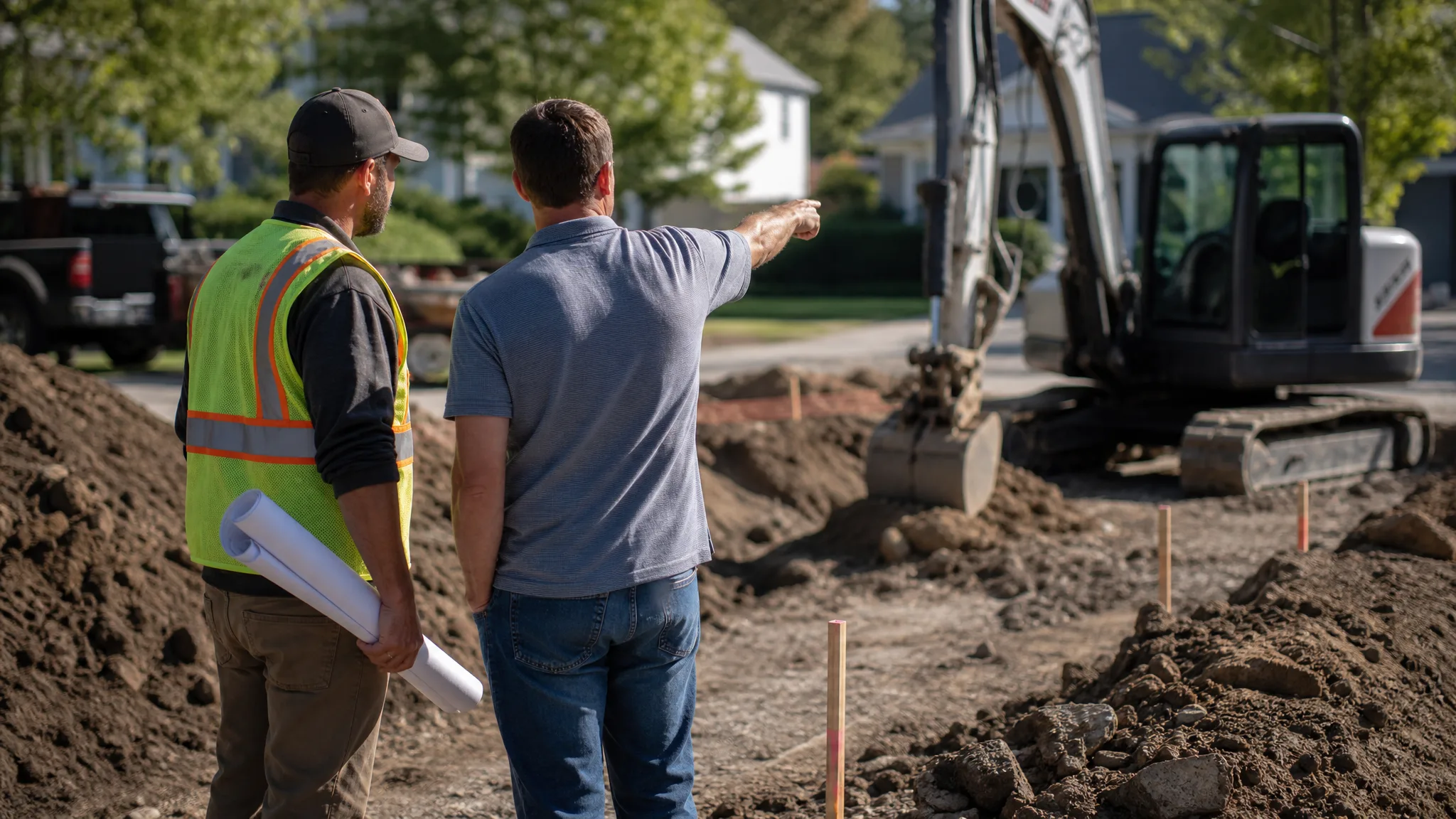
Before you commit, walk the site with the contractor and ask these questions out loud: What is excluded from this price? Who pulls the permit? Who calls for utility locates, and what happens if the marks are wrong? What is the unit price for rock and for unsuitable soil? How will you handle water if we hit it? Who supplies and compacts the fill, and who pays for the compaction test? What is the schedule if it rains for three days? Who is your competent person for trench work?
The red flags are consistent across the trades: someone who knocks on the door because they are "in the area," offers leftover material from another job, pressures you to decide today, wants cash only, asks you to obtain the building permit, cannot produce a license number or an insurance certificate, or wants a large deposit before mobilization. Any one of those is a reason to slow down.
Good excavation contractors are not hard to identify once you know what to look for. They ask about soil and access before they quote, put exclusions in writing, carry real insurance, and are comfortable talking about trench protection. If you are still scoping the project, start with the essentials of residential excavation, excavation and grading permits, and what excavation costs per cubic yard.