How Much Slope Does a Yard Need for Drainage?


Water running toward a house instead of away from it is the most common drainage problem in residential construction, and almost always the fix comes down to slope. The ground around a home needs a consistent fall in the right direction, and the numbers are smaller than most homeowners expect — fractions of an inch per foot separate a yard that sheds water from one that ponds it against the foundation.
This guide covers the slope percentages that matter around a house, what building codes require, how to measure your own yard's grade, and when a regrade, a swale, or a drain is the right fix.
The short answer: these are the slopes that matter
Most residential lots need a minimum fall of about 2 percent — roughly a quarter-inch of drop per foot — across lawns and open ground, and more in the critical band next to the house. The most important numbers to remember:
- First 10 feet from the foundation: at least 6 inches of fall, which is about a 5 percent slope. This is the single most important grade on any residential property.
- Lawns and planted ground: about 2 percent minimum (¼ inch per foot, or 2 feet of drop per 100 feet). Below that, turf does not shed water reliably and low spots pond.
- Patios, walks, and driveways: roughly 1 to 2 percent. Smooth, hard surfaces move water at flatter grades than grass can.
- Swales and drainage channels: enough continuous fall to keep water moving — commonly 2 percent or more along the channel, with at least about 1 percent as a floor.
As a quick conversion, 1 percent is about ⅛ inch per foot, 2 percent is about ¼ inch per foot, and 5 percent is about ⅝ inch per foot. Those two easy conversions let you sanity-check almost any drainage grade on the fly.
The code rule: 6 inches of fall in the first 10 feet
The most widely adopted residential grading requirement in the United States is Section R401.3 of the International Residential Code (IRC). It requires the ground immediately around a building to slope away from the foundation at a minimum of 6 inches of fall within the first 10 feet — the equivalent of a 5 percent slope. Most municipalities adopt the IRC in some form, so this rule applies to the vast majority of U.S. homes, though local amendments can be stricter.
The first 10 feet matter most because that soil is backfill. When a foundation is built, the excavation around it is filled with disturbed soil that never compacts as densely as the undisturbed ground around it, and it settles over time. A steep, deliberate slope in this zone pushes surface water away before it can soak into that permeable backfill and travel down the foundation wall. Even a grade that passes inspection at build time can slowly reverse as the backfill settles, which is why drainage professionals often recommend building in more fall than the minimum — 8 to 12 inches over the first 10 feet is a common target — to leave a margin for settling.
The code also carries an exception worth knowing: where lot lines, walls, slopes, or other physical barriers make 6 inches of fall in 10 feet impossible, the grade may be reduced to a 2 percent minimum if the water is directed away by an approved drainage system, swale, or other engineered method. Paved surfaces like patios and walks within the first 10 feet may also be graded flatter, typically at a 2 percent minimum. In other words, if you cannot get the slope, you have to give the water a pipe or a channel to leave through.
Beyond the foundation: lawns, patios, and driveways
Once water clears the first 10 feet, it still has to keep moving across the rest of the yard, and each surface type has its own practical minimum. Lawns need about 2 percent — anything flatter develops low spots that read as zero or negative grade once sod is down and soil settles, and zero slope ponds. The ideal range for turf is roughly 2 to 5 percent, with the steeper end on slopes that drain to a swale or property edge.
Hard surfaces can run flatter because they are smooth and true. Concrete and asphalt paving typically hold a minimum of about 1 percent, with 2 percent a comfortable target for most residential work. Driveways are a special case: they need enough cross-slope and longitudinal fall to shed water but must stay gentle enough to drive on safely, and most fall somewhere in the 1 to 8 percent range depending on length and local conditions. The crowned shape that keeps driveways dry is covered in our guide to building roads and driveways with proper crown and slope.
There is an upper limit worth respecting too: the steepest grade that can be mowed safely with a walk-behind or riding mower is roughly 3:1 — about 33 percent. Anything steeper belongs in ground cover, terracing, or a retaining wall, because steeper banks erode and are effectively unmaintainable. In practice, that means most of a usable yard lands between the 2 percent minimum and the 3:1 mowing limit, with steeper grades reserved for swale banks and transition areas.
Swales: the drainage channel that carries water away
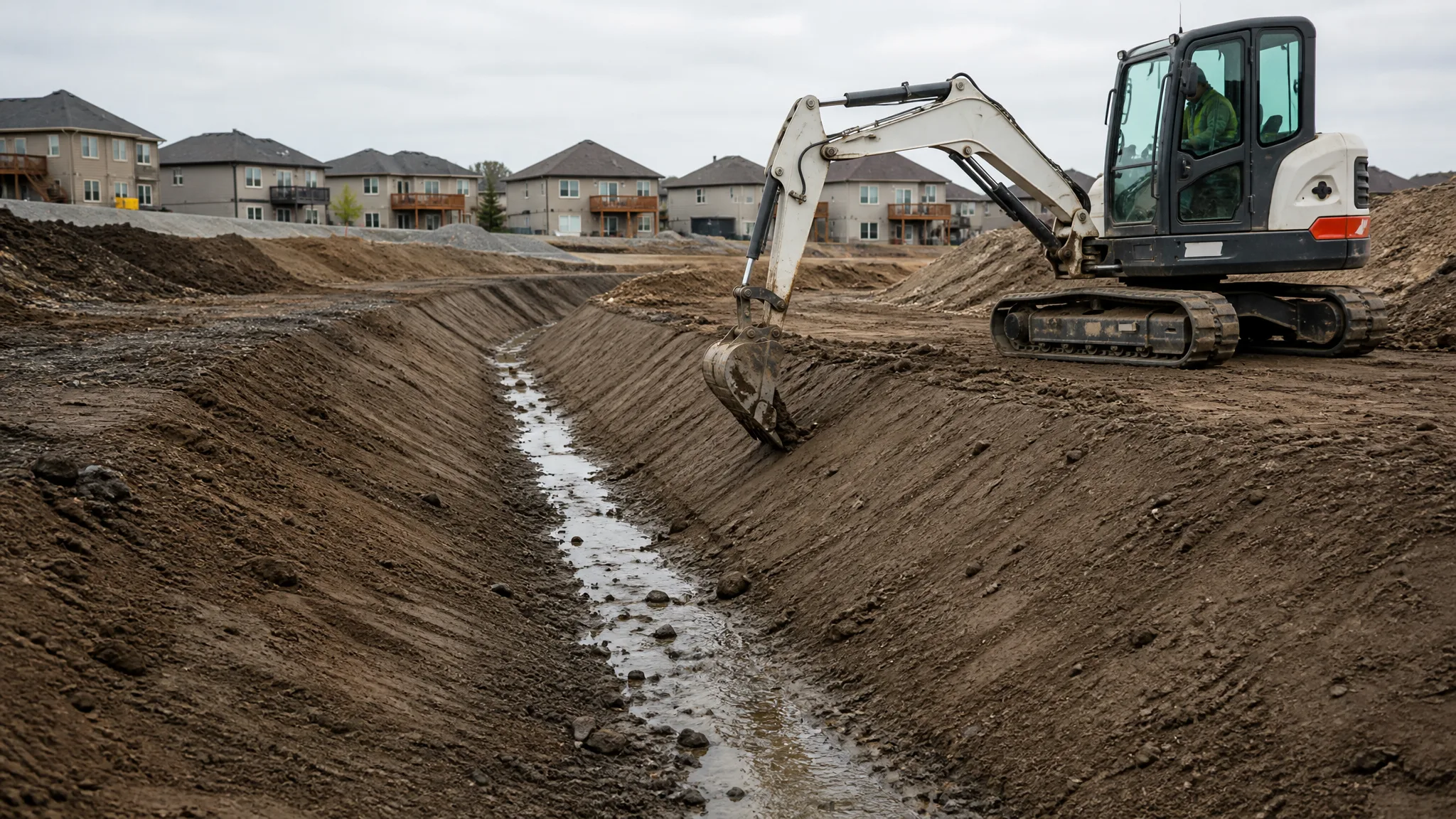
When a yard cannot shed water as a broad, even sheet — because the lot is flat, the house sits low, or a neighbor's grade pushes water your way — a swale concentrates the flow into a shallow, grassed channel and carries it to an outlet. A well-built residential swale holds water only briefly during a storm and is dry between rains.
Swale design comes down to three numbers. The channel needs continuous longitudinal fall — roughly 2 to 4 percent is the design range used by stormwater guidance, with 1 percent about the practical floor before water crawls and ponds. The side slopes need to be gentle enough to mow and stable enough not to erode, which means no steeper than about 3:1. And the channel has to be big enough for the water it will actually carry in a hard rain — too small a swale simply overflows and the water finds its own way back toward the house.
Whatever collects in a swale has to drain completely after the storm. A common design standard is that standing water should leave the surface within 48 to 72 hours; a swale that stays wet for days after rain is either too flat, too small, or has no real outlet — and it will breed mosquitoes and kill the grass. The general principles of moving water across a site are covered in more detail in our article on creating effective drainage systems during excavation.
Positive vs. negative drainage: what your yard is actually doing
Positive drainage means water flows away from the structure and toward an outlet. Negative drainage means it flows toward the house or collects where it should not — and negative drainage can exist even on a sloped lot if the slope points the wrong way. Direction matters as much as degree.
Walk the yard during or right after a hard rain and look for the warning signs of negative drainage: water ponding within 10 feet of the foundation, runoff curling back against the house, puddles that last more than a day or two in the same spot, erosion gullies along the foundation or downspout outlets, and water stains, efflorescence, or cracks on the foundation wall. Low spots anywhere in the yard are worth fixing too — water that ponds near the house eventually finds its way down through the soil, and where the soil is saturated, it travels sideways toward the lowest point, which is usually the basement or crawl space.
Understanding how water behaves on and around a site before construction — where it comes from, where it goes, and how the water table sits — is the foundation of good drainage, and our article on the role of hydrology in excavation and grading explains why.
How to measure your yard's slope
You do not need a survey crew to check the most important grades on your property. A string line, a level, and a tape measure will do it:
- Drive a stake at the foundation wall and a second stake 10 feet out, at the spot where you want to measure.
- Tie a string to the foundation-side stake at ground level, stretch it to the outer stake, and level it with a line level.
- Measure the vertical distance from the string down to the ground at the outer stake. That drop, in inches, is your fall over 10 feet.
Six inches of drop over 10 feet meets the IRC rule. Four inches is about a 3.3 percent slope — short of the 5 percent target but better than many homes have. One inch of drop over 10 feet is roughly 0.8 percent, effectively flat for drainage purposes, and water will sit against the foundation. Measure at several points around the house — each side can be different — and check the low spots where water actually collects after rain. A self-leveling laser level makes the job easier over long distances, and it is the same tool grading contractors use to establish finish grades with the precision described in our article on advanced precision land grading techniques.
Fixing a yard that slopes the wrong way
If the grade falls short or runs toward the house, the fix depends on how much dirt is involved and how much room you have:
- Regrade the first 10 feet. For most homes, the fix is adding fill around the foundation to rebuild the 6-inches-in-10-feet slope. Clean fill should be placed in thin lifts and compacted — dumped loose dirt settles, which is exactly how the problem started. When you need to raise a large area or match grade to an existing slab, knowing what material to use matters, and the choice between select fill and native soil is one of the first decisions.
- Cut the high spots. If the yard bowls toward the house, lowering the far side or building a subtle ridge can redirect the sheet flow. Sometimes a light re-grade with a box blade is all it takes — the techniques in our land grading techniques guide show how small changes in grade redirect large volumes of water.
- Add a swale or drain. Where property lines or hardscape make slope impossible, a swale carries the water to daylight, and a French or curtain drain intercepts it below grade. Both are legitimate alternatives under the code exception — but both need a real outlet, or they just move the ponding somewhere else.
- Extend the downspouts. Gutters concentrate roof water at the foundation, and a downspout that discharges next to the wall can overwhelm even a perfect grade. Discharge downspouts at least 4 to 6 feet from the wall, ideally closer to 10 feet, and never tie them into a perforated footing drain.
- Watch the landscaping. Raised flower beds, piled mulch, and border edging built up against the foundation act as dams that trap water against the wall. Grade beds to fall away from the house like the ground around them, and keep mulch shallow — a few inches at most — so it sheds water instead of holding it.
After any regrade, the lawn has to be re-established quickly — bare, loose soil erodes in the first hard rain and undoes the work. Seeding or sodding promptly, and keeping the new grade compacted and covered, protects the investment. Timing matters too: a regrade is a much better job in some seasons than others, and our guide to the best time of year to regrade a yard walks through the trade-offs.
When to call a contractor with equipment
Small fixes — a few yards of fill, a weekend of hand grading, extending a downspout — are homeowner territory. But when the grading work involves moving meaningful amounts of dirt, the job changes. Adding several inches of compacted fill around an entire foundation is measured in tens of cubic yards, and compaction matters: loose fill settles, and settling is what recreates the negative slope you just fixed. That kind of work needs a skid steer or mini excavator, a supply of suitable fill, and proper compaction in lifts.
That is also the point where it pays to understand what residential excavation actually involves before you hire — what to expect from the process, the equipment, and the finished grade. Our guide to residential excavation for homeowners covers the practical side of hiring and overseeing dirt work, and our overview of grading in construction explains what a professional grade should look like when the job is done.
The good news is that slope problems are almost always fixable. Measure the fall, compare it to the targets above, and decide whether the answer is a few wheelbarrows of fill or a phone call to a grading contractor. Water follows gravity every time — the job is simply making sure gravity points away from the house.