Geogrid and Geotextiles Explained

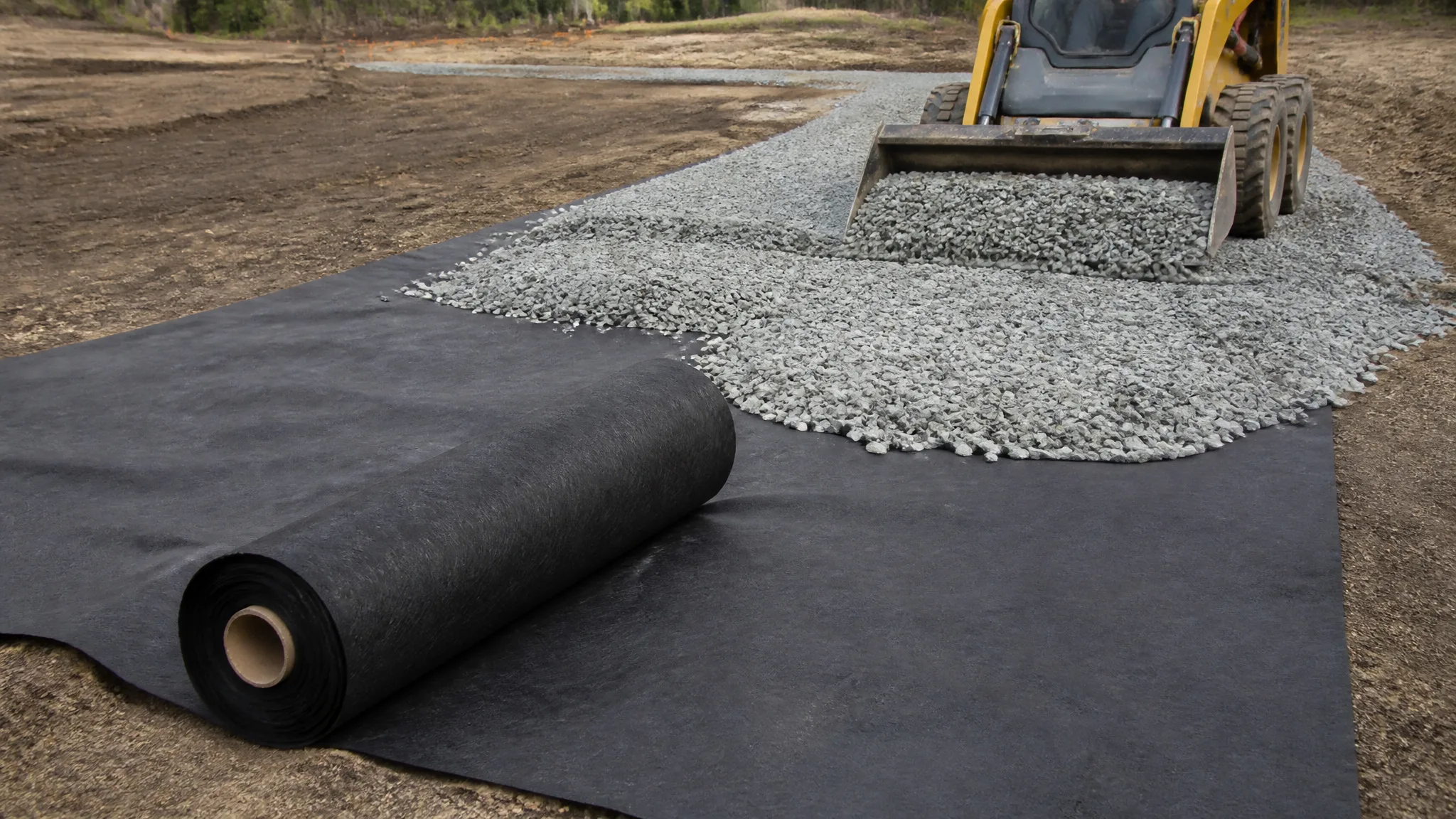
A geotextile or geogrid never shows up in a finished project. It gets buried under stone, soil, or pavement, and once it is covered nobody sees it again — until something goes wrong above it. That invisible layer decides whether a gravel driveway keeps its stone or pumps it into soft clay, whether a drainage trench keeps draining, and whether a base sits stable over wet ground. Here is what these materials actually do and how to choose between them.
Geosynthetics 101: The Family of Products
"Geosynthetic" is an umbrella term for manufactured polymer materials used with soil and rock. The family includes geotextiles (permeable fabrics), geogrids (open structural grids), geomembranes (impermeable sheets), geonets (drainage cores), geocells (cellular confinement), and geocomposites that combine several. For earthwork and site prep, the two that matter most are geotextiles and geogrids.
They are easy to confuse because both are roll goods that go under aggregate, but they are not interchangeable. A geotextile is a fabric that manages water and keeps materials separate; a geogrid is a stiff grid that adds structural reinforcement to the aggregate itself.
The Jobs a Geotextile Performs
Geotextiles serve several distinct functions, and the plan usually names the function before it names the product:
- Separation — keeps an aggregate base from mixing with the soft subgrade below it
- Filtration — lets water pass while holding soil particles back
- Drainage — conveys water within a drainage blanket or underdrain
- Reinforcement — adds tensile strength to a soil mass
- Protection and containment — cushions liners and armor stone
The national specification for geotextiles in highway work is AASHTO M288, which sets minimum values for grab strength, tear, puncture, permittivity, and apparent opening size for five application types: separation, stabilization, subsurface drainage, permanent erosion control, and paving fabrics. It also sorts geotextiles into three survivability classes — Class 1 for severe installation conditions, Class 2 as the most commonly specified, and Class 3 for lighter duty.
Woven vs Nonwoven Geotextile: The Core Choice
Geotextiles come in two constructions, and picking the wrong one is the most common mistake on a small job.
Woven geotextiles are made like fabric, with interlaced yarns. They typically deliver high tensile strength and relatively low elongation — under about 50 percent at failure as measured by ASTM D4632. That makes them the choice for separation and reinforcement, where the fabric has to resist being pulled and punctured by stone. Their water flow is often lower, though some high-performance wovens are engineered to pass water in both directions.
Nonwoven geotextiles are bonded or needle-punched fibers that form a thick, felt-like mat. They elongate more than 50 percent, and their open structure gives them high permittivity — commonly in the range of about 0.5 to 5.0 per second — with apparent opening sizes that filter a broad range of soils. That is why nonwovens are the default for filtration, drainage, and cushioning under riprap or liners.
What the Geotextile Numbers Actually Mean
The properties printed on a spec sheet tell you whether a fabric fits the job:
- Grab strength (ASTM D4632) — resistance to tearing in the plane of the fabric; a survivability indicator
- Tear and puncture (ASTM D4533 and D4833) — how the fabric resists rips and stone punctures during placement
- Permittivity (ASTM D4491) — how fast water flows through the fabric, normalized for thickness
- Apparent opening size (ASTM D4751) — the effective pore size that controls how fine a soil the fabric will hold back
- UV stability (ASTM D4355) — how long the fabric tolerates sunlight before it must be covered
The filtration rule of thumb is that the fabric has to be fine enough to hold back the soil it is protecting but open enough to let water through. Get that balance wrong and you either clog the fabric or wash fines through it.
Geogrid: Reinforcement Instead of Filtration
A geogrid is a grid of stiff polymer ribs with large apertures, usually made from punched-and-drawn polypropylene. It does not filter water and it does not act as a separator. Instead, aggregate interlocks through the openings, and the grid limits the lateral movement of the stone — creating a composite layer that spreads load over a wider area and reduces stress on the subgrade.
Geogrids come in two orientations. Biaxial grids carry load in both directions and are the standard choice for base reinforcement and subgrade stabilization under roads, parking lots, and working platforms. Uniaxial grids carry load in one direction and are used in mechanically stabilized earth walls and steepened slopes, where the reinforcement pulls back into the retained soil.
Geotextile vs Geogrid: Which One Do You Need?
The decision comes down to the function named on the plans. If the problem is separation or filtration — stone mixing into soft soil, or water needing to pass while soil is held back — you want a geotextile. If the problem is strength over weak ground — a base that needs to carry traffic while the subgrade is soft — you want a geogrid.
A common residential example makes it concrete. A gravel driveway built over moderate soil usually needs only a woven separation fabric so the stone stops sinking in. A driveway built across very soft, saturated clay — the kind of ground that swallows stone no matter how much you add — is a candidate for a biaxial geogrid, which stiffens the base and can reduce how much aggregate is required. On the worst sites, both are used: fabric for separation, grid for reinforcement. The principles behind soil stabilization for unstable subgrade are the same ones at work here.
Where They Go on a Typical Excavation Job
Geosynthetics show up in more places than most people expect:
- Under a gravel driveway or parking base, on the prepared subgrade — see building a gravel driveway
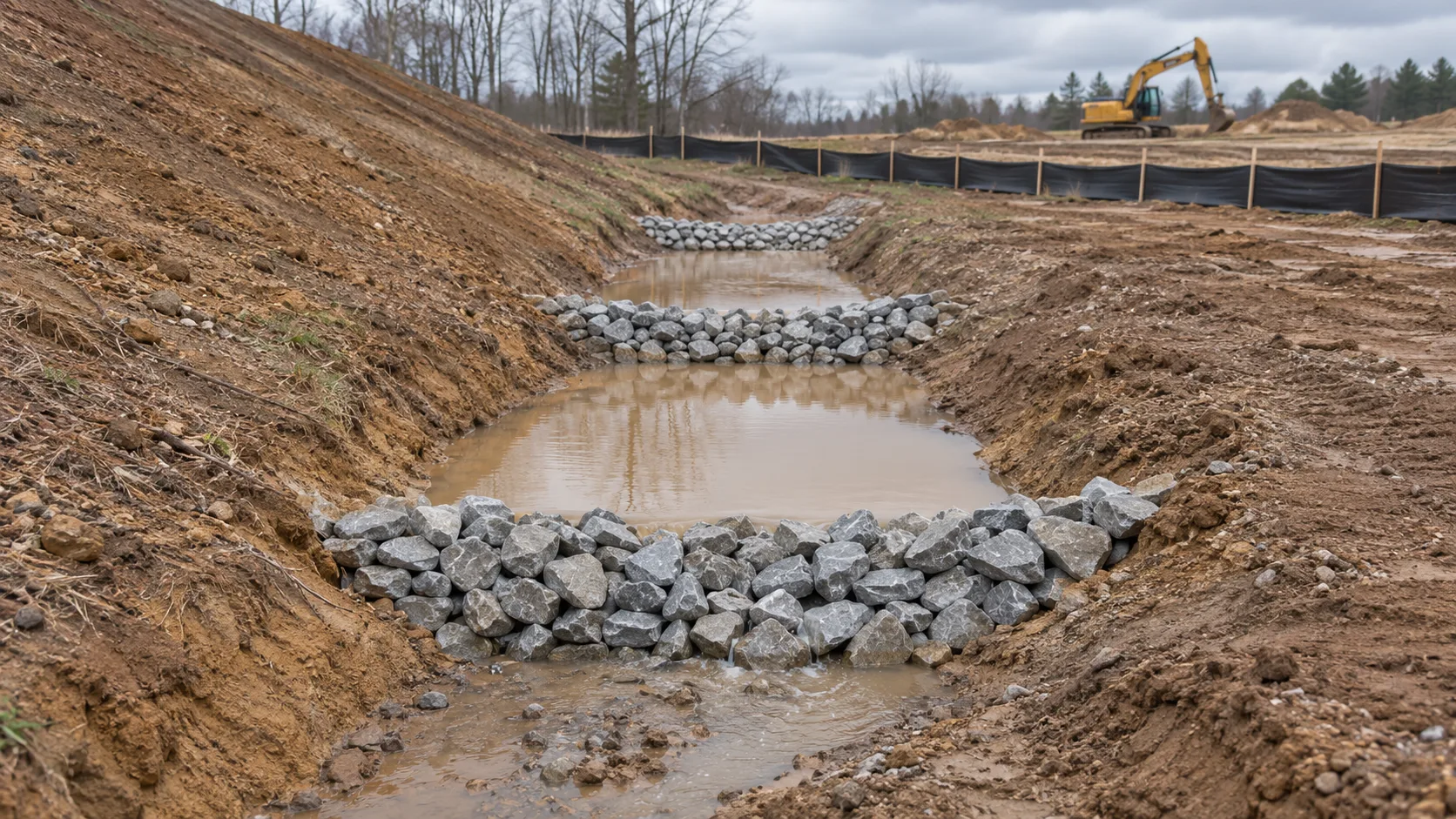
- Beneath riprap and armor stone to hold fines and prevent scour — the same idea covered in riprap for erosion control
- Wrapping a French drain or underdrain so the stone stays clean — see installing a French drain
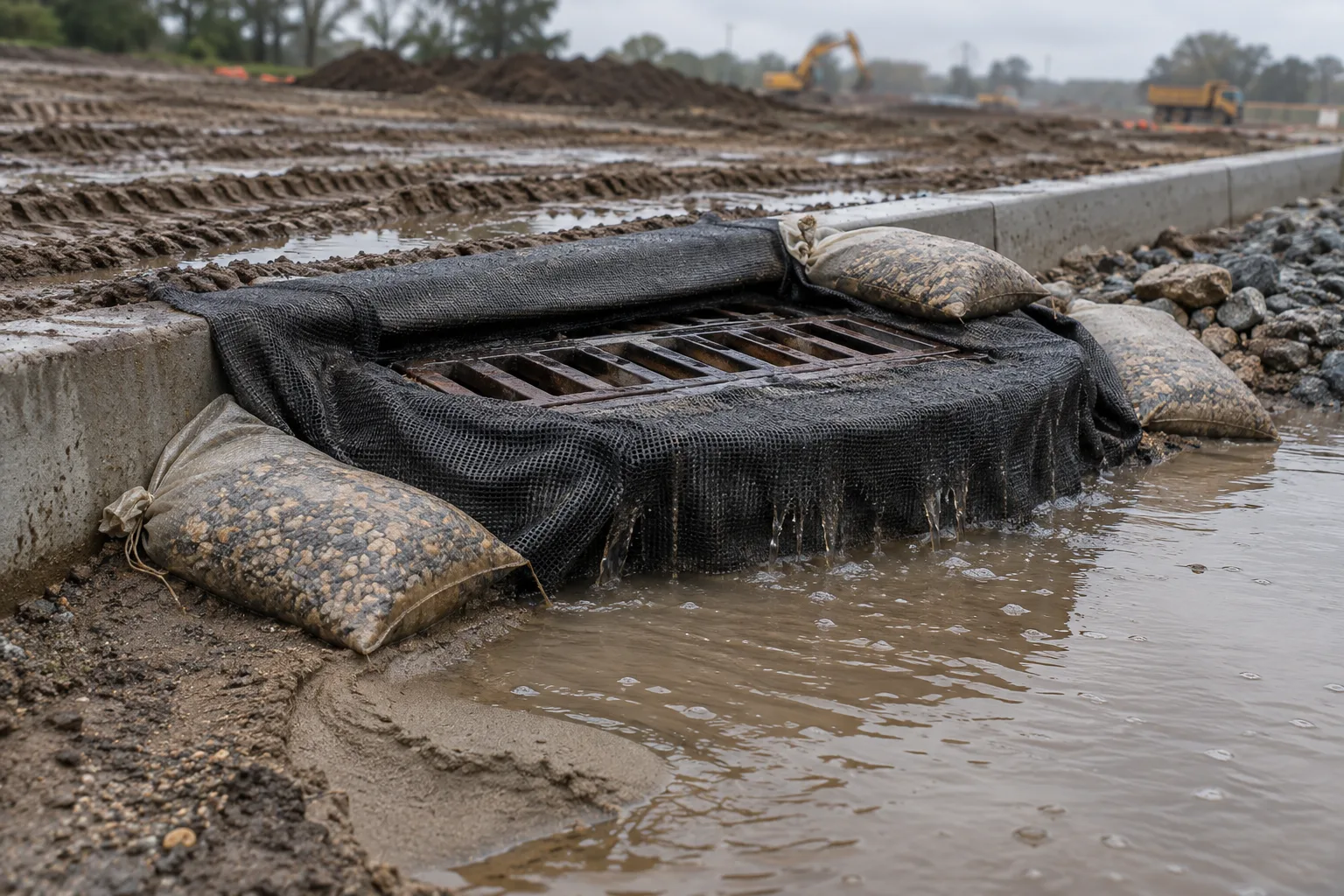
- A woven geotextile is the fabric used to build a silt fence, separating muddy runoff from soil
- A geogrid reinforces the backfill of a retaining wall or slope — see excavating for a retaining wall
- Under a slab or working platform, on top of stabilized ground — see preparing a site for a concrete slab
Installation Mistakes That Kill Performance
Most geosynthetic failures are installation problems, not product problems. The single biggest error is placing a separation fabric above the aggregate subbase instead of directly on the prepared, compacted subgrade. Doing that leaves the subgrade free to mix with the stone, which defeats the entire purpose.
Other common mistakes: overlapping seams too little, so stone pushes through the gap; laying fabric over sharp, angular rock that punctures it before it is covered; leaving fabric exposed to sunlight long enough to degrade; and expecting a fabric to fix a base that is simply too thin. On poorly graded subgrades, water can also pond under the fabric and create a soft void if the stone layer does not drain. Matching the fabric's opening size and permittivity to the actual soil — and using a geogrid where stiff reinforcement is the real need — is what separates a fix from a callback.
How to Choose the Right Geosynthetic
Start with the function on the plans, then work through the properties. Confirm the fabric meets the applicable AASHTO M288 class for the installation conditions. Check that the apparent opening size is fine enough for the soil being held back and that permittivity is high enough for the water it must pass. Verify the aggregate gradation it will be paired with, since a well-graded, properly sized stone base protects the fabric and drains better. Prepare and compact the subgrade first, overlap the rolls per spec, and cover the material promptly.
Treated as an engineered layer rather than an afterthought, a geotextile or geogrid can cut the amount of aggregate a job needs, extend the life of a base, and prevent the soft-ground problems that otherwise keep coming back. Understanding the underlying soil is the other half of that equation — if you are not sure what you are building on, start by identifying the soil type before you choose the fabric.