Frost Depth and Footing Excavation

Footing depth looks like a single number on a foundation plan, but it is really a decision made by three things: the building code, the soil under the trench, and how deep the ground freezes in winter. Get it right and the footing sits on stable bearing material for the life of the building. Get it wrong and the first hard freeze starts lifting a corner of a structure that was never designed to move.
For an excavation crew, frost depth changes the scope of the dig. It sets how deep the trench goes, how much material comes out, and how much protection the open excavation needs before concrete arrives. This guide covers the code rules, the soil mechanics behind frost heave, and the field practices that keep a cold-climate pour from becoming a callback.
What Frost Depth Actually Means
Frost depth is the depth to which seasonal freezing penetrates the ground. It is not a fixed national number. It varies with latitude, elevation, soil type, moisture, snow cover, and the severity of a given winter, so two sites in the same county can behave differently.
Codes handle that variability by pointing to a locally established frost line rather than publishing one figure. In the International Residential Code, that value appears in Table R301.2(1) as part of the climate criteria adopted by the local jurisdiction. The frost depth that governs your footing is the one your building department enforces, not a rule of thumb from a forum.
The Two Code Rules That Set Footing Depth
Most residential footing questions come down to two provisions in Chapter 4 of the IRC. Section R403.1.4 requires exterior footings to be placed not less than 12 inches below the undisturbed ground surface. That is a floor, not a target.
Section R403.1.4.1 then requires foundation walls, piers, and other permanent supports to be protected from frost by one or more approved methods—most commonly by extending below the frost line shown in Table R301.2(1). The International Building Code addresses the same issue in Section 1809.5, with extending below the local frost line as one accepted method.
Both codes allow alternatives. A frost-protected shallow foundation or another engineered solution can change the required depth, but those are design decisions that belong on the plans and in the inspector's approvals, not field calls made at the top of the cut.
Interior footings in heated spaces are treated differently because the building keeps the ground beneath them warm; unheated structures such as garages, shops, and additions generally follow exterior rules. If the plan is unclear, ask before digging, and see Excavating for a House Foundation for the broader sequence.
Why Frost Heave Happens—and Why It Doesn't Happen Everywhere
Frost heave is not simply water expanding as it freezes. The damaging movement comes from ice lenses—layers of ice that grow as capillary action pulls water toward the freezing front. As a lens thickens it lifts everything above it, and a footing that crosses a growing lens rises while the footing beside it rises less. That differential movement cracks foundations and racks door frames.
Three conditions have to exist at once: a frost-susceptible soil, subfreezing temperatures that penetrate the ground, and a supply of water. Remove any one and frost heave is eliminated or greatly reduced. That is the logic behind most frost-protection details.
Frost susceptibility is mostly about fines. Clean sands and gravels drain freely and generally do not heave, while silts and fine-grained soils hold water and support capillary rise. The Casagrande criterion expects significant ice segregation in non-uniform soils with more than about 3 percent of grains finer than 0.02 mm, and in very uniform soils with more than about 10 percent finer than 0.02 mm.
Differential heave is more likely where the subgrade changes abruptly—clean sand meeting a silt pocket, a cut transitioning to fill, or an excavation exposing a water-bearing layer. Buried drains and utility trenches can create localized heave because the backfill differs from the surrounding soil.
Read the Soil Before the Machine Shows Up
The fastest way to misjudge a footing excavation is to assume the material at the bottom of the trench matches what was at the surface. Topsoil gets stripped, and what remains may be stiff clay, loose silty sand, or a layered profile that changes every few feet.
A geotechnical report is the best available guide. It identifies the soil profile, groundwater conditions, allowable bearing pressure, and frost concerns. Read the boring logs before the dig and compare them with what the bucket actually turns up. Where no report exists, test pits and visual classification of the spoils are the minimum. See What Is a Geotechnical Report?
Watch groundwater, too. A high water table within the frost zone keeps soil near saturation and makes heave more likely; Dewatering an Excavation covers the options. Expansive Clay Soil and Foundations covers clays that move with moisture independent of frost.
Excavating the Footing Trench Without Weakening the Bearing Surface
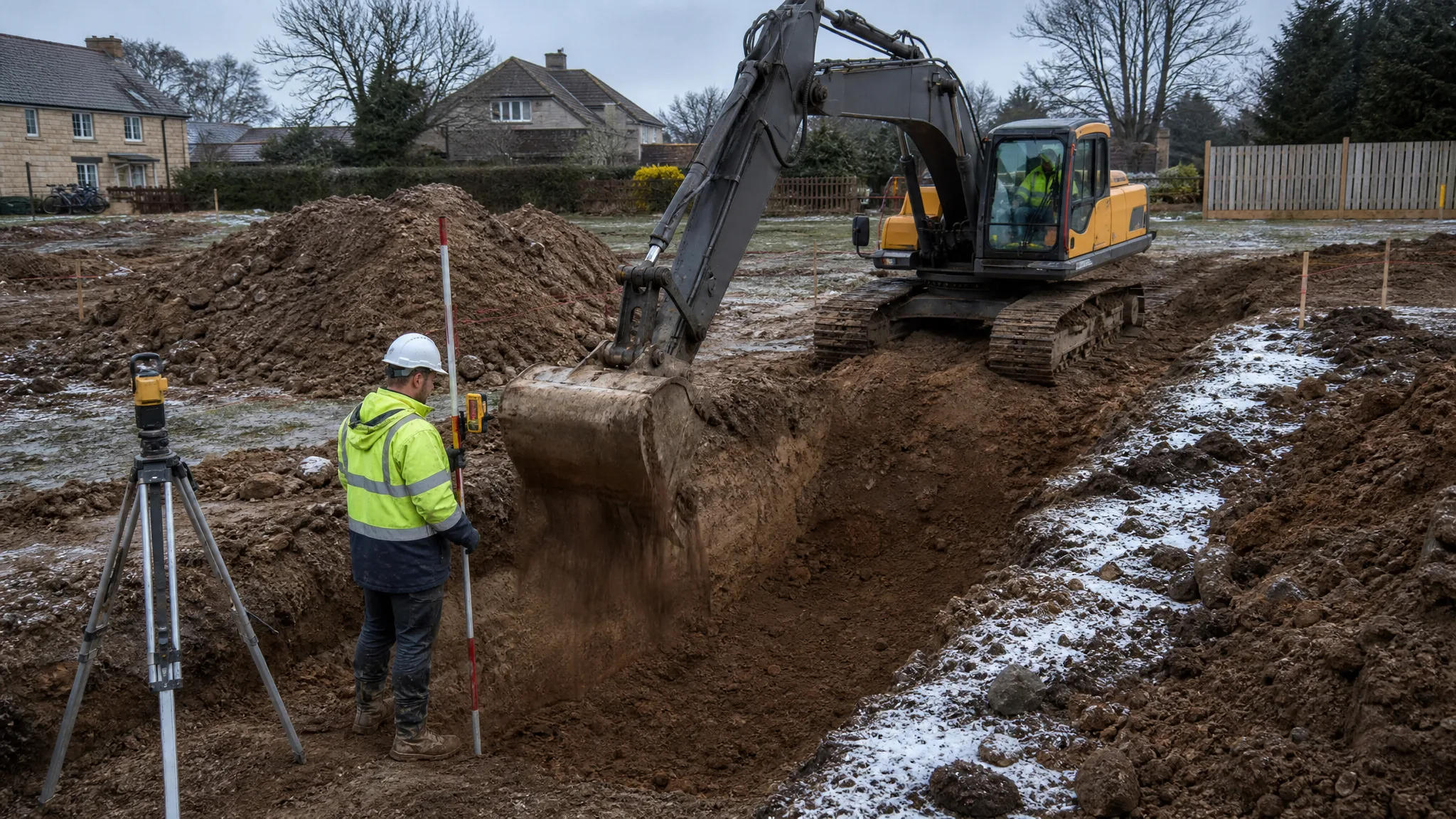
The bottom of a footing trench is a bearing surface, and it is easy to destroy it while cleaning it up. The goal is a flat, firm, undisturbed bottom at plan elevation. A bucket that digs two inches too deep and then back-drags loose soil into the trench has created a soft layer that will compress under load.
Cut to grade in controlled passes and leave the last few inches for a clean final cut. If the excavation goes past design elevation, fill the over-dig with compacted engineered fill or lean concrete—not loose spoils. The same applies to soft spots, root holes, or old utility trenches in the bottom: remove the unsuitable material and replace it with something that can be compacted and tested. How to Prepare a Site for a Concrete Slab covers the same discipline for flatwork.
Keep the trench bottom dry. Standing water softens the bearing surface and makes it impossible to judge whether the soil is firm. Grade the bottom to a sump and pump before concrete is scheduled, not after the truck is on site. A trench that is acceptable at 7 a.m. can be unacceptable after an afternoon of rain, which is the same lesson behind How Wet Is Too Wet to Compact Soil?
Never Pour on Frozen Ground
This is the rule that causes the most cold-weather failures, and it is entirely preventable. A footing poured on frozen soil is a footing poured on a surface that will change volume. When the frost leaves, the soil consolidates, the support disappears, and the concrete settles or cracks.
Frozen ground also refuses to compact. Fill placed as frozen lumps cannot be brought to density, and when those lumps thaw they leave voids inside what looked like a solid lift. Many highway specifications take a hard line: frozen material is removed before fill is placed, and a frozen lift surface is stripped before the next lift goes down. Residential work should follow the same logic.
That means three practical rules on a winter site. Do not pour on a frozen trench bottom. Do not backfill with frozen spoil. And do not assume a sunny afternoon has thawed material that was frozen solid that morning—soil temperature lags air temperature by a wide margin.
Concrete temperature is a separate requirement, covered by ACI 306.1. The excavation contractor's job is to deliver a trench that is unfrozen, clean, and at the right elevation so the concrete crew can meet it. Cold Weather Earthwork covers the broader winter operating picture.
Protecting an Open Excavation Through Winter
An open excavation loses heat from the bottom and sides, not just the top, so frost can penetrate deeper in a trench than in surrounding undisturbed ground. A footing trench that sits open for a week in January can freeze well below the depth that would normally be frost-free.
Cover the trench when work stops. Insulated blankets or comparable cover slow heat loss and keep the bearing surface from freezing. Keep water out—pump standing water, divert surface runoff, and remove snow before it melts and refreezes.
Do not let traffic cross close to the excavation. Vehicle loads near the edge can displace frozen sidewalls, and a frozen crust gives a false sense of stability. Re-check the excavation after weather events and before anyone re-enters.
Frost-Protected Shallow Foundations and When They Apply
Frost-protected shallow foundations, covered in IRC Section R403.3 and in ASCE 32, use rigid insulation around and under the perimeter to keep the soil beneath the footing above freezing. Done correctly, they allow a shallower footing in cold climates and reduce excavation depth and concrete volume.
They are not a field shortcut. The insulation has to meet the material standard referenced by the code—ASTM C578 for rigid cellular polystyrene—and the dimensions and R-values come from the code tables and the design. Placement, protection from damage, and inspection all matter. If a project uses one, the excavator's job is to dig to design elevation and avoid disturbing the soil where the insulation and footing will bear. Extending below the frost line, or another approved method, remains the default.
Backfill and Drainage Details That Protect the Footing
The work does not end when the concrete is placed. Backfill material and drainage details decide whether water sits against the foundation through every freeze-thaw cycle. Frost-susceptible backfill that holds water can heave against a wall and add lateral pressure it was not designed for.
Where the plans call for free-draining backfill, use it and compact it in lifts. Maintain final grade so water runs away from the building, and make sure downspouts discharge well clear of the foundation. Footing drains only work if they are at the right elevation with a functioning outlet, which is why Backfilling a Foundation is worth reading before the first lift goes in.
Expect some settlement. Compacting in lifts reduces it, but a low strip along the foundation after the first winter is common. Plan a grade check after the first freeze-thaw season. If the pad itself is the concern, What Makes a Building Pad Fail? and Proof Rolling a Construction Site cover the compaction side.
A Cold-Climate Footing Excavation Checklist
- Confirm the governing frost depth with the building department and approved plans before setting elevations.
- Read the geotechnical report and compare the boring logs to the material actually excavated.
- Strip topsoil and unsuitable material completely; never mix it into the bearing surface.
- Cut to design elevation and leave the bottom undisturbed; replace any over-dig with compacted engineered fill.
- Keep the trench dry with positive drainage and pumping before concrete is scheduled.
- Never place concrete on frozen ground and never backfill with frozen material.
- Cover open excavations when work stops in freezing weather, and keep equipment and spoil back from the edge.
- Use free-draining, compacted backfill and grade the finished surface away from the foundation.
Frost depth is one of the few parts of an excavation that cannot be corrected after the fact without real cost. Digging to the right elevation, on the right material, and keeping it unfrozen until concrete arrives is inexpensive. Repairing a heave-damaged foundation is not.