Expansive Clay Soil and Foundations

Some soils are nearly indifferent to weather. Expansive clay is the opposite: it changes volume with every wet and dry cycle, and that movement is transferred straight into anything built on it. Shrink-swell clay is a leading cause of cracked slabs, out-of-level floors, rotated footings, and broken flatwork, and the damage rarely comes from a single event. It accumulates season after season until the moisture around the foundation is brought under control. Here is how expansive soil is identified, why it moves, and how earthwork, drainage, and stabilization keep a foundation stable.
What Makes a Clay Expansive
Expansive behavior comes from a family of clay minerals — most famously montmorillonite in the smectite group — whose crystal structure absorbs water between its layers. When moisture increases, the mineral takes on water and the soil swells; when it dries, the water leaves and the soil shrinks. Soils dominated by this behavior belong to the Vertisol soil order, and USDA-NRCS soil surveys describe them in terms of their high clay content and their large coefficient of linear extensibility, the lab measure of how much the material moves.
The practical consequence is simple: the soil's volume depends on its moisture content. Wet it and it lifts; dry it and it settles. Any structure on top experiences that movement as heave, settlement, or — worst of all — differential movement, where one part of a building moves more than another.
How Engineers Measure Expansiveness
Expansion potential is a measured property, not an opinion. The core index is the plasticity index (PI), calculated from the Atterberg limits — liquid limit minus plastic limit — under ASTM D4318. A higher PI means more active clay and more shrink-swell potential.
Building codes codify a common threshold. Under the International Building Code, Section 1803.5.3, soil tests are required where expansive soil is likely, and soils meeting all four of the following are considered expansive:
- A plasticity index of 15 or greater (ASTM D4318);
- More than 10 percent of particles passing the No. 200 sieve (ASTM D6913);
- More than 10 percent of particles finer than 5 micrometers (ASTM D6913);
- An expansion index greater than 20 (ASTM D4829).
Where the code test is run, it can stand in for the first three items. Lab swell testing, such as ASTM D4546, and index-based estimates of potential vertical rise give engineers a way to predict how far a given profile could move and to set the fill or foundation design accordingly. On a real project this work lives in the geotechnical report, which is where the design values come from.
How Shrink-Swell Clay Damages Foundations
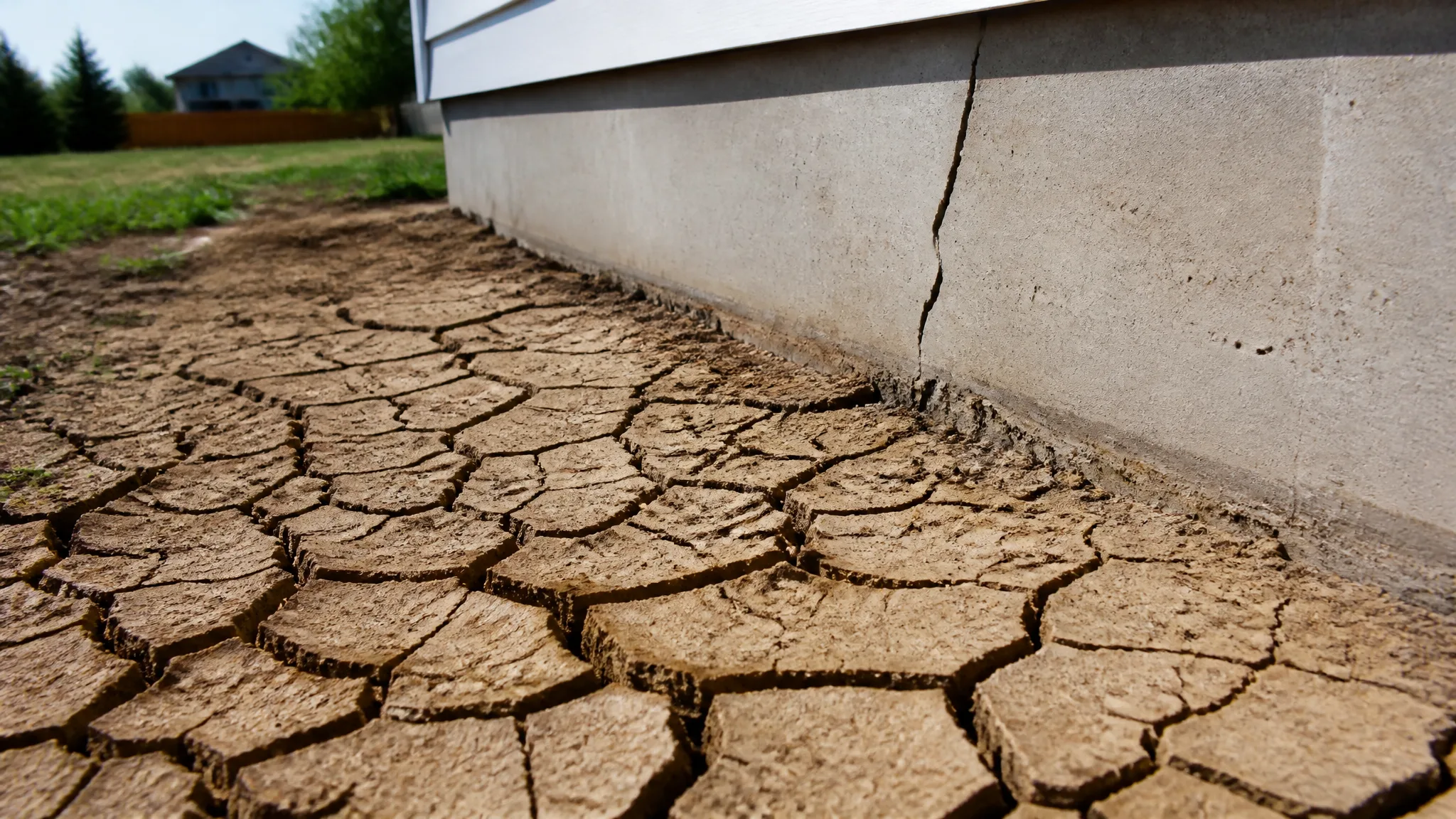
Damage shows up as a familiar list: slab and flatwork cracking, heaving floors, rotated or cracked footings, sticking doors, and cracked masonry or drywall, especially at corners and openings. The pattern is driven by differential moisture — the soil under one edge of the building dries out, from bare soil, a thirsty tree, sun exposure, or missing gutters, while soil elsewhere stays damp. Because the movement is seasonal and cyclic, repairs that ignore the moisture mechanism tend to fail again, and building pads that were never engineered for the soil can fail outright.
Moisture Control Comes First
The cheapest and most effective defense is keeping the moisture in the ground as uniform and stable as possible. Start with grading and drainage:
- Grade finished soil to fall away from the foundation so surface water never ponds against the wall — see how much slope a yard needs for drainage.
- Collect roof water in gutters and discharge it well clear of the building instead of dumping it at the base of the wall.
- Route concentrated flow with swales or subsurface drains such as a French drain where the site collects water.
- Backfill and compact around the foundation with suitable, free-draining material so water drains down and away — see backfilling a foundation.
Uniform, moderate moisture is the goal. Wide swings are what cause movement, so neither a bone-dry edge nor a soggy pocket is acceptable.
Earthwork That Manages Expansive Soil
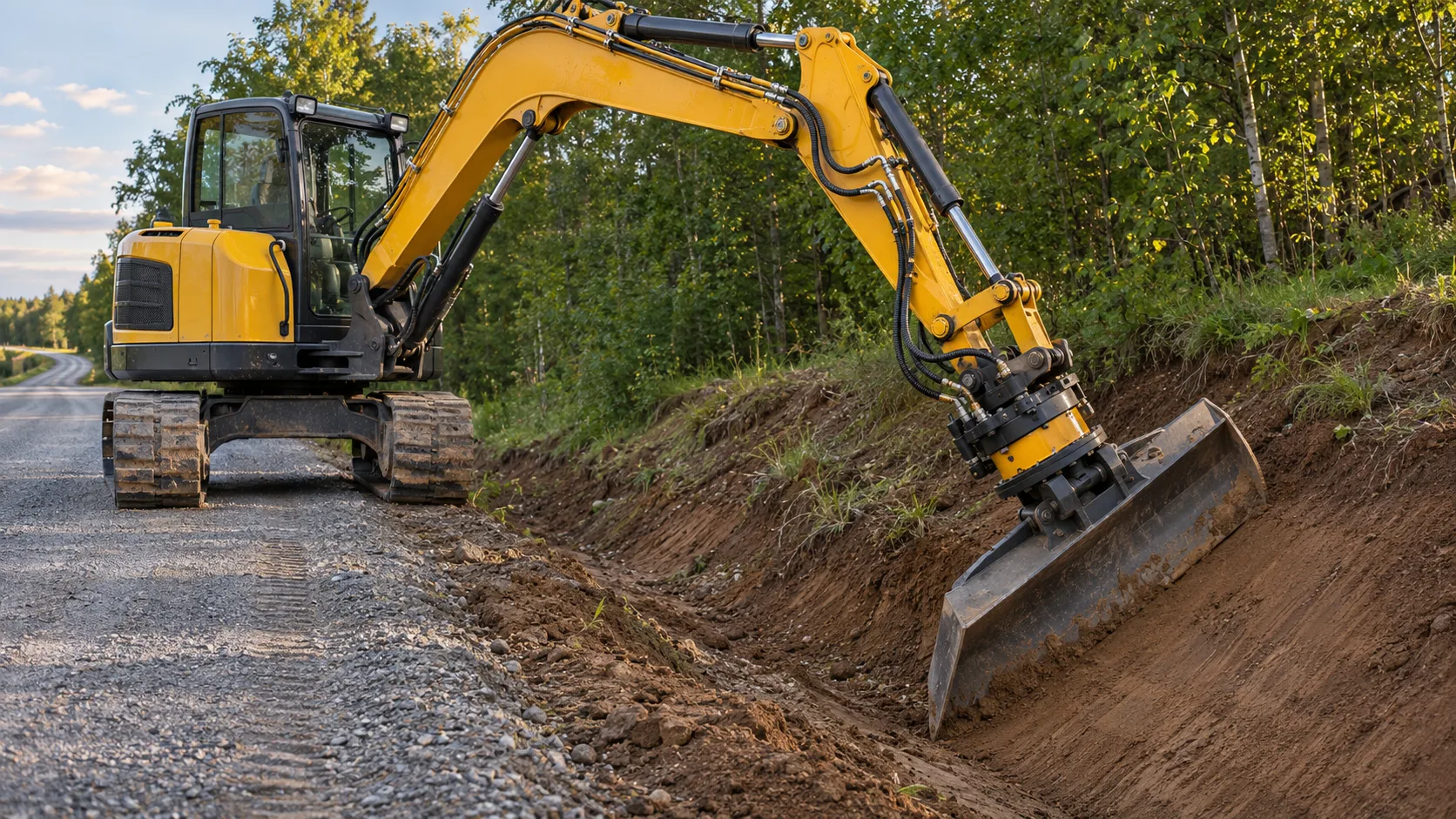
During construction, the earthwork itself has to account for the reactive material. That starts with stripping topsoil and unsuitable soil, and with a subgrade proof-rolled and inspected before any fill or slab goes in — see excavating for a house foundation. Where the native clay is too reactive to build on directly, the common fixes are:
- Undercut and replace — excavate the reactive layer and rebuild with suitable fill compacted in lifts.
- An engineered fill cap — place select fill with a controlled, low plasticity index and the gradation the geotechnical engineer specified, at the design thickness, to isolate the structure from the reactive clay below.
- Moisture conditioning — bring the clay to a stable moisture content and mellow it before compaction so it is not compacted too wet or too dry. See how wet is too wet to compact soil.
Chemical Stabilization: Lime, Cement, and Fly Ash
Where the soil stays in place, chemical stabilization changes its behavior. Lime is the classic treatment for high-plasticity clay: mixing hydrated lime into the soil raises the plastic limit, lowers the plasticity index, reduces swell potential, and improves workability and strength. Cement, often blended with fly ash, is frequently used for wetter or more granular soils and where strength gain is the priority. The right product, dosage, and mixing depth come from the geotechnical report, and the treated layer is compacted in lifts and verified with density testing, just like any engineered fill. The full menu of methods is covered in soil stabilization for unstable subgrade.
Structural Options When the Soil Stays Reactive
Sometimes the most economical answer is to design the foundation around the movement instead of fighting it. Options include deep foundations such as drilled or belled piers that extend past the active zone into stable soil, grade beams that span between piers, post-tensioned slab-on-grade systems, and structural slabs supported so that slab and grade are decoupled. Void forms may be used under grade beams so swelling soil has room to move without lifting the structure. Which of these fits depends on the thickness of the active zone, the predicted movement, and the loading — again, a design decision based on the soils report rather than a generic rule.
Practical Field Notes for Working in Expansive Clay
A few habits keep reactive clay from causing trouble during construction. Protect the subgrade from rain and from drying out; a stiff clay surface that shrinks and cracks before a slab is poured is a warning sign, not a cosmetic issue. Get excavated material identified and classified early so you know what is suitable fill and what has to be hauled off — see how to identify soil types on a jobsite. Track volume deliberately, because reactive clay is often handled wet and rehandled, so swell and shrinkage factors always matter. And document compaction work with real testing rather than assumption.
Common Mistakes
- Building without a geotechnical investigation on soil that shows shrink-swell signs.
- Ignoring drainage so one side of the building dries out while the other stays wet.
- Capping reactive clay with unsuitable fill or at the wrong thickness.
- Compacting clay at the wrong moisture content.
- Planting trees or running irrigation right against the foundation without accounting for the moisture effect.
- Treating an existing crack as a simple cosmetic repair instead of addressing the soil and moisture cause.
Expansive clay is not a reason to avoid a site — it is a reason to design for it. Identify the soil, control the water, use the right fill and stabilization, and inspect the work. Foundations on shrink-swell soil perform well when the movement is understood and managed from the ground up.