Excavator Quick Couplers

Swapping a bucket by hand takes two people and the better part of half an hour. Swapping it with a quick coupler takes seconds from the operator’s seat. That convenience is why quick couplers are one of the most common upgrades on working excavators — and why they deserve more respect than they usually get. A coupler that is worn, mismatched, or engaged only partway can let a bucket weighing thousands of pounds fall onto the crew below. Understanding the designs, the safety standard behind them, and the daily habits that keep them locked is the difference between a machine that does more work and a machine that hurts someone.
What a Quick Coupler Does
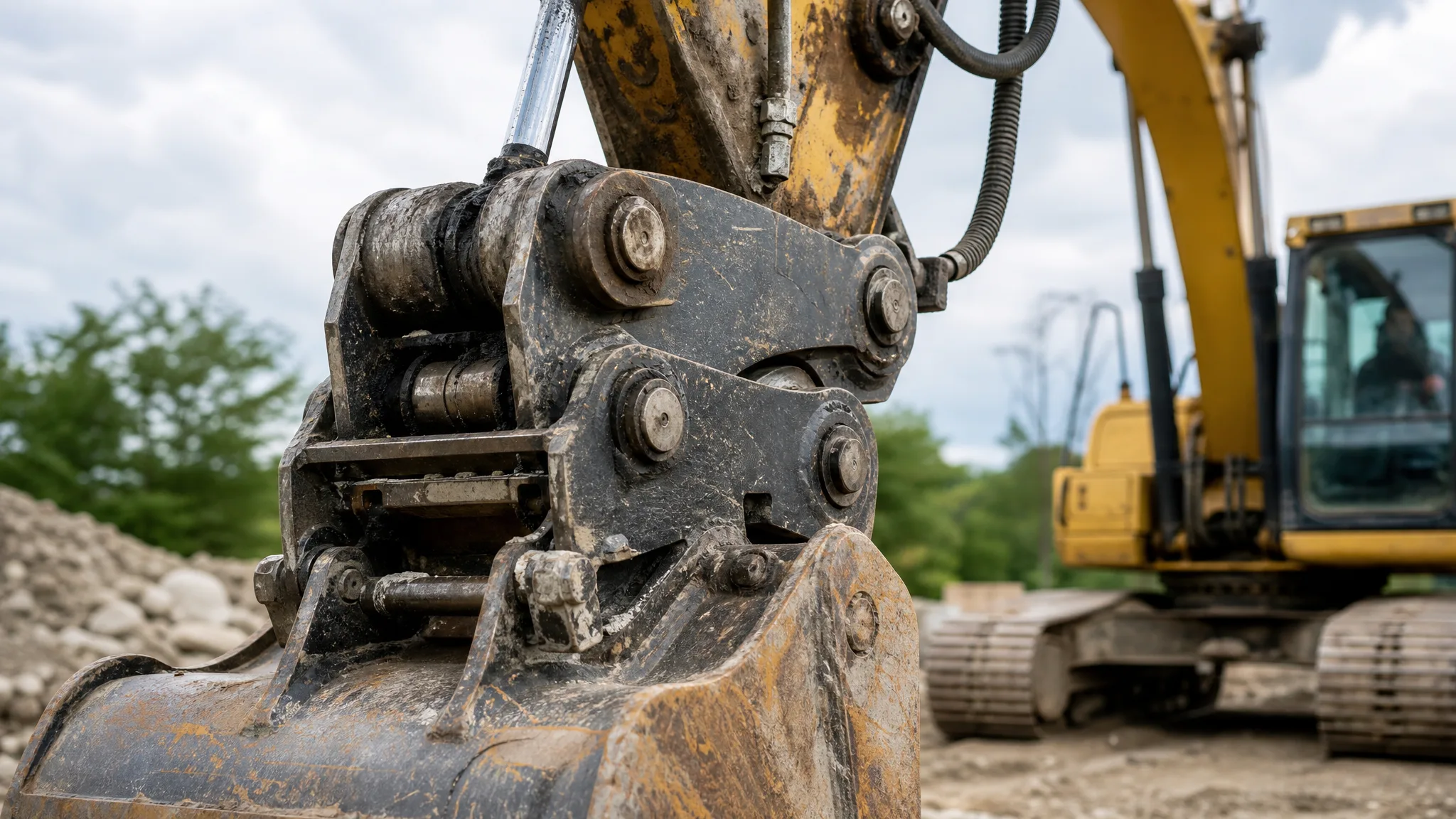
A standard excavator attachment — bucket, hammer, grapple, or thumb — is held to the arm by two steel pins through the dipper tip and the attachment’s pin boss. Pulling and reinstalling those pins by hand typically takes 20 to 40 minutes and at least one person on the ground with a mallet and a pin punch. A quick coupler mounts permanently between the arm tip and the attachment, captures the attachment’s two pins inside its body, and uses a locking mechanism to hold them. To switch tools, the operator releases the lock, backs the coupler out of the attachment’s pin eyes, positions over the next attachment, and re-engages the lock.
On a job that alternates between digging and breaking rock several times a day, the time saved compounds into hours of recovered production. Vocabulary varies by region: in the United States the device is usually a “quick coupler,” while Europe and Australia lean toward “quick hitch.” Mechanically, the devices are the same, and the same safety logic applies to all of them.
Mechanical vs. Hydraulic Couplers
A mechanical coupler has a fixed front hook that grabs the attachment’s front pin and a movable rear jaw or wedge that swings into place behind the rear pin. The operator, standing on the ground, then drives a locking pin or tightens a bolt to hold the jaw. It needs no auxiliary hydraulics, has fewer parts to fail, and is the least expensive option — published retrofit estimates put a mechanical coupler on a 20-ton-class machine at roughly $1,200 installed. The trade-off is that locking and unlocking happen on the ground in rain, mud, and tight quarters, and partial engagement is possible if the procedure is rushed.
A hydraulic coupler uses a cylinder fed from the machine’s auxiliary circuit to actuate the rear jaw, so the operator engages and releases the lock from a switch or button in the cab. “Dual-lock” hydraulic couplers add a second, independent locking pin so the attachment stays on even if hydraulic pressure is lost. On the same 20-ton-class machine, a hydraulic dual-lock coupler runs about $2,500 installed, and a hydraulic tilt coupler — which adds a lateral tilt axis of roughly 45 degrees each way — runs about $5,500 to $6,500. Match the coupler class to the machine: hydraulic couplers require a working auxiliary circuit with enough flow and pressure to drive the cylinder.
Pin Grab vs. Wedge Lock Designs
Within those categories, two locking philosophies dominate. A pin grabber uses jaws that physically grasp both attachment pins. It tends to be simple and secure, and it allows some attachments to be reversed, but it adds weight at the tip. A wedge lock drives a tapered wedge that tightens as load increases, and it generally keeps a lower, lighter profile that preserves the machine’s OEM tip radius. Convertible wedge-lock designs can be configured to pick up either pin-grab or wedge-style attachments.
Neither design is automatically safer than the other — what matters is whether the coupler is compliant, correctly matched to the machine’s pin size, and properly maintained. There is no single universal coupler standard across brands, so the coupler must be specified to the machine’s pin diameter, pin center distance, and bucket class, and the attachments you intend to use must match that same pin class.
Dual Locking Is the Safety Core
The international safety baseline for quick couplers is ISO 13031, Earth-moving machinery — Quick couplers — Safety requirements. Its central demand is a redundant locking system: a primary lock (a hook, slide jaw, or hydraulic wedge) plus an independent secondary lock that holds the attachment even if the hydraulic hose bursts or a cylinder seal fails. The lock must be a positive mechanical engagement, not something that depends on the weight of the attachment or on gravity to stay closed.
The standard also calls for operation from the cab, a visible way for the operator to confirm full engagement (indicator pins, safety paddles, or an electronic indicator), protection against inadvertent release through a simple action, an audible warning when the release function is operated, and structural testing that includes static loading well beyond the working load plus dynamic and fatigue cycles. Single-lock and gravity-dependent designs are the ones the standard exists to eliminate. Europe folds ISO 13031 into EN 474-1 with CE marking, Australia applies AS 13031, and the United States has no single federal coupler mandate — enforcement instead runs through OSHA’s General Duty Clause and the documented hazard record.
How Couplers Fail — and the Fatalities Behind the Rules
This is not a theoretical risk. NIOSH publications and California FACE fatality assessments document workers killed when excavator buckets detached from quick couplers and struck people working below — including a pipefitter killed in a trench beneath a coupled bucket and a laborer struck by a detached bucket on a sewer-and-water installation. Thousands of pounds of steel falling without warning leaves no room for reaction time, and OSHA has issued bulletin guidance on quick coupler struck-by hazards. In the United States, a coupler failure that injures a worker can also trigger serious liability when there is no documented inspection and safety procedure.
Couplers generally fail for the same few reasons: partial engagement that was never verified, worn or incorrect pins that let the attachment shift, single-lock designs with no independent backup, and operators who skip the confirmation step because the equipment “always locks.” Every one of those is preventable with a fifty-cent habit and a fifteen-second test.
Matching a Coupler to Your Machine
Sizing starts with the machine, not the coupler. Confirm the machine’s pin diameter, pin center distance, bucket class, and weight class, then choose a coupler rated for that combination. The coupler itself adds weight at the end of the stick, which reduces the machine’s rated lift capacity, so account for that in the load charts you rely on when lifting pipe, structures, or spoil over a wall.
Because there is no universal fit, a coupler that came off a different brand or size class will not simply bolt on. If the machine needs auxiliary hydraulics for a hydraulic coupler, verify the circuit exists and can supply the required flow and pressure. Installation and any welding to the stick or linkage should be done by a qualified shop following the coupler maker’s instructions — a homemade or improperly welded mount is a failure waiting to happen.
Couplers are sized to an attachment interface, not to a brand. Those interfaces carry designations of their own: the S1, S2 and S3 coupling sizes used for excavator attachments each lock a specific pin spacing and diameter, and they are not interchangeable. A bucket built to an S2 interface will not pin up in an S3 coupler, and a coupler listed as matching S1, S2 or S3 attachments only will not accept a bucket built to a different pattern.
Buying and Verifying a Coupler
When buying new or used, ask for documentation, not assurances. A compliant coupler should come with test information covering static, dynamic, and fatigue testing, a marking plate showing manufacturer, part number, serial number, year of manufacture, mass, and capacity, and an operator’s manual with fitting instructions. On European equipment, look for the CE mark and a Declaration of Conformity. Treat as red flags any supplier who claims compliance but cannot produce test documents, offers only single-lock or gravity-dependent designs, or ships without manuals and safety labels.
On the used market, inspect the coupler as carefully as you would the machine itself: check the jaws and wedges for wear and deformation, look for cracks around the pin bores and mounting points, and confirm the lock cylinder and hoses are sound. A cheap coupler that has to be replaced — or that drops an attachment — is the most expensive one on the lot. If you are evaluating a whole used machine, the same care pays off, as outlined in what to inspect on a used excavator.
Pre-Use Inspection and the Bump Test
Before work each day, confirm both the primary and secondary lock indicators show full engagement, check the hoses and cylinder for leaks or pinch points, and inspect the mounting pins and bolts for cracks or unusual wear. Verify the audible warning still sounds when the release control is operated. These checks take a couple of minutes and catch the small failures — a weeping seal, a partially seated pin — before they become drops.
The single most important habit is the ground test, sometimes called the bump test. Every time an attachment is changed, set it on the ground, apply downward pressure while curling the bucket inward, and confirm the lock is fully engaged before lifting the attachment any distance. It takes about fifteen seconds, and skipping it is exactly how buckets end up falling. Do the test every change, even when you are certain the lock took — certainty is what the test replaces.
Safe Operating Habits Around Attachments
Even a correctly locked attachment is a suspended load, and the same rules apply. Never pass an attachment over workers and never let anyone stand beneath a suspended load — the standing rule in working safely around heavy equipment. Maintain visual contact with ground crews whenever the machine is running, and release an attachment only near the ground with the tool curled inward, never at height over a trench. Keep the operator’s manual in the cab so the correct procedure is never in question, and make sure the coupler’s release interlock or two-step control is never bypassed for speed.
Those habits matter most on trenching and utility work, where crews are down in the excavation near the bucket, and around the tasks couplers are bought to enable — grabbing and placing with a thumb, sorting with a skeleton bucket, or swapping to a breaker. The more often a machine changes tools, the more chances there are to get a lock wrong.
Maintenance, Wear, and Common Mistakes
Couplers wear like any other pin-and-bushing assembly on the machine. Check jaw and wedge surfaces, pin bores, and the lock cylinder regularly, replace worn pins before the fit gets loose, and keep engagement tight and clean. Mud and packed debris can prevent full seating, so clean the mating surfaces before you lock in. If the lock indicator looks marginal, take the attachment off and inspect rather than assuming it will hold under load.
The mistakes that cause trouble are consistent: choosing the cheapest single-lock coupler, buying without test documentation, fitting a coupler that does not match the machine’s pin class, ignoring the weight it adds when calculating lift capacity, and above all skipping the bump test. A coupler is one of the best productivity upgrades you can put on an excavator. Treat the lock as the safety device it is, and it stays that way. For the attachment end of the equation, see choosing the right bucket for the soil and excavator bucket teeth types, and for running the machine itself, how to operate an excavator.