Excavator Hydraulic System Problems

Hydraulic problems rarely announce themselves. They show up as a machine that feels slightly lazy in the morning, a boom that creeps down overnight, a cylinder that leaves a shine of oil on the rod, or a tank hot enough to sting through a glove. By the time an operator says the machine "lost its power," the damage has usually been running for a while — which is why diagnosis starts with cheap checks, not a pump quote.
The System in Plain Terms
A hydraulic excavator is a power transmission machine. The engine drives one or more pumps, usually variable-displacement axial piston units on anything bigger than a compact. Those pumps send oil through a control valve bank that routes flow to the cylinders and the travel and swing motors, while a lower-pressure pilot circuit shifts the spools that tell the main valves what to do.
On modern machines the pumps are managed electronically or by load sensing, so output follows demand instead of pumping full flow all the time. That is efficient and precise, and it also means a sensor, solenoid, or calibration issue can imitate a mechanical failure. Rule out the controls that command the pump before condemning the pump.
Every symptom below comes back to four root causes: dirty oil, hot or wrong oil, pressure escaping where it should not, or restricted flow.
The Five-Minute Checks Before You Blame the Pump
Start with fluid level, checked the way the manual specifies — machine level, attachment in the specified position, oil at operating temperature. A sight glass read cold on a slope is meaningless. If the level is low, find out where the oil went before adding more; a slow external leak and an internal bypass past a piston seal both consume oil, but only one leaves a stain. The correct fill and check procedure is covered in adding hydraulic fluid to an excavator.
Check the filter restriction indicator if the machine has one, and look at the suction strainer history. Look for wet fittings, weeping hoses, and oil mist around the pump compartment. Confirm the machine is not in economy mode, that the right work mode is selected, and that the quick coupler is fully engaged — a partly seated coupler can strangle flow and feel exactly like a weak pump.
Then ask the two questions that save the most diagnostic time: does the problem affect every function or just one, and did it start suddenly or gradually? Everything weak points upstream — pump, relief, pilot pressure, filters, oil. One function weak points at that circuit — cylinder seals, circuit relief, spool, or hose.
Contamination: What Most Failures Trace Back To
Hydraulic oil is a fluid, but it is also a wear surface. Particles smaller than the eye can see live in the clearance between a piston and a bore, and they grind that clearance open. Filtration industry guidance is blunt about the consequence: contamination is the leading cause of premature hydraulic component failure.
The industry measures it with ISO 4406, a three-number code describing how many particles per milliliter are at or above 4, 6, and 14 micrometers. A code of 18/16/13 is cleaner than 19/17/14, and each single-digit increase represents roughly double the particles in that size range. Targets depend on component sensitivity — proportional and servo valves need cleaner oil than a rugged open-center system — so the right number is the one in your machine's service literature, not a generic one from the internet.
Contamination usually gets in during maintenance, not operation. Dirty transfer containers, funnels stored on a shop floor, open fittings, a damaged breather, pressure washing near a seal, and hose assemblies built without flushing are the usual entry points. Once inside, the wear chain is predictable: particles open clearances, hot oil accelerates wear, more wear makes more particles, and eventually the pump cannot hold pressure.
Slow Cycles and Weak Digging
When every function is slow, stop looking at the cylinders. Check pump output and relief pressure against the service manual specification, confirm pilot pressure is in range, and verify the filters and suction path are clear. A pump at the end of its life still moves oil; it just cannot hold pressure under load, so the machine feels fine in the air and dead in the dirt.
When one function is weak, the fault is usually local. A cylinder with worn piston seals bypasses oil internally and loses force while the rod may still move both ways. A stuck or misadjusted circuit relief dumps pressure early. A worn spool leaks past the land. A hose that has collapsed internally looks perfect outside and chokes flow.
Resist turning up the main relief to "get the power back." If pressure is low because the pump is worn, raising the setting overheats the oil and finishes the pump.
Cylinder Drift and Settling Booms
Some drift is normal. A boom that settles a fraction over a week is different from a bucket that drops a foot in an hour. The judgment is drift rate, and the reference is the manufacturer's limit, not a guess.
Drift has three common sources. Internal bypass past the piston seal moves oil from the loaded side of the cylinder to the other with no external leak. A leaking holding valve or load check lets the load down through the valve. Worn spool clearances let oil slip past the neutral position. A cylinder that drifts with the engine off and the valve centered points at the holding valve or piston seal; one that drifts only with the engine running points more toward the control valve.
Test on level ground, attachment lowered to a safe position, nobody underneath. Never use your body as a gauge for a suspended load, and treat a disconnected cylinder as stored energy — cracking a line on a charged cylinder can injure someone badly.
Overheating
Hydraulic oil runs hot by design; that is how the system sheds heat. The problem is oil that keeps climbing past the normal operating range, because heat breaks oil down and thin oil leaks past clearances that used to seal.
The most common field cause is not exotic: a cooler packed with dust, chaff, and dried mud. On a machine working in dry dirt, the hydraulic and radiator fins can blind over in a week. Wash them out from the fan side, gently, with the machine off and cool, then check the fan drive, belt, and whether the fan is pulling air properly.
If the cooler is clean, look at oil level, oil viscosity, and the relief circuit. Oil that is wrong for the climate — too thick in winter, too thin in heat — runs hot or builds pressure where it should not. A relief valve stuck partly open converts pressure into heat continuously, and so does an operator who works against relief all day. A machine that has been overheated before may also have oxidized oil — a heat problem a cooler cleaning cannot fix.
Noise, Foam, and Spongy Controls
Hydraulics should sound like a steady whine under load, not gravel in a can. Knocking or banging from the pump area usually means air in the oil or cavitation because the suction side is restricted. Both are urgent. Air compresses, so the oil loses stiffness, the controls feel spongy, and the machine responds late.
Foam in the tank, milky oil, or a level that rises without anyone adding oil points to aeration or water. Aeration comes from a suction leak — a loose clamp, a cracked suction hose, a worn pump inlet seal, or low oil. Water comes from condensation, a missing filler cap, or pressure washing. Water in hydraulic oil does not just freeze in winter; it attacks the oil and the internals year-round.
Shut the machine down and find the air source rather than running it until the foam clears. Repeated cavitation damages pump surfaces permanently. After any repair that opens the system, follow the manual's bleeding procedure and cycle functions slowly at low idle before returning to work.
Leaks, Hoses, and Injection Injury
A hydraulic leak is a maintenance item and a safety hazard at the same time. Never run a hand along a pressurized line to find a leak. A pinhole can eject fluid fast enough to pierce skin without leaving a dramatic wound, and the injury that follows is a surgical emergency, not a first-aid case.
The numbers are not trivial. A national emergency department study covering 2012 through 2021 estimated more than 15,000 high-pressure injection injuries to the hand, with pressure washers accounting for the large majority of cases and paint injection carrying a much higher infection rate. Industrial hydraulic fluid is worse than water: it is toxic, it spreads along tissue planes, and delay costs fingers. If you feel a sting while working around a pressurized line, stop and go to an emergency room, and tell the staff it was hydraulic fluid under pressure.
Inspect hoses for abrasion, bulging, cracks, and chafing against the boom or frame. Replace rather than splice, use hose rated for system pressure, and route it so it cannot rub. Before any work on a line, shut the engine down, relieve stored pressure at the controls, lower the attachment, and follow the machine's lockout procedure. Working around these machines safely is covered in working safely around heavy equipment.
Pressure Testing and Oil Sampling
Guessing gets expensive. A calibrated pressure gauge on the test ports, compared with the service manual specification, separates a pump problem from a relief problem in minutes. A flow test or case-drain measurement tells you how much oil the pump is bypassing internally — the difference between a tired pump and a failed one.
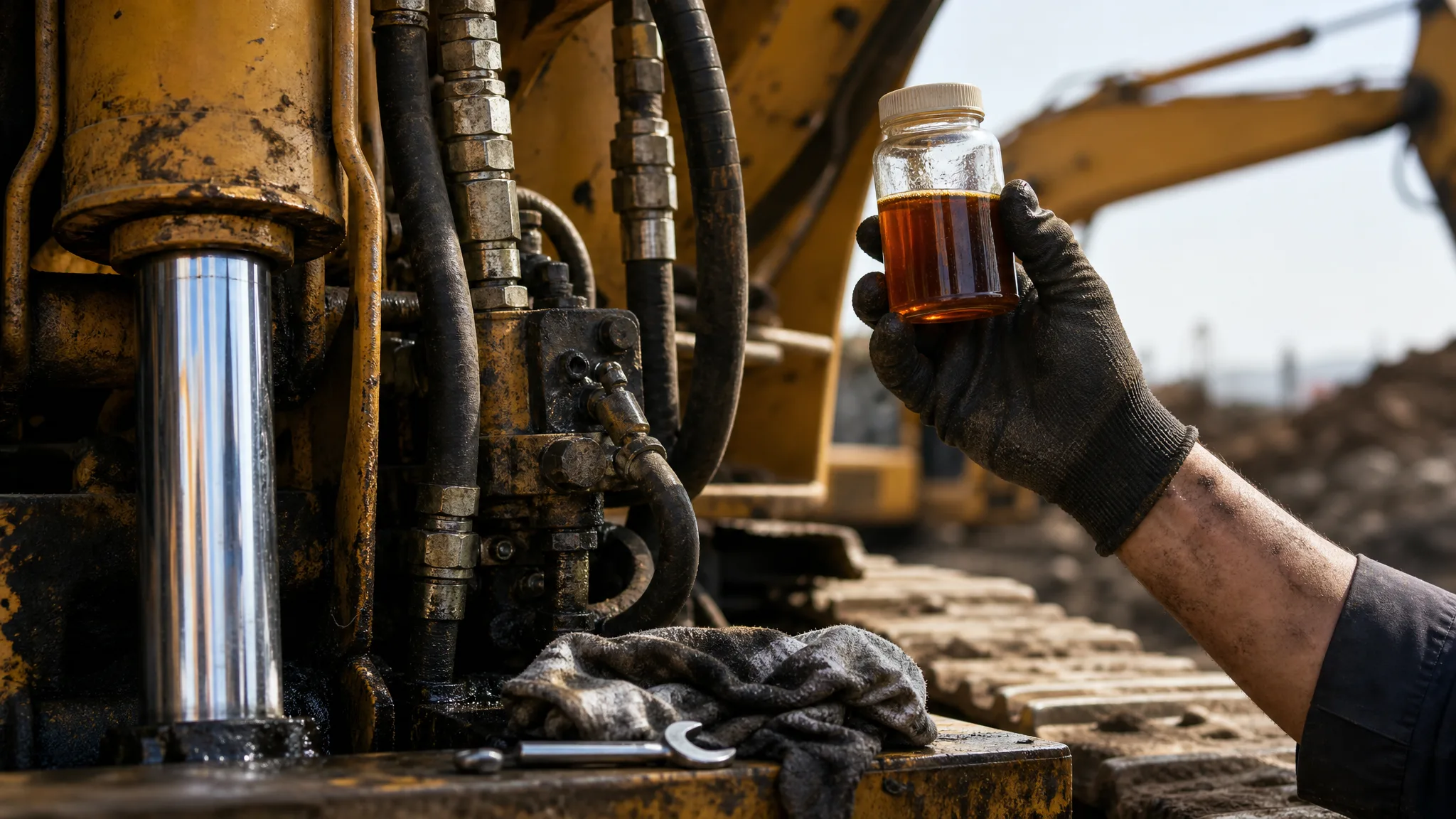
An oil sample does the same for the fluid. A lab report gives you the ISO cleanliness code, viscosity, water content, oxidation, and wear metals, and the trend across samples matters more than any single result. Sample from the same point, at the same operating temperature, at consistent intervals.
Record baseline numbers on a new-to-you machine. On a used excavator, a pressure and flow check plus an oil sample is the cheapest insurance you can buy before it goes to work. For more on that process, see what to inspect on a used excavator.
Prevention and a Realistic Repair Path
Most prevention is unglamorous. Keep the cooler clean, keep the breather working, use clean transfer equipment, cap and plug every fitting you open, and do not pressure wash directly at seals. Change filters on schedule and use the specified element rather than the cheapest one that threads on. Warm the machine before loading it, fix weeping fittings before they drip, and treat every leak as a contamination question, not just a cleanup question.
When a repair is needed, diagnose before you replace. A new pump bolted onto a contaminated system will fail again, and the second failure costs more than the first. If the machine needs pump work, ask whether the shop will flush the system afterward and what cleanliness target it will verify. If the repair approaches a meaningful fraction of the machine's value, compare repair, remanufactured components, and replacement honestly — the same math that governs the rest of the fleet, covered in heavy equipment cost per hour.
Finally, keep the operator in the loop. A machine that gets a little slower every week is giving a warning. The cheapest hydraulic repair is almost always the one that happens before the pump. Daily checks are in the excavator maintenance checklist, and the habits that keep a machine alive are in how to operate an excavator.