Do You Need a CDL to Haul Heavy Equipment?


The question comes up at the worst possible time: a truck, a trailer, and a machine that needs to move today. Do you actually need a commercial driver's license to haul it? The honest answer is that it depends on numbers printed on the door jamb and the trailer's weight plate — not on what you happen to be hauling that afternoon, and not on whether the machine is empty or loaded.
Federal rules key the requirement to rated weights. Understanding which two numbers matter, and what else applies even when a CDL is not required, will save a contractor a very expensive roadside conversation.
The Two Numbers That Decide It
Under federal regulation (49 CFR 383.91), a combination vehicle is classified as Group A — a Class A CDL vehicle — when the gross combination weight rating (GCWR) is 26,001 pounds or more and the gross vehicle weight rating (GVWR) of the towed unit is more than 10,000 pounds. Both conditions have to be met.
That means the practical test for a truck pulling a trailer with equipment on it is simple to apply: add the truck's GVWR to the trailer's GVWR. If that total is 26,001 pounds or more and the trailer is rated over 10,000 pounds, the combination is a Class A vehicle.
It is worth knowing the other groups as well. Group B covers a single vehicle rated 26,001 pounds or more, or such a vehicle towing something rated 10,000 pounds or less. Group C covers everything else that still counts as a commercial motor vehicle because it carries 16 or more passengers or hauls hazardous materials.
Why the Rating Matters More Than the Load
The regulation is built on ratings, because a driver has to be licensed for the vehicle's capability, not for one day's cargo. An 11,000-pound truck pulling a 21,000-pound gooseneck trailer creates a 32,000-pound combination rating that triggers Class A requirements even when the trailer is completely empty.
FMCSA guidance makes the flip side equally clear. If the GCWR is less than 26,001 pounds, a CDL is not required even when the trailer's GVWR is over 10,000 pounds — unless the vehicle is transporting hazardous materials or is designed to carry 16 or more people.
Many states apply a "whichever is greater" approach comparing the rated and actual weights, so it is not a strategy to buy a trailer detuned on paper and then load it past its rating. If the actual gross combination weight exceeds the rating thresholds, the requirement follows.
Worked Examples
- Half-ton pickup (GVWR 7,100 lb) + 14,000 lb trailer: 21,100 lb — under 26,001, so no Class A CDL on rated weight.
- Three-quarter-ton pickup (GVWR 10,000 lb) + 14,000 lb trailer: 24,000 lb — still under the threshold, but the combination is now over 10,001 pounds, which brings in other requirements discussed below.
- One-ton pickup (GVWR 14,000 lb) + 22,000 lb trailer: 36,000 lb — a Class A CDL combination, even with nothing on the deck.
- Class A holder: may also operate a Group B or Group C vehicle, provided any required endorsements are held. A Class B holder may operate Group C.
Owners of smaller machines sometimes assume the weight of the excavator is what decides it. It does not — the rating of the trailer does. For scale, see our breakdown of how much an excavator weighs before you match a machine to a trailer.
What You Need Even When No CDL Is Required
Dropping below the Class A threshold does not mean the rules go away. Two requirements catch many owner-operators off guard.
First, the USDOT number. FMCSA requires a USDOT number for a commercial vehicle operating in interstate commerce with a GVWR or GCWR of 10,001 pounds or more. That threshold is far lower than the CDL threshold, and many states also require a DOT number for intrastate operations.
Second, the medical examiner's certificate. Interstate drivers operating commercial vehicles with a maximum GVWR above 10,000 pounds must hold a valid Medical Examiner's Certificate, even when no CDL is involved. Intrastate requirements follow what each state has adopted, which varies.
In other words, a contractor who never expected to be regulated can still be operating a commercial motor vehicle on paper. If your work crosses state lines, it is worth a short conversation with your state licensing agency and FMCSA before the next transport.
Trailers: Ratings, Brakes, and Hitches
A trailer's GVWR is the maximum it can weigh fully loaded, and the difference between that number and the trailer's empty weight is the usable payload. Exceed it and you have an overweight vehicle regardless of what the CDL question says.
Brakes are the other common gap. Under the Federal Motor Carrier Safety Regulations, trailers over 3,000 pounds gross generally must be equipped with brakes, and commercial trailers with brakes must have an automatic breakaway system that applies the brakes if the trailer separates from the tow vehicle. Individual states set their own thresholds for non-commercial trailers, and some are far lower than 3,000 pounds.
Finally, the hitch, receiver, ball, or gooseneck coupler is rated too, and so is the truck's own GCWR. A legally licensed driver can still be outside the vehicle's rated capacity if the trailer's tongue weight pushes the truck past its rear axle rating. Matching a machine to the trailer is only half of the equation — see renting versus owning an excavator for how transport cost fits into the ownership decision.
Securing the Machine: The Four-Tiedown Rule
Getting the weight ratings right is only the beginning; the load also has to stay on the trailer. Federal securement rules for heavy equipment (49 CFR 393.130) apply to machines that individually weigh 10,000 pounds or more and are specific about how they are held down.
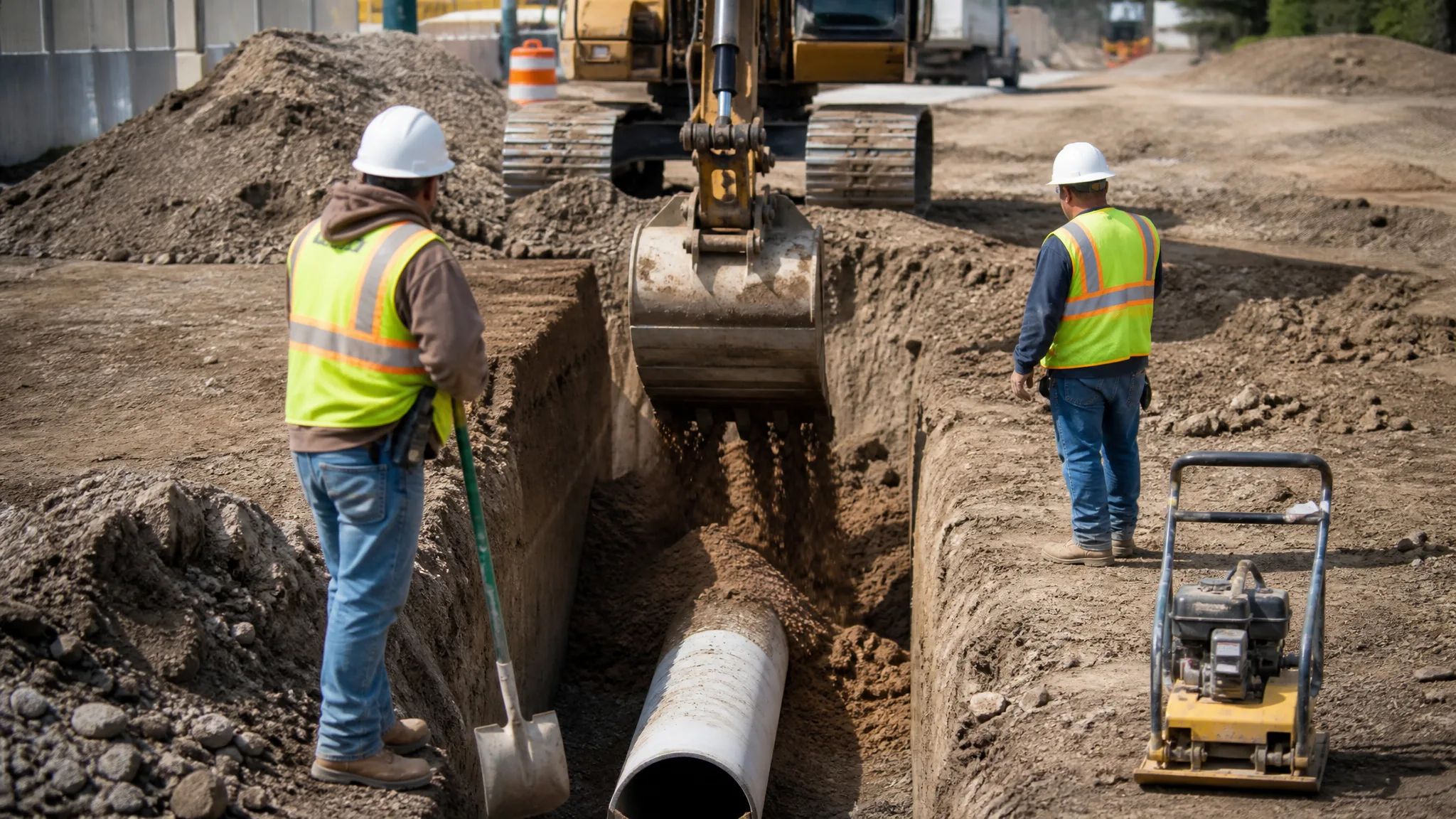
Accessory equipment such as a hydraulic boom or bucket must be completely lowered and secured to the trailer. Articulated machines must be restrained so they cannot articulate in transit. And equipment with crawler tracks or wheels must be restrained against lateral, forward, rearward, and vertical movement using a minimum of four tiedowns, each affixed as close as practicable to the front and rear of the machine, or to mounting points designed for that purpose.
There is also a strength requirement. Under 49 CFR 393.106, the aggregate working load limit of the tiedowns must be at least one-half the weight of the machine. That means the chains, binders, and attachment points have to be sized for the load, not selected by habit. Our step-by-step guide to chaining down an excavator covers the technique, and transporting a backhoe walks through loading a similar machine.
Oversize and Overweight Loads
Weight is not the only trigger for paperwork. Loads that exceed standard legal dimensions — commonly 8 feet 6 inches in width, and height limits that typically fall between 13 feet 6 inches and 14 feet 6 inches depending on the state — need an oversize or overdimensional permit before they move on public roads. Some states add escort vehicle requirements at certain widths or on certain routes.
Height is easy to miscalculate, because the machine's transport height depends on how the boom and stick are positioned on the deck. Measure the loaded combination, not the machine spec sheet. For perspective on how tall and wide different classes of machines get, see excavator size and cost and our comparison of tracked versus wheeled excavators, which affects both transport weight and height.
The Operator's License Is a Separate Question
It is also worth separating the CDL question from the operator question. Whether a person needs a specific license to run an excavator on a jobsite is a different matter from whether the person driving the truck needs a CDL. As covered in our article on licensing to operate an excavator, there is no universal federal operator license for private construction work — but the driver of the tow vehicle is squarely covered by CDL rules.
How Contractors Handle This in Practice
Most excavation companies settle into one of three patterns. Small operators stay deliberately under the 26,001-pound combination rating by using lighter trucks and trailers, and manage their loads carefully to stay legal. Growing companies put at least one driver through Class A training so they can move their own machines. And for the biggest moves — large excavators, dozers, cranes, or any load that is clearly oversize — many contractors hire a permitted heavy haul company rather than take on the licensing, insurance, and permit burden themselves.
Whichever route you take, the rules reward planning: know the truck's GVWR, know the trailer's GVWR, add them before you buy or rent, and confirm your license covers the combination you actually own. Contractors shopping the used market should also confirm the machine's shipping weight and dimensions as part of the inspection, which is part of what a proper used excavator inspection should cover.
Get those numbers right and the CDL question answers itself — and the load arrives where it needs to be, legally, the first time.