Diesel Aftertreatment and DEF

Any new excavator, dozer, or wheel loader on a dealer lot today is not just a diesel engine. It is a diesel engine wrapped inside an emissions control system, and that system decides how the machine idles, how often it needs to "regen," what happens when a fluid tank runs low, and what it costs to run. For contractors and owner-operators, understanding diesel exhaust fluid (DEF) and aftertreatment is now as basic as understanding hydraulic oil.
What Tier 4 Final Changed on Diesel Equipment
The U.S. EPA regulates nonroad diesel engines under a tiered program, and the current step is Tier 4. The rule was built as a system: cleaner engines plus cleaner fuel, because the emission control devices are damaged by sulfur. That is why the rule also capped in-use nonroad diesel fuel at 15 parts per million of sulfur — ultra low sulfur diesel, or ULSD — a better than 99 percent reduction from the old fuel.
Timing depends on engine size. Tier 4 standards phase in across power categories rather than landing on one date, with Tier 4 Interim arriving first in the largest power bands and Tier 4 Final generally taking effect for model years 2014 and 2015. Large engines above 751 horsepower came under Tier 4 Final on January 1, 2015. The technical standards themselves live in 40 CFR Part 1039, with general compliance rules in 40 CFR Part 1068.
The payoff is large. EPA's own summary of the nonroad rule describes nitrogen oxide (NOx) and particulate matter (PM) reductions of roughly 90 percent or more compared with the engines being replaced, which is why a Tier 4 Final machine exhausts dramatically cleaner than its Tier 2 or Tier 3 predecessor — and why it carries hardware those older machines never had.
The Three Parts of a Modern Aftertreatment System
Most Tier 4 Final construction equipment stacks three functions behind the turbocharger. A diesel oxidation catalyst (DOC) handles carbon monoxide and hydrocarbons. A diesel particulate filter (DPF) traps soot, the visible black smoke older diesels were known for. And a selective catalytic reduction (SCR) system converts NOx into nitrogen and water using a urea-based fluid injected into the exhaust.
Tier 4 Interim machines typically relied on cooled exhaust gas recirculation plus a DPF. When Tier 4 Final lowered the NOx limit again, most manufacturers moved to SCR with DEF because it controls NOx in the exhaust stream rather than inside the cylinder. That shift is the reason DEF exists on a jobsite at all.
What DEF Actually Is — and What It Is Not
Diesel exhaust fluid is not a fuel and not an additive. It is a solution of 32.5 percent high-purity urea in 67.5 percent deionized water, defined by the ISO 22241 series of standards. That exact concentration matters: too little urea and the SCR cannot convert enough NOx, too much and the system can deposit solids.
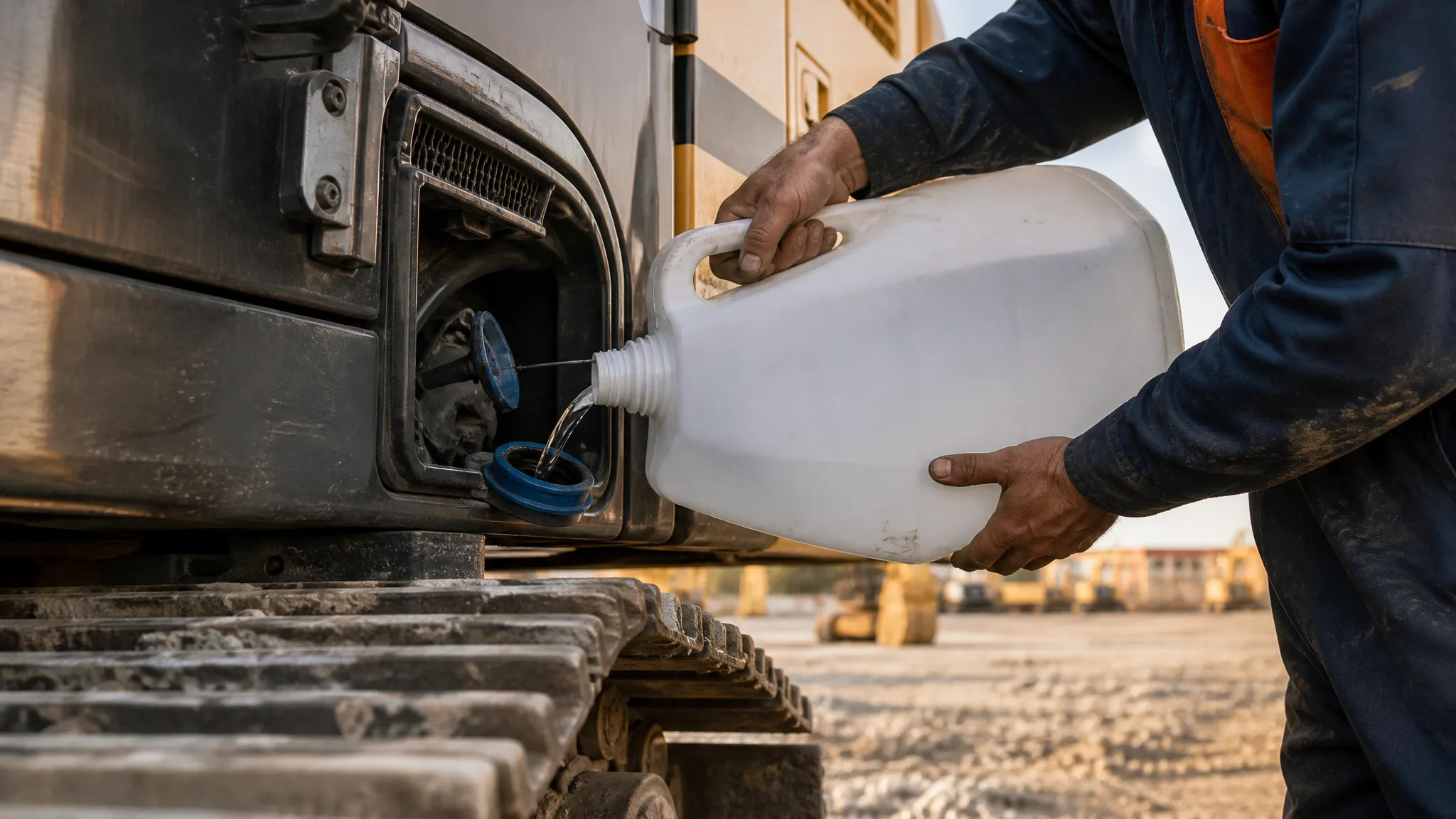
DEF is not interchangeable with anything else. Agricultural-grade urea can contain biuret and other contaminants that poison the catalyst. Water, washer fluid, or diesel in the DEF tank are all serious faults — diesel in DEF is the worst case and can destroy the SCR catalyst. Likewise, DEF belongs nowhere near the fuel tank. Use sealed, dedicated containers and funnels, and never top off DEF with water to stretch a jug.
How Much DEF a Machine Uses
DEF consumption tracks diesel consumption closely, which makes it easy to plan. Published industry guidance puts typical SCR consumption at roughly 2 to 3 percent of diesel volume, rising toward 4 percent under sustained heavy load. An excavator burning five gallons of diesel an hour would therefore use on the order of 0.10 to 0.20 gallons of DEF per hour — a jug or two a day at most, but a real line item across a season.
Because the ratio is predictable, DEF can be built into an hourly cost model alongside fuel. It is rarely the biggest cost on a machine, but it is a cost that a machine with a failed sensor or a habit of running the tank near empty will multiply. See how much fuel an excavator uses per hour and how heavy equipment cost per hour is calculated if you are building that number into a bid.
DPF Regeneration: Passive, Active, and Parked
The DPF is a filter, so it fills up. Soot is burned off in a process called regeneration, and there are three common forms. Passive regeneration happens on its own when exhaust temperatures stay high during hard, steady work. Active regeneration is triggered by the engine control unit, which raises exhaust temperature — often toward 1,100 degrees Fahrenheit — to oxidize accumulated soot, usually with a noticeable change in engine note or fan noise. Parked regeneration runs the same process at a standstill, either commanded by the operator or by a technician with a service tool.
This is where operating style shows up. Machines that idle for hours, run short cycles, or work in cold weather rarely reach passive-regeneration temperatures, so soot builds faster and the machine interrupts work to regen more often. Cutting unnecessary idling is one of the few habits that improves fuel burn, aftertreatment health, and exhaust temperatures at the same time.
Regeneration also creates a genuinely hot exhaust. Follow the OEM manual, keep the exhaust area clear of dry grass, debris, and anything combustible, and respect any instruction to keep the machine away from structures during a parked regen.
What Happens When DEF Runs Low or Goes Bad
Emissions systems are monitored, and they protect themselves. A low DEF level, a quality sensor reading outside the acceptable concentration range, or a faulty sensor will typically trigger a warning first, then an engine derate that limits power, and eventually a severe derate that allows little more than limp or idle operation. A derate in the middle of a pour or a backfill is an expensive way to learn that the DEF tank was empty.
The failure also escalates. A clogged DEF injector or a failed quality sensor is a modest repair. Running for weeks with degraded NOx conversion lets excessive NOx pass through the catalyst and can damage the SCR itself, turning a small fix into a major one. When a warning appears, treat it as a real fault and address it — do not clear it and keep digging.
DEF Storage and Handling Rules
DEF is sensitive to heat and contamination. Industry guidance based on ISO 22241 points to storage around 12 to 25 degrees Celsius (roughly 54 to 77 degrees Fahrenheit) for full shelf life, with sealed containers generally good for about 12 months under those conditions. Shelf life shortens as temperature climbs — plan on something closer to a year at a steady 86 degrees Fahrenheit and noticeably less in a hot shop or a sun-exposed tank.
Freezing is not the problem people assume. DEF freezes at about 12 degrees Fahrenheit (minus 11 Celsius) and expands roughly 6.5 percent, so containers must be left with headspace, but freeze-thaw cycling does not degrade the fluid. The real risks are heat, sunlight, dirty containers, and mixing.
In practice that means: fill from sealed, ISO-rated sources; keep bulk DEF out of direct sun and away from engine heat; do not reuse a jug that held anything else; keep the tank above roughly a quarter full; and never mix top-up fluids.
Operating Habits That Keep Aftertreatment Healthy
Most aftertreatment problems are operating problems. Run the machine at working load rather than idling it all day, because load builds the exhaust temperature that keeps the DPF clean. Keep the DEF tank topped up and use only properly specified fluid. Use the engine oil the OEM specifies for emissions-equipped engines, since oil chemistry affects what reaches the DPF. Handle warning lights and fault codes promptly instead of deferring them to the next service.
Cold weather deserves its own attention. Frozen DEF is normal, but a machine that never reaches operating temperature and runs short cycles will load the DPF quickly, which is one more reason cold weather earthwork asks more of operators and maintenance schedules. A daily walkaround that includes DEF level, visible leaks, and dash warnings costs minutes and prevents derates, so it fits naturally into an excavator daily maintenance checklist. Deferred maintenance elsewhere on the machine compounds the problem; see excavator undercarriage wear and maintenance for the mechanical side of the same discipline.
Buying or Renting Equipment With Aftertreatment
When you buy used, aftertreatment history is part of the machine's condition. Ask about active fault codes, regen history, DEF tank and injector condition, and whether any emissions hardware has been altered. Tampering with or bypassing emissions controls violates federal rules and voids the value of the asset you are buying — a "deleted" machine is not a bargain. An inspection that covers these systems belongs in the walkaround described in buying a used excavator: what to inspect.
When you rent, aftertreatment mostly becomes the rental company's problem, which is part of the value of a rental rate. But the operator still owns the DEF level and the idling habits. The trade-off between owning a machine with all its maintenance obligations and renting a newer one is covered in renting vs. owning an excavator, and the purchase math in how much an excavator costs.
Common Mistakes and a Quick Field Checklist
The most expensive aftertreatment mistakes are simple ones. Putting DEF in the fuel tank, or diesel in the DEF tank. Diluting DEF with water or buying off-spec fluid to save money. Storing DEF in a hot, sunny spot for months and then blaming the machine for a fault. Letting the DEF tank run dry because it is "just emissions." Idling all day and wondering why the machine regens constantly. Ignoring a derate warning until the excavator will barely move.
- Check DEF level and look for leaks during the daily walkaround.
- Use only sealed, ISO 22241-compliant DEF from a trusted source.
- Keep the tank above a quarter; do not wait for the warning.
- Reduce unnecessary idle time and work the machine at load.
- Keep the exhaust and regen area clear of combustibles.
- Act on fault codes and derate warnings immediately.
- Never mix fluids or accept a machine with tampered emissions hardware.
Tier 4 Final hardware is not optional and not going away. Treating DEF and aftertreatment as ordinary consumables and ordinary maintenance — fluid to buy, filters and sensors to service, habits to keep — is what separates a machine that runs for a decade from one that spends its life in the shop.