Construction Staking and Site Layout

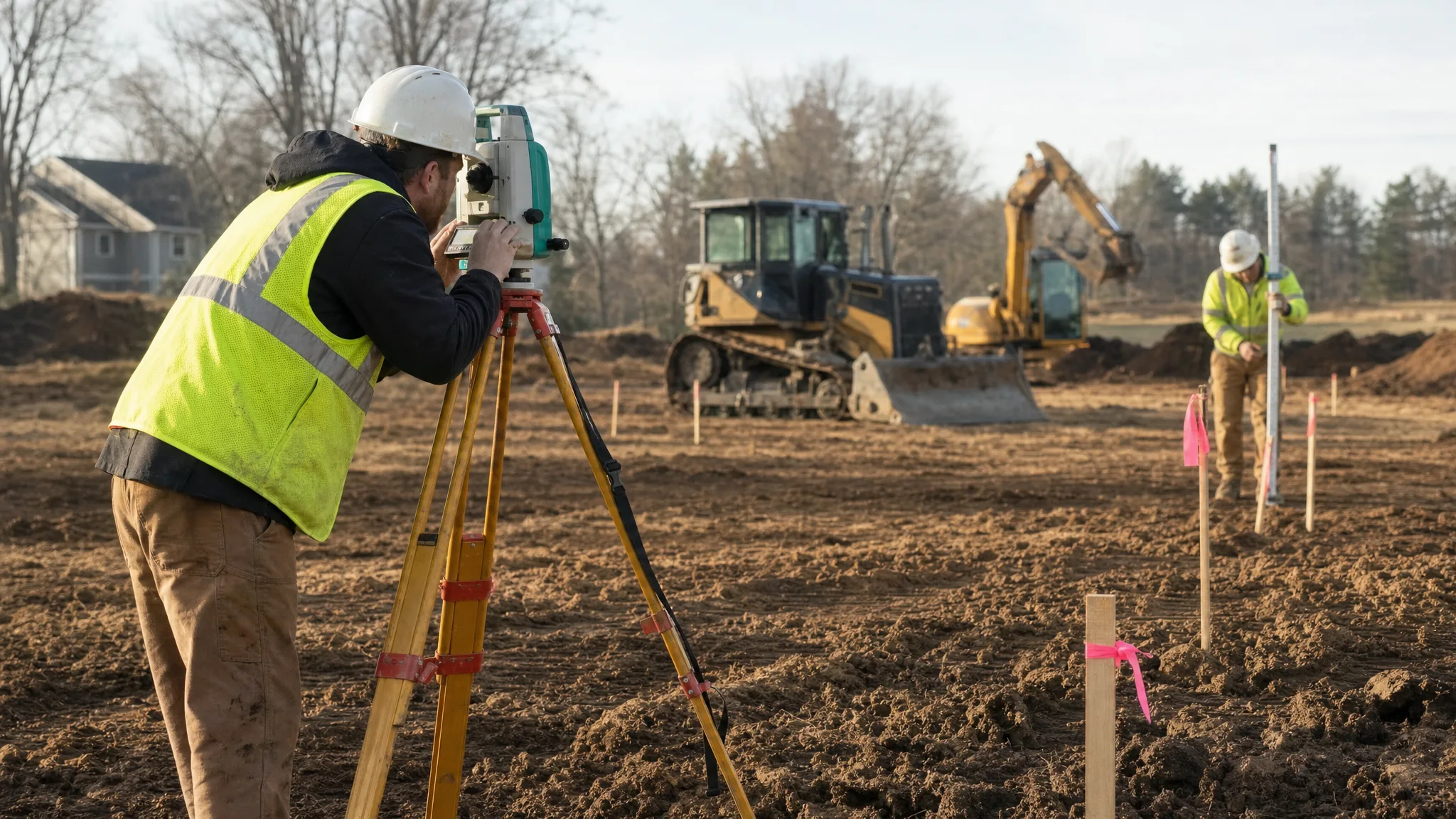
Every grading job starts with someone deciding where the dirt goes, and that decision arrives on the site as a set of stakes, hubs, and paint marks. When layout is right, the operator cuts to grade without thinking about it. When layout is wrong — or missing, or stale — the machine still moves exactly as instructed and the error gets built into the pad.
Here is how construction staking and site layout actually work on an earthwork job: what each layer of control does, how to read the marks in front of you, where the tolerances come from, and what to protect before the first bucket breaks ground.
What Staking Actually Delivers
Staking has three jobs, and they are usually performed by the same survey party: re-establish enough horizontal and vertical control to stake the work accurately, provide enough stakes to show the contractor the required grade and alignment, and take the measurements needed to compute quantities for payment.
State transportation practice makes the separation explicit. Control points, slope stakes, and finished grade stakes are distinct products with distinct purposes, and a grading contractor is expected to understand what information each one carries. On a private site the paperwork is lighter, but the logic is identical.
The Three Layers: Control, Grade, and Layout
Horizontal and vertical control is the skeleton. It is a set of points and benchmarks with known coordinates and elevations, tied to the project datum, placed where they will survive construction. Everything else is measured from them.
Grade references tell the machine how deep to cut or how high to fill. They come as slope stakes at the edge of the work, grade hubs set to a design elevation, or grade stakes carrying a cut or fill number. The arithmetic behind those numbers is covered in how to set grade.
Layout sets position: building corners, column lines, footing edges, pipe inverts, curb line, and offsets for structures. On building work this is where the excavator gets its dig line and where the concrete crew later gets its form line — the same layout that decides whether the house foundation excavation starts in the right place.
All three must agree on the same datum. A common and expensive failure is staking computed from a different datum than the one the design used, which shifts the work and is nearly invisible from the seat of a machine.
Reading a Stake in the Field
Most stakes carry the same information in a similar order: a station and offset or a lot corner reference, a cut or fill value, and a note identifying what the stake governs. A hub with a tack marks the exact point; the lath beside it carries the numbers. Some crews mark grade directly on the lath, others set a hub to a calculated elevation and let the operator measure up or down from it.
Two habits prevent most reading errors:
- Confirm the units and whether the cut or fill is to subgrade or to finished surface — asphalt, base, and slab thickness change the number
- Read the stake that governs your operation. A finished grade stake for pavement is not a cut line for the excavator
If the markings are ambiguous, stop and get them explained in writing. Agency practice in some states is to hand the contractor a written explanation of the staking method and the meaning of the marks, precisely because a misread stake is a rework claim waiting to happen.
Why Nobody Stakes the Line You Dig To
Stakes get knocked out by tracks, buried by backfill, and destroyed by the work itself. That is why layout is normally set back from the line of work at a fixed offset — a reference point at a constant distance from the catch point or the structure line, typically in the range of 10 to 20 feet on highway work — and why hubs are placed where machines will not run over them.
The offset is also practical geometry. A stake at the exact toe of a slope would have to be removed before the slope could be cut. An offset stake lets the operator set a string line or use the machine's own measuring reference and re-establish the line at any time.
Offsets mean direction matters. "Ten feet left of the line" is meaningless unless the crew agrees which way left is and which baseline is being referenced.
What the Tolerances Really Are
Tolerances come from the project specifications, not from habit. Published agency practice gives a useful sense of scale: in one state DOT quality-assurance check of a grading template, catch points were expected within 0.2 feet horizontally and 0.1 feet vertically, and slope stakes were read to the nearest 0.1 foot for both elevation and distance.
Residential and commercial work is often looser for mass grading and much tighter for finished surfaces — slab subgrade, pavement base, and structure excavation have their own requirements. The number that matters is the one in the spec book or on the plan, and the time to find it is before the grading starts, not after a density test or a laser screed reveals a problem.
If the plan or specification is silent, ask the engineer to confirm in writing. That single email protects both the contractor and the owner.
Who Is Responsible for Staking
Contract documents assign this duty in one of two ways: the owner or engineer stakes the work, or the contractor furnishes surveying and staking as part of the contract. Some agencies do both — the owner stakes primary control while the contractor's surveyor performs secondary layout and is required to preserve the marks.
Where the contractor stakes, expect three requirements: work supervised by a licensed surveyor or professional engineer, stakes furnished at the contractor's expense, and preservation of all stakes and marks with the cost of replacement chargeable if they are destroyed. That last clause is a real number on a grading job.
Either way, verify the arrangement before mobilizing. Discovering on day one that nobody is staking the building corners is a schedule problem, not a paperwork problem.
Protecting Control: The Cheapest Insurance on the Job
Good control is fragile. Benchmarks get buried by spoil, control points get used as a turning radius, and a hub in the middle of a haul road lasts about one shift.
- Walk the control before clearing and mark every point that will be affected by the work
- Establish additional control in areas where the original points will be destroyed
- Set benchmarks and control away from excavation limits, stockpiles, and traffic
- Tie critical points to durable references the crew can find again — fence corners, utility structures, structures that are not being demolished
- Re-shoot the control after any event that could have moved it, and always after a grade change
A benchmark that has been disturbed is worse than no benchmark, because it will be trusted.
Machine Control and Stakeless Grading
GPS and total-station-based machine guidance have reduced the number of stakes on many sites, but they have not removed the need for control. Automated machine guidance still needs accurate control points, a verified design model, and periodic checks against an independent reference.
The failure mode is different, though. Instead of a knocked-out stake, you get a model built on the wrong datum, a base station set over a point that has moved, or a surface that was never updated after a design revision. The machine will grade perfectly to a wrong surface with total confidence.
Pair machine control with an independent check — a grade hub, a laser, or a survey shot on a known point — at the start of each shift and after any model or control change. For more on how the technology fits into a dig, see leveraging GPS technology for accurate excavation.
The Layout Failures That Cost the Most
- Datum mismatch between design and field control, discovered after the pad is cut
- Offset direction reversed, shifting a structure line by twice the offset
- Stale stakes left in the ground after a revision or a grade change
- Single-benchmark reliance — no check, no redundancy, no way to detect movement
- Stakes destroyed and not re-set, with the crew grading from paint marks and memory
- Wrong reference surface — cutting to finished grade instead of subgrade, or the reverse
- No as-built record, leaving the next trade to guess what was actually built
Most of these are caught by one habit: check the layout against an independent piece of information before you commit a machine to it.
Practical Sequence Before the First Bucket
- Read the plan set and confirm datum, units, and the structure and pad elevations you are working to — the same reading skills covered in how to read a grading plan and the broader sequence in grading and site preparation
- Confirm who stakes what, and when the survey crew is scheduled
- Request utility locates and integrate the marks into the layout so stakes steer the dig away from buried lines
- Walk and preserve control points; establish extra control where the work will destroy the originals
- Verify the staking against the plan — dimensions, offsets, and at least one computed elevation
- Brief the operator on which stake governs which operation, and on the offset convention
- Set grade references you can re-establish yourself: hubs out of the traffic path, string lines, or a laser reference
- Re-check grade behind the machine as the work proceeds, matching method to stage — rough grading versus finish grading carry different tolerances for a reason
- For structure work, verify footing and slab layout before excavation and again before the pour — the sequence in preparing a site for a concrete slab depends entirely on layout accuracy
- Record as-builts and photograph the stakes and control before they disappear
Staking is not a formality that happens before the real work. It is the specification translated into physical marks, and every yard of dirt moved on the site is measured against it. Protect the control, read the marks correctly, and the grade takes care of itself. Get it wrong, and the site will be built exactly as badly as it was staked.