Choosing an Equipment Trailer

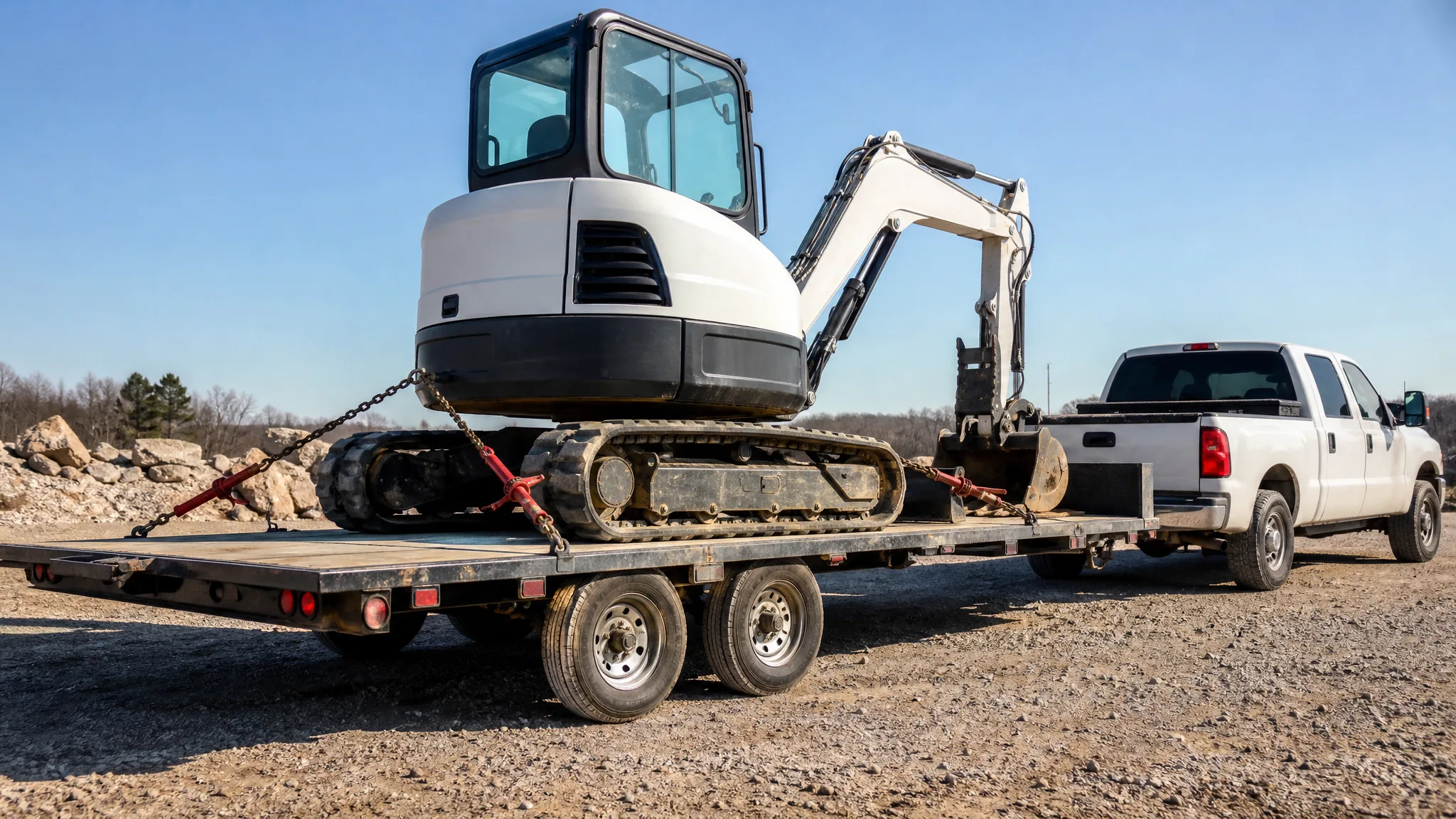
An equipment trailer is the weakest link in most hauling setups, and it is usually the part nobody researches. Buyers spend weeks comparing excavators or skid steers and then pick a trailer off a lot because it looks heavy enough. The result is a combination that tows badly, overloads an axle, or cannot legally carry the machine it was bought for.
Getting it right is mostly arithmetic plus a few legal rules. Five separate ratings have to agree with each other and with the machine, and the truck's advertised tow rating is only one of them.
Five Ratings Have to Agree
Every hauling combination is limited by the lowest of five numbers: the trailer's gross vehicle weight rating, the trailer's axle ratings, the tire ratings on the trailer, the tow vehicle's ratings, and the hitch and ball or coupler ratings. Exceeding any one of them is an overload, even if the others have room to spare.
This is where most mismatches hide. A trailer rated at 14,000 pounds gross may only carry 10,000 pounds of cargo once its own weight is subtracted, and a truck rated to tow 14,000 pounds may have little payload left for tongue weight once fuel, tools, and passengers are aboard.
Start With the Machine's Real Weight
Use the machine's operating weight, not the shipping weight. Operating weight includes fuel, lubricants, and the standard configuration, and it is the number the manufacturer publishes for a machine ready to work.
Then add everything that travels with it. A bucket, a hydraulic thumb, a breaker, a ripper, or a quick coupler all add weight, and some of those attachments sit far enough forward to shift the load. A machine that weighs 11,000 pounds bare can easily be a 13,000-pound load on the deck.
If the exact figure matters, scale it. A certified public scale ticket removes the guesswork, and it is also the only way to know what the trailer and truck actually weigh when loaded. Published weights for used machines are frequently optimistic after years of attachments, repairs, and counterweight changes.
For a rough cross-check, published operating weights for common sizes are worth reviewing before you shop, including how much an excavator weighs by class and what changes that number.
GVWR, Empty Weight, and Payload
GVWR is the maximum loaded weight the trailer is rated to carry, including the trailer itself. It is set by the manufacturer and printed on the certification label along with the axle ratings and tire sizes.
Payload is simple subtraction: GVWR minus the trailer's empty weight. A 14,000-pound trailer that weighs 4,000 pounds empty has a 10,000-pound payload. A 20,000-pound deckover that weighs 5,500 pounds empty has 14,500 pounds of payload.
Axle ratings matter separately. The GAWR for each axle, combined with the tire load rating at the specified pressure, sets what can actually be carried. A trailer can be under its GVWR and still overload one axle if the machine sits too far forward or too far back. Load placement, not just total weight, is what keeps each axle legal.
What the Tow Vehicle Can Actually Carry
Towing capacity is only half the truck question. The other half is payload, because tongue weight counts against the truck's payload rating, along with passengers, fuel, tools, and anything in the bed.
Modern tow ratings are published under SAE J2807, which standardizes how manufacturers test acceleration, braking, and cooling on a grade. That makes the numbers more comparable than they used to be, but the rating still assumes a specific configuration, typically a base truck with a driver and no cargo. Read the footnotes for your cab, bed, axle ratio, and trim.
Then check the hitch. A receiver, ball mount, ball, and coupler each carry their own rating, and the lowest one governs. A weight-distributing hitch changes how the load is carried, but it does not raise the trailer's GVWR or the axles' ratings. If the combination pushes past 26,001 pounds gross combined, licensing rules change as well, which is covered in CDL requirements for hauling heavy equipment.
Deck Length, Width, and Loading Angle
Deck length has to fit the machine plus its attachments plus a little fore-and-aft adjustment. That adjustment is how you tune tongue weight, so a deck that fits the machine with zero room to move is a deck that locks you into one load position.
Width matters for the machine and for the ramps. Track or tire width has to sit inside the deck with clearance to spare, and the ramp spacing has to match the undercarriage. A machine that barely fits between the fenders is a machine that will eventually be loaded crooked.
On smaller machines, published mini excavator width figures are a starting point, but measure the machine you own with the attachments mounted rather than trusting a spec sheet written for a different configuration.
Loading angle is the spec buyers forget. Deck height, ramp length, and any dovetail determine the angle the machine climbs, and that angle has to be within what the machine can handle without dragging its belly or tipping.
Loading itself is a procedure, not a maneuver. Chock the truck, pin the ramps, line up straight, keep the bucket low, and keep everyone out of the downhill side. The same commonsense rules that apply to working around heavy equipment apply at the ramp.
Also confirm the machine will clear the fenders and any ramps stowed on the deck, and that the trailer's breakover point will not high-center on the driveway or site entrance you use every day.
Trailer Types and What Each Is For
Utility trailers are light, inexpensive, and often unbraked. They are fine for small attachments and lawn equipment, but they are not built for a tracked machine.
Car hauler and equipment trailers are the standard choice: tandem axles, brakes on at least one axle, a flat deck between or over the fenders, and ramps. Most compact and mid-size machines live here.
Deckover trailers put the deck above the tires, which widens usable deck space and raises capacity, at the cost of a higher loading angle and a higher center of gravity. Gooseneck trailers move the hitch over the truck's rear axle, which improves weight distribution and allows higher capacities, but they require a bed hitch and reduce bed space.
Tilt-deck trailers eliminate ramps and lower the loading angle, which is a real advantage for machines with low ground clearance. Dump trailers are for material, not equipment, and should not be substituted for a proper equipment deck.
Axles, Brakes, Tires, and Suspension
Axle capacity is the foundation. Tandem 3,500-pound axles give a 7,000-pound running gear rating, tandem 5,200s give 10,400, and tandem 7,000s give 14,000. The trailer's GVWR is built around those numbers, so a "14K" trailer and a "14,000-pound GVWR" trailer are not automatically the same thing.
Brakes are not optional on a loaded equipment trailer. Electric drum brakes are the common setup, with a breakaway system that applies the brakes if the trailer separates from the truck. Surge brakes are self-contained and common on lighter trailers, but they are less common on heavy equipment decks. Many states require a breakaway system on braked trailers; check your state's equipment rules rather than assuming.
Tires carry the load and fail first when they are neglected. Match the load range to the axle rating, keep them inflated to the pressure on the placard, and check the date codes. Trailer tires age out even when the tread looks fine, and a blowout with a machine aboard is a bad day.
Suspension type affects how the trailer tracks and how the load rides. Spring axles are simple and repairable; torsion axles ride better but are less forgiving of uneven loading. Inspect spring hangers, shackles, and U-bolts as part of the pre-trip walkaround.
Securement: Tiedowns Are Rated Too
Federal rules for commercial operations give a useful baseline even for operators who are not running under a USDOT number. For heavy equipment with crawler tracks or wheels that individually weighs 10,000 pounds or more, 49 CFR 393.130 requires a minimum of four tiedowns restraining movement laterally, forward, rearward, and vertically, with each tiedown attached as close as practicable to the front and rear or to mounting points designed for that purpose.
The same section requires accessory equipment such as a boom or blade to be completely lowered and secured, and requires articulated machines to be restrained so they cannot articulate in transit.
The number of tiedowns also scales with length. Under 49 CFR 393.110, an article longer than 10 feet needs two tiedowns plus one additional tiedown for every 10 feet of length or fraction beyond the first 10 feet. Securement hardware has to be rated, too: 49 CFR 393.106 requires the aggregate working load limit of the tiedowns to be at least half the weight of the load, and it counts a tiedown that runs from one side of the trailer to the other at its full working load limit rather than half.
In practice, that means grade-70 chain and rated binders, or straps with a legible working load limit tag, attached to the machine's designated tie-down points rather than to hoses, steps, or thin sheet metal. The chain-down procedure for an excavator is worth learning properly, and the same habits transfer to any tracked machine. Re-check the load after the first few miles and at every stop; chain stretches and settles.
Inspection, Paperwork, and the Legal Details
Before buying, inspect the frame for cracks and repairs, especially around the gooseneck or tongue, the spring hangers, and the ramp hinges. Look at the deck for soft spots and rust-through, check the axle tubes for bends, and confirm the brakes and lights work with the truck connected.
The same discipline applies to the machine that rides on it. Inspecting a used excavator before purchase is easier when you already know what it weighs and how it will be hauled.
Verify the VIN on the frame matches the title, and confirm the seller's name matches the paperwork. Trailers are stolen and re-titled often enough that a mismatched VIN is a walk-away signal.
Then check the boring details: registration and title requirements in your state, inspection rules, insurance coverage while towing, and whether the combined rig needs a USDOT number. Weight law applies to the combination, not just the trailer, and the rules for axle and bridge-formula limits are worth understanding before you load a machine and head for a scale house.
A Sizing Walkthrough
Suppose the machine is an 11,000-pound compact excavator, and the bucket, thumb, and quick coupler add 1,500 pounds. The load is 12,500 pounds before anything else goes on the deck.
A 14,000-pound GVWR trailer that weighs 4,000 pounds empty offers 10,000 pounds of payload. That is already 2,500 pounds short, before fuel cans, attachments, or a spare bucket. The next step up is a 20,000-pound deckover weighing roughly 5,500 pounds empty, which leaves about 14,500 pounds of payload and enough margin to be legal.
Then check the truck. A 12,500-pound load plus a 5,500-pound trailer is 18,000 pounds behind the hitch. Ten to fifteen percent of that on the tongue is 1,800 to 2,700 pounds, which has to come out of the truck's payload and stay within the rear axle rating and the hitch rating.
Write the numbers down before you shop. The trailer that fits is the one whose payload, deck, axles, brakes, and tie-down capacity all clear the machine with margin, and whose hitch weight the truck can actually carry.
If you are moving a machine that does not run, or one that has to be loaded by someone else, the procedure changes and so does the equipment list. See moving a non-running excavator and transporting a backhoe for the loading and securing side of the job.